The 2026 Marine Aviation Plan and Steel Knight 25: Turning Project Eagle into Combat Practice
The 2026 Marine Aviation Plan marks a pivot point for Marine Corps aviation, moving from Force Design rhetoric to a structured blueprint for a distributed, data‑driven, lethal Aviation Combat Element (ACE). Steel Knight 25, executed by I MEF and 3rd MAW across the Southwest in December 2025, shows what it looks like when that blueprint is stress‑tested in a realistic campaign: not with slide decks, but with embassy reinforcements, forward spokes, contested logistics, and kill‑web command posts running under real friction. Taken together, the plan and the exercise reveal a force that is trying to do two things at once: fight tonight with an aging but still potent mix of platforms, and deliberately build the aviation architecture needed for a chaos‑management fight against peer adversaries.
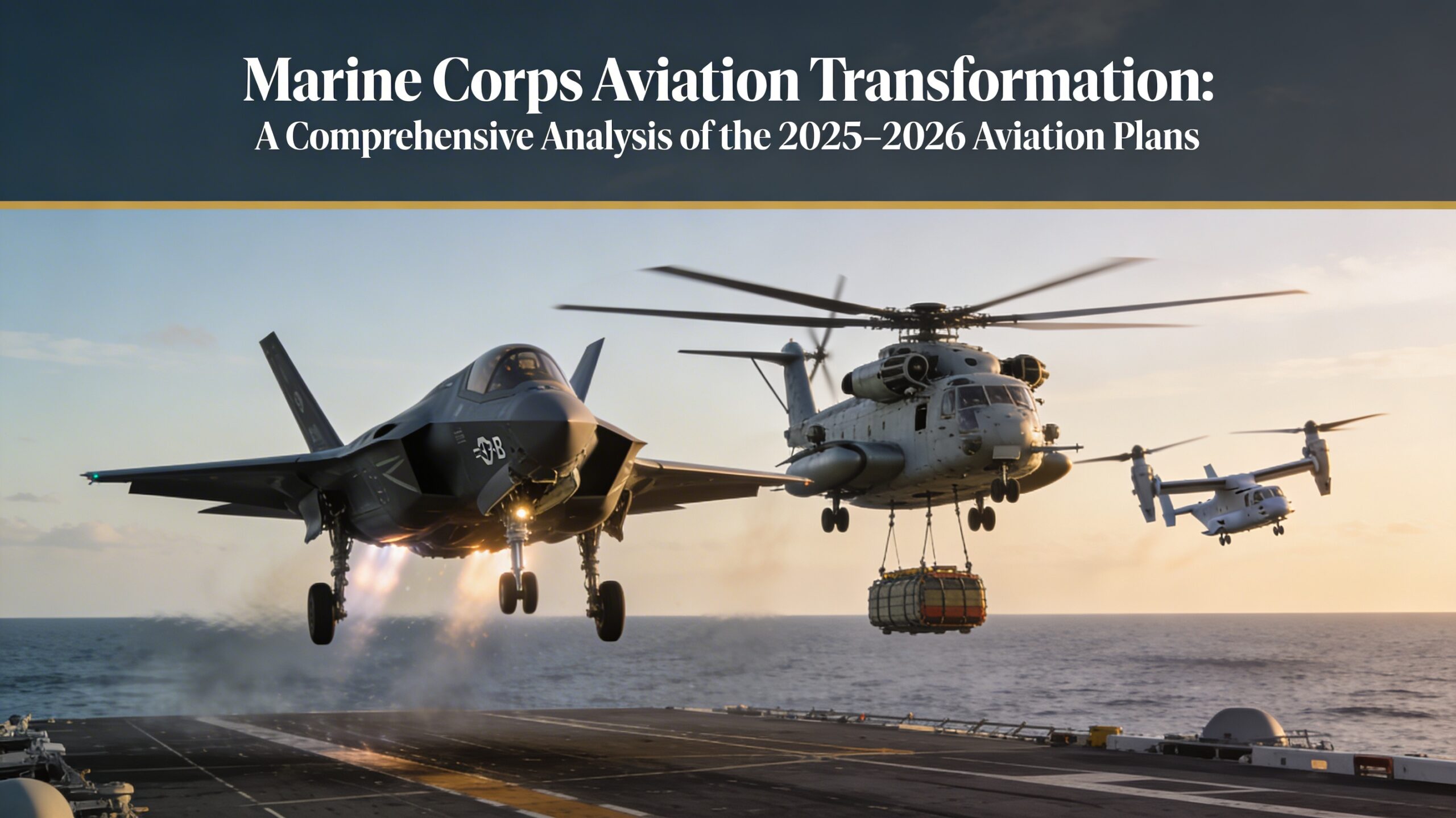
On paper, the 2026 Marine Aviation Plan is about coherence and pacing. Project Eagle stretches aviation planning across three Future Years Defense Programs, Fight Tonight (2026–2030), Bridge the Gap (2031–2035), and Future Fight (2036–2040), to prevent the service from lurching from crisis to crisis with a FYDP‑deep vision. It codifies Distributed Aviation Operations (DAO) as the aviation contribution to Expeditionary Advanced Base Operations (EABO), elevates Aviation Ground Support (AGS) to the seventh function of Marine aviation, and lays out explicit modernization tracks for F‑35, MV‑22, CH‑53K, H‑1, MQ‑9, collaborative combat aircraft, ground‑based air defense, and digital interoperability.
Steel Knight 25 translated those abstractions into a campaign laboratory spread from Camp Pendleton to Mather Airport and Victorville. Rather than a single set‑piece battle, it strung together embassy reinforcement, noncombatant evacuation (NEO), distributed fires, and contested logistics into a coherent narrative that forced I MEF to fight as a dispersed, networked MAGTF from the first hours of crisis. The exercise doubled as certification for the regiment deploying as Marine Rotational Force–Darwin, tying experimentation directly to forward deployment in the Indo‑Pacific architecture the plan is written to support.
This is where the plan’s “Fight Tonight / Bridge / Future Fight” framework becomes operational rather than bureaucratic. Steel Knight was firmly a Fight Tonight event: it used the force actually available in late 2025—F‑35Bs and Cs that are still ramping to full Block 4 capability, MV‑22s with nacelle improvements only partially fielded, CH‑53Es with the first CH‑53Ks entering service, H‑1 squadrons just achieving full digital interoperability, MQ‑9 squadrons early in Pacific integration, and a MACG still transitioning toward the Multifunction Air Operations Center (MAOC) construct. Yet the scenarios, C2 architectures, and logistics problems it tackled were clearly written against the Future Fight: adversary long‑range precision fires, a dense drone and ISR threat, degraded comms, and the requirement to run kill webs across hundreds of miles of contested maritime space.
The 2026 plan is explicit: DAO is now the central organizing principle for Marine aviation in support of stand‑in forces. DAO is defined not just as dispersal, but as the ability to sustain combat power from multiple expeditionary sites, spokes, FARPs, austere airfields, under contested logistics and electromagnetic conditions, enabled by robust AGS and digital interoperability.
Steel Knight 25 applied that logic with a concreteness planners seldom enjoy. 3rd MAW established aviation spokes at Pendleton and a FARP at Sacramento Mather, roughly 400 nautical miles away, to prove that fuel, ordnance, maintenance and C2 could be pushed well beyond main air stations. MAG‑16’s MV‑22 and CH‑53 squadrons used those nodes to move Marines for embassy reinforcement and follow‑on operations across a wide battlespace rather than shuttling between a handful of “big bases.” MAG‑11’s F‑35Cs operated from Victorville, where MWSS‑372 created an expeditionary node capable of rapid hot‑refuel and re‑arm, validating exactly the kind of AGS‑driven DAO the plan elevates.
Retired Lieutenant General Hedelund’s observations during Steel Knight underlined the distinction between constructive dispersion and mere scattering of forces. DAO only matters, he argued, if distribution changes how Marines close with the enemy, protect sustainment, and generate effects under pressure. The exercise made that distinction visible: where hub‑spoke‑node constructs were tied to clear objectives and time‑limited “shelf lives,” distribution delivered survivability and tempo; where nodes were too heavy, insufficiently time‑bounded, or not well connected to kill webs, dispersion risked becoming an end in itself.
The aviation plan, for its part, tries to institutionalize those Steel Knight lessons. It treats AGS, not aircraft, as the pacing function for DAO, with specific modernization lines for expeditionary surfacing systems, transportable firefighting and refueling gear, and C‑130‑movable arresting systems. It also formalizes MAOC as the replacement for stove‑piped DASC and TAOC constructs, exactly the integration logic MACG‑38 was working at Steel Knight as it wired MWSS, MASS‑3, LAAD, MACS‑1, and comms assets into coherent C2 packages for specific vignettes.
If DAO is about where aviation operates, Decision‑Centric Aviation Operations (DCAO) in the plan is about how decisions are made fast enough to matter across that geometry. Project Dynamis and DIMAGTF Agile Network Gateway Link (MANGL) are the aviation plan’s answer: make data the primary weapon, integrate sensors, processors, interfaces, and radios across platforms, and use AI/ML to turn raw information into prioritized, actionable cues for commanders and crews.
At 3rd MAW, that language is translated into kill‑web problem‑solving. The G‑6 staff and MACG‑38 described their challenge in the simplest terms: separate sensors from shooters, because weapons now outrange onboard sensors, but maintain the speed and precision necessary for contested combat. To do that, they built an “ecosystem” of communications paths—Link‑16 for tactical data, military and commercial SATCOM, cellular and fiber when available, and even unclassified networks to move non‑sensitive sensor data quickly.
The exercise’s most important work here was not technical, though it involved plenty of radios, masts, and satellites. It was cultural. Officers and staff NCOs talked about needing “three ways to win” for every message; about resisting over‑centralization as senior headquarters gain more access to forward sensor data; and about giving sergeants and lieutenants enough decision authority to execute on commander’s intent when a 32‑second transmission might get them targeted within minutes.
This is exactly the tension the aviation plan grapples with when it moves from platform roadmaps to digital transformation. It details DIMANGL as the DI backbone, outlines Extended Tactical Network concepts to extend that backbone to fly‑away kits and vehicles, and even proposes AI‑enabled tools to fuse data from maintenance and operations systems to optimize schedules and readiness. But it repeatedly returns to the T‑E‑A‑M framework, Take care of Marines, Execute the basics with brilliance, Attain and maintain readiness, Mitigate risk, as a reminder that human factors still account for nearly 80 percent of mishaps and that digital tools only matter if crews and controllers can actually use them under stress.
Steel Knight made that human dimension visible. In the Wing Operations Combat Center (WOCC), watch officers stressed that the core question was not whether a given system “worked,” but whether Marines could integrate it into real mission execution without being overwhelmed or slowed. At the squadron level, HMLA‑267’s journey from “forgotten” attack squadron to fully digitally interoperable H‑1 unit showed how much mental rewiring is required for aviators to treat information and spectrum as co‑equal to weapons. Major Jonathan Moss’s trajectory, from voice‑radio Cobra pilot to digital interoperability lead at VMX‑1 and then HMLA‑267, illustrated the plan’s point that transformation is ultimately a cognitive and cultural exercise.
The aviation plan is, necessarily, platform‑heavy. It spells out F‑35B/C inventory targets, squadron PAA growth from 10 to 12 jets, TR‑3 and Block 4 upgrade paths, and detailed weapon integration timelines for SDB II, AARGM‑ER, LRASM, and JASSM. It charts the final glide paths for FA‑18 and AV‑8B, engineering details of MV‑22 nacelle and gearbox improvements, the three‑pillar logic for CH‑53K deployment (inventory, sustainment, capability), SPINE and PASM for H‑1, and the force‑structure growth of MQ‑9 squadrons.
Steel Knight’s contribution was to show what those transitions mean in operational context. MAG‑11’s F‑35Cs were treated less as boutique strike assets and more as long‑range, high‑endurance sensor and C2 nodes, the “brain” of multi‑domain aviation packages that could stretch sensing and networking well beyond the range of legacy platforms, while still delivering kinetic effects when required. Their ability to operate from shorter runways with mobile arresting gear, and to combine partial fuel loads with inflight refueling, mapped directly onto the DAO and AGS constructs in the plan.
MAG‑16’s CH‑53Es and MV‑22s, meanwhile, embodied the plan’s heavy‑lift and tiltrotor storylines. Commanders described routinely flying ranges that outstripped rotary‑wing escorts, gambling on tankers that might or might not make it to the rendezvous, and pushing into regimes where the CH‑53K’s promised lift, stability, and predictive maintenance capabilities will be the difference between concept and reality. Exercise vignettes highlighted both the potential and the current limitations: on the one hand, rapid employment of spokes and short‑duration nodes that fit the S²D (survivability, sustainability, duration) framework the plan wants to embed in force‑insertion thinking; on the other, the continued dependence on USAF C‑130s and scarce KC‑130Js for long‑range logistics, and the immaturity of predictive‑maintenance and 3D‑printing ecosystems to support truly lean detachments.
For H‑1s and MQ‑9s, the alignment was striking. The plan’s SPINE, PASM, and DI lines for the H‑1 community are written against a vision of Cobras and Hueys as digital, multi‑role nodes in kill webs rather than just close‑support trucks. HMLA‑267 at Steel Knight was that vision in its first operational iteration: a fully DI “unit of employment” using Link‑16 to plug into the same digital ecosystem as F‑35s, MQ‑9s, E‑2s, Growlers and ground C2 nodes, compressing the find‑fix‑track‑target‑engage‑assess cycle and serving as C2 extensions for stand‑in forces.
Similarly, the plan’s expansion of MQ‑9A squadrons and capability sets, Sky Tower relay, persistent LEO links, electronic support, DAAS kits, is written to make VMUs central to distributed C2 and maritime domain awareness. Steel Knight’s integration of unmanned surface vessels into the air picture via unclassified networks, and its emphasis on making any sensor feed any shooter, showed how 3rd MAW and MACG‑38 are already thinking in those terms even as MQ‑9 fielding and integration continues.
The plan dedicates significant space to ground‑based air defense (GBAD), with Marine Air Defense Integrated System (MADIS) scaling to 190 systems and Medium Range Intercept Capability (MRIC) achieving IOC in FY26, and to the restructuring of MACGs around MAOC and modernized air traffic control. It also emphasizes G/ATOR as the multi‑mission radar tying MRIC, air control, and counter‑battery functions together, and calls for reactivating a reserve LAAD battalion to close long‑standing gaps.
Steel Knight highlighted why those investments matter. MACG‑38 commander Colonel O’Connell described his group not as a supporting element but as the “dial” that configures aviation for distributed operations: combining MWSS, MASS‑3, MACS‑1, 3d LAAD, and the comms squadron into modular packages that create specific effects in time and space. Air defense, which spent the Iraq and Afghanistan years on the margins or serving as provisional infantry, is now central: MADIS and future MRIC batteries must protect nodes and hubs against a saturated UAS and missile threat, and must be integrated into the same fires and maneuver logic as artillery and aviation.
Lieutenant Colonel Astacio’s account of MACS‑1’s evolution showed the hardware side of that shift. In a decade, the unit has gone from “big box” radars set up as enduring fixtures to the G/ATOR—a single radar replacing five legacy systems, transportable by C‑130 or potentially CH‑53K, and designed to feed expeditionary command posts that move, operate under EMCON, and distribute sensing via both active and passive systems. Steel Knight forced MACS‑1 and MAOC‑like elements to actually move C2 nodes, manage bandwidth and risk, and maintain decision‑quality information without the comfort of a fixed tower at a secure base.
The plan codifies that direction by formally transitioning to MAOC, restructuring active and reserve MACGs, modernizing expeditionary ATC, and aligning MANGL/MAGTAB integration with forward air sites and FARPs. Steel Knight, in turn, exposes where that transition is incomplete: parts availability for G/ATOR, the deployment lift burden for MAOC‑scale packages, remaining seams between F‑35, G/ATOR, and GBAD data, and the still‑evolving understanding of how much C2 authority and functionality must reside at forward hubs versus rear wings and MEF headquarters.
Both the 2026 aviation plan and Steel Knight 25 are wrestling with the same deeper shift: from crisis management to chaos management. The plan hints at this in its emphasis on decision‑centric operations, Project Dynamis, and a Fight Tonight / Future Fight continuum rather than neat phase lines between “competition,” “crisis,” and “war.” Steel Knight makes it explicit.
Modern operations unfold within persistent complexity rather than discrete, bounded crises. Adversaries test and probe in the gray zone; satellite comms can be disrupted; centralized command posts can be targeted; cyber and information operations can create enduring ambiguity. In that environment, a Marine aviation enterprise optimized for surge from secure bases is insufficient. The force must be designed to live in chaos: sustainable presence rather than episodic surge, distributed decision authority rather than centralized control, resilient nodes rather than exquisite but brittle hubs.
Project Eagle, DAO, DCAO, DIMAGTF, AGS elevation, MAOC, MQ‑9 growth, GBAD expansion—all of those plan artifacts make sense only when read against that chaos‑management backdrop. Steel Knight 25 is where those artifacts get their first full‑up operational rehearsal: Marines discover that tanker density and heavy‑lift shortfalls will limit what DAO can really do; that predictive maintenance and AI‑driven sustainment tools must mature if small nodes are to remain viable; that mission command has to be more than a slogan if distributed Marines are to exploit fleeting targets without over‑the‑horizon micromanagement; and that command posts must be as mobile and signature‑managed as the aircraft they control.
In that sense, the relationship between the 2026 Marine Aviation Plan and Steel Knight 25 is symbiotic. The plan gives structure, resources, and sequencing to the transformation; Steel Knight supplies the operational truth serum, revealing where that structure is well‑founded and where it must be reworked. Together, they are writing, not just in concept, but in practice, the architecture of a Marine Aviation Combat Element designed not for tidy crises, but for the enduring, contested chaos of 21st‑century war.
My forthcoming book on the evolution of the USMC is to be published in June 2026.