Embraer: A Different Brazilian Story

The latest earnings report from Embraer tells a story about Brazil that runs directly against the grand narrative now being spun in Brasília. It is the story of a Brazilian company with genuine global reach, a diversified customer base across democracies and middle powers, and a growth model that does not rest on structural dependence on what I call “Global China.” At the very moment when President Lula is proclaiming an “indestructible” relationship with Beijing and tying Brazil more tightly into China‑centric trade and finance, Embraer is quietly demonstrating that there is another path.
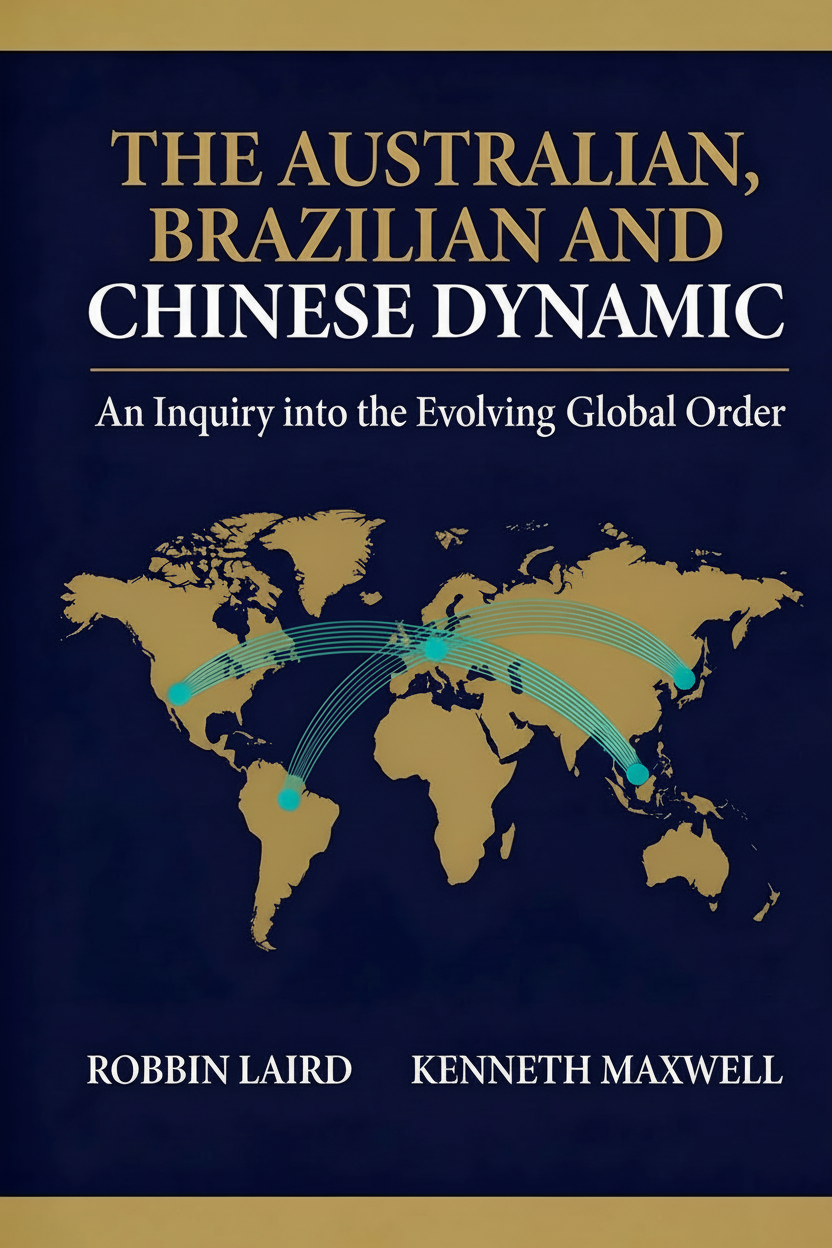
That contrast is not just about one firm’s balance sheet versus one president’s rhetoric. It goes to the heart of the question my recent book with Kenneth Maxwell examines through the Australian and Brazilian cases: how middle powers navigate the rise of Global China’s informal empire. Embraer’s 2025 results show that Brazil still has within it an alternative model of development and strategic autonomy—if the country chooses to build on it.
A Record Year for a Brazilian Global Player
Embraer ended 2025 with the strongest top‑line performance in its history. Revenues reached US$7.578 billion, an 18 percent increase over 2024 and above the high end of the company’s own guidance. The fourth quarter alone brought in US$2.652 billion, underscoring that this is not a one‑off spike but the culmination of a sustained upward trajectory in orders and deliveries.
Behind those numbers lies a healthy and diversified portfolio. In 2025, Embraer delivered 244 aircraft across its commercial, executive, and defense segments, up from 206 the year before. Commercial jets—the E‑Jets and the newer E2 family—went to operators in North America, Europe, and beyond; executive jets went into a global market that now sees Embraer as a core player; and the defense and security division continued to expand the footprint of the KC‑390, the A‑29 Super Tucano, and special‑mission platforms. The company closed the year with a record backlog on the order of US$31–32 billion and a book‑to‑bill ratio of 1.7, signaling that demand is outpacing deliveries.
This is not growth built on financial engineering. Embraer generated roughly US$491 million in adjusted free cash flow in 2025 (excluding Eve), and used that cash to strengthen its balance sheet. The company moved into a net cash position, ending the year with around US$109 million more cash than debt, and extended the average maturity of its liabilities from 3.7 to 9.1 years. It did all this even as US tariffs imposed an additional cost of some US$54 million—costs that a weaker firm would have struggled to absorb.
Those are the financial markers of an industrial champion. But numbers alone do not capture what is strategically significant about Embraer’s position in today’s fractured global order.
Global Reach Without Chinese Structural Dependence
In our book, we argue that Global China has built an “architecture of dependence” that operates less through territorial control and more through the control of material flows, infrastructure, processing, finance, and digital platforms. The aim is not to turn countries into formal colonies, but to ensure that the cost of going against Chinese preferences becomes prohibitively high over time. Brazil, under Lula, has become one of the clearest examples of a democratic middle power drifting into that architecture.
Embraer is an outlier to that trend—and that is precisely why it matters.
China is not irrelevant to Embraer. The company has been present in the Chinese market for years, with a fleet of roughly 80–100 jets in service there and a long‑standing focus on secondary and tertiary routes that are poorly served by larger narrowbodies. In March 2026 it even published a new China market report outlining how right‑sized regional jets can improve profitability for Chinese airlines in these markets. But for Embraer, China is one market among many, not an existential anchor.
If Beijing were to decide tomorrow to squeeze Embraer out of China, the impact would be measured in lost marginal growth, not in corporate survival. The bulk of Embraer’s revenues come from customers in the United States, Europe, and other regions that operate within the liberal trading system. Its defense platforms are being acquired by NATO allies—Portugal, Hungary, the Netherlands, the Czech Republic—as well as by South Korea and other security partners. Its business‑jet customers are dispersed across multiple continents. Its supply chains, while global, are not designed to run through Chinese processing chokepoints in the way that Brazilian soy or iron ore exports increasingly do.
In other words, Embraer has succeeded in building a Brazilian presence in global high‑technology markets without entangling its future in the architecture of dependence that Global China has woven around commodity exporters and infrastructure‑poor states. It competes in open tenders, meets Western certification standards, and lives or dies by its ability to deliver performance and reliability, rather than by the favor of a single party‑state.
That is not to romanticize Embraer or to deny that it operates within a harsh competitive landscape. It is to underline the strategic fact that the company’s bargaining power is rooted in a diversified customer base and in the value of Brazilian engineering, not in the discretionary demand of a single authoritarian buyer.
Lula and the Brazil Inside Global China
Set this alongside Lula’s China policy and the contrast could not be sharper.
On his May 2025 trip to Beijing, Lula declared that, “If it depends on my government, our relationship will be indestructible,” celebrating the fact that bilateral trade had increased more than thirty‑fold since his first presidency. He welcomed China’s rise as Brazil’s largest Asian investor, with stock estimated around US$54 billion, and explicitly framed the relationship as the core of Brazil’s economic future.
There is no mystery about what that future looks like. China already absorbs more than a quarter of Brazil’s exports, dominated by soybeans, iron ore, and crude oil. Chinese firms have stakes in Brazilian ports, electricity distribution, and critical‑minerals concessions. The Belt and Road Initiative has created a network of ports and corridors in Latin America—notably the Chancay deep‑water port in Peru—that are designed to route the region’s commodities into logistics chains Beijing finances, operates, and ultimately leverages.
Ideologically, this is wrapped in the language of multipolarity, BRICS solidarity, and Global South leadership. Brazil co‑authors a China‑leaning “peace plan” for Ukraine that Kyiv itself cannot accept, positions the BRICS New Development Bank as an alternative to Western finance, and brings Huawei back into critical infrastructure decisions once treated as too sensitive for Chinese vendors.
What we show in the book is that this pattern is not an accident, but the political expression of structural incentives that have been built up over two decades. When key sectors of your economy—agribusiness, mining, energy—become heavily dependent on Chinese demand, and when Chinese capital and infrastructure underwrite your export corridors, the political cost of displeasing Beijing rises steadily. At some point, the rhetoric of “active non‑alignment” becomes a rationalization for structural accommodation.
That is what we call the “middle‑power trap.” A country remains formally sovereign, holds elections, and proclaims autonomy, but in practice its foreign‑policy bandwidth is constrained by economic dependencies that it cannot afford to challenge.
Australia, Embraer, and the Other Brazilian Path
This is where the Australian comparison becomes illuminating. Australia is also a resource‑rich democracy that made itself heavily dependent on Chinese demand, particularly for iron ore. In the 2010s, it seemed to be following a similar path: deep economic integration with China, under the assumption that trade would be stabilizing, if not democratizing.
The test came when Canberra called for an inquiry into the origins of COVID‑19. Beijing responded with a sweeping campaign of economic coercion: punitive tariffs and informal bans on Australian barley, wine, beef, coal, cotton, lobster, and more. But the strategy misfired. Australian exports found alternative markets, the multilateral trading system absorbed much of the shock, and the political response in Canberra was to double down on security ties with the United States and the United Kingdom through AUKUS and other arrangements.
Australia was able to resist because its dependence, while real, was structured differently. China needed Australian iron ore more than Australia needed any single Chinese buyer. The rest of the trading system had enough depth to redirect many of the targeted exports. And Australian political culture proved willing to absorb short‑term pain for long‑term strategic autonomy.
Brazil’s position is more precarious. Chinese demand for its soy and ore can often be substituted among suppliers; Brazilian ports and rail corridors built or financed by China can be used as leverage; and Brazilian political elites have repeatedly chosen accommodation over resistance. The architecture of dependence has sunk deeper roots.
Yet Embraer looks, in many ways, more like the Australian story than the Brazilian one. Its revenues do not hinge on Chinese demand. Its core partners and customers are in the democratic world. Its backlog is composed of contracts that embed Brazil into allied air forces and global business networks, not into Chinese‑controlled port systems or BRICS currency experiments.
In our chapter on Brazil–India relations, we sketch a possible path whereby Brazil could leverage ties with another large democracy to diversify its economic and technological partnerships. The logic is straightforward: if you want autonomy, you build overlapping relationships with other middle powers and advanced democracies, reducing your exposure to any one great power’s leverage. Embraer is already living that logic.
Industrial Sovereignty Versus Commodity Comfort
There is a deeper philosophical divide here about what constitutes national development and sovereignty.
Lula’s project, as articulated with Chinese counterparts, is to move Brazil up the value chain with Beijing’s help—using Chinese investment to build electric‑vehicle plants, battery factories, and AI centers in Brazil, in exchange for a stable flow of commodities and political alignment. The implicit argument is that Brazil lacks the capital and technology to do this on its own or with Western partners, and that China offers a shorter path to modernization.
Embraer falsifies that premise. Here is a Brazilian firm that has, over decades, developed world‑class engineering capabilities, established itself in some of the most demanding civil‑aviation and defense markets on earth, and financed its own expansion through global capital markets. It has done so not by relying on a single patron, but by operating in competitive markets where performance, certification, and reliability are the tickets to entry.
The lesson is not that Brazil can do everything on its own. No middle power can. The lesson is that a middle power can choose to invest in sectors that enhance its bargaining power and embed it in plural networks, rather than doubling down on the old comfort of being a quarry and a farm for a rising empire.
That is why Embraer’s performance is more than a corporate success story. It is a strategic argument in numbers. It shows that Brazil is not condemned to a future in which autonomy is reduced to rhetorical flourishes at BRICS summits while the material levers of influence reside in Beijing. It shows that Brazil can still build and sustain national champions whose very existence expands the country’s room for maneuver.
Choosing Between Two Brazils
In the book, we conclude that middle powers like Australia and Brazil are not mere spectators in a US–China drama. They are consequential actors whose choices will shape the emerging global order. But those choices are constrained by the structures they themselves have built.
Embraer’s 2025 results arrive at a moment when Lula’s Brazil is doubling down on the structures of Chinese dependence rather than unwinding them. That juxtaposition crystallizes the decision facing Brazilian elites and society.
One Brazil is the Brazil of Embraer: a country that invests in high‑value manufacturing, integrates into allied and partner defense and aerospace ecosystems, and earns its influence by what it can design, build, and sustain. The other is the Brazil of “indestructible” partnership with Beijing: a country that continues to rely on soy, ore, and crude exports while allowing foreign control and influence over the logistics and financial plumbing that move those commodities to market.
Both Brazils are real. Both exist today. The question is which one will define the country’s trajectory over the next decade.
Embraer cannot, by itself, reverse the broader drift of Brazilian policy. But its latest results give substance to a different vision of Brazilian power and autonomy—one that does not require surrendering to the gravitational pull of Global China’s informal empire. For a middle power still deciding what kind of actor it wants to be in the twenty‑first century, that example is too important to ignore.
Note: We are publishing our book on Global China and middle powers later this year.