
Running Toward the Problem: Fairbanks Morse Defense and the Digital Transformation of Naval Sustainment
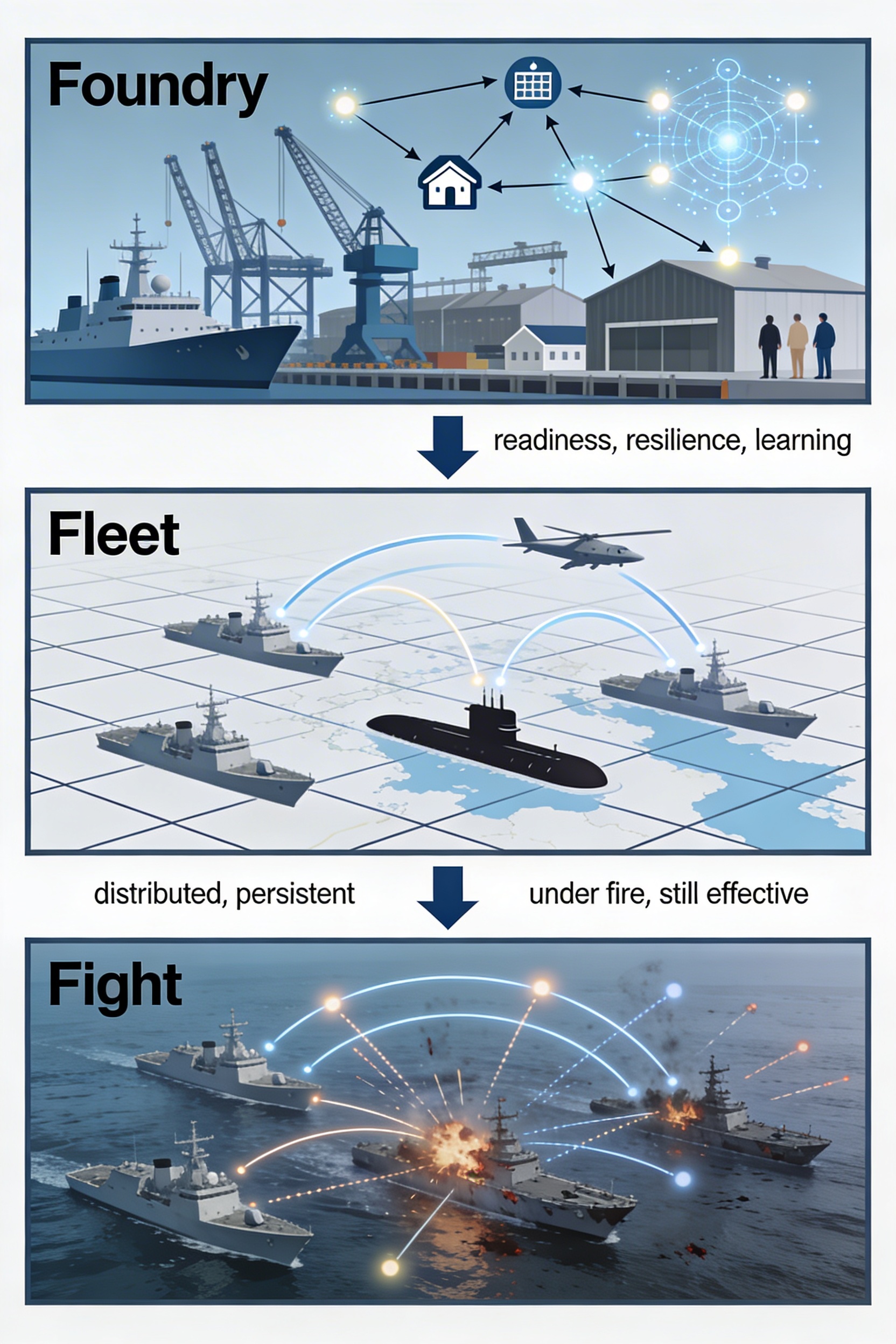
The U.S. Navy faces a sustainment crisis that is, by most honest accounts, far worse than official Washington acknowledges. Ships age beyond their designed service lives, diesel engines originally built for 30-year platforms are being asked to survive 40 to 45-year deployments, and the industrial base that is supposed to keep the fleet ready struggles under the weight of outdated processes, workforce shortages, and a data enterprise that remains locked in the previous century.
Against this backdrop, Fairbanks Morse Defense (FMD) is doing something unusual in the defense industry: running toward the problem. Jim Kenny, Executive Vice President of Naval Affairs at FMD and a former Senior Executive Service official who led NAVSEA’s Engineering and Logistics Directorate, frames the company’s posture in straightforward terms: “We are unique in that we are running towards defense when a lot of other folks are running in the opposite direction. We see it as nothing but an opportunity and an honor. How do we bring unique solutions to age-old problems?”
Alongside Kenny, Nirav Patel, FMD’s Navy Segment Director and a retired 25-year submarine officer, brings a warfighter’s understanding of what sustainment failures actually cost. Together, they are leading an effort that extends well beyond maintenance contracts, one that is beginning to redefine what it means to keep a fighting fleet ready in the digital age.
From Open and Inspect to 30-Day Overhauls: Rethinking the Maintenance Paradigm
For the past 15 to 20 years, maintenance of the Navy’s diesel engines, both main propulsion units and ship service generator sets, has followed a contracted model built around what Kenny calls “open and inspect and time fills.” In practice, this meant work expanded to fill whatever time was available. Durations that should have taken weeks routinely stretched to months. The Navy was, in effect, paying for time rather than outcomes.
FMD challenged that model directly, working with innovative partners in Naval Surface Warfare Center-Philadelphia and NAVSEA to demonstrate that a complete diesel engine overhaul, delivered t OEM specifications, with certified reliability, could be accomplished in 30 days or less. “You’re buying the OEM expertise,” Kenny explains. “How can we turn that around and in a 30-day period, no kidding, provide the reliability that you need?” The combination of FMD’s six service centers positioned near fleet concentration areas and its role as original equipment manufacturer gives the company an asymmetric ability to compress timelines that no third-party maintainer can replicate.
The institutional resistance this approach encountered tells its own story. Patel, drawing on his submarine career, identifies why the old model persisted for so long: “For two decades, we have not had a global adversary who was able to challenge us. So as an institution, the Navy and Industry got very comfortable with paying for just what they needed. Open and inspect like approach was okay because I only want to pay for what I can justify. That’s different now.” Leadership has recognized the shift for roughly a decade, he notes, but over coming inertia inherent in large organizations a slow and resistant process.
Robots in the Oil Sump: The Case for Automated Engine Block Repair
A vivid illustration of FMD’s approach involves a problem that is at once mundane and technically demanding: restoring the engine block structure that supports crankshaft bearings in legacy submarine diesel engines. These engines, designed in the 1970s for platforms with nominal 30‑year service lives, are now expected to operate reliably through life‑extension programs that are pushing many boats toward nearly five decades of service. Ensuring precise bearing alignment over that extended life is vital to proper crankshaft operation and to sustaining full engine performance.
The geometry of the task is unforgiving. FMD’s opposed‑piston engine configuration, with crankshafts on both the top and bottom for increased power density, forces welders to work in roughly a two‑foot gap, lying in the oil sump and looking up at U‑shaped bearing saddles while laying down weld beads. In this cramped, hot environment, where temperatures can reach 95 degrees Fahrenheit, a single engine repair may require more than 1,000 individual weld passes. Wearing full protective gear, working overhead with slag falling, a human welder might only achieve two effective hours of productive welding per shift. The process could stretch to three weeks and was inherently vulnerable to error as fatigue accumulated.
FMD’s answer was to introduce robotic welding, paired with an AI‑enabled visual inspection system, to take on the most repetitive and physically punishing aspects of the job while preserving human oversight and judgment. A near‑field camera evaluates each weld as it is laid down, comparing it against a trained image library of acceptable and deficient welds. A set of gradient criteria guides the robot: as long as the welds stay within those quality bounds, the system continues; when they do not, the robot stops and calls in a human welder to inspect, decide whether the weld is acceptable, or excavate and correct as needed. Human expertise remains decisive in every repair, but it is applied where it matters most.
The result is not automation supplanting skilled labor. It is human–machine teaming designed to protect the most critical form of human judgment while eliminating the brutal repetition that erodes quality over time. The quality of the thousandth weld now matches that of the first, a level of consistency that is practically unattainable with manual methods alone under such conditions.
The Data Problem: A Locked Enterprise in a Digital Age
FMD’s robotic welding program generates something beyond repaired crank lines: it generates data. And data, in the current naval enterprise, runs into a wall.
Kenny frames the issue with characteristic directness. The Navy holds an enormous repository of in-service reliability data, managed through the Naval Surface Warfare Center Corona. “That expertise is leveraged internally, Navy-only,” he says. “It’s not actively shared unless you ask, and it’s got to be on your equipment.”
The result is an institutional paradox: the Navy possesses decades of operational performance data that could drive competitive innovation, predictive maintenance, and industrial reform, but instead uses it primarily for internal operations. “The Navy has missed the boat on how they use and share that data as a competitive advantage,” Kenny says, “to work with their industrial partners, stimulate change, and build a degree of competitiveness that does not exist today.”
FMD has found a partial workaround by working on its own proprietary equipment. Because FMD is the OEM, responsible for certification of the engine design, it owns the data produced during maintenance and repair. This is precisely why the robotic welding program was feasible: the company could develop, test, and qualify the process without waiting for Navy permission at every step. As Patel puts it, the team was willing to be fully transparent, “open kimono, brought them into our factory, let them see all the things we were doing”, while retaining the ability to move without being paralyzed by the approval process.
The company has gone further, developing an anomaly detection system using large language models trained to identify abnormal sensor readings from equipment in service. The concept directly addresses one of the most persistent weaknesses in naval maintenance: the gap between data collection and actionable insight. “In my day of going to sea, understanding how good your equipment was meant a sailor walking around for an hour taking a bunch of numbers, and maybe he had three minutes to interpret what was actually put down on paper,” Patel recalls. “It is difficult to understand trends and machinery health. Instead, we have the ability to live-stream that information into a large language model” that can flag developing problems before they strand a ship at the pier.
FMD ran a pilot of this system on LCS 27.
Advanced Machining, Additive Manufacturing, and the War on Old Paradigms
Robotic welding is only one front in FMD’s broader campaign against industrial stasis. Kenny describes the company’s investment in advanced machining capabilities as a direct challenge to assumptions that have governed naval manufacturing since the Second World War.
The traditional casting paradigm assumes a “near net shape” starting point, a cast component that requires relatively little machining to reach final dimensions. This made sense when machinists worked manually on lathes and milling machines. FMD has inverted the logic. By investing in highly automated machining centers capable of lights-out operation, the company is not constrained to “near net shape” paradigm, thus can begin from forged block stock and machine components to specification overnight without human attendance. “The automated loader loads the machine up with raw shapes of forgings,” Kenny explains. “We go home at night, and the elves have made 25 to specification valves and a bunch of shoes for us when we come back in the morning.” The elimination of casting from the supply chain removes a chronic source of delay and quality variance.
The company has applied the same philosophy to copper-nickel components, a notoriously difficult casting problem for submarine construction. Working with Lincoln Electric’s Cleveland facility, which operates more than 26 advanced manufacturing weld heads, FMD is now producing copper-nickel ship service ball valves for Virginia and Columbia-class submarines using additive manufacturing as the shaping step and FMD’s own naval qualification expertise as the finishing process.
The qualification timelines remain a source of frustration. Kenny cites the example of mechanizing the hard-facing process for disc valves, a welding task that previously required years of skill development and had delivered zero first-time yield for over three years under manual methods. After introducing a mechanized process and navigating the qualification pathway, the team achieved six first-time pass qualifications in three days. But the approval process itself consumed 14 months. “We’re actively working with our innovative partners in Navy and declaring war on processes that fail to achieve rate, scale and bias first-time quality,” Kenny says. “How do we start to speed those things up?”
The Workforce Question: Capturing Tacit Knowledge Before It Walks Out the Door
Underlying all of FMD’s technical work is an urgent demographic reality. The experienced workforce that built and maintained the current fleet is aging out, and the trades required to replace them, skilled welders, machinists, engineers with decades of platform-specific knowledge, are not recruiting at the rates needed. This is not a problem unique to FMD; it pervades the entire naval industrial base.
Kenny is direct about the stakes: “How do we somehow capture that tacit knowledge from the gray hairs like me and others that are eventually retiring?” The answer FMD is building toward is embedded in the approach to robotic welding and automated machining. If the most demanding skills can be encoded into systems that guide or replace the physically limiting parts of the work, then newer workers can reach meaningful proficiency faster and sustain it longer. Skills that previously required 20 years of experience to master can, with the right automated tools and training frameworks, be developed in a fraction of that time.
Patel draws the analogy from his submarine service. In his early career, tracking underwater contacts required a dry-erase board and mental geometry, a skill that was both demanding and hard to scale. The submarines he later served on had computer systems that offloaded that cognitive burden, freeing operators to focus on interpretation and decision-making rather than raw computation. “We’re trying to show students today, and our apprentices frankly, that that’s what we’re trying to do,” Patel says. “This robotic welder, for example, our younger welders who are down there on the deck plates with it are using it to offload the repetitive tasksand thinking about the more difficult part of the problem.”
USN’s ShipOS for Warships initiative is funded through the Navy’s Maritime Industrial Base program to bring AI and advanced analytics into U.S. shipbuilding and related suppliers. FMD is working with Palantir’s AI tools in its manufacturing operations as part of the Navy’s broader ShipOS for Warships effort, using AI to coordinate thousands of concurrent shopfloor tasks that are vulnerable to supply chain, workforce, or equipment disruptions. Kenny says of AI-enabled manufacturing. “We just want to make sure we’re also clear that we will be dissatisfied with rate and speed until we can actually start to build ships at a rate closer to our near peer global competitors.”
A Federated Future: The Digital Backbone That Doesn’t Yet Exist
What FMD is demonstrating, piece by piece, is a model of naval industrial capability that the broader shipbuilding enterprise has not yet embraced. Kenny articulates it as “federated shipbuilding” or a modular approach that draws on manufacturing capacity distributed across the country, with components and sections arriving at points of final construction ready-tested and certified. The backbone of such a system is data: shared, operationalized, and used to drive competitive improvement rather than hoarded for internal administrative purposes.
“If we don’t employ this kind of national effort on shipbuilding, built on a digital backbone and the ability to communicate and take advantage of all the capacity we have, we are not going to win this,” Kenny warns. The urgency is not rhetorical. The Navy’s submarine fleet, built to operate for 30 years, is being extended to 40-45 years. In a strategic environment where platform availability is increasingly the binding constraint on operational capability, these are not maintenance abstractions. They are war fighting limitations.
What FMD is building, one qualified process at a time, is both a practical capability and a proof of concept. The robotic welding system works. The anomaly detection LLM works. The lights-out machining works. The copper-nickel additive manufacturing pathway works. Each represents a template for how the naval industrial base could operate if the institutional barriers to data sharing, process qualification, and modular manufacturing were removed.
As Kenny puts it, the company will remain persistent regardless. “We want to be that catalyst for change, and we’re going to be a willing and collaborative partner every step of the way and hopefully two or three steps up.”
Built in the Foundry: Robotic Maintenance and the Future of a Warfighting Navy