
The Age of Chaos: Kill Web Warfare, Authoritarian Coercion, and the Democratic Advantage
A $1,000 commercial drone strapped with explosives and used to systematically destroy a $50 million strategic bomber on a Russian airfield. That is not science fiction. It happened in Ukraine, and it shattered the economic mathematics of modern warfare in ways that defense establishments around the world are still scrambling to absorb.
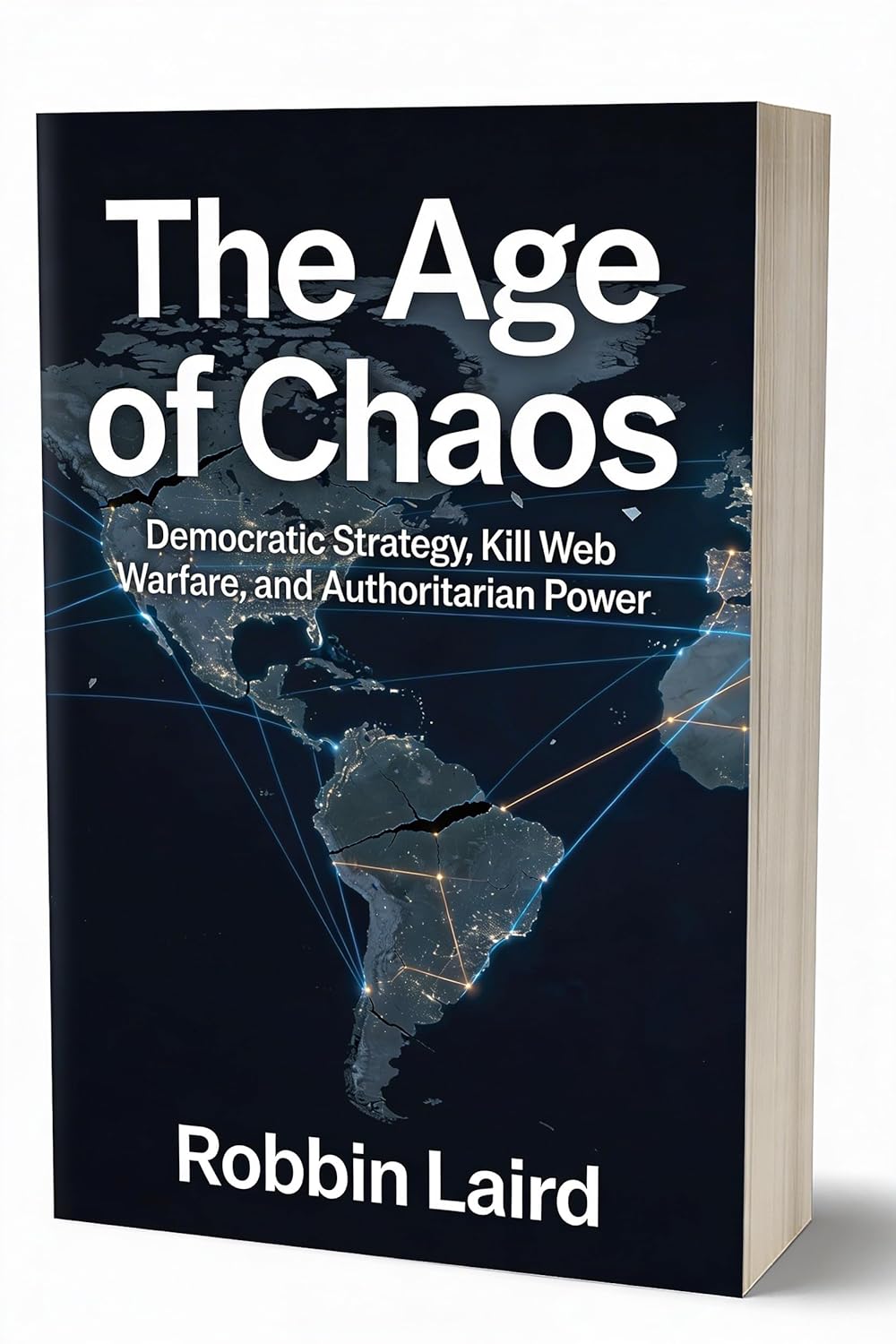
That striking image anchors The Age of Chaos: Democratic Strategy, Kill Web Warfare and Authoritarian Power, the new 2026 book by defense analyst and Second Line of Defense editor Dr. Robbin Laird. Drawing on four decades of field-based research across allied militaries, Laird has produced a comprehensive strategic map yet of the world order that has replaced the post-Cold War settlement, a world not of temporary crises to be managed, but of permanent, structural turbulence to be navigated.
The book opens with a frank diagnosis of Western strategic failure. Since the Soviet Union’s collapse in 1991, Laird argues, Western strategic thinking became frozen, “stuck in the mental amber of the Unipolar Moment.” Policymakers in Washington, London, and Brussels operated on the quietly held assumption that economic globalization and liberal institution-building would automatically transform authoritarian regimes into democracies. History, in the famous phrase of the era, was over. The rules-based order had won.
What that complacency missed was the construction, in plain sight, of an entirely parallel system by authoritarian powers. While the West reached for economic sanctions as its default instrument of coercion, expecting compliance to follow automatically, Russia, China, Iran, and North Korea were quietly building what Laird calls the “marketplace of coercion.”
Unlike the old Warsaw Pact, which was a rigid ideological bloc resembling a top-down corporate merger, this new network functions more like a gig economy. Its members are not bound by shared ideology but by mutual vulnerability and transactional exchange. Russia needs weapons and diplomatic cover to sustain its war effort; Iran supplies drones and missile technology; North Korea provides millions of artillery shells and even military labor. In return, Russia delivers discounted energy, food, hard currency, and critically, Security Council veto protection at the United Nations.
China serves as the financial anchor of this entire shadow network. Beijing provides alternative financial channels to bypass the SWIFT banking system, purchases sanctioned Russian oil at scale, and supplies dual-use technology, civilian-looking components that end up in missile guidance systems — quietly rewiring Russia’s economic operating system into a yuan-centric orbit beyond the reach of the US dollar. The result is a financial shock absorber, deliberately engineered over fifteen years, to neutralize the West’s primary instrument of pressure.
Beyond this marketplace of coercion lies a deeper and more durable form of authoritarian influence. Laird introduces the concept of the “informal empire”, a strategy for gaining strategic leverage without the messy expense of territorial conquest. China executes this through debt, infrastructure, and the control of technology standards.
Under the Belt and Road Initiative, Beijing finances and builds critical infrastructure across the developing world, deep-water ports, railways, 5G telecommunications networks. When recipient nations cannot repay their loans, China renegotiates terms to secure long-term leases on those facilities, potentially converting commercial ports into dual-use logistical hubs for the People’s Liberation Army Navy. Control over trade routes and digital backbones, achieved without a single shot fired.
The book cites a striking historical observation contributed by historian Kenneth Maxwell: China is currently constructing a new mega-embassy in London on the exact site of the old Royal Mint, directly overlooking the Tower of London. A 21st-century informal empire, its headquarters planted atop the geographic heart of the 19th-century one it is displacing.
Laird insists this demands a conceptual correction. We must stop speaking of “great power competition”, a framing that implies the 18th-century model of separate empires with hard borders, and begin speaking instead of “major power competition,” a condition far messier and more entangled. The United States and China are enmeshed in the same global supply chains, hold each other’s debt, and conduct hundreds of billions in annual trade while simultaneously preparing for potential conflict. Neither can collapse the other without risking its own destruction.
It is in Ukraine, however, that Laird’s most operationally consequential analysis takes shape. The war has served as a live laboratory exposing the obsolescence of platform-centric warfare, the decades-long Western assumption that victory goes to whoever fields the most exquisite, technologically advanced, heavily armored platforms. Billion-dollar stealth fighters. Main battle tanks. Nuclear aircraft carriers.
What Ukraine has demonstrated is that the era of the isolated platform is over. The future belongs to what Laird and his longtime collaborator Ed Timperlake have called the “kill web”: a resilient, fast-cycling digital network that connects thousands of diverse sensors and shooters, where the value of any single node is less important than the health and speed of the network as a whole.
The concept is illustrated through Operation Spider Web, a Ukrainian action in which over 100 cheap commercial quadcopters, hidden in the backs of ordinary civilian pickup trucks, were driven near Russian air bases deep inside Russian territory. Using AI-assisted targeting software trained on museum aircraft, the drones identified and destroyed billion-dollar strategic bombers on the tarmac. The targeting data was drawn from a fusion of commercial satellite imagery, military intelligence, and crowd-sourced information from civilians logging enemy movements on their smartphones — essentially a decentralized ridesharing app for lethal force.
This introduces what the book terms “intelligent mass”, the deliberate deployment of large numbers of cheap, networked, AI-guided systems rather than small numbers of expensive exquisite platforms. The economics are devastating for legacy militaries. A Russian air defense battery that successfully intercepts 90% of an incoming drone swarm still loses, because the 10% that gets through destroys an asset that took a decade and a billion dollars to build. Firing a $2 million interceptor missile at a $2,000 drone is a race toward national bankruptcy.
Central to this kill web architecture is what Laird calls the “SAR commons”, the proliferation of synthetic aperture radar, which bounces microwave signals off the Earth’s surface and can see through clouds, weather, and darkness alike. Once a capability reserved exclusively for national intelligence agencies of superpowers, this transparent targeting layer is now being provided commercially by firms like Finland’s Iceye, by NATO’s Aquila Federation pooling allied commercial satellite data, and by Japanese companies providing continuous feeds. There is, quite literally, nowhere left to hide.
How should democratic governments and militaries respond?
Laird’s central prescriptive argument is a shift in the fundamental logic of leadership from crisis management to chaos management.
Crisis management assumes that disruptions are temporary anomalies; the goal is to weather the storm and return to stability. But in the age of chaos, there is no stable normal to return to. Overlapping shocks, technological leaps in artificial intelligence, ongoing economic warfare, simultaneous conflicts across multiple theaters, are not aberrations. They are the permanent operating condition.
Building institutions for chaos management means designing organizations that expect unpredictability, are structured to pivot constantly, and can absorb continuous disruption without losing coherence. The realistic long-term strategic objective, Laird argues, is not the democratization of rival powers, they are enduring forces that are not going anywhere — but what he terms “competitive coexistence”: drawing hard, enforceable lines against territorial conquest and severe economic coercion while accepting that the rivalry itself will persist indefinitely.
Enforcing those lines requires leverage, and leverage requires industrial strategy as grand strategy. Democracies cannot fight kill web wars without the factories to mass-produce the intelligent mass those wars demand — tens of thousands of drones, munitions, and sensors. That in turn requires “friend-shoring”: moving critical manufacturing away from rival nations and into allied countries, so that an adversary cannot switch off a democracy’s military supply chain simply by closing its export borders.
Laird also introduces a leadership framework he calls “listen to lead”, a recognition that in a fast-evolving kill web environment, critical knowledge often resides at the edge of the network, not at the top. A 22-year-old drone operator in a forward position may understand a newly deployed enemy jamming frequency far better than a four-star general miles away. Effective leadership means having the disciplined humility to listen to those practitioners, synthesize their intelligence, and rapidly resource them — treating the people on the ground as co-authors of strategy, not an audience to be managed.
The book closes with a deliberately provocative inversion. Authoritarian regimes consistently weaponize democratic dysfunction as propaganda, pointing to messy elections, polarized legislatures, and street protests as evidence that liberal systems are failing. By contrast, their own rigid order, they argue, is superior.
But Laird asks his readers to look again at the kill web they have just examined: the garage inventors iterating drone software in days, the commercial technology startups undercutting the procurement timelines of major defense contractors, the citizens crowd-sourcing battlefield intelligence from their smartphones. Authoritarian systems must suppress unauthorized information and punish unsanctioned innovation simply to maintain control. They are structurally incapable of the kind of decentralized, trial-and-error adaptation that kill web warfare demands.
In an age where adaptability is the only currency that matters, democratic chaos, loud, decentralized, argumentative, and messy. may prove to be not a vulnerability to be overcome, but the defining operational advantage of the free world.