
From Platform Mastery to Ecosystem Management: The Unfinished Revolution in Military Transformation
There is a persistent conceit in Washington defense circles — that military transformation is something you design in a think tank, brief into existence with a well-crafted slide deck, and then implement through the machinery of acquisition. Four decades of field research across allied militaries tells a different story. Genuine transformation happens in the maintenance hangar and the ready room, in the friction between what doctrine prescribes and what the enemy actually does.
The gap between those two realities is not a problem to be solved. It is the primary space where real innovation is born.
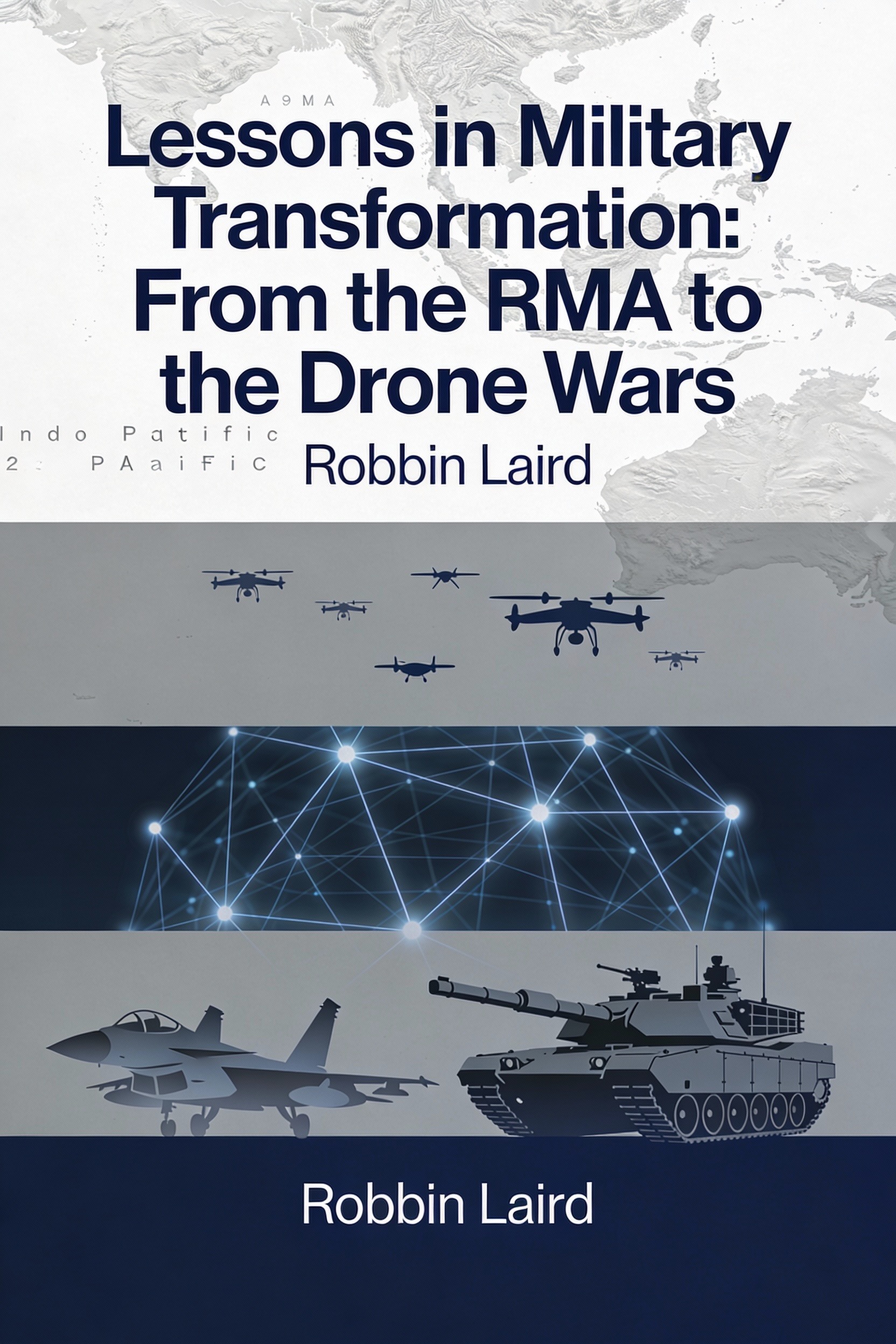
This is the argument at the heart of Lessons in Military Transformation: From the RMA to the Drone Wars. The book does not offer another Washington consensus on the Revolution in Military Affairs. It documents what transformation actually looks like when it works and more importantly, when it doesn’t drawing on sustained engagement with the practitioners who live these realities, not the theorists who observe them from a distance.
The central argument of this book can be stated simply: power has migrated toward centralized bureaucracies at precisely the moment when operational complexity demands the opposite. Washington’s hold on budgetary authority, requirements definition, and acquisition timelines has grown tighter even as the pace of competitive change has accelerated. The result is a system that optimizes for process compliance rather than combat effectiveness.
The Center and the Field inhabit fundamentally different information environments. At the Center, authority flows from hierarchy, budgets, and layered review. Information is often contaminated by institutional fashions and the political imperatives of the moment. At the Field, authority derives from operational proximity and mission necessity. Information is concentrated on task mastery and enemy behavior. These two environments do not naturally communicate. Building a functioning innovation ecosystem requires mechanisms that bridge that divide deliberately.
Paul Bracken’s Lead User theory offers a rigorous alternative to the centralized design paradigm. Its premise is direct: in environments of high innovation where no prior operational experience exists, bottom-up adaptation is the only reliable path to effective employment. The world is too complex for centralized design to anticipate. Hand prototypes to informed users under field conditions, demand they figure out the best way to use them, and institutionalize what they learn.
The methodology has four steps.
- First, identify the Lead Users — those subunits operating closest to the actual battlespace, whose understanding of mission requirements exceeds anything that can be captured in a strategic concept document.
- Second, give them genuine freedom to experiment. This means tolerating failure, protecting the process from bureaucratic interference, and resisting the temptation to evaluate early results against mature-program metrics.
- Third, capture organizational learning, build the mechanisms that translate individual “lessons learned” into institutionalized changes in collective behavior.
- Fourth, integrate that learning back into the Center to reshape budgets, force structures, and future requirements.
This is not a theory about avoiding central authority. It is a theory about sequencing. The Center’s role is to enable and then absorb field innovation, not to pre-define it. The distinction matters enormously in practice, because the instinct of centralized bureaucracies is always to specify requirements before understanding them.
Platforms as Catalysts: The F-35, MV-22, and CH-53K
The platforms examined in this book are not case studies in procurement. They are case studies in cognitive transformation. The F-35 Lightning II is not primarily a fighter aircraft in the traditional sense. It is a sensor-shooter node whose value resides in how it manages and distributes information within a networked operational environment. Pilots transitioning to the F-35 must undergo a fundamental reconceptualization of their role, from individual air-to-air combatants to information managers within a distributed strike ecosystem.
Operation Rising Lion in 2025 validated this architecture under live operational conditions. Israeli pilots leveraged the F-35’s sensor fusion as the essential lead element of a distributed strike network not as a platform flying solo missions, but as the connective intelligence at the center of a Kill Web. This is what the platform-centric critics consistently miss: the aircraft’s value cannot be assessed in isolation. It has to be assessed as a node within the larger ecosystem it enables.
The MV-22 Osprey follows a similar pattern, but through a different route. Its most consequential operational applications were not designed at the Center. They were discovered by practitioners who recognized unanticipated possibilities. By exploiting the Osprey’s unique combination of range and speed, users developed employment concepts that moved well beyond conventional assault support into distributed operations across the vast distances of the Pacific. The aircraft became the connective tissue of expeditionary forces operating in environments that previous mobility platforms could not reach.
The CH-53K King Stallion represents something different again, a discontinuous technological break so profound that it arguably deserved a new designation entirely. Its digital flight controls and precision hover capability are not incremental improvements on its mechanical predecessor. They enable operations in environments where previous heavy-lift platforms would have failed. The challenge now is building the operational concepts, training pipelines, and maintenance cultures to exploit what the platform actually makes possible.
The Innovation Protector and the Yuma Triangle
None of these transformations happen automatically. They require individuals willing to shield innovation from institutional friction what the Michael Wynne / Ted Bowlds model calls the “Innovation Protector.” This is a leader in a position of sufficient authority to bypass standard bureaucratic protocol when necessary, someone with the visionary foresight to recognize peer competition before the consensus does, the personal courage to speak truth to power, and the principled contrarianism to challenge fashionable assumptions.
Secretary Michael Wynne understood China as a peer competitor long before Washington consensus caught up. That understanding came at professional cost. The same pattern appears repeatedly in the history of successful military innovation: the people who got it right early paid a price for being early.
At the institutional level, the Yuma Innovation Triangle — the collocation of MAWTS-1, VMX-22, and operational squadrons at Yuma, Arizona — provides a structural model for how this protection can be embedded in organizational design rather than relying solely on exceptional individuals. The triangle creates three interlocking capabilities: an intellectual engine for fifth-generation concepts, a compressed “test to fleet” cycle that moves capabilities from evaluation to fielding at operational speed, and a culture of operational honesty that tests technology against the physics of combat rather than scripted scenarios designed to produce favorable results.
The Kill Web and the Democratization of the Battlefield
The Rover box story is worth telling in detail because it captures, in miniature, everything this book argues about how transformation actually works. CWO Manuel asked a simple question: why couldn’t UAV video be pushed directly to the ground? Major Greg Harbins answered it with a Panasonic hard-book and components from Radio Shack, creating an unofficial prototype that proved the concept. What began as an unauthorized workaround became a Quick Reaction Capability that fundamentally compressed the kill chain by giving ground units real-time visibility of what the aircraft overhead was seeing.
This is what the democratization of the battlefield looks like at the tactical level: information formerly hoarded at headquarters pushed to the edge, enabling action without the delays imposed by hierarchical reporting. The Combat Cloud — or Kill Web — scales this principle across an entire operational architecture. Unlike a rigid “System of Systems,” which assumes pre-defined sensor-shooter pairings, a Kill Web is an ecosystem where any sensor can support any shooter. The network is the weapon. The platform is a node.
Within this ecosystem, Maritime ISR Officers — the “Purple Shirts” — function as warrior-solution architects, working the left side of the kill chain before the first shot is fired. Find, Fix, Track. The cognitive work that determines whether the kinetic action that follows produces the desired strategic effect. This is the operational expression of the shift from Crisis Management — the effort to restore vanished stability — to Chaos Management, the ability to operate effectively within irreducible turbulence.
Managing the Unfinished Revolution
Military transformation is not a project with a completion date. It is a process to be managed continuously, against adversaries who are simultaneously managing their own processes of adaptation. The search for a final end-state, a stable configuration of forces and systems that will deliver sustained dominance, is itself a form of the platform-centric thinking that has repeatedly failed.
The operational mandate that emerges from this research is disciplined in its specifics. Platforms alone are never transformation; combat impact is determined by how operators integrate them within an ecosystem. Readiness is the price of admission for innovation, transformation must not create windows of vulnerability. Training must outpace technology, because warfare is now fundamentally cognitive and operators must be prepared to manage information flows with the same proficiency they bring to flying. Adversaries co-evolve, which means every advantage is transient by definition. And innovation is the child of friction, the gap between strategic concept and tactical reality is not a problem to be eliminated but a productive tension to be institutionalized.
What this era demands, above all, is strategic courage and the willingness to prioritize future competitive requirements over present institutional convenience. The forces that prevail will not necessarily be those with the most advanced platforms.
They will be those that have built the learning cultures, protected their practitioners, and mastered the cognitive demands of operating within the chaos of an unfinished revolution.
That is what this book documents.
Not a theory of transformation.
A record of how it actually happens.