
Balancing Performance and Cognitive Dependence: The AI Learning Challenge
Article Summary:
The article is clear-eyed about the risks. Conversational AI creates automation bias (the tendency to follow machine recommendations even when wrong), strategic dependency on digital architectures that are fragile in contested environments, and a new form of algorithmic sovereignty risk, particularly from the rapid diffusion of Chinese open-source AI models into Western systems. It cites the February 2026 Anthropic–Pentagon dispute over Claude as a live illustration of where the ethical frontier currently sits. The response is not to reject these tools but to build “cognitive resilience” into training itself: forces must learn both how to exploit AI and how to operate effectively without it. Explainability, degraded-environment exercises, and “AI literacy” at all command levels are the proposed guardrails.
The conclusion is that conversational AI does not automatically strengthen mission command. It can do so only if integrated with appropriate doctrinal and pedagogical discipline. Like the broader transformation of education in civilian society, operational preparation is where this tension must be worked out: not just learning to use these tools, but learning to challenge them and, when necessary, discard them.
Since AI’s earliest days several decades ago, the boundary between decision support and automated decision-making has been a recurring source of controversy. All Western militaries uphold the principle that humans must remain in the loop and bear sole responsibility for final decisions.
In fact, within allied doctrines, a distinction is generally made between “human in the loop” configurations (where humans validate each action), “human on the loop” (the human supervises and can intervene), and “human out of the loop” (systems capable of acting without immediate human intervention)—with operational tempo tending to favor supervisory modes over systematic validation.
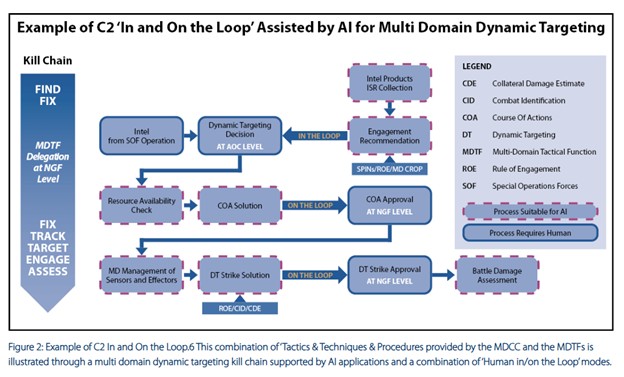
© Joint Air Power Competence Center
Despite this framework, critics fear that accelerating operational tempos will push more decision-making authority toward automated systems. A telling illustration of this tension emerged in the United States when Anthropic, in February 2026, refused to grant the U.S. government unrestricted access to its Claude model, citing concerns about mass surveillance and use in autonomous weapons systems. The controversy at stake is not whether the Pentagon uses AI that is already well established but rather how much control technology companies intend to retain over the military application of their models.
A central challenge lies in growing dependence on the digital architectures underpinning these systems. Despite a sometimes oversimplified public perception, AI models—whether from OpenAI, Anthropic, or Meta are ultimately “cognitive engines”: capable of producing text, analyzing data, and generating hypotheses, but nothing more on their own. Deployed in a real military context, they must be connected to classified databases, sensor feeds, command networks, and secure infrastructure. The AI model itself is therefore not the core of operational capability. That role belongs to the integration platforms such as Palantir’s AIP discussed earlier which provide the critical connectivity layer.
Within this architecture, AI models are largely interchangeable, It is control of the orchestration infrastructure that becomes strategically decisive. Whoever commands that layer holds a central lever in the decision-making chain, with profound implications for sovereignty, industrial dependency, and data governance. The strategic tipping point is clear: whoever controls the platform linking military data, sensors, satellites, and analytical tools effectively controls the decision-making infrastructure itself.
Balancing sovereignty and interoperability
This dynamic is at the heart of the AI-driven transformation of command and control, as illustrated by NATO’s adoption of the Maven Smart System. The program, which drew on contributions from various European partners, including Safran.AI, Quantum Systems, and Hadean, during recent demonstrations is presented as the Alliance’s first AI-“augmented” command and control system, designed to fuse multi-sensor data and accelerate targeting loops at the inter-allied level.
Although NATO members are not at identical levels of technological development, strategic foresight and careful design can reconcile what appear to be contradictory objectives: technological and decision-making sovereignty on the one hand, and the interoperability essential to Alliance cohesion on the other. Such balance has been achieved in other domains; there is no reason AI should be an exception. On the French side, this dual approach is articulated by Colonel Bruno de San Nicola, NATEX (National Technical Expert C4I/TransfoNum) at the French Military and Defense Representation to NATO, in a recent article:
Architectural and organizational choices regarding C2 are never neutral. They reflect a vision of command, the role of the coalition, the place of national sovereignty, and the relationship between humans and machines. NATO’s adoption of the Maven Smart System, France’s development of Artemis.IA [Editor’s note: Architecture for the massive processing and exploitation of multi-source information and AI], and Ukraine’s experience with the Delta system illustrate three distinct yet complementary responses to the same strategic equation: making decisions faster without relinquishing political control over the decision-making process. (…)
Artemis.IA does not oppose allied interoperability, but redefines its terms. It is no longer necessarily a matter of sharing raw data or algorithms, but of producing qualified, contextualized, and actionable intelligence that is compatible with common standards, while maintaining national control over processing chains. This more demanding conception of interoperability aims to reconcile operational cooperation and decision-making sovereignty without sacrificing one for the other. (…)
The future of command and control will not lie in exclusive dependence on an inter-allied solution, nor in sovereign withdrawal. It lies in the ability to combine collective effectiveness, national control, and operational agility.”
This reflection on sovereignty and interoperability broadens the very concept of strategic dependence: sovereignty can no longer be defined solely in terms of physical flows, supply chain security, and access to strategic resources. It now extends to the cognitive architectures that shape decision-making itself. We can thus speak here of an emerging “algorithmic supply chain”, one that remains exceptionally difficult to audit, given the novelty of the challenges it poses. This is all the more critical because the rapid spread of certain models, particularly through open-source distribution, introduces dependencies that are hard to trace.
This exponential trend is now explicitly documented: as highlighted in an article published on April 1 2026, in War on the Rocks, these models can become deeply embedded in Western software architectures including sensitive environments while remaining bound by national legal frameworks that may require cooperation with state authorities. Dependency no longer stems solely from hardware components, but from AI software itself, now widely distributed and integrated into Western systems, including sensitive ones. According to multiple AI industry reports, Chinese models’ share of global usage rose from roughly 1% at end-2024 to nearly 30% by end-2025. Certain architectures, such as Alibaba’s Qwen, have surpassed 700 million downloads on open-source platforms, making it among the most widely distributed software systems in the world. Far from “technological neutrality,” these models remain closely tied to their national political ecosystems, giving rise to unprecedented systemic risks for global digital value chains, data exfiltration, model opacity, and traceability gaps among them.
We are shifting from visible, tangible dependencies, energy, components to a diffuse, software-based dependency that is far harder to detect and map. The author of the article in War on the Rocks addresses through four recommendations:
- Control over the dissemination of models (monitoring of “open-source” models, i.e., those that are somewhat more auditable than closed-source models, restrictions or frameworks for use).
- Safety standards for models (audits, testing, certification, the equivalent of industry standards applied to AI).
- Ecosystem-based approach (cooperation with allies, building a secure technology bloc).
- Reducing dependence (developing national models, supporting non-Chinese alternatives).
These vulnerabilities align directly with broader allied concerns. NATO recognizes AI as a central driver of operational transformation enabling situational awareness, accelerating decision-making, and supporting multi-domain integration. Yet the Alliance is equally emphatic on a critical condition: the reliability and security of these systems (“trustworthiness”), encompassing data control, audibility, and bias resilience.
In this context, AI models must be treated as critical capabilities, integrated into security policies and developed within trusted frameworks.
This mirrors the growing focus on supply chain resilience, now extended to digital and cognitive domains. AI models must be subject to certification and testing processes, and built through trusted partnerships.
Like communications networks or weapons systems, AI has already become a core component of operational superiority.
The resilience of the decision-support architecture in degraded and/or high-intensity environments
These doctrinal and technological developments converge on a central question: the resilience of decision-support architecture in degraded or high-intensity environments.
The integration of AI models into command systems reflects a deeper transformation in the conduct of operations. The armed forces’ objective is to maintain military superiority through faster analysis than the adversary and a faster decision cycle. U.S. doctrine captures this in the concept of “decision advantage.”
In this framework, AI functions as a force multiplier converting the vast volume of battlefield data into operational advantage. It must augment human intelligence, not supplant it, and training must ensure that operations can continue even when AI systems fail.
The problem, at least in the near and medium term, is that this entire decision-support architecture rests on extremely fragile infrastructure, especially when forces must operate in contested, degraded, or high-intensity environments. Systems like Project Maven or Palantir’s integration platforms require several conditions to function reliably (a prerequisite for any technology to earn trust in wartime): network connectivity, data access, computing power, and a steady power supply.
Yet recent conflicts make clear that these are precisely the first targets: jamming, cyberattacks, destruction of communications relays, and strikes on electrical infrastructure are all priority options for adversaries. Ensuring that AI-enabled decision systems remain operational under such conditions is the challenge that must be solved before they can be reliably deployed at the tactical level.
Several technologies already exist to extend AI’s role as a battlefield “cognitive assistant” and improve its resilience under fire, foremost among them “edge AI” (the French translation generally used is “artificial intelligence at the network’s periphery”).
“Edge AI” refers to running AI models directly on field platforms, sensors, drones, vehicles, or tactical terminals, rather than relying on remote data centers. This reduces latency, limits exposure to vulnerable data links, and preserves critical detection, triage, and prioritization functions even in degraded conditions.
Ukraine’s experience with the Delta battle management system illustrates this potential: by combining multi-sensor data aggregation with AI modules that can automatically identify and classify thousands of Russian targets per week, the Delta/Avengers ecosystem functions as a genuine cognitive assistant for command centers and frontline units alike, compressing the sensor-to-shooter loop even under persistent jamming and infrastructure degradation.
The deployment of such systems and the development of embedded AI remain inseparable from a distributed energy infrastructure capable of sustaining significant computational loads as close to the front line as possible. High-density batteries, micro-generators, tactical micro-grids, and intelligent energy management systems together form a support ecosystem as essential as the algorithms themselves. Energy resilience at the tactical level is now considered a “central pillar of force operational readiness”.
The risks of cognitive dependence: being able to cope with it, but also without it.
Just as reliance on GPS prompted the military to retain training on the compass and paper map, the rise of AI is prompting a similar precautionary instinct. The disruption, however, is more profound: many experts are questioning AI’s long-term effect on the human brain’s capacity to function without digital support. One risk is already well-identified: “automation bias” or the tendency to defer to the machine’s recommendation even when it is wrong, as operators grow accustomed to a system that reliably surfaces the optimal option.
Long studied in aviation, automation bias is now becoming a cross-cutting concern with AI systems. The Armed Forces are therefore beginning to consider several safeguards:
A fundamental principle of military thinking holds that however much technology enhances warfare, it cannot replace human judgment and the soldier’s capacity to improvise remains indispensable, above all in high-intensity environments. Officers therefore tend to view AI as a tool for training and augmentation, not a permanent crutch. Operational readiness thus serves a double function: a space for learning to use AI and a space for learning to operate without it.
Conversational AI is emerging as a major driver of transformation in operational readiness, facilitating the mastery of complex systems and accelerating understanding of multi-domain logic in an increasingly demanding environment. It supports the broader integration of AI within the military and prepares decision-makers for a context in which situational understanding and option generation are increasingly data-driven.
Yet this capability presents a genuine dilemma. In simplifying access to complexity, these tools also risk fostering cognitive dependence and inserting algorithmic mediation into human decision-making in ways that could subtly distort it. The key question is therefore not whether conversational AI will reinforce intent-based command, but under what conditions it can do so without eroding its foundations.
Just as the rise of AI demands a profound adaptation of educational systems in civil society, operational training is, in the military domain, the decisive arena for this transformation—not only to learn how to use these tools, but to test their limits and preserve, in all circumstances, the capacity for initiative, discernment, and responsibility that lies at the heart of military action.
For the original French article, here is the link.
Bibliography
Cummings, M. L. 2023. “Automation Bias in Intelligent Time-Critical Decision Support Systems.” Massachusetts Institute of Technology, American Institute of Aeronautics and Astronautics. https://maritimesafetyinnovationlab.org/wp-content/uploads/2023/02/Automation-Bias-in-Intelligent-Time-Critical-Decision-Support-Systems.pdf.
Delaporte, Murielle. 2025. “Toward Sustainable AI in the Armed Forces?” October 9, 2025. https://www.eurosatory.com/vers-une-ia-soutenable-dans-les-armees/.
Fedasiuk, Ryan. 2026. “China’s AI Is Spreading Fast. Here’s How to Stop the Security Risks.” War on the Rocks, April 1, 2026. https://warontherocks.com/2026/04/chinas-ai-is-spreading-fast-heres-how-to-stop-the-security-risks/.
Hughes, Whitney. 2020. “Training on the Maven Smart System: A U.S. Army Officer Uses a Multi-Source Data Analysis Interface, Illustrating the Growing Integration of AI into Operational Decision-Making Processes.” Photograph, February 20, 2020. U.S. Army, Arlington, Virginia.
Joint Air Power Competence Center. 2021. “Human on the Loop.” 2021. https://www.japcc.org/essays/human-on-the-loop/.
La Tribune. 2026. “L’IA chinoise a siphonné 30% du marché mondial cette année.” Accessed April 2, 2026. https://www.latribune.fr/article/tech/intelligence-artificielle/1986408584800/lia-chinoise-a-siphonne-30-du-marche-mondial-cette-annee.
LeMagIT. 2026. “Qu’est-ce que l’IA en périphérie?” Accessed April 2, 2026. https://www.lemagit.fr/definition/Quest-ce-que-lIA-en-peripherie.
San Nicola, Bruno de. 2026. “Command and Control in the Multidomain Era: Between Allied Effectiveness, Digital Sovereignty, and Operational Agility.” Revue de la Défense Nationale, no. 887 (February).
U.S. Army. 2026. “‘Powering the Front’: Tactical Energy Delivery and Management in the Ukraine War.” https://www.army.mil/article/291199/powering_the_front_tactical_energy_delivery_and_management_in_the_ukraine_war.
Center for European Policy Analysis (CEPA). 2026. “‘The Heart of War’: Ukraine’s Key Battlefield System.” https://cepa.org/article/the-heart-of-war-ukraines-key-battlefield-system/.