
Three Webs at Malacca: From Architecture to Operational Reality
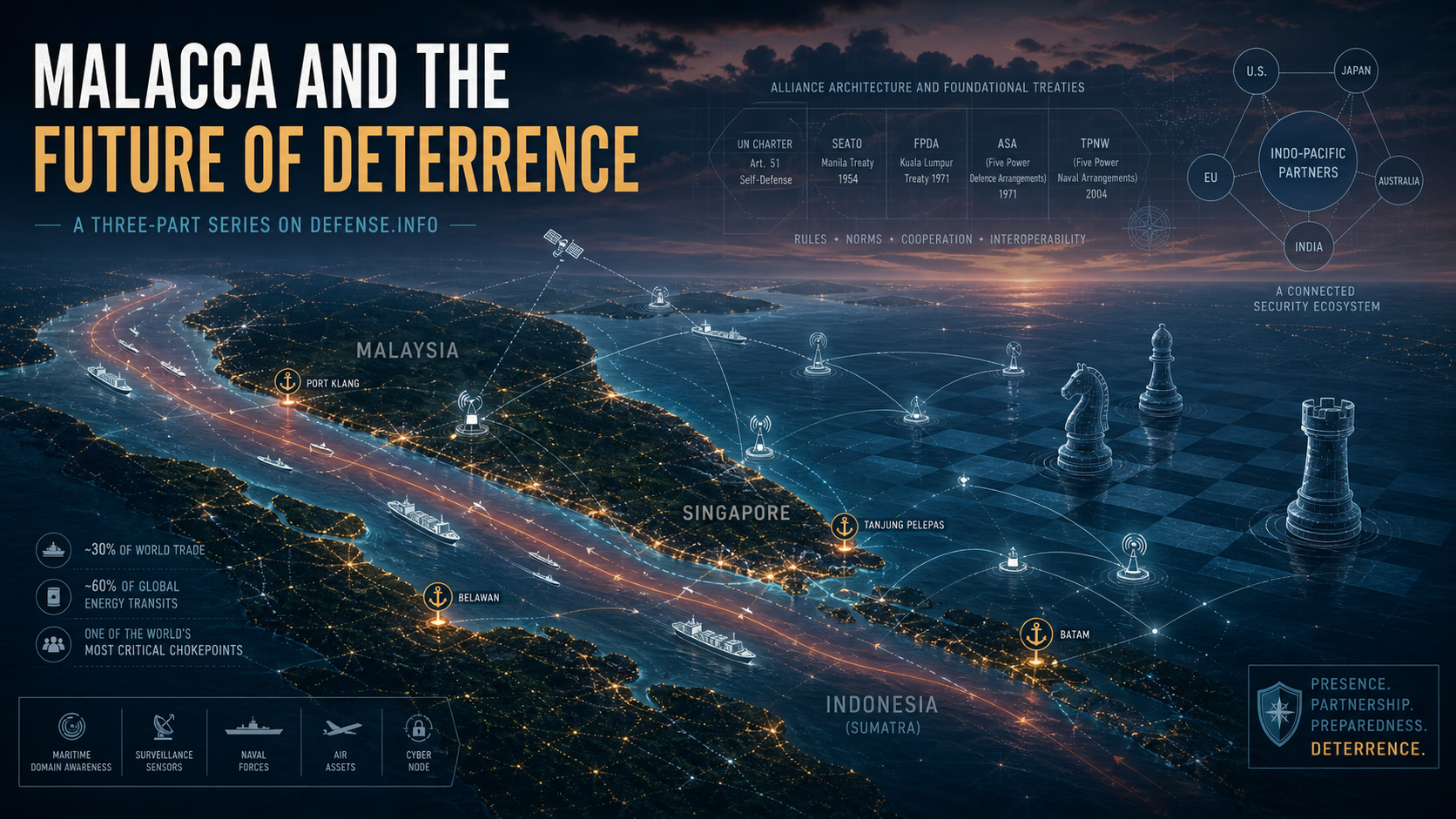
The emerging U.S. posture at the Strait of Malacca represents more than incremental security cooperation or a tactical ISR upgrade. When examined through the lens of lessons learned from the drone wars, the MDCP and its supporting initiatives reveal the skeletal outline of three overlapping webs, security, deterrence, and kill webs, that could transform how maritime power operates at the world’s most critical chokepoint.
The Three-Web Framework
Secretary Hegseth’s earlier proposal at the November 2025 ASEAN Defense Ministers Meeting for a shared maritime domain awareness system leveraging unmanned aerial and undersea drones foreshadowed what is now taking operational form at Malacca. The genius of this architecture lies not in choosing between security, deterrence, or warfighting missions, but in recognizing that the same mesh infrastructure, the same persistent ISR blanket, the same distributed autonomous platforms, the same networked command nodes, can serve all three functions depending on authorities, payloads, and rules of engagement.
Security webs at Malacca would provide persistent intelligence, surveillance, and reconnaissance across the strait and alternative routes through Sunda and Lombok. The emphasis in the MDCP on “maritime, subsurface and autonomous systems” translates operationally into mesh fleets of unmanned surface vessels and underwater vehicles maintaining around-the-clock sensor grids over key sea lanes, approaches to ports, and strategic bottlenecks. In peacetime, this architecture supports counter-smuggling, anti-piracy, fisheries enforcement, and general maritime domain awareness—legitimate constabulary missions that Indonesia and regional partners can embrace without compromising non-aligned identity.
Deterrence webs leverage the same infrastructure to expose and impose friction on coercive behavior. The omnipresent witness capability, networked autonomous systems documenting unsafe maneuvers, tracking unusual shipping patterns, and generating time-stamped, geolocated records, removes the ambiguity that gray-zone operations require. When Chinese vessels operate in contested waters near Malacca, persistent documentary evidence from distributed sensors creates political costs and alliance consultation triggers that shift the calculus of coercion. The transparency function becomes strategic leverage: adversaries conducting maritime pressure campaigns face not sporadic observation but continuous monitoring from multiple nodes that cannot all be jammed or spoofed simultaneously.
Kill webs integrate sensors and effectors into reconnaissance-strike complexes capable of generating theater-wide effects. While the current MDCP framework stops deliberately short of explicit coercion or interdiction commitments, the operational enablers being built, blanket overflight rights, expeditionary sea bases like USS Miguel Keith, subsurface sensors, and autonomous tracking systems, provide future options for selective monitoring, inspection regimes, or coordinated interdiction should crisis escalate. The distributed nature of these capabilities creates targeting dilemmas for adversaries: when sensors, shooters, and command nodes are spread across Indonesian waters, the Malaccan approaches, and the wider Marianas network, adversaries cannot defeat the system by neutralizing one node or one capability.
Operational Integration and Coalition Resilience
What distinguishes Malacca from traditional chokepoint control concepts is the coalition architecture embedded in its design. Indonesia is not simply a host nation but a structurally indispensable partner whose geography, political choices, and operational capacity determine whether security, deterrence, or kill webs can function at all. This creates mutual dependencies that the three-web framework accommodates: Jakarta maintains sovereign control over what matters most politically, no permanent bases, no formal alliance obligations, no explicit blockade participation—while participants gains access to the distributed nodes, airspace corridors, and maritime cooperation that make mesh operations feasible.
The software-defined nature of modern autonomous systems enables this coalition massing without forcing political integration. Indonesian Coast Guard vessels, U.S. P-8 maritime patrol aircraft, allied submarines, and commercial shipping monitors can all contribute nodes to shared security webs, feeding contact data into common operational pictures while maintaining distinct national authorities and rules of engagement. When graduated crisis escalates from routine monitoring to heightened alert or selective interdiction, the same physical infrastructure shifts functions through changes in tasking, payload configuration, and command authorities—not through wholesale redeployment of forces.
From Chokepoint to Chaos Management
The Trump administration’s Malacca posture reflects a recognition that contemporary maritime competition is not a sequence of discrete crises but a condition of persistent turbulence, Chinese economic coercion, hybrid gray-zone tactics, proliferation of autonomous systems, and blurring of commercial and military shipping. Traditional crisis management seeks to restore stable normalcy. The three-web architecture accepts that no such baseline exists and instead builds capacity for chaos management or the ability to operate effectively within persistent complexity rather than fighting against it.
Mesh fleets are ideal for such environments precisely because they can be rapidly reprogrammed, their mission sets can evolve through software updates, and they can operate in coordinated networks that adapt to local conditions. A Malacca security web focused today on illegal fishing and smuggling can shift tomorrow to deterrence functions documenting Chinese maritime militia activity, and the day after contribute to distributed anti-surface warfare—all without fundamental platform reconfiguration.
What is clear is that operationally, the chessboard has changed. The moves now being made, ISR platforms overhead, expeditionary bases quietly transiting, autonomous systems knitting together a distributed sensor picture, and Indonesian partnership deepening across maritime, subsurface, and airspace domains, are building the three interactive webs that will shape options available to Washington, Beijing, Jakarta, and the littoral states for years to come.
The question is no longer whether Malacca matters strategically, but whether the web architecture now taking form can balance leverage with stability in an environment where both are essential and neither is guaranteed.
Note: For a discussion of the mesh fleet and the web concepts, see the following: