
Commercial Space and Sovereign Capability: Optus Satellite and the Fight Tonight Imperative

The Sir Richard Williams Foundation seminar “Fight Tonight: Exploiting Australia’s Strategic Advantage” brought together practitioners and analysts focused on what it actually takes to field capable, integrated defense forces in the Indo-Pacific today.
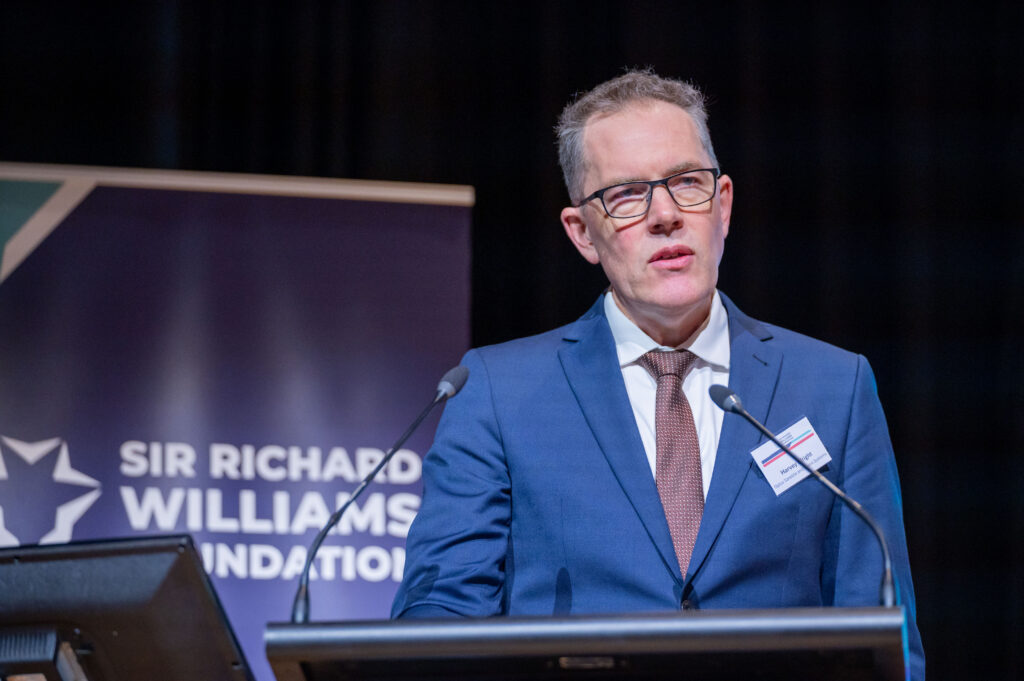
Harvey Wright, Executive General Manager of Optus Satellite and Space, addressed a question that sits at the intersection of every serious defense modernization discussion: how does a sovereign nation leverage the extraordinary dynamism of the commercial space sector without surrendering strategic control to non-sovereign actors?
His answer was neither ideological nor bureaucratic. It was operational.
Wright comes to this question with a practitioner’s eye. Optus Satellite has been providing satellite design, build, and operate services to the Australian Defence Force for more than two decades. That heritage matters.
It means his framework for thinking through the commercial-sovereign tension is grounded in the realities of fielding capability, not simply theorizing about it. And the challenge he described is not a future problem. Iit is a present one, intensifying by the quarter.
The Cost Collapse and Its Consequences
Wright opened with a set of data points that deserve serious attention from anyone thinking about the future operating environment. The cost of placing payloads in orbit has undergone a structural transformation.
When Optus launched its first satellite aboard the Space Shuttle Discovery, the cost ran between seventy and ninety thousand US dollars per kilogram. By the 1990s, that had dropped to approximately ten thousand dollars per kilogram. Then SpaceX entered the market. Falcon 9 and Falcon Heavy have brought costs to around twelve hundred dollars per kilogram today. When Starship reaches full operational tempo, current estimates put the figure at two hundred dollars per kilogram, roughly the cost of a FedEx Express parcel to the United States.
This is not incremental improvement. It is a paradigm shift, and its strategic implications are only beginning to be absorbed.
But Wright was careful to note something that tends to get lost in the headline numbers: the cost reduction has accrued primarily to SpaceX itself. The cost to operators like Optus has not fallen at the same rate. What SpaceX has done is create a massive strategic advantage that it is now exploiting at scale, pushing enormous volumes of capability into orbit in a way that no traditional commercial operator can match through organic investment.
The consequence is visible in the orbital capacity numbers. Between 2000 and 2015, growth in satellite communications capacity was driven largely by improvements in individual satellite quality, high-throughput designs that could carry more traffic per platform. The volume of satellites remained relatively flat.
Over the last five years, the dynamic has inverted. Volume has exploded, driven by low Earth orbit constellations, while per-satellite capability continues to improve simultaneously.
The result has been a roughly tenfold increase in total in-orbit satcom capacity. With SpaceX aiming to push individual satellite capacity toward terabits per second, that trajectory is not flattening. And Wright was careful to note that satcom is only one dimension, Earth observation, optical communications, and data processing in space are all following similar acceleration curves.
The Structural Shift: From Government-Owned to Hybrid
The investment data tells a parallel story. Private venture capital flowing into space has increased dramatically in recent years, reflecting market recognition that the innovation cycle in this domain now rewards commercial speed and risk tolerance in ways that government procurement processes cannot easily match. In 2015, roughly half of all satellites in orbit were non-commercial—government and defense platforms.
Today, ninety percent of satellites in space are commercial assets. This is not a marginal shift. It represents a fundamental restructuring of who controls the infrastructure upon which modern defense and national security capabilities increasingly depend.
This restructuring carries both opportunity and risk. The opportunity is straightforward: the pace of innovation, the scale of investment, and the efficiency of commercial operators are now so far ahead of what individual nations or companies can replicate internally that attempting to stay purely sovereign is economically irrational.
Wright put it plainly: that train has well and truly left the station. The question is not whether to engage with commercial space capability. It is how to do so without creating unacceptable strategic vulnerabilities.
The risk dimension is equally concrete, and Wright illustrated it with three examples drawn from just the preceding weeks.
• In March 2026, a commercial satellite ground station in Israel was struck by a Hezbollah attack, a direct demonstration that space-enabled infrastructure is now treated as a legitimate military target. The logic is straightforward: if it is critical infrastructure, it is a target.
• In April, the U.S. government restricted commercial satellite imagery providers from making high-resolution, near-real-time imagery freely available, because the data had become too capable and too accessible to be treated as a purely commercial product.
• And SpaceX itself had already moved to restrict resale of Starlink terminals over concerns about end users in sanctioned entities using the terminals for military purposes.
Commercial providers, in other words, are not neutral actors. They make sovereign-like decisions with strategic consequences, and those decisions do not always align with the interests of allied nations dependent on their services.
Three Imperatives for the Path Forward
Wright’s framework for navigating this environment is built around three imperatives that he argued must check and balance any strategy of leveraging commercial scale.
The first is sovereign control at critical points in the value chain. Not everything needs to be sovereign, that position is neither economically viable nor strategically necessary. But specific assets and, crucially, ground infrastructure must be anchored in national hands. As satellite numbers grow and data volumes from space become exponential, ground stations are emerging as strategic chokepoints. Control of that ground layer is, in Wright’s framing, the decisive terrain.
For Optus, this translates directly into investment strategy. The company has recently expanded its Burroughs facility to support up to twenty GEO satellites and concurrent LEO operations, available for both commercial and defense purposes. More broadly, Wright articulated a vision for a scalable, flexible ground station-as-a-service platform that could extend sovereign Australian capability across the Indo-Pacific. The geographic position is an asset. The trained Australian workforce, accumulated over four decades of operations, is equally so. The home team advantage, in this context, is not rhetorical. It is operational.
The second imperative is speed of capability delivery. Multi-year development cycles, Wright argued, are no longer viable in an environment where technology becomes obsolete in months, not years. The disruptors, SpaceX foremost among them, have demonstrated iterative development at a pace that traditional defense procurement cannot match.
The answer is not to abandon rigor, but to reframe what rigor means. Iterative, collaborative development that prioritizes speed and optionality over perfection is the emerging model. Blended workforce arrangements that pool resources and allow rapid scaling are part of the practical implementation. Wright pointed to recent track record in delivering on time, to specification, and within budget through defense partnerships as evidence that this approach is executable, not merely aspirational.
The third imperative is targeted but asymmetric investment in key technologies, developed in partnership with Australian industry and research institutions.
Wright highlighted several active programs. Project Swift, in collaboration with the Defence Science and Technology Group, is developing non-Earth imaging and laser optical communications capabilities with a potential expansion into quantum encryption. Sky Ops is developing an integrated, technology-agnostic platform for end-to-end management of multi-orbit SATCOM operations, a system designed to plug into LEO, MEO, and GEO constellations with equal facility. And most recently, Optus completed the in-orbit servicing of its D3 satellite through a docking maneuver with a Northrop Grumman Mission Extension Vehicle, a rendezvous and proximity operations demonstration that Wright described as generating critical insight into capabilities with broad future applications.
The Kill Web Logic Applied to Space
What Wright described, in effect, is the logic of distributed resilience applied to the space domain. The kill chain conception of space capability, a linear set of sovereign assets providing specific functions in sequence, is inadequate to an environment in which commercial satellites now constitute ninety percent of the orbital layer, commercial ground infrastructure is a legitimate target, and the pace of technological change makes any static architecture obsolete before it is fully fielded.
The alternative is an architecture that deliberately combines sovereign control at critical nodes with commercial scale in the broader network, managed through integrated platforms that can operate across orbital regimes and ownership structures simultaneously.
This is not a theoretical framework. It is what Optus is building, and the timing is not coincidental. The seminar’s theme, Fight Tonight, reflects an understanding that capability that cannot be employed immediately is not capability at all. Wright’s contribution to that discussion was a clear-eyed account of where the leverage points actually are in the commercial-sovereign space equation, and what Australia needs to hold if it is to maintain genuine strategic control over the infrastructure upon which its defense posture increasingly depends.
The ground layer matters. The workforce matters. The partnerships with defense and academia that produce asymmetric technological advantages matter. And the willingness to move at commercial speed not procurement speed matters most of all.