A Bridge Between History and Transformation: Reviewing The United States Marines: A History (Fifth Edition)
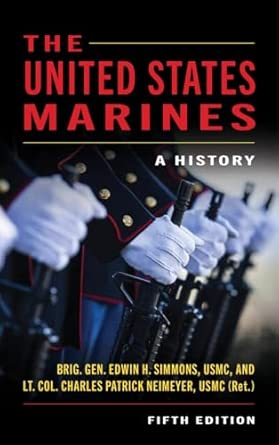
The fifth edition of The United States Marines: A History by Edwin Howard Simmons and Lt. Col. Charles Patrick Neimeyer stands as the definitive single-volume chronicle of America’s amphibious force-in-readiness. Spanning from the Continental Marines of 1775 through modern conflicts, this Naval Institute Press publication demonstrates why certain military histories endure, comprehensive scope, narrative clarity, and institutional insight that respects both the Corps’ fighting traditions and its capacity for adaptation.
The Enduring Value of Institutional Memory
Simmons and Neimeyer excel at what military historians do best: connecting operational detail to strategic context. Their treatment of the amphibious warfare revolution during the interwar period remains unmatched, showing how the Fleet Landing Exercises transformed abstract concepts into operational doctrine. The Pacific island campaigns receive the detailed analysis they deserve, while Korea, Vietnam, and post-9/11 operations are covered with appropriate nuance. The fifth edition’s expanded chapters on Iraq and Afghanistan operations provide essential grounding for understanding how the modern Marine Corps evolved through sustained counterinsurgency and combined arms operations.
For readers seeking to understand the Marine Corps as an institution, its culture, its doctrinal evolution, its role within joint operations, this volume delivers authoritative analysis. The authors avoid hagiography while respecting the Corps’ genuine operational achievements, a balance difficult to maintain in military history.
The Gap Between History and Transformation
Yet even the most comprehensive history faces a challenge: it captures what was, not necessarily what is becoming. The fifth edition, published in late 2025, necessarily predates the operational insights emerging from the Corps’ most consequential transformation since amphibious warfare doctrine itself, the shift from crisis management force to what might better be termed an impact force optimized for chaos management conditions.
Steel Knight 2025, conducted by I Marine Expeditionary Force in December 2025, represented the first full-scale dress rehearsal of Marine Corps operations under the assumptions driving Force Design 2030. This wasn’t another readiness exercise with scripted phases and permissive force closure. It tested whether distributed Marines, operating within adversary weapons engagement zones from the opening moments, could generate disproportionate effects not through organic firepower but by enabling joint kill webs. functioning essentially as forward JTACs at scale for Navy, Air Force, and allied strike platforms.
The operational logic tested at Steel Knight, hub-spoke-node architectures, timestamp concepts for survivable positioning, F-35s as airborne sensors rather than strikers, MQ-9s providing persistent ISR integration, digital interoperability connecting shooters across services, represents doctrinal innovation as significant as the amphibious warfare revolution Simmons and Neimeyer chronicle so effectively. But this transformation is happening now, driven by what the Marine Corps calls a Campaign of Learning: iterative experimentation, war-gaming, and adaptation based on evidence rather than predetermined concepts.
From Crisis Response to Chaos Management
The distinction matters strategically. For decades, the Marine Corps organized around crisis management, forward positioning, rapid response, discrete contingencies with identifiable beginnings and endings. Embassy reinforcements, noncombatant evacuations, humanitarian assistance operations all reflected this logic. The force Simmons and Neimeyer describe evolved to excel at these missions.
Today’s competitive environment operates differently. Adversaries compete continuously below traditional conflict thresholds. The boundary between peace and war erodes. Ubiquitous sensors and long-range precision strike compress decision timelines. In this environment, waiting for crises to crystallize before responding invites strategic surprise. The emerging Marine Corps must shape the competitive environment continuously, not just respond episodically.
This evolution, visible in the October 2025 Force Design Update, the 2026 Marine Aviation Plan, and exercises like Steel Knight, reflects what Brigadier General Christopher Haar articulated clearly: “The original concept was all about killing ships for the stand-in force. Through the Campaign of Learning, we realized we’re better as the JTAC for the joint force—using our sensors, using our eyes, killing occasionally, but using our time and capabilities to enable the rest of the joint force.”
That represents impact force logic. Success isn’t measured by organic lethality but by how much joint force effectiveness you enable. A Marine element that discovers, characterizes, and tracks ten targets for Navy destroyers or Air Force bombers generates more operational impact than successfully employing its own weapons against two targets.
The Aviation Transformation Dimension
Nowhere is this transformation more visible than in Marine aviation’s reconceptualization as connective tissue for distributed operations. The 2026 Marine Aviation Plan doesn’t simply list platform modernization. It codifies Digital Aviation Operations (DAO) as doctrine, elevates Aviation Ground Support to a seventh functional capability, and reframes platforms like the F-35, MQ-9, MV-22, CH-53K, and H-1 helicopters as networked nodes in kill webs rather than isolated shooters.
The H-1 helicopters’ digital revolution particularly illustrates this shift. Units like HMLA-267 are pioneering distributed aviation operations where relatively modest platforms become airborne command-and-control nodes, feeding targeting data across services and enabling fires far beyond their own weapons range. This isn’t incremental improvement, it’s fundamental reconceptualization of what rotary-wing aviation contributes to modern warfare.
History as Prologue
The United States Marines: A History provides the essential foundation for understanding why the current transformation matters and what institutional strengths the Corps brings to this challenge. The interwar amphibious warfare innovators faced similar skepticism. They too confronted critics who argued the Corps was abandoning proven capabilities for untested concepts. They too worked through a campaign of learning, the Fleet Landing Exercises, that iteratively refined doctrine based on operational friction rather than abstract theory.
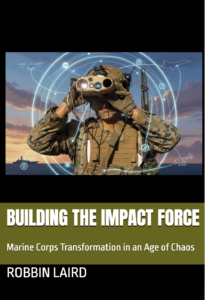
My forthcoming book, Building the Impact Force: Marine Corps Transformation in an Age of Chaos, picks up where traditional histories necessarily leave off, examining what’s emerging in real time through field research during Steel Knight 2025 and extensive engagement with the Marines wrestling with these problems operationally. It analyzes how kill web integration through digital interoperability, force design adjustments based on evidence, and the cultural transformation required for mission command under chaos conditions will determine whether the impact force becomes decisive reality rather than compelling concept.
The verdict isn’t final. Capability gaps remain, insufficient platforms, logistics challenges under contested conditions, digital vulnerabilities that create new risks even as they enable new capabilities. Critics raise legitimate concerns about over-specialization, industrial base constraints, and whether transformation cut too deeply into conventional capacity. But standing still was never viable. The competitive environment changed. Adversary capabilities evolved. Assuming the Marine Corps of 2020 could succeed in 2030 was more dangerous than attempting transformation with uncertain outcomes.
Recommendation
Read Simmons and Neimeyer to understand the Marine Corps that was and the institutional DNA it carries forward. But recognize that the most consequential chapter in Marine Corps history since amphibious warfare doctrine is being written now, not in staff papers or PowerPoint decks, but in exercises like Steel Knight 2025 where operational friction meets strategic ambition. The gap between these perspectives isn’t a weakness in either. It’s simply recognition that history and transformation operate on different timelines.
The Marine Corps deserves analysis that respects both its past achievements and its current challenges. The United States Marines: A History delivers the former superbly. Understanding the latter requires grappling with the impact force as it emerges, fragile in places, contested in others, but undeniably real in its operational implications for how America’s expeditionary force-in-readiness will fight in an era defined by chaos rather than crisis.