
Air Marshal Stephen Chappell and the RAAF: Building Fighting Depth for Australia’s Integrated Force

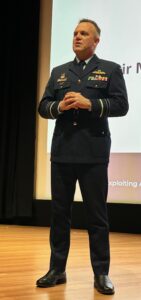
At the Sir Richard Williams Foundation seminar “Fight Tonight: Exploiting Australia’s Strategic Advantage,” Air Marshal Stephen Chappell, Chief of Air Force, delivered what was in many ways a master class in how a senior military leader thinks through the challenge of shaping a credible deterrent force in a period of sharpening strategic competition.
His remarks were notable not for their novelty — much of what he covered is familiar to those who follow Australian defence closely — but for the clarity with which he connected the threads: geography, human capability, technical investment, national potential, and allied integration. He was, in effect, articulating a coherent framework for what he called “building fighting depth,” and it is a framework that deserves careful attention.
The seminar’s theme, exploiting Australia’s strategic advantage, was Chappell’s organizing principle throughout. He structured his remarks around a series of interlocking questions.
• What does Australia’s geography actually mean for air power employment?
• What does the quality of Australian airmen contribute to the integrated force?
• What technical capabilities need to be sustained and grown?
• And how does the aviation potential of the nation as a whole, not just the Royal Australian Air Force, become a genuine strategic resource?
Let me work through each of these dimensions, because they collectively define the direction Chappell is driving the Air Force.
On geography, Chappell offered a provocative reframe. Australia is conventionally understood as either an island or a continent, a geographic fact that shapes strategic thinking in familiar ways. But Chappell drew attention to a recent article by Andrew Carr in the Australian Journal of International Affairs that approaches Australia differently: as an archipelago. If you look at where the population centres are, where the internal lines of communication run, and how aviation connects the nation’s people and places daily, an archipelagic understanding of Australia opens different strategic apertures than the island-continent frame. For defence planners, this reframe is not trivial. An archipelago is defended differently. It implies the need for disaggregation, dispersal, and distributed operations precisely the direction Chappell outlined for the RAAF’s future posture.∗
The Indo-Pacific context reinforces this urgency. Chappell reminded his audience of the region’s staggering scale: 14,000 kilometres east-west from Pakistan to Tonga, 20,000 kilometres north-south from the Arctic Circle to the Antarctic. The sea lines of communication running through this space through the Malacca Strait, past the molecular straits now back in the news carry over 30 percent of global trade. Air power, he argued, has a critical role to play alongside the other four domains in ensuring freedom of navigation and access in this maritime environment.
The lessons of the Battle of the Atlantic are not distant history here. The areas most vulnerable to German submarine warfare in the early 1940s were those beyond the reach of allied air power. The lesson translates directly: where air power cannot reach in the Indo-Pacific, adversaries will probe.
On current conflicts, Chappell was measured but direct. Ukraine demonstrates what happens when neither side can achieve sufficient air control , attritional tragedy at a scale not seen in nearly a century. The drones have changed much, particularly for ground forces, but they have not resolved the fundamental problem of air superiority. The Middle East, by contrast, has shown what tier-one air forces can actually deliver both to national authorities and to joint and integrated forces.
Chappell’s observation is worth underlining: tier-one air forces are relatively expensive to build and sustain, but they are vastly cheaper than the alternative, which is a tier-two air force that cannot set the conditions for success on the surface of the earth where the outcome is ultimately decided.
This brings us to the human dimension, which Chappell treated as perhaps the most important of Australia’s strategic advantages. The RAAF is, in his assessment, a tier-one force and he provided concrete evidence rather than assertion. About a month before the seminar, Australia deployed an E-7A Wedgetail to the Middle East on short notice, into an active two-way range. When the C-17 arrived behind it and the crew cracked the door, the first thing they heard was air raid sirens. On multiple subsequent occasions, crews preparing to taxi and launch missions had to take cover when sirens sounded, then returned to their aircraft and generated air power as soon as the all-clear came. You cannot train for those specific circumstances, Chappell noted. But if the human foundations — character, judgment, professional mastery — are right, then remarkable things become possible.
The Air Warfare Instructors Course, Australia’s weapons school, is one mechanism for building and sustaining that human edge. Running every two years since 1954 born from lessons of the Korean War under Dickie Cresswell, it generates among the finest aviators in the world. Chappell cited the Air Mobility graduate who captained the C-130J into Tel Aviv last year, timing his approach to land and assist over a hundred Australians and New Zealanders to safety between ballistic missile barrages. The joint simulation environment at Nellis Air Force Base, where RAAF fighter crews hold their own with the best in the world, is another data point. These are not aspirational claims. They are validated performance in conditions that matter.
The technical dimension received careful treatment as well. The NDS 2026 and the Integrated Investment Program frame the resource allocation challenge honestly: all five domains need to be lifted simultaneously, which means trade-offs are real and the pace of investment cannot always match ambition.
Within those constraints, Chappell was clear about priorities. The F-35A and Super Hornet and Growler fleets will remain at the leading edge of combat capability. The E-7A replacement will go to government within the next year or so. The MQ-4C Triton has expanded its main operating base to Edinburgh. The MQ-28 Ghost Bat — the first Australian-built combat aircraft in fifty years — achieved a milestone in nine months that Chappell described with evident pride: the team successfully fired an AMRAAM and shot down a target, validating the platform as a genuine combat system. The MC-55A Peregrine, with two now in country and a third arriving, rounds out a tier-one technical inventory that matches the tier-one human capability.
But the most distinctive element of Chappell’s vision is his concept of the National Air Power Council and what he calls Australia as an aviation nation. There are roughly 2,200 airfields across Australia, but only about 20 air bases. There are approximately 20,000 uniformed aviators, but 50,000 Australians engaged in aviation as a whole.
That broader national aviation potential, dispersed, largely unrealized in defence terms, and deeply embedded in the fabric of a continental nation that depends on aviation to connect its people, represents a latent strategic resource. The National Air Power Council, co-chaired by Chappell and his counterpart in the transport department, is designed to begin bringing that resource into coherent national use, drawing together public and private sector aviation leaders to optimize capability, build capacity, and enhance resilience as the strategic environment continues to deteriorate.
Exercise Camel Train offers a concrete illustration of this thinking. Working with the Jabiru 400, a general aviation light aircraft equipped with optics to enable autonomous collision avoidance, the RAAF is exploring how to turn civilian aviation platforms into aerial logistics and resupply vehicles without human crews. The first flight of the Jabiru without a safety pilot aboard is expected in the coming months.
The concept is straightforward but strategically significant: 50,000 civilian aviators and a large general aviation fleet represent enormous unrealized capacity. Camel Train is a pathway to converting that capacity into additional national air power effects, at scale, without proportionate increases in human resource.
Chappell also addressed the survivability challenge that any serious deterrent posture requires confronting. The RAAF has trained for decades from the luxury of safe, established, coalition air bases. That assumption no longer holds.
Exercise Bronze Crocodile — conducted with U.S. and Canadian counterparts in the Townsville training ranges — is building the runway repair and airfield recovery capacity that austere and dispersed operations will require. Future exercises will go further: airfields will take simulated hits, portions will be declared off-limits by the white force, and repair squadrons will have to demonstrate they can restore operating surfaces under pressure and reopen dispersed bases for continued operations. Exercise Point Group Rising extends this logic, reconnecting the force with the foundational reality that air bases whether main operating bases or agile civilian strips are the core of the weapon system.
Allies and partners complete the picture. Exercise Pitch Black, run every two years with 20 nations, roughly 3,500 aviators, and over 130 fast jets, is perhaps the clearest demonstration of integrated capability that the RAAF can offer. That more than two thirds of participating nations do not speak English as a first language, yet come together to plan, brief, execute, and debrief complex tactical missions to a high standard, speaks to the depth of the relationships and the quality of the interoperability that has been built over decades.
What Chappell articulated at Canberra was not a set of disconnected programmes. It was a coherent strategic logic: a tier-one air force embedded within an integrated force, drawing on the full potential of an aviation nation, dispersed and resilient enough to absorb hits and keep fighting, connected to allies and partners who can multiply its effects.
The metaphor he returned to, autumn deepening toward winter — captures the urgency without the hysteria that sometimes distorts strategic discourse. Deterrence requires capability, credibility, and comprehension by the adversary. All three must be built and demonstrated, collectively and cumulatively, before deterrence can fail and winter arrives.
The RAAF under Chappell’s leadership is clearly working to build that deterrent depth. The question, as always, is whether the pace of investment and adaptation matches the pace of the strategic environment’s deterioration. That is ultimately a question for the political leadership. What the Chief of Air Force can do and what Chappell demonstrated at the Williams Foundation seminar is ensure that the force is thinking clearly about the problem, building the right capabilities in the right sequence, and leaving nothing of Australia’s genuine strategic advantages unrealized.
∗ Andrew Carr, “What is Australia’s strategic metageography? Island, continent or archipelago?”, Australian Journal of International Affairs, published online 9 February 2026.