
Rivets or welds? Today’s defense industrial base must relearn the hard-earned lessons of speed over quality
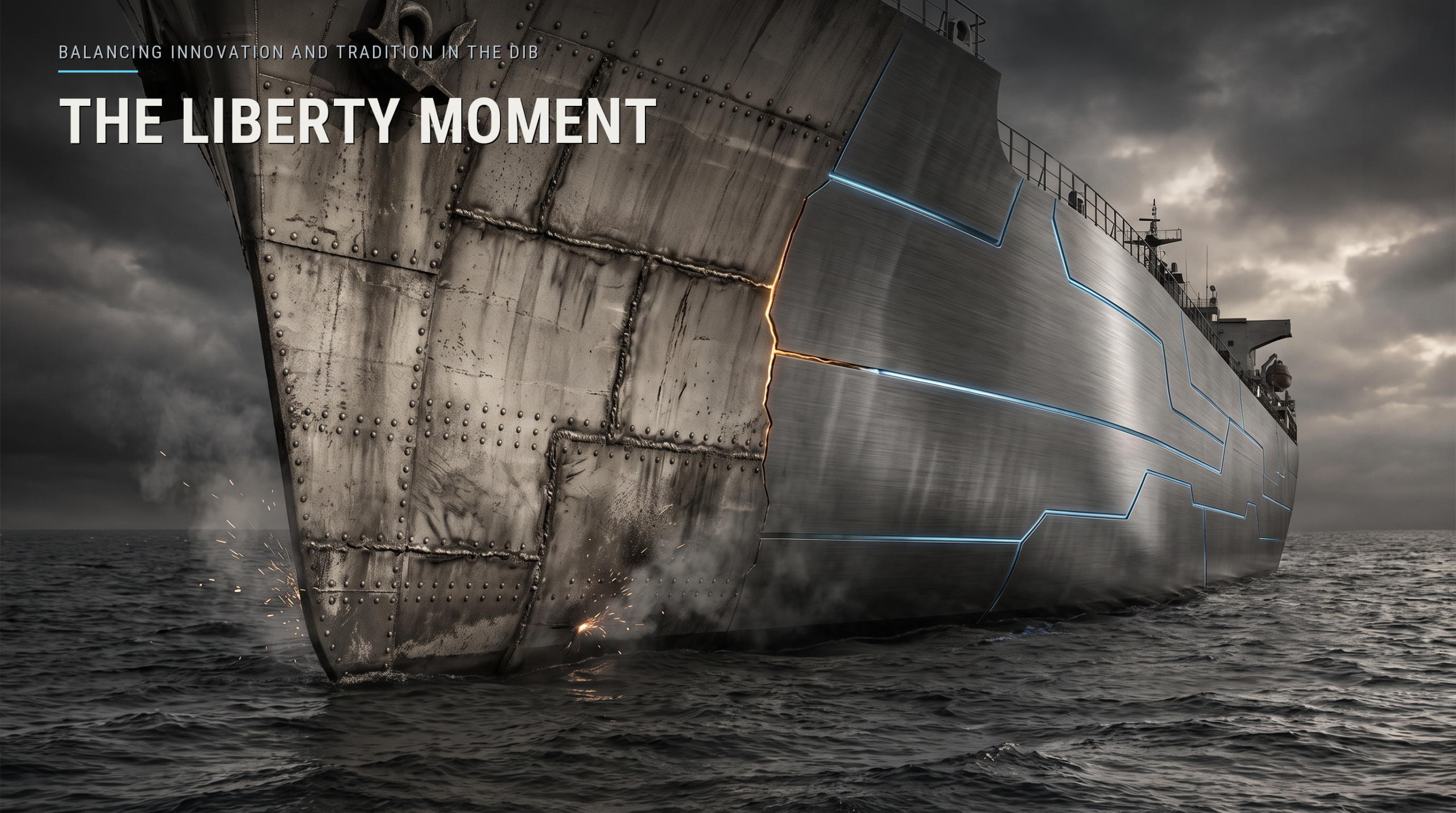
In November of 1943, the Liberty Ship SS John P. Gaines broke in two and sank, resulting in the loss of 10 of her crew. The board of investigation found that the grade of steel used in welded construction embrittled in the cold waters of the Aleutian Islands.
Today, the defense industrial base (DIB) is facing a Liberty-like moment: immense demand for volume and speed, innovation from founders outside of the traditional industrial base, and existential global threats, where getting things wrong has dire consequences. The industrial base would do well to take a moment to look back at history’s lessons to balance the speed the moment requires with the well-established foundations of testing and quality.
The lessons
The Liberty Ship was a class of cargo ship used in World War II that was simple, slow, and unglamorous – and critical in moving people and supplies for the war. Demand wasn’t the issue – the time it took to make one was. Historically, it took an average of 355 days to build one ship.
Henry Kaiser was a teenage dropout who made his name in government paving contracts. He brought his Henry-Ford style mass-production logic to the Liberty ship. His plan? Replace rivets with welds. Welding was better suited to mass production and required less skilled labor. His showpiece vessel, the SS Robert E. Peary, took just over seven days to complete.
The war demanded speed and Kaiser delivered. Putting ships in the water wasn’t the problem, keeping them afloat was – often overloaded and in harsh conditions. Unfortunately, of the 2700 Liberty Ships produced, there were 1500 instances of significant brittle weld fractures, with twelve ships breaking in half without warning.
History’s rhyme
While the West isn’t technically in a “World War” today, the demand for speed and volume mirrors the conditions of 1943. Conflict in the Middle East, the war in Ukraine, and looming threats across the globe have spurred nations to invoke a need to be on a “wartime footing,” in the wake of decades-long outsourcing of industrial manufacturing.
The war in Ukraine outstripped NATO’s peacetime production capacity for 155mm artillery shells within months. In 12 days of war in June of 2025 between the US and Israel versus Iran, the US reportedly fired 28% of all THAAD interceptors ever delivered.
In 2025, US Secretary of War Pete Hegseth said it explicitly, “This is a 1939 moment or hopefully a 1981 moment,” and later in testimony to the U.S. Congress, “We’ve sent an unambiguous demand signal to industry partners to build more and build faster.” EU Defense Commissioner Andrius Kubilius has echoed these sentiments, “We cannot afford to slow it down… we are asking industry to speed up.”
History is rhyming, so how should the defense industrial base embrace speed and innovation without repeating past mistakes?
The pitfalls of innovation at speed
Tectonic estimates that from the first half of 2025 to 2026, private investment in defense tech has increased by 40% year over year. Across Silicon Valley Defense has become en vogue, but the Kaisers of today don’t come from the traditional defense prime ecosystem. Palmer Luckey of Anduril was best known for his VR headset, Dino Mavrookas of Saronic is a former Navy SEAL and spent time in private equity, and Chris Power of Hadrian has a background in e-commerce.
But defense hardware isn’t an app or a commercial VR gadget. Quality testing processes enshrined in defense manufacturing are lessons learned on the battlefield. Companies like Anduril are leveraging commercial practices to speed products to market, and are also institutionalizing testing as an accelerant. For example, it is employing field engineers embedded with their customers – often in harm’s way.
This way, lessons learned first-hand can be brought back to base for improvements, but still recent failures – such as mechanical issues with unmanned fighter jets and drones crashing and missing targets in combat – means that not every lesson can be caught early. Failure found in the field rather than on the practice range.
The OODA loop
In fact, the war in Ukraine has become the fastest real-world example of the Observe, Orient, Decide, and Act (OODA) loop for military technology in a generation.
From low-cost attritable drones to exquisite counter-drone munitions, this conflict has offered a preview of future warfare that has captured the industry’s imagination. Some commentators have said that “non-drone militaries are obsolete.” History is replete with nations not recognizing the evolving nature of warfare. It took the U.S. years to adapt to the impact of Improvised Explosive Devices on convoys in Iraq.
Industry is responding at pace. In July of 2026, the EU launched an industrial partnership with Ukraine focused almost exclusively on drones, disbursing a billion euros.
Over-indexing on one data point
In the U.S., Georgetown’s CSET tracked 283 separate investment deals in U.S. drone companies between 2010 and 2025 – with 77% of them going into small, cheap systems in demand in the war in Ukraine.
But let’s take a breath. Nobody is arguing that drones in Ukraine don’t work, against that adversary, and in that terrain they demonstrably do. But while these systems have undoubtedly bent the curve in Ukraine, they are not a panacea for broad defense investment. This type of drone wouldn’t make it past the ocean breakers in the Taiwan Strait.
Defense manufacturers would do well not to just focus on what’s happening in Ukraine. It is a real data point, but it isn’t the only ocean that the fleet will sail in.
Instead, the DIB should listen to the people who would have to do the fighting, not the VC hype. In July of 2026, Task Force 401, the Department of War’s lead body on drones, released a publication that explicitly states, “In sum, drones are not a magic weapon.”
The DIB must go back to first principles
The DIB is developing and building for the military and defense, and must not forget that this is in a different league from most of manufacturing. Trae Stephens, in a now famous article in War on the Rocks, pointed out, “In 2018, Under Secretary for Research and Engineering Mike Griffin noted that, on average, it takes the United States 16 years to deliver an idea to operational capability. Software, by contrast, is developed by shipping a minimum viable product out the door as quickly as possible and seeing where it fails.” As a former U.S. Army attack helicopter pilot, a “minimum viable product” is not a helicopter I would have climbed into.
Yes, there are benefits to the current move to “design to build.” While these ideas can undoubtedly improve the speed of manufacturing, the defense industry has to keep its customer in mind – the warfighter. There are ways to both improve speed while maintaining safety and performance.
The lessons the DIB must learn
The value of the digital thread. Today’s best industry-specific business systems are not just financial reconciliation software solutions. They are robust and enable a real digital thread – from engineering to production to lifecycle management. The DIB needs to invest in just such a system – one that is specific enough to handle the unique requirements in the defense industry – yet broad enough to cover the full lifecycle of the assets they make for Soldiers, Sailors, and Airmen.
Defense manufacturers should heed the lessons of the past and learn from the wars of the present, when nations demand speed over all else. First -Testing shoulder-to-shoulder with the end user is vital, especially as several companies have little defense experience. Manufacturers can go fast, but they must fail fast.
Second, learn the right lessons. Future wars are not today’s wars, and over-indexing on one capability or environment is a costly mistake.
Finally, don’t ever design to build in defense manufacturing. Manufacturers must design to operate. Doing so is fundamentally better, with robust data and technology simply unavailable in 1943.
As nations find themselves rearming in the modern threat environment, they are being handed the same choice, with a faster clock – we don’t need to wait until the ship splits in half.