
I Was Curious”: A Chemist, a Mussel, and the Navy’s Next Repair Problem

The Michelson Memorial Lecture Series at the U.S. Naval Academy is an annual scientific lecture series honoring Albert A. Michelson, Naval Academy Class of 1873 and the first American scientist to receive a Nobel Prize.
The Naval Academy, with well-deserved pride in scientific research, describes the intent of the annual lecture this way: each year, a distinguished scientist is invited to Annapolis to discuss important research and scientific developments. Speakers have represented fields including physics, chemistry, mathematics, oceanography, and computer science.

Photo USNA Nathon Burke
This year’s Michelson lecturer was Professor Jonathan Wilker of Purdue University, who spoke on “From the Beach to the Fleet: Biological and Biomimetic Adhesives”. His cutting-edge research explores how marine organisms inspire new technologies for naval and medical applications.
Midshipman Albert Michelson U.S. Naval Academy was class of 1873, served as a naval officer and Academy instructor, teaching physics and chemistry. While in the Navy, he was curious about optics and precision measurements, particularly measuring the speed of light, and he conducted some of his early important experiments while associated with the Navy.
His naval background gave him access to scientific equipment, disciplined experimental training, and opportunities to develop his precision measurement techniques, which he did on Yard of the US Naval Academy on the banks of the Severn River.
Now, after many generations of sea-service warriors trained at the Academy, a very inquisitive chemistry professor discussed his cutting-edge research on September 8, 2026, in the Mahan Auditorium.
Naval Academy Academic Dean and Provost Samara L. Firebaugh, Ph.D. noted in her introduction the powerful words of “relentless inquiry” which perfectly captures the academic excellence of the Academy.
In a pre-lecture discussion, I asked the Professor how he came to focus on the great strength of sea creatures, barnacles, mussels, and oysters, and their ability to stay in place. His answer was profoundly simple: I was curious.
Considering that shellfish have been holding tight against every challenge the ocean can bring since before the dinosaurs, his scientific curiosity can have profound effects for America’s fighting Navy and Marines.
Navy ships are well designed for combat, but a determined enemy can still land a punch.
Both the USS Stark (FFG-31), an Oliver Hazard Perry-class guided-missile frigate, and the USS Cole (DDG-67), a Burke-class guided-missile destroyer, took significant hits — the Stark struck by two air-launched Exocet missiles, the Cole by a suicide boat. As was said famously of the Cole, the crew saved the ship.
Serving as Principal Director for Mobilization Planning and Requirements under President Reagan, I saw that the issue of having enough dry docks for battle-damage repair in the event of a major war at sea was a problem and that problem still exists.
We published a book in 2013 which provided an insider’s look at the challenges facing American military leaders in building out relevant capabilities in the Pacific to defend America and its allies.

And one we highlighted was that ship repair measures don’t magically create industrial capacity. The Navy itself is now pursuing a fifth public shipyard, specifically because existing infrastructure isn’t sufficient for the future.
In a Pacific war, a very concerning scenario is multiple simultaneous battle-damaged ships. Suppose several carriers, cruisers, destroyers, and submarines require major structural repairs at the same time.
The Navy would likely have to:
- Do emergency stabilization and temporary repairs at forward bases.
- Keep moderately damaged ships operating with limited capability where possible.
- Send the most seriously damaged vessels to Guam, Hawaii, the U.S. West Coast, or other facilities.
- Use private/commercial yards for repairs that don’t require nuclear facilities.
- Potentially employ floating dry docks or other expeditionary repair arrangements.
Add into the combat mix the emerging offense-defense kill web drone warfare capabilities, and the issue of addressing battle-damage repair becomes even more significant and critical.
This is a comprehensive outline of the core focus areas and topics covered in Wilker’s lecture:
- Introduction to Marine Biology and Adhesion
- Naturally Occurring Adhesives: Examining how marine organisms such as mussels, oysters, and barnacles successfully adhere to surfaces in wet environments.
- The Challenge of Water: The chemical and physical difficulties of creating bonds that survive continuous water exposure.
- Biomimetic Engineering
- Translating Nature to the Lab: How researchers extract mechanical principles from marine biology to design synthetic, high-performance underwater glues.
- Material Science Innovations: The development of sustainable, strong biomimetic adhesive compounds.
- Naval and Operational Applications
- Underwater Ship Repair: Utilizing advanced adhesives to patch vessel hulls or equipment without drydocking.
- Leak Prevention and Mitigation: Real-time damage control strategies for maritime platforms.
- Corrosion Control: Applying sealants that prevent moisture from degrading structural hulls and military infrastructure.
Because of a brilliant chemistry professor’s curiosity, reaching back to the earliest days on earth to study underwater adhesives better than anything currently in existence, those who go down to the sea in ships to fight should wish him good fortune and all ahead flank. His very promising research deserves to be accelerated, with wartime-level funding behind it.
Postscript:
Pride and visionary accomplishment runs deep in the Navy diving community. This family photo shows Navy “hard hat” diver Vivian Haggood, grandfather of fellow Marine fighter pilot Bill Buckey preparing to dive over 100 years ago.
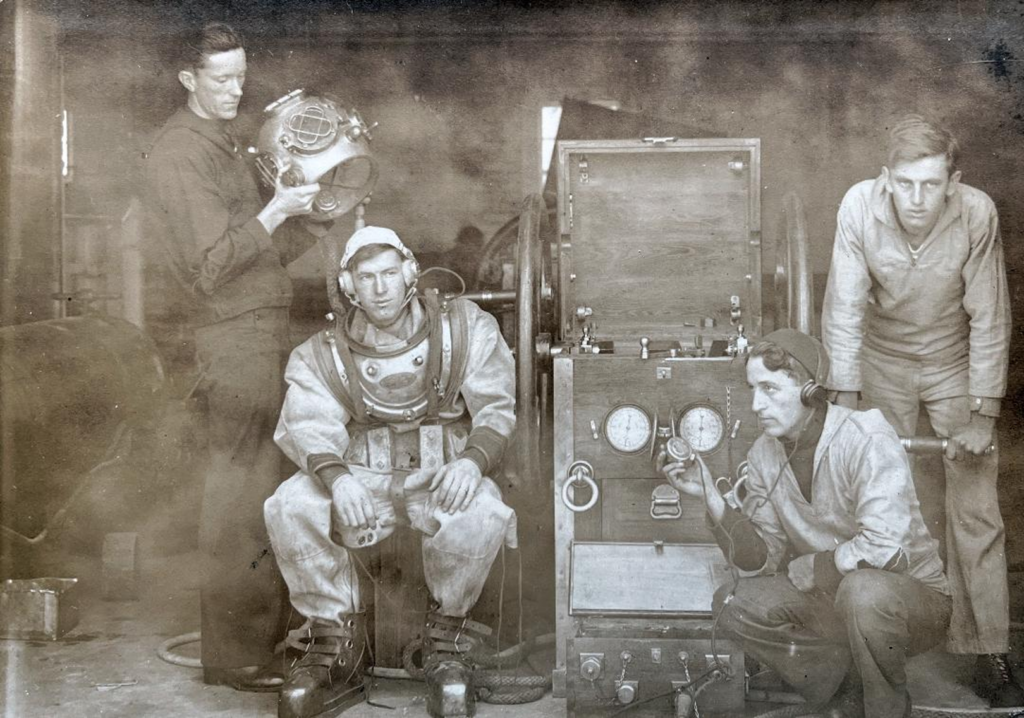
His underwater mission was to go into sunken German WWI submarines and exploit the technology found there. If nature produced “superglue,” underwater metal-on-metal adhesives developed from it may ease the demand for dry docks. Have no doubt Navy divers can handle that challenge.