
Obsidian Shield: How a Modular Pod Is Turning Legacy Aircraft into Kill Web Participants
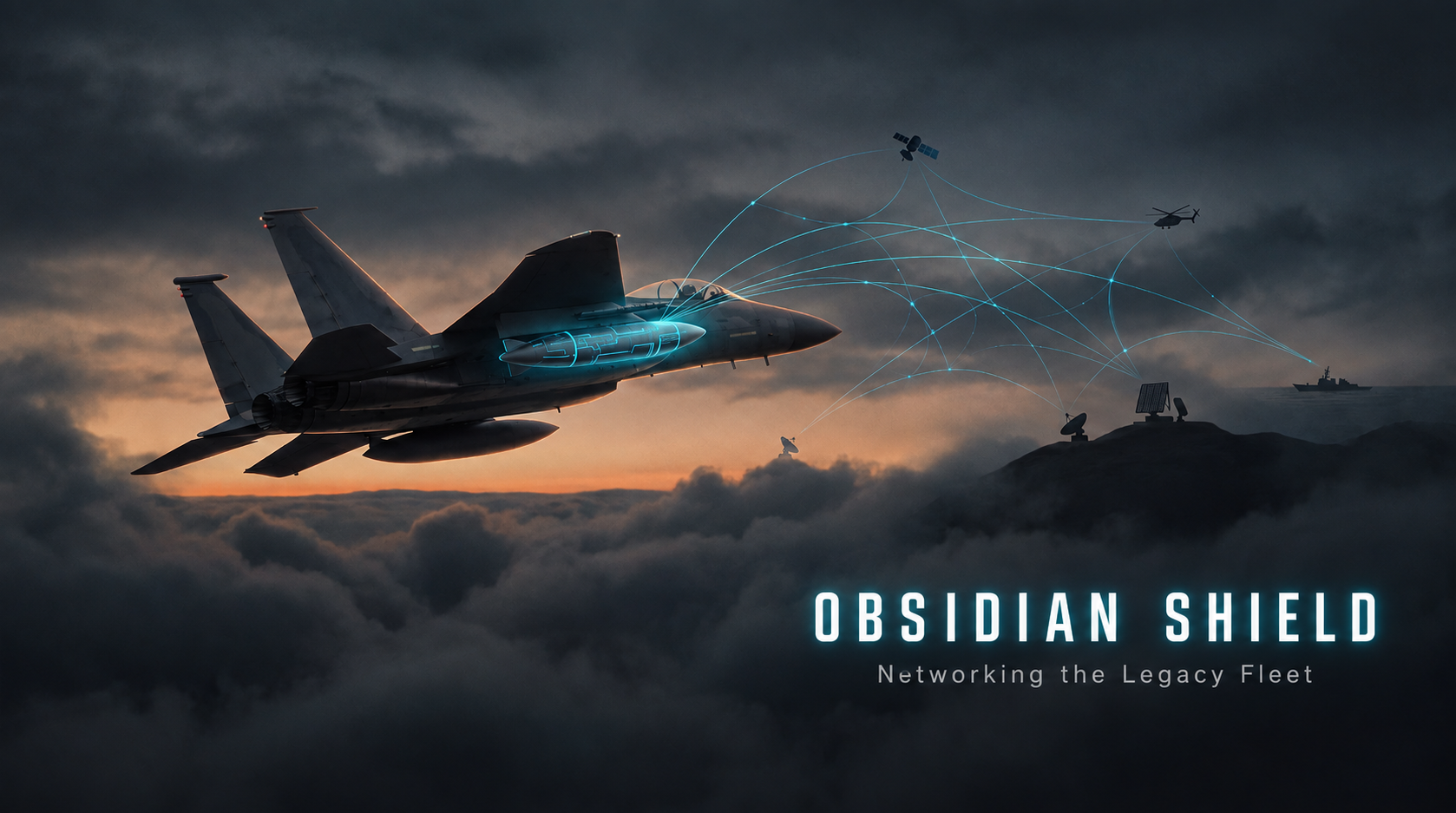
Every air force in the world has the same problem hiding in its hangars: a fleet of legacy fighters and helicopters that were built for a different war and that cannot talk to the coalition architectures now being assembled around them. The aircraft still fly. The airframes still have years of service life left in them. What they lack is a digital identity, a way to be seen, trusted, and tasked inside a modern air and missile defense network.
Mike Twyman, Chief Strategy Officer of Integrity Defense Solutions (IDS), has spent the past several years building solutions to exactly this class of problems. IDS is a service-disabled veteran-owned small business, and the program Twyman leads publicly announced as Obsidian Shield (assessed awardable by the Chief Digital Artificial Intelligence Office(CDAO)), is a pod-based system designed to bring legacy aircraft into the digital fold without the years-long, budget-busting avionics upgrades that have traditionally been required.
In a recent conversation, Twyman laid out the problem his company set out to solve, the architecture it built to solve it, and why he believes the approach amounts to more than a stopgap. It is, in his telling, a fundamentally different way of thinking about how partner air forces get integrated into a coalition fight.
The Interoperability Gap
Twyman framed the challenge as one that cuts across multiple combatant commands. “We’re partnering with new nations on a regular basis, and we need a way to integrate them into a common operating picture,” he said. That is not simply a matter of goodwill or diplomacy. It is an operational necessity. Coalition partners need to be positively identified inside an air and missile defense architecture, need to participate in the command-and-control system that ties shooters to sensors, and need to be able to do all of that quickly, affordably, and without exposing sensitive technology.
The traditional path to that kind of integration is aircraft modification, pulling a partner nation’s jets into a depot, rewiring avionics, requalifying software, and waiting years for the work to be certified. “Traditionally modifying aircraft takes a long time and it’s very expensive,” Twyman said, and that cost and timeline is itself a strategic problem, because it means the air forces most in need of rapid integration are the ones least able to get it.
IDS’s answer was to build what Twyman calls “a modular export tailorable solution” — Obsidian Shield — intended to deliver “a step change in coalition interoperability through an innovative integration approach.” The design goal was explicit: cut years off the traditional aircraft upgrade timeline while keeping the system affordable both to acquire and to sustain.
A Missile-Shaped Pod, Not an Airframe Rebuild
The central engineering choice behind Obsidian Shield is its form factor. “It’s a missile form factor pod,” Twyman explained. “We’re focused principally on the initial product on jet aircraft and helicopters, and so we’ve chosen a missile form factor for aerodynamic suitability and ease of mount and maintenance.” Because the pod occupies a standard hardpoint rather than requiring the aircraft to be opened up and rewired, it can be fitted to a jet or a rotorcraft without the invasive structural or wiring changes and certifications that normally drive years off an aircraft’s availability.
Twyman described the pod as designed “to mount to existing hardpoints and power interfaces,” with the added resilience of being able to “operate independent of aircraft power”, meaning that if the aircraft suffers combat damage or loses power, the pod can continue to function on its own batteries. Inside that missile-shaped housing sits what he called “the mission functionality needed to turn these legacy aircraft into fully networked, positively identified participants.”
That functionality is built around a modular open systems architecture, integrating a Link 16 capability, a Mode 5 IFF capability, position-navigation-and-timing systems, co-site mitigation, and other functions, all built to accommodate future capability upgrades.
Crucially, Twyman emphasized that the design keeps the sensitive parts of the system “isolated and severable” in modules that can be pulled out or tailored depending on which partner nation is receiving the system. “We like to call it a modular export tailorable system design,” he said, a phrase that captures the core business logic of the program: one architecture, tailored to what each partner is cleared to receive.
Twyman was careful to note that the internal architecture is built from off-the-shelf components rather than proprietary cards. “It’s really components… off-the-shelf boxes,” he said, which means that as new capabilities become available, they can be swapped into the pod without redesigning the whole system. Using “standard interfaces… mil standard and commercial standard interface strategies,” the pod is built to “plug and play different devices” over time which enables future-proofing the design against changing threats and changing partner requirements alike.
Competition as a Cost and Risk Strategy
One of the more striking details Twyman shared was how the modular, open architecture translated directly into cost savings. Because the subsystems inside the pod are not locked to a single vendor, IDS was able to run a genuine competition for each component. “Based on what he calls “a competitive open systems architecture”, costs are cut and contained, which is a deliberate alternative to the traditional model in which a single large prime controls every subsystem inside its own product.
That same modularity turned out to be a supply chain risk mitigator as well, not just a cost play. Twyman described a real example: “A couple of our key antennas, their lead time went from weeks to months, and then we were able to modify the design to use a different vendor’s antenna to meet our quick schedule… to put it back within weeks.” Because the architecture was never locked to a single supplier, the program could absorb a supply chain shock and still hold its delivery schedule, a capability Twyman described as central to how the system copes with the kind of subsystem availability problems that have plagued defense production broadly.
A Digital Foundation for AI-Enabled Command and Control
Beyond interoperability and cost, Twyman returned repeatedly to a broader argument: that Obsidian Shield is not simply a stopgap patch on old airframes, but a necessary precondition for the next phase of command and control. “Until you’re digitally integrated, you can’t really leverage AI,” he said. “Now you’ve got the digital foundation on which the AI can operate in the overall command and control architecture.”
He put the point even more sharply later in the conversation: without a digital connection, a future AI-enabled command and control system “cannot reason over assets it cannot see.” In other words, a legacy aircraft that isn’t digitally networked isn’t just harder to integrate. It is functionally invisible to the algorithms that will increasingly be doing the work of connecting sensors to shooters. Twyman sees the pod as solving that visibility problem first, so that whatever AI-enabled capabilities follow have something to operate on.
Simple to Operate, Hard to Notice
From an operational perspective, Twyman was emphatic that the system was designed to impose minimal burden on the units that will actually fly with it. “From an installation [perspective], there’s minimal training to do,” he said, describing the process of activating the pod as loading radio keys, pushing a few buttons to confirm the keys loaded correctly, checking for green lights, and being ready to fly, “a few minutes really to get it ready to launch.” He compared it to installing any other radio system: a training module, not a training program, with no need for specialized personnel or a lengthy qualification pipeline.
That simplicity extends to how partner nations receive the capability. For an air force flying aircraft that were never built with digital networking in mind, the pod offers what he called “a complete standalone capability that they didn’t have before” making their existing force more effective without waiting for a broader fleet recapitalization.
Combat-Credible Partners
Twyman framed the strategic payoff of the program in terms of partner credibility. Integrating legacy aircraft into a modern kill web, he argued, does more than close a technical gap. It changes what a partner air force can contribute to a coalition fight. “We make them combat credible partners,” he said, describing the deterrence value of turning aircraft that could not previously participate in coalition operations into forces that can be positively identified, tracked, and tasked alongside allied assets.
He also pointed to the practical value of the US/NATO-derived standards underpinning the system. Acknowledging that many of the interface standards trace back to U.S. military standards, Twyman argued that their adoption across the NATO alliance is precisely what gives the alliance its practical value: “the fact that they are NATO standards and they allow us to work together is the real benefit of NATO… because we can work together, whereas if we hadn’t done that, we would not be as credible as a coalition.”
The Prime Contractor’s Role
Asked directly what IDS itself contributes versus what it draws from outside partners, Twyman was clear about the division of labor. “We’re the prime contractor,” he said, “responsible for the system design and mission subsystems, as well as… the ground support equipment”, the test set used to verify, before a mission, that a given pod is functioning correctly and ready to fly. Around that core, IDS has assembled “a number of key partners,” some supplying components, others building the missile-form-factor pod body itself. The company’s own value-add, in Twyman’s description, is the systems integration and software work that turns a collection of qualified subsystems into a single interoperable product, not necessarily the manufacturer of every part inside it.
That distinction matters for how the program scales. Because IDS does not need to own every subsystem, it can shop the market for the best available component at the best price, then integrate it into the architecture under its own software and interface standards. Twyman described the components themselves as “military standard qualified subsystems”, meaning technology that has already been proven and fielded elsewhere, rather than experimental hardware being matured for the first time inside the pod. The innovation, in other words, sits in the integration and the open architecture, not in reinventing already-mature subsystems.
No New Training Pipeline
Twyman returned more than once to how little disruption the system imposes on the operating force that ultimately flies with it. Loading and preparing the pod, he said, requires no specialized aircrew or maintenance skill set: “you have to load keys… turn it on, and then push a few buttons to ensure that the keys loaded properly, and the lights are green, and then you’re ready to go.” He was explicit that this is not a high-skill requirement, comparable to fielding any other radio system rather than a wholly new avionics suite requiring its own qualification course. For an air force juggling limited maintenance manpower, that translates into a capability that can be absorbed into existing squadron routines almost immediately, rather than one that requires a dedicated new training pipeline before the first operational sortie.
Built for an Environment That Changes in Weeks, Not Years
A recurring theme in Twyman’s description of the program is the pace at which the threat environment it is meant to address is itself changing. He pointed to counter-UAS, counter-cruise-missile, and counter-hypersonic missions as example of use cases driving the requirement. Because those threat sets are evolving on a timescale of weeks rather than years, Twyman argued that a system with a fixed, single-vendor internal architecture would struggle to keep pace. The modular, competitively sourced design is his answer to that problem: rather than waiting for a multi-year redesign cycle every time the threat picture shifts, the pod’s open architecture is meant to allow individual subsystems, an antenna, a radio module, a navigation component — to be swapped or upgraded on a much faster cycle, without disturbing the rest of the system or requiring the host aircraft to be touched again.
A Program Still in Motion
Throughout the conversation, Twyman treated Obsidian Shield less as a finished product than as an evolving architecture, one whose next steps will be shaped by whichever partner nation or mission set needs it next. The modular, export-tailorable design exists precisely so that the system can be adapted, subsystem by subsystem, to whatever combination of interoperability, IFF, navigation, and networking a given partner requires, without triggering a new multi-year development effort each time.
That adaptability is the throughline of everything Twyman described: a pod built to be swapped, tailored, and upgraded rather than one built to be perfect on day one. In an environment where air defense networks are evolving in response to drone saturation on a timescale of weeks rather than years, Twyman’s argument is that the only sustainable answer is a system engineered from the outset to change with the threat, component by component, partner by partner, without ever requiring the aircraft itself to go back into a depot.