
Multi-Mission Force Multiplication: Phil Gordon on Generating Combat Mass by Doing More with What You Have

When a Lockheed Martin executive takes the stage at an air power seminar, the room expects a pitch for more F-35s, or at least for a new variant of something. Air Commodore (Retd) Phil Gordon AM opened by acknowledging that expectation and then setting it aside. He told the audience he could talk about those platforms afterwards. His subject at the Williams Foundation was a different route to combat mass, depth and resilience, which he called multi-mission force multiplication.
Gordon is well placed to take that route. He spent 36 years in the Royal Australian Air Force. He commanded No. 2 Operational Conversion Unit and 81 Wing and led Air Force planning for the introduction of the F-35. He commanded Air Task Group 630 on operations in the Middle East and served as Australia’s Joint Force Air Component Commander. He later commanded the Air Warfare Centre and then served as Director General Air Defence and Space, where he led capability development across integrated air and missile defence, air battle management and command and control. He also helped establish Defence Space Command. He joined Lockheed Martin Australia in July 2025 as International Strategy and Business Development Director for Rotary and Mission Systems, a role that covers command and control, integrated air and missile defence, radars, sensors, cyber, electronic warfare and sustainment.
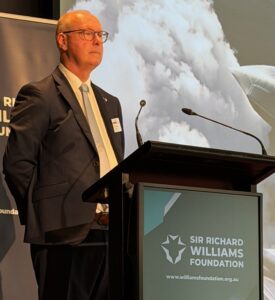
His argument concerns how a defence force thinks about what it already owns, and it is aimed squarely at the way Australia buys and structures capability. In his view the problem is organizational at least as much as it is technological.
Mass as a Matter of Concentration
Gordon began from a simple proposition. Combat mass at a particular point in time and space can be generated in two ways: by having more things to call on, or by doing more with the things you have. He spent his fifteen minutes on the second.
He offered what he called, with a nod to the Guinness Book of Records, a new air power formula. Mass is concentration of force, and air power generates it through its characteristic attributes. To generate mass, he argued, you maximize speed, reach and flexibility while minimizing dependency and fragility.
His treatment of speed was the interesting part. Air power people usually think of speed in knots. Gordon wanted to focus on speed as a unit of time: how quickly a force can detect, make sense of what it has detected, decide, and then communicate decisions, directives and coordinates to the force at both the operational and tactical levels. Concentration of force depends on how fast the decision cycle turns, as well as on how fast the aircraft fly.
Time Measured in Seconds
To anchor the point, Gordon drew on a recent presentation by Admiral Brad Cooper, the commander of U.S. Central Command, who had been discussing Operation Epic Fury. As Gordon relayed it, Cooper’s observation was that time in that operation is measured in seconds, sometimes minutes and rarely hours. Gordon said plainly that this is the movie the force is now in. Command and control can no longer mean assembling slide decks so that a commander can approve an action 72 hours ahead. Everything is happening in real time and machine to machine.
He tied this to Boyd. The OODA loop has never been more relevant, he said, but technology and integration have opened new opportunities to improve performance at every stage of it. His case was not that the loop is new. He argued that the tools for compressing it are now available, and that the way capability is acquired and organized has to change to take advantage of them.
For readers who follow the kill web versus kill chain debate, this will sound familiar. A kill chain is a linear sequence in which each link is a single point of failure. A kill web gives the force multiple paths through the same decision cycle. Gordon argued that the paths multiply when the force’s battle management nodes can do many things, rather than being built to do one.
Air Battle Management as the Core
Gordon was candid that, being from Lockheed, he would talk about a program that is close to his heart: the joint air battle management network the company is delivering under AIR 6500. He described it as a scalable, survivable, cyber-hardened, next-generation joint air battle management system that will be the core of Australia’s integrated air and missile defence.
The nodes come in many form factors. He described everything from hard cases and pelican cases that can be set up in tents, through vehicle-mounted and cabin-integrated configurations, to fixed facilities. They operate as a multi-nodal network, and each node can continue to operate independently and resiliently if it is cut off, which is the condition a contested battlespace will impose.
On artificial intelligence he was measured. The program aims to incorporate machine-assisted human decision making. Gordon said the force is not ready to hand over the keys to superintelligence and does not want to unleash the killer robots just yet. But he saw great potential in smart machine learning and algorithms running in the background, paired with the right human-machine interface.
He made a point of stressing the architecture’s openness. The system is built on a modular ecosystem approach and delivered through agile software development. For the many industry partners in the room, he said, Lockheed’s role as strategic partner is to integrate best-of-breed solutions. In his words, it is not about selling more Lockheed Martin products. If the system is genuinely open, the question of whose effector or sensor plugs in becomes secondary to what the network can do with it.
The Mission App Model
The center of Gordon’s argument was what he called mission apps. Air battle management and integrated air and missile defence are the first mission app on the system. He then walked through the other missions the ADF faces and asked why each is treated as a separate problem.
Electromagnetic battle management was originally in scope for the program. It has since been pulled out, but Gordon noted that considerable work with industry partners had already been done to prepare a solution, and that the team is ready to move quickly if it returns.
On counter-UAS he was emphatic. He expects most of the room would agree that counter-UAS cannot be treated as something separate from integrated air and missile defence. If a hostile track is closing on a defended asset, nobody wants to hear that it is a Group 2 UAS and out of scope. The problem runs from counter-hypersonic to counter-UAS, and it is all battle management that has to be done in an integrated way.
Lockheed had spent money and time developing a homegrown counter-UAS battle management app, and it has since become the company’s global counter-UAS app, scaled and uplifted in the United States.
He stressed that this is not in competition with LAND 156. The land-based project is still needed, and not every counter-UAS node needs full joint battle management functionality. But every battle management node, he argued, needs a counter-UAS capability, and the sensors and effectors industry is developing for the ADF’s counter-UAS solution could all be integrated with an open system fairly quickly.
Space followed the same logic. If a hostile track transits 100 kilometres in altitude, it is still a hostile track. Nobody should hand it to another team in another building running another system, least of all on a contested battlefield where reliable communications with that other unit cannot be assumed. Everything above the surface of the Earth, including above 100 kilometres, belongs to integrated air and missile defence.
He extended the pattern further. Offensive fires coordination is a large airspace and battle management problem. Fire support applications are mission apps that could sit on the same battle management systems. ISR processing, exploitation and dissemination, joint targeting and theatre command and control are different versions of the same underlying challenge.
The Fragmentation Problem
Here Gordon turned from capability to institutions. Each of those circles on the chart, he observed, is a separate project with a separate funding source and a separate team running the competition and the acquisition. Each produces its own individually fragile and bespoke solution, rolled out to the ADF in ones and twos. The result is dependency and fragility, the two variables his formula says must be minimized, and it undermines the depth and resilience the force needs.
This is the sharpest part of his argument, and it will resonate well beyond Australia. Acquisition systems are organized around discrete requirements, and each one is scoped, competed and delivered on its own. The battlespace has stopped respecting those boundaries. Gordon’s contention was that the missions are merging in the current technology environment. They are all essentially versions of the OODA loop, and the force is still buying them as if they were different things.
From Common Operating Picture to Common Operating Data
His proposed remedy has a vocabulary shift at its core. He asked the audience to move past the twentieth-century fixation on the common operating picture and embrace a twenty-first-century view of common operating data within a common OODA loop. That data is then presented through what he called a mission context interface.
The practical reasoning is easy to follow. An operator fighting the counter-hypersonic fight and an operator fighting the counter-UAS fight should not be looking at the same screen at the same range scale. Each needs an interface tailored to the mission, including its own machine-assisted decision support. Gordon joked that if people dislike changing the acronym, they can call it a contextualized operating picture and keep saying COP. The underlying data is shared, while the presentation is tuned to the task.
The other half of the concept is external connectivity. Common operating data flows through the mission context interface and through a series of external system interfaces that pass secure, cyber-resilient, actionable information machine to machine in both directions. That, he said, is the dream behind the lightning bolts on every integration chart, and it is achievable if the force changes the way it thinks about the problem.
PACE Applied to Roles, Not Just Radios
The idea that generated the most interest was Gordon’s application of PACE. Military communicators already use primary, alternate, contingency and emergency as a planning construct for communications paths. Gordon proposed applying the same logic to battle management, and indeed to everything the ADF does.
If every system and every unit has a primary, alternate, contingency and emergency role, then people can rise to the occasion. Gordon was confident that ADF personnel are exceptional and that, given the tools, they will handle complex multi-mission battle management challenges. His model does not require everyone to be highly proficient at everything all the time. People need the tools and a base level of training, and in a contingency they can be trained quickly to do more. What the force gains is options.
That is where depth comes from. If every battle management node is a potential strike cell, a potential counter-air cell and a potential contributor to space battle management, the force no longer depends on a single strike cell. And when those nodes are fighting in a contested, disconnected environment, they retain the tools to keep fighting. Gordon said this gives real meaning to mission command: tell your teams the objective and trust them, now equipped with the means, to take it while cut off from higher headquarters.
This should reassure anyone worried about overloading operators. The model he describes is not about asking every airman to master every mission on day one. It is about designing systems and training pipelines so that a secondary or contingency role can be activated rapidly, rather than being a separate capability that has to be built from scratch.
Effectors: Doing More with Platforms Already Bought
The obvious objection, which Gordon raised himself, is that battle management is all very well but the force does not have enough effectors. He argued that the same mindset applies there, and offered several examples.
The first was a reusable high-power microwave system, which he said has been proven against Shahed-sized drones and can manage more than twenty engagements before the battery pack needs changing. He argued that every battle management node could be equipped with high-power microwave kill capability and the supporting battle management solution for less than it would cost to stand up a project, run a competition and staff the team.
The second was the lead-in fighter. What if the new aircraft were also a capable second-tier fighter? Its primary mission would be training and its ultimate mission ADF support. Its contingency mission could be to carry APKWS rockets with a targeting pod and Link 16 and take down large drones and cruise missiles. This, Gordon said, is a way to buy something the force was going to buy anyway but give it more utility by embracing the PACE mindset.
The third was the Apache. He hoped someone, somewhere, was writing the tactics, techniques and procedures for Apaches to join the inner layer of air defence as part of counter-UAS and integrated air and missile defence. It is a highly capable platform with a favorable cost per kill against some of these targets. He went a step further: strap weapons on the Black Hawks and make them loyal wingmen to the Apaches. Black Hawk crews would not need to be proficient in targeting. They would carry munitions to the fight and the Apache would do the targeting for them.
Assessment: Intelligent Mass Without New Platforms
Gordon’s presentation sits comfortably alongside the wider conversation at the seminar about mass and depth. Much of the debate about mass turns on how many aircraft, how many munitions and how many uncrewed systems the force can field, which are really questions about scale and affordability. Gordon’s contribution was to ask how much latent mass the force already holds and why it is not being used.
His answer implies a particular view of air power as an enterprise, in which the integration layer matters as much as any airframe. It also reflects an argument familiar from the kill web debate. A force built from single-purpose nodes is brittle, while one built from nodes that can each take on several roles can lose pieces and keep fighting. Intelligent mass depends on this kind of flexibility as much as it depends on numbers.
Several questions remain for the force and for industry. Multi-mission nodes require a training and certification regime that supports rapid role changes, and the ADF has to decide how much proficiency in secondary roles is enough. A more concentrated architecture raises the stakes on cyber hardening, which Gordon identified as a design priority but which will need continuous testing. And an open ecosystem depends on government being willing to hold the integration standards, and on prime contractors, including Lockheed, being willing to let competitors’ products into the system. Gordon’s statement of intent was clear, but the proof will come in contract structures and interfaces.
The deeper obstacle is the one Gordon named at the start of his critique, the way projects are scoped and funded. A multi-mission mindset cannot be delivered by a contractor alone. It requires the customer to rethink how requirements are written, so that a counter-UAS capability is specified as part of battle management rather than competed separately, and a fighter’s contingency role is considered at the point of purchase rather than after delivery.
More Options, More Places, More Often
Gordon closed with an observation about language. When he joined the Air Force, multi-role was the goal. He suggested the force now needs to expand that to multi-mission and to embrace the PACE mentality.
He added that, by pure coincidence, he had come across a document the previous night, and read more of it that day, whose theme was more options, more places, more often. That, he said, is what he had just spent fifteen minutes describing. There are ways to generate more options with the things the force already has, which makes those assets capable of acting in more places and doing so more often.
For a seminar devoted to mass and depth, it was a fitting summary. The most accessible source of combat mass may be the capacity already sitting in the force, waiting for a mindset, an architecture and an acquisition system that allow it to be used.