
U.S. Aircraft Losses in Operation Epic Fury: The Double Challenge of Dispersion and Regeneration
This article was originally published in French by Operationnels SLDS: Pertes aériennes américaines pendant Epic Fury
This brief takes a recent Congressional Research Service (CRS) report as its starting point and draws on additional sources to offer insight into some of the operational and capability lessons emerging from Operation Epic Fury.
In a CRS Insight updated on October 5, 2026, the Congressional Research Service effectively doubled its count of U.S. aircraft, manned and unmanned, lost or damaged since Operation Epic Fury against Iran began on February 28, 2026. The report now records 81 aircraft, compared with 42 in an initial assessment published in May.
Beyond the raw numbers, the new tally highlights the diversity of causes: enemy action, friendly fire, accidents and technical failures, and the deliberate destruction of aircraft that could not be recovered.
It also offers a glimpse of the lessons, and their complexity, that these losses carry for both the Pentagon and Congress. Three areas stand out:
- The vulnerability of air bases, and a dispersion strategy already well underway within the U.S. armed forces.
- The overlap of aircraft generations, and the vulnerability and replacement of critical capabilities that rely on aging fleets available only in limited numbers. On this point, the CRS puts the question of force sufficiency directly to lawmakers: “Congress may assess whether losses in certain high-demand platforms that are aging and limited in number, such as the E-3 Sentry, create capability gaps or increase risk in other theaters.”¹
- The capacity of the defense industrial base to replace equipment lost or damaged in war.
The updated CRS list of 81 aircraft, helicopters and drones lost or damaged in operations against Iran draws on publicly available information: Pentagon and U.S. Central Command (CENTCOM) releases, media reports, and the quarterly report of the Lead Inspector General for Operation Epic Fury, published on September 14. The CRS stresses that the tally remains subject to revision, in part because some information is classified and some attributions remain uncertain. It also notes that some of the aircraft counted as damaged have already been returned to service.
The trend is nonetheless telling. The CRS’s previous tally, published in May, reported 42 aircraft lost or damaged. Much of the increase comes from drones: 45 MQ-9 Reapers are now recorded as lost in operations against Iran, along with three MQ-1s shot down and one MQ-4C Triton lost in an accident. The CRS does not specify the circumstances of the individual MQ-9 losses.
Setting the MQ-9s aside, the tally reveals several distinct causes of loss.
Enemy Fire and Hostile Attacks
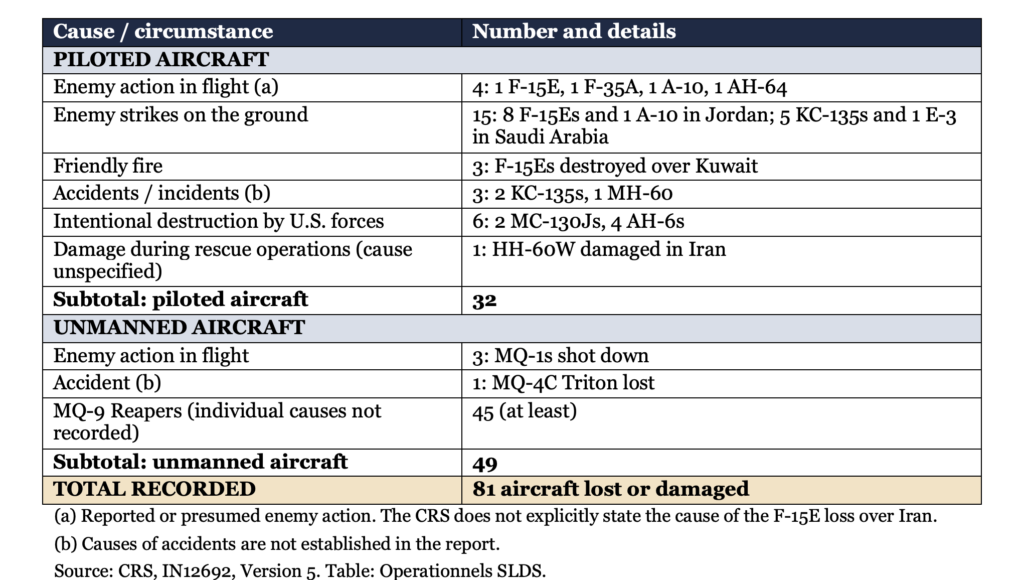
Enemy fire was directly or very likely responsible for at least 23 aircraft destroyed or damaged. Notable cases include an F-15E lost over Iran, an F-35A hit by Iranian ground fire, an A-10 shot down, an AH-64 Apache shot down over the Strait of Hormuz, three MQ-1s, and an HH-60W damaged during a search-and-rescue mission for the downed F-15E crew.
Vulnerability on the Ground
A second key lesson concerns the vulnerability of aircraft on the ground. Iranian strikes on Prince Sultan Air Base in Saudi Arabia and Muwaffaq Salti Air Base in Jordan alone damaged 15 aircraft: five KC-135s and one E-3 Sentry in Saudi Arabia, and eight F-15Es and one A-10 in Jordan. The eight F-15Es sustained only minor damage and have returned to service.
This concentration of damage is itself a lesson about the dispersion, protection and resilience of air bases. The Inspector General’s report extends the observation to infrastructure: according to CENTCOM, Iranian strikes damaged or destroyed hundreds of buildings and structures at U.S. bases in eight countries across the region. Force protection measures included relocating personnel, equipment and storage, repositioning air defense assets, and rapidly evacuating aircraft from threatened bases. Dispersion has thus emerged as an operational response that has already been tested in this conflict.
Friendly Fire
The report also notes that three F-15Es were destroyed by friendly fire over Kuwait on March 2. They were shot down in error by a Kuwaiti F/A-18 while the area was simultaneously under attack by Iranian aircraft, ballistic missiles and drones. All six crew members ejected and were recovered.
Accidents and Incidents
Other losses are attributed neither to enemy action nor to friendly fire, and their causes have not been determined or made public. On March 12, two KC-135s were involved in an incident: one crashed in Iraq, killing all six crew members, while the second made an emergency landing. CENTCOM stated that the incident was not caused by hostile or friendly fire. An MQ-4C Triton was also lost in a mishap whose cause the CRS does not specify, and an MH-60 crashed over the Arabian Sea.
Intentional Destruction During Recovery Operations
Finally, six aircraft were intentionally destroyed by U.S. forces during recovery operations: two MC-130J Commando IIs grounded in Iran, reportedly after a mechanical failure, and four AH-6 Little Birds. The aircraft were destroyed after personnel had been evacuated, to keep them out of enemy hands.
Epic Fury: 81 U.S. Aircraft Lost or Damaged
Analytical breakdown based on the CRS report of October 5, 2026
Absorbing and Replacing the Losses
Beyond the tally itself, the CRS draws Congress’s attention to the U.S. military’s ability to absorb and replace losses at this level: replacement costs, the availability of already strained fleets, the capacity of the defense industrial base, and potential consequences for other theaters. The report singles out the E-3 Sentry, an aging aircraft available in limited numbers. It also asks whether these losses reflect changes in the threat environment or in adversary capabilities that would require adjustments to equipment, operational concepts, tactics and basing posture.
More broadly, the Congressional Budget Office (CBO) estimated the cost of equipment losses requiring changes to the Pentagon’s replacement plans at $1.9 billion, rising to as much as $3.3 billion if the Pentagon were to request additional funding for all lost equipment. Those losses include a THAAD missile defense radar destroyed by Iran. The CBO also notes that the cost of the war has risen sharply: estimated by the Pentagon at nearly $29 billion in May, it had reached approximately $38 billion as of August 1, according to the CBO’s latest estimates.
For the Pentagon, the challenge goes beyond the number of aircraft affected. It must link base protection and dispersion, operational readiness, and industrial replacement capacity, in order to understand not only how U.S. forces are absorbing these losses, but also what lessons are already emerging for current and future missions.
Notes
¹ CRS, “U.S. Aircraft Combat Losses in Operation Epic Fury: Considerations for Congress,” IN12692, p. 3, under “Force sufficiency.” https://www.congress.gov/crs-product/IN12692
Sources
- Jennifer DiMascio and Daniel M. Gettinger, “U.S. Aircraft Combat Losses in Operation Epic Fury: Considerations for Congress,” Congressional Research Service, CRS Insight IN12692, Version 5, updated October 5, 2026. https://www.congress.gov/crs-product/IN12692
- Michael Scanlon, “U.S. aircraft lost or damaged in Iran war nearly doubles in latest congressional report,” Military Times, October 7, 2026. https://www.militarytimes.com/news/your-military/2026/10/07/us-aircraft-lost-or-damaged-in-iran-war-nearly-doubles-in-latest-congressional-report/
- Michael Scanlon, “Congressional report tallies 42 U.S. aircraft lost or damaged in Operation Epic Fury,” Defense News, May 22, 2026. https://www.defensenews.com/news/pentagon-congress/2026/05/22/congressional-report-tallies-42-us-aircraft-lost-or-damaged-in-operation-epic-fury/
- Lead Inspector General for Operation Epic Fury, Quarterly Report to the United States Congress, April 1, 2026–June 30, 2026, published September 14, 2026. https://www.stateoig.gov/uploads/report/report_pdf_file/oef_q3_jun2026_final_508-secure.pdf
- Congressional Budget Office, “Estimating the Cost of Combat Operations Against Iran,” letter from Phillip L. Swagel, CBO Director, to Rep. Brendan F. Boyle, Ranking Member, House Budget Committee, September 15, 2026. https://www.cbo.gov/system/files/2026-09/62756-Iran.pdf