
Sensing and Acting: The Challenge of Closing the Gap
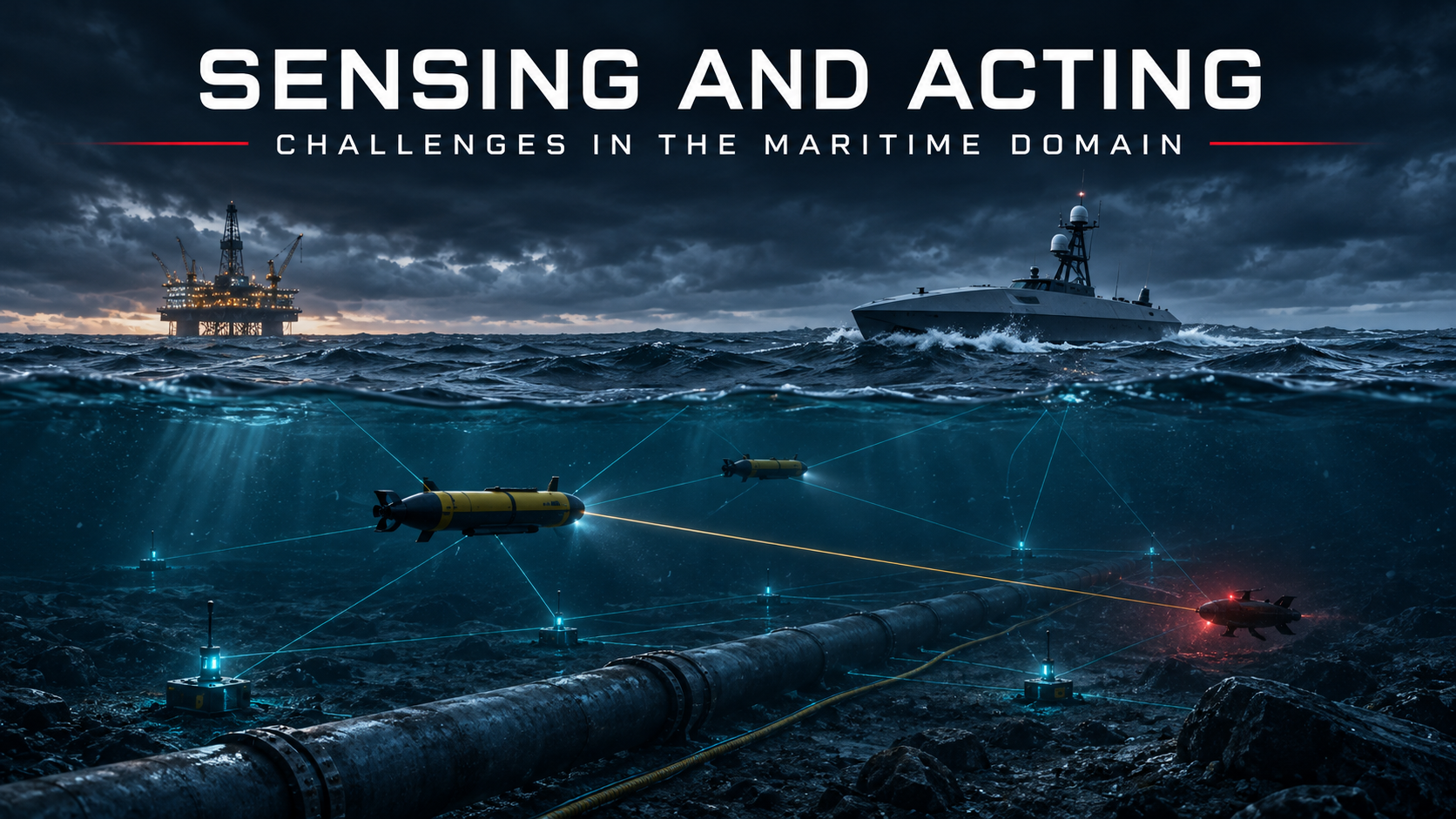
The gap Kongsberg’s chief executive named in Oslo is not mainly a sensor gap or a vehicle gap. It is the distance between sensing and acting. Norway and its allies are learning to see the seabed faster than they are learning to do anything about what they see. Closing that distance is the central challenge of the undersea kill web.
Eirik Lie, Kongsberg’s president and chief executive, spoke at the Atlantic Future Forum in Oslo, on board HMS Prince of Wales, as UK Defence Journal reported on 15 November. Asked about the distance between what is technically possible and what has actually been bought to protect cables and pipelines on the Norwegian shelf, he said the drone warfare now seen in the air over Ukraine will come to the sea and under it. Much of the technology already exists and is in use, he added, but countermeasures need more work.
That is a short remark from a vendor chief on a panel. It deserves more attention than it will get, because it states, almost in passing, a central design problem for maritime security in the Atlantic and the Pacific alike: who is able to act once the sensors light up.
Why sensing gets built and acting waits
A kill chain is linear and owned: one service finds, fixes, tracks, engages and assesses, and the budget follows the chain. A kill web is a network in which any sensor can feed any effector, and whoever holds the right shot at the right moment takes it. The difference matters most where no single owner exists, and the seabed is that place.
Undersea infrastructure is divided among pipeline and cable operators, energy companies, coast guards, navies, and the vendors who sell each of them a piece of the picture. Each can buy what is useful in peacetime. Persistent sensing is useful in peacetime: it supports inspection, mapping and traffic awareness, so it finds a buyer. Kongsberg’s own account of its Oslofjord test bed describes it as a place to accelerate readiness and test integrated protection solutions, and it points to the 2022 Nord Stream sabotage as the turning point.
A countermeasure has no peacetime buyer. It is an effector, it needs legal authority to use, and it only matters after an attack has begun or is about to. That is the asymmetry in Lie’s remark. The sensing node is funded because it pays its way every day. The acting node waits for a decision about who is allowed to act, against what, and with what.
This reading is mine. The report does not define “countermeasures,” and the term could mean defeating hostile undersea drones, deterring and attributing sabotage, or protecting a vessel or cable once it is targeted. The argument holds for all three, but the answer to each is different.
Lie’s three layers, read as a kill web
Lie described protection in three layers, according to the same report: persistent awareness from seabed sensors and autonomous underwater vehicles, rapid response to investigate quickly, and resilience, meaning the ability to repair after an accident or attack. He also pointed to the scale of the problem. Norway has about 9,000 km of pipelines, plus fibre cables and other infrastructure, and allies cannot guard all of it at once.
Read as a kill web, the layers line up as follows:
- Persistent awareness is the sensing function. Per his remarks, the technology exists and is in use.
- Rapid response is the deciding and acting function. This is where he named countermeasures as the gap.
- Resilience is the absorb-and-recover function. Repair capability is assumed to follow an incident.
Three points follow.
First, “investigate quickly” is the first act, not a shot. A vehicle or vessel that arrives, looks and reports completes the identify step. It does not stop anything. The countermeasure begins where investigation ends.
Second, the 9,000 km figure is the argument for intelligent mass over exquisite scarcity. A handful of expensive crewed ships cannot cover that length of seabed. Dense, cheap and persistent nodes can. Their cost per node is what makes the geometry work, and the same logic should govern the effectors, not only the sensors.
Third, the resilience layer is chaos management rather than crisis management. It assumes the attack will come and plans the recovery. That is sound, but it should not be the only layer with an answer for the moment of attack.
Who owns the shot
Lie called for close coordination among operators, authorities and industry, with clear roles and responsibilities. He also argued that fielding equipment needs a different model, because threats and technology change quickly.
He called this a strategic direction and said he hoped the next step would bring British and Norwegian industry together on capabilities.
That is where the gap lives. Acting raises questions that sensing never does.
Who may disable or divert an uncrewed vehicle near a pipeline in peacetime?
Who decides, and in how many minutes?
Who pays for an effector that may sit unused for years?
A technology that exists but has not been bought has usually stalled on questions of authority and budget ownership, not engineering.
Two cautions
First, the report does not name a countermeasure system, a program, a budget or a buyer. The “bought versus possible” gap is the question put to Lie, and the report gives only his general points in reply. The gap is asserted, not measured.
Second, Lie leads a company that sells the awareness layer. Kongsberg has been building that position: the Oslofjord test bed, its HUGIN autonomous vehicles, the completed acquisition of the U.S. sonar and acoustics firm Sonatech, and a $54 million US contract modification for autonomous underwater vehicles through the Defense Innovation Unit.
A chief executive who names countermeasures as the gap is also describing the next market. That does not make him wrong. It means the claim should be tested against what governments say they will buy.
Arctic Hunter: the same gap on the surface
On 9 November, ahead of the Oslo forum, Kongsberg Maritime unveiled the Arctic Hunter, an uncrewed surface vessel for hybrid fleets. It combines a proven hull design, flag-state-approved uncrewed technology and commercial shipbuilding with Thales UK sonar and military communications. It is being adapted for the Royal Navy’s Type 92 anti-submarine programme, with ships to be built at Birkenhead, according to UK Defence Journal. Lisa Edvardsen Haugan, who leads Kongsberg Maritime, called Atlantic security an absolute priority and pitched the vessel as a response to the need for more submarine detection capability.
This is the capital ship argument in miniature. The Royal Navy does not have enough crewed ships to watch the sea space it is responsible for, a point a German defence outlet ties to the 2025 Strategic Defence Review.
The answer is a bifurcated industrial base. Commercial yards and commercial hulls produce the numerous, persistent and cheap platforms that carry sensors and, eventually, effectors. Naval yards concentrate on the few ships that must be built to military standard. The Arctic Hunter belongs on the commercial side of that line.
It also shows the same imbalance as Lie’s three layers. The vessel is a sensing node, built to detect and track. The product description points to detection, not engagement. If the Royal Navy ends up with a dense net of persistent sensors in the High North and no agreed way to act on what they find, it will have bought the first half of a kill web.
The forum panel pointed in the same direction in alliance terms. Canada’s ambassador to Norway said Canada is entering a submarine partnership with Norway and Germany and negotiating an enhanced defence cooperation agreement with Norway. Kongsberg also supplies combat system elements for the Type 212CD submarines being built for Germany and Norway, so the company sits on both sides of the Atlantic undersea contest: the boat and the system that hunts it.
From the shelf to the submarine
The following is inference, and Lie did not say it.
If uncrewed systems become routine underwater, the problem is not limited to pipelines.
The Asian allies now moving toward nuclear-powered submarines, South Korea, Japan and Australia, are buying boats whose value rests on survivability.
A boat that can be tracked by a dense net of cheap persistent sensors, or harassed by uncrewed vehicles, needs its own countermeasures, and the same unanswered question of who owns the shot applies to a submarine at sea.
The Norwegian shelf is a preview of a problem the Pacific will meet in a harder form.
Five signs the gap is closing
Five things would test this reading.
- A fuller record of Lie’s answer. The report gives general points only. A transcript or video of the panel would show what he meant by countermeasures.
- A definition. Detect-and-disable, attribute-and-deter, and protect-and-recover are different programmes with different owners.
- A buyer. Any Norwegian, British or allied procurement that names an undersea countermeasure, rather than another sensor, would show the gap beginning to close.
- The Type 92 path. Whether the Royal Navy pairs its sensing vessels with any means of acting on what they find.
- The legal frame. Whether any government publishes rules for acting against uncrewed vehicles near seabed infrastructure in peacetime.
Sources
- Kongsberg chief warns of undersea countermeasures gap, UK Defence Journal, 15 November 2026
- Kongsberg pitches Type 92 sub hunter for Royal Navy needs, UK Defence Journal
- Kongsberg Maritime launches Arctic Hunter USV for the Hybrid Navy, EDR Magazine, 9 November 2026
- Arctic Hunter and U-boats in the North Atlantic, ESUT, November 2026
- KONGSBERG opens Oslofjord test bed for critical infrastructure protection, Kongsberg
- Kongsberg buys Sonatech to expand US underwater technology, The Defense Post
- Kongsberg secures US deal for autonomous undersea operations, Interesting Engineering
- Kongsberg to deliver ORCCA combat system for Type 212CD submarines, Naval News