
From the Show Floor to the Fleet: Naval Drones at Euronaval 2026 and Beyond
Army Recognition’s video report from Euronaval 2026 offered a useful snapshot of where unmanned maritime systems now sit in the market. It featured Israel’s Elbit Systems, Croatia’s Shadow Nautics, the Netherlands’ High Eye, and Latvia’s NEWT21, including unmanned surface vessels supplied to Ukraine (Army Recognition).
The report was careful on one point that deserves emphasis: the Black Sea experience “does not independently establish the specific combat performance” of any single platform shown in Paris, and integrating crewed and unmanned assets depends on communications, control arrangements, sensor compatibility and each system’s operational maturity.
That caution is the right lens for the whole show. Euronaval 2026 was the drone show. Organizers expected 705 exhibitors, 40% more than in 2024, and the number of drone makers had tripled (Second Line of Defense). European governments, alarmed by Russia and less certain of the United States as an ally, are moving quickly to rebuild their navies (Baird Maritime/Reuters). But what was on display ranged from combat-proven boats to scale models of ships that may never be built. The task is to sort them.
The Four Companies in the Report
The four firms in the Army Recognition piece illustrate four different entry points into maritime autonomy.
Elbit Systems used Euronaval to present its unmanned underwater vehicle portfolio for the first time, built on its acquisition of Canada’s International Submarine Engineering, which has delivered more than 250 underwater vehicles to customers in over 20 countries. Elbit pitched the modular AUVs alongside its Seagull family of surface vessels as an integrated surface-and-subsurface package for mine countermeasures, anti-submarine warfare, seabed mapping and infrastructure protection (Elbit Systems). The point is less any single vehicle than Elbit’s move to offer the whole stack, from vehicles to mission management.
Shadow Nautics, a Šibenik builder of NATO-standard patrol craft for the Croatian Navy, Coast Guard and Customs, represents the crewed side of the hybrid fleet (Shadow Nautics). A month before Paris, it showed its Shadow Patrol 47 Outboard fitted with ASELSAN’s remotely controlled SMaSH 12.7 mm weapon station to the Croatian Navy, though no procurement agreement was announced (Defense Talks).
High Eye’s Airboxer is a 32 kg unmanned helicopter with up to 7 kg of payload and a flight endurance of up to four hours (RobotToday). Its significance is that it is already chosen: the Royal Netherlands Navy selected the Airboxer as its shipborne VTOL system in 2024 (Naval News).
NEWT21 is the most telling case. Founded in January 2025 by Jānis Garisons, a former State Secretary of Latvia’s Ministry of Defence, the company builds carbon-fiber and Kevlar composite hulls in one of the largest composite plants in the Baltic states (Deeplist). It completed an EU-backed project to move its FOG and RAY boats from prototype to serial production (Global Defense Corp). The FOG is a 4.5-meter, roughly 200 kg surveillance boat with a range of up to 700 km and a Starlink link; a unit funded by more than €100,000 in Latvian private donations has been delivered to Ukraine’s Defense Forces (Defence Blog). This is a small country turning a wartime demand signal into an industrial niche.
What Else Was on the Floor
The broader Euronaval offering fell into roughly four bands.
Small, expendable strike boats. France’s DGA publicly showed SMOKERS V1, a 5-meter, 500 kg remotely operated explosive boat capable of 40 knots and more than 50 nautical miles, developed in-house in under six months. Three prototypes sailed from the Tonnerre, Chevalier Paul and Jacques Stosskopf during the Wildfire exercise off Toulon from September 28 to October 2, and the DGA has opened an industrialization competition with bids due December 4, a manufacturer to be selected in 2027, and production envisaged at about 10 per year in peacetime, rising to 50 (Army Recognition). KNDS and French startup SeaOwl signed an agreement to develop a 35-knot surface drone with a 30 kg qualified KNDS warhead and a 200 km combat range, with the engagement decision reserved for a remote operator (KNDS/SeaOwl release via Deutsche Börse). ASELSAN highlighted its TUFAN one-way attack USV and KILIÇ one-way attack AUVs (Al Defaiya).
Drone motherships and swarm nodes. Türkiye’s MKE unveiled an armed PIRANA variant designed as a command node for kamikaze drone swarms, with a 1,000 kg payload, a 400 nautical mile range, and a model displayed with eight tube-launched UAVs (Naval News). Its kamikaze sibling has a firmer record: a PIRANA was controlled from TCG Anadolu via a Bayraktar TB3 relay in June 2025 and destroyed a target at Denizkurdu 2026 (Naval News).
Medium vessels built for serial production. Rheinmetall brought its Kraken K3 to a wider audience, a USV built in series at its Hamburg site; the 8.5-meter K3 Scout carries 600 kg at up to 55 knots, and series production began at Blohm+Voss in April (Rheinmetall). Saildrone picked Norway’s Umoe Mandal to build its 20-meter Surveyor, which can operate unattended for up to 100 days, at an initial rate of at least two per month; Saildrone has a yearlong four-Voyager surveillance mission for the Swedish Navy and Danish use since 2025 (Defense News). EDGE Europe signed an MoU with Italy’s Novamarine to explore joint USV development, with Abu Dhabi Ship Building integrating and TII providing autonomy. Naval Group unveiled the design of its 37-meter Seaquest M, with a containerized combat system and a goal of ten-day autonomy increments, and plans initial sea trials within months (Naval News).
Large uncrewed warships and drone carriers. Navantia UK’s LASV75 is a 75-meter, 1,000-tonne-plus monohull aimed at Royal Navy Type 9X roles, able to carry up to 32 strike-length Mk 41 cells; it has no price and no order (Navy Lookout). Naval Group’s SCX 26 destroyer concept would devote nearly a third of its hull to a mission bay for UAVs, USVs and AUVs, but no French Navy program, schedule or cost exists (Army Recognition); Naval Group itself calls it “a still highly theoretical ship concept” (Naval Group).
France Builds an Ecosystem
The host nation’s moves were the most consequential. Armed Forces Minister Catherine Vautrin launched a naval-drone pact with industry on the opening day, modeled on France’s 2024 aerial-drone pact (Defense News). The pact itself is a framework, not a procurement (Second Line of Defense). The money went to the seabed and to mines: a second 6,000-meter ROV Deep Sea from LD Travocean, eight Exail A18 mine-countermeasure drones, and a second, larger Naval Group unmanned combat underwater vehicle meant to stay in the water for weeks.
Around that core sit the DGA’s tender for a few dozen embarked long-endurance ISR surface drones, requiring 100 nautical miles of range and 5-to-10-day endurance from Mistral- and Loire-class ships, and the DANAE effort to field armed autonomous boats for base protection and escort. The French Navy is explicit that armed medium USVs are “later increments”; the near-term focus is endurance, secure connectivity and hull durability (Naval News).
The Black Sea Sets the Standard
The demand signal behind all of this comes from Ukraine. Kyiv’s remotely controlled explosive speedboats sank about a third of Russia’s Black Sea Fleet, and 27 Ukrainian companies are now experimenting with new naval platforms (Seattle Times/AP). The boats have kept evolving. The SBU’s Sea Baby now carries six to eight FPV drones, some fiber-optic and jam-resistant, plus thermobaric rockets (Defense News). Katran boats act as miniature aircraft carriers: interceptor drones launched from one destroyed Russian radar antennas on offshore oil platforms, opening a path for other sea drones to attack Tuapse and Novorossiysk (Seattle Times/AP). The SBU’s Sub Sea Baby underwater drone struck an Improved Kilo-class submarine at its pier in Novorossiysk, which analysts assessed as a mission kill (Defense News).
In September came what Naval News described as the first time one USV destroyed another in combat: a Ukrainian Navy Sargan-3000 with a Kongsberg Protector 12.7 mm weapon station sank an improved Russian Orcan-type attack boat (Naval News). Russia is adapting too, basing USVs at a new revetted site on Lake Donuzlav and pairing them with Geran drones as relays (Naval News). The tactical knowledge is now exportable: Ukraine’s navy led the red team against NATO’s blue force at the REPMUS exercise in Portugal and won all five scenarios (Defense News).
The Hard Problems
The most useful reporting of the week came not from a stand but from Navantia’s designers. They argue the hardest part of a large USV is not weapons but a ship that can stay in the North Atlantic for weeks with nobody aboard while staying simple and cheap enough to build in numbers. Someone still has to clean strainers, change filters and reset breakers; the Royal Navy is seeking missile silos that can stay ready for 30 days without human touch; and removing the crew shifts cost and people ashore to operations centers, software assurance and contractor support. The same piece notes that lessons from five- or six-meter Ukrainian boats, used for hours or days and redesigned in months, do not transfer directly to a warship-sized platform expected to serve for years (Navy Lookout).
Integration is the other choke point. Officials in Paris stressed the difficulty of connecting new drones to ships and submarines built decades ago; as one French Navy official put it, “A ship at sea moves a lot. All of the GPS-based systems need to take that into account” (Baird Maritime/Reuters). And Ukrainian commanders, whose systems have worked under fire without GPS, keep returning to the human element: “Technology is not what matters most,” said Lt. Col. Kochevenko. “People are”. Sam Tangredi offered the necessary counterweight: drones “are tools in the tool kit… They don’t change the equation” (Seattle Times/AP).
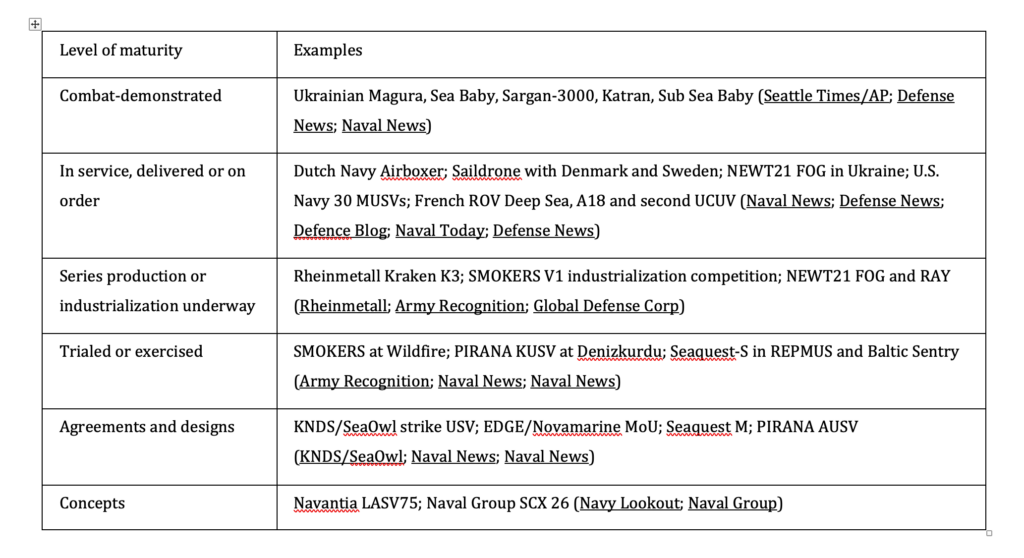
A Maturity Ladder
Sorting what was seen in Paris by evidence rather than by brochure produces a clearer picture.
The Bottom Line
Euronaval 2026 showed that naval autonomy has crossed from experimentation into industry. The orders are real but still concentrated where risk is lowest and payoff clearest: the seabed, mine countermeasures, persistent surveillance and cheap strike boats.
The armed medium and large uncrewed combatants that dominate the renderings remain later increments, constrained less by weapons than by endurance, maintenance, communications, certification and the people needed ashore to run them.
The navies that get this right will be the ones that build the integration, sustainment and operator base alongside the hulls, and that treat Ukraine’s experience as a lesson in adaptation speed rather than a template to copy wholesale.