
Heavy Lift as Force Protection: The CH-53K’s Mountain Recovery
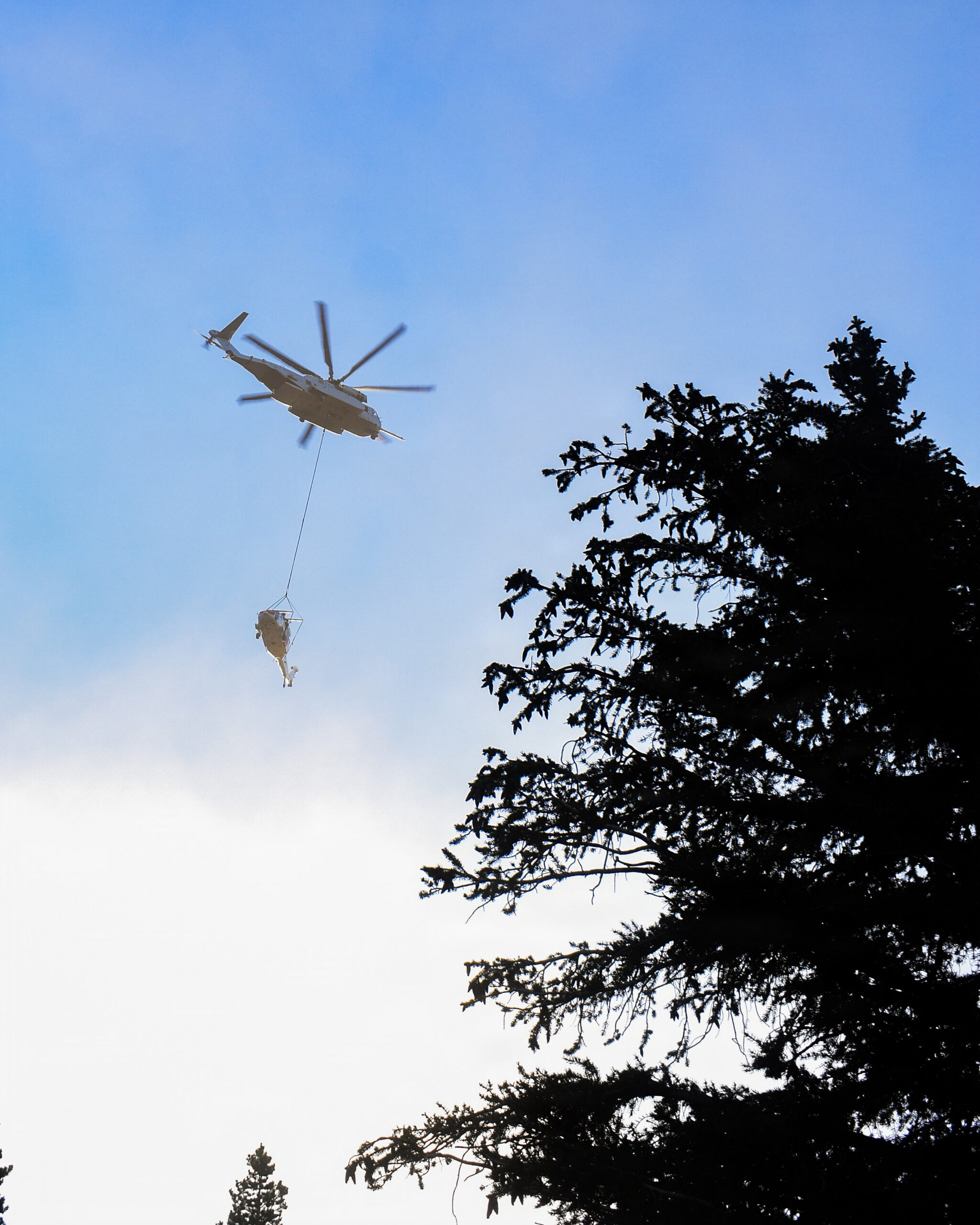
In late September, a CH-53K King Stallion from Marine Operational Test and Evaluation Squadron 1 (VMX-1) recovered a Navy MH-60S Seahawk stranded in the Sierra Nevada. It flew the nearly 16,000-pound helicopter on a long line to an airfield at Naval Air Weapons Station China Lake, California. Because the MH-60S came out without incident or damage, it will be able to fly again without extensive maintenance, according to the H-53 Heavy Lift Helicopters Program Office. The story and three photos were posted to DVIDS on 4 November (DVIDS).
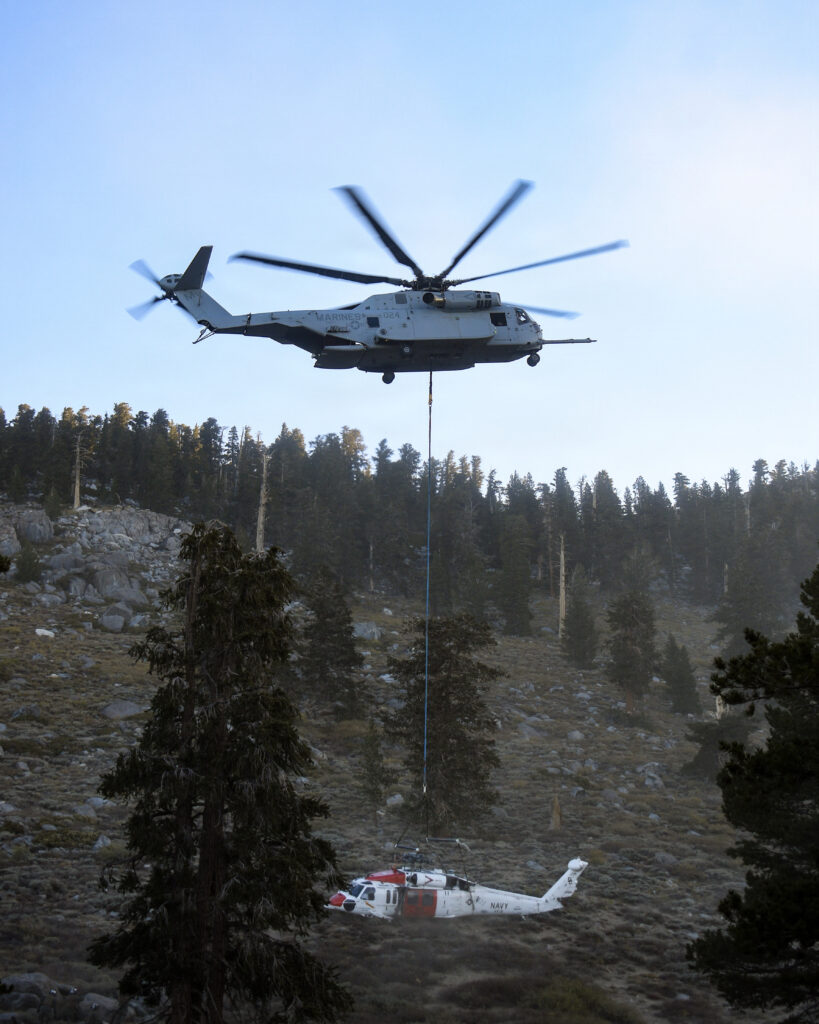
The MH-60S, from Air Test and Evaluation Squadron 31 (VX-31), had landed hard at an elevation of 10,000 feet. It was undamaged but could not take off because of the slope of the terrain. The remote site and the altitude made it hard to get people and equipment in, and defuelling the helicopter to reduce its weight would have been extremely difficult. The program office says the CH-53K was the only aircraft capable of the recovery, given the power required and the restrictive terrain.
Engineering the Lift
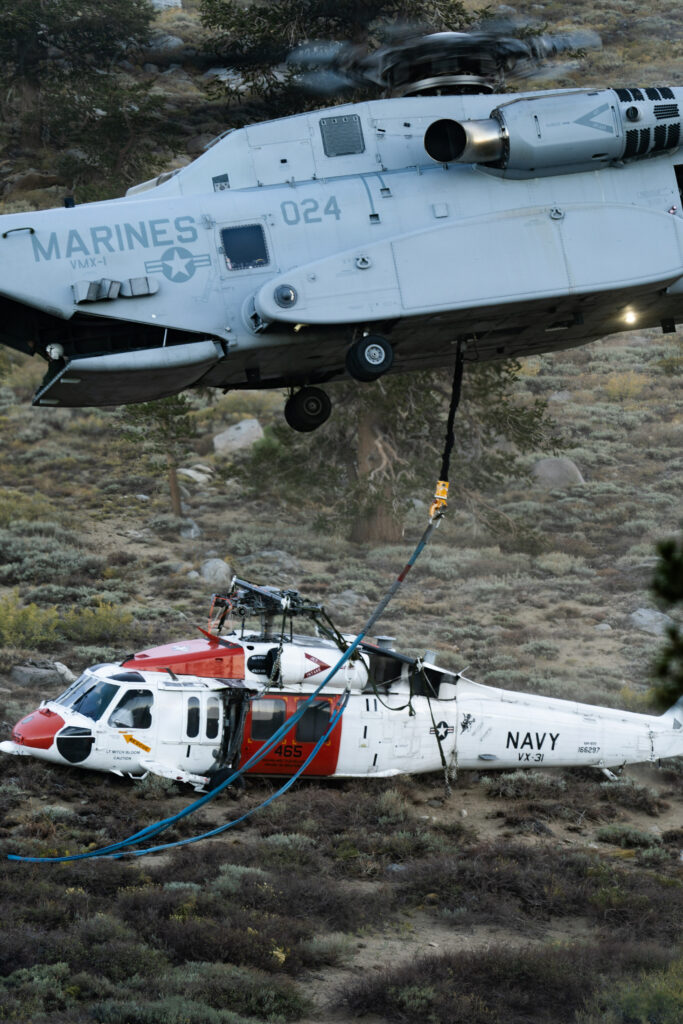
The goal was to bring the Seahawk out as “whole” as possible. Engineers from the Naval Air Warfare Center Aircraft Division (NAWCAD) Cargo Lab and Structures Lab designed the rigging. Rather than lift by the main rotor head, they used the aircraft’s built-in lift points and the hoisting sling designed for them, removing only the main and tail rotor blades to protect them in transit. The H-60 Fleet Support Team at Marine Corps Air Station Cherry Point advised on configuring the aircraft and reducing its weight.
The 70-foot line was longer than the standard Marine Corps sling line, so the operation also served to certify the CH-53K for its use. The Structures Lab acquired a commercially available long line, tested it at Patuxent River up to 20,000 pounds on an existing Defense Supply Center crane, and ran the data through flight clearance. “It took us less than two weeks from when the squadron reached out to us to finish testing and gain the necessary clearances,” said team lead Brandon Norris.
Cargo Lab engineer Michele Hoefer said the weight of the helicopter, the elevation, the distance and the weather meant the recovery “would be putting the CH-53K in the corner of its envelope, both for power required and for fuel consumption.” Pilot and lead planner Maj. Lee Henderson said: “The hardest part of this recovery wasn’t necessarily lifting the H-60. It was figuring out how to do it safely without causing any additional damage.” He credited the aircraft’s available power, its precise flight-control system and its ability to calculate power available in real time from engine performance and environmental conditions with significantly reducing risk.
Why It Matters
Heavy lift is often treated as a logistics function. This recovery shows it is also a way to protect the force. Writing off a damaged helicopter, or dismantling it on a mountainside, would cost far more than one CH-53K sortie. Being able to bring back a downed aircraft intact, from high altitude and rough terrain, is the kind of capability a force operating from scattered, austere sites will need. The process matters as much as the lift: test engineers, fleet support experts and an operational test squadron moved from request to cleared procedure in under two weeks, using a commercial line and existing equipment.
The story is a capability showcase, and it should be read as one. It reports a single successful lift by a test squadron with dedicated engineering support. It says nothing about the readiness, sustainment costs or maintenance demands of the operational CH-53K fleet, which is now expanding as the 26th Marine Expeditionary Unit becomes the first MEU to field the aircraft ahead of its first operational deployment (Inside Defense). The aircraft first landed aboard the amphibious transport dock USS Arlington in June (DVIDS). What the mountain recovery proves is the aircraft’s performance margin. Whether that margin can be delivered routinely, from ships and austere sites, depends on how well the fleet is supported.
Sources
PMA-261 story on DVIDS, 4 November 2026: https://www.dvidshub.net/news/578599/ch-53k-king-stallion-recovers-mh-60s-fly-again
Recovery photo on DVIDS: https://www.dvidshub.net/image/10070085/ch-53k-king-stallion-recovers-mh-60s-fly-again
Inside Defense daily digest, 9 October 2026: https://insidedefense.com/insider/insider-daily-digest-october-9-2026
26th MEU photo, CH-53K aboard USS Arlington, DVIDS: https://www.dvidshub.net/image/9745817/26th-marine-expeditionary-units-type-commanders-amphibious-training-ch-53k-king-stallion-land-uss-arlington