
Admiral Paparo’s April 2026 Posture Statement: A Kill Web Practitioner Reads the Record
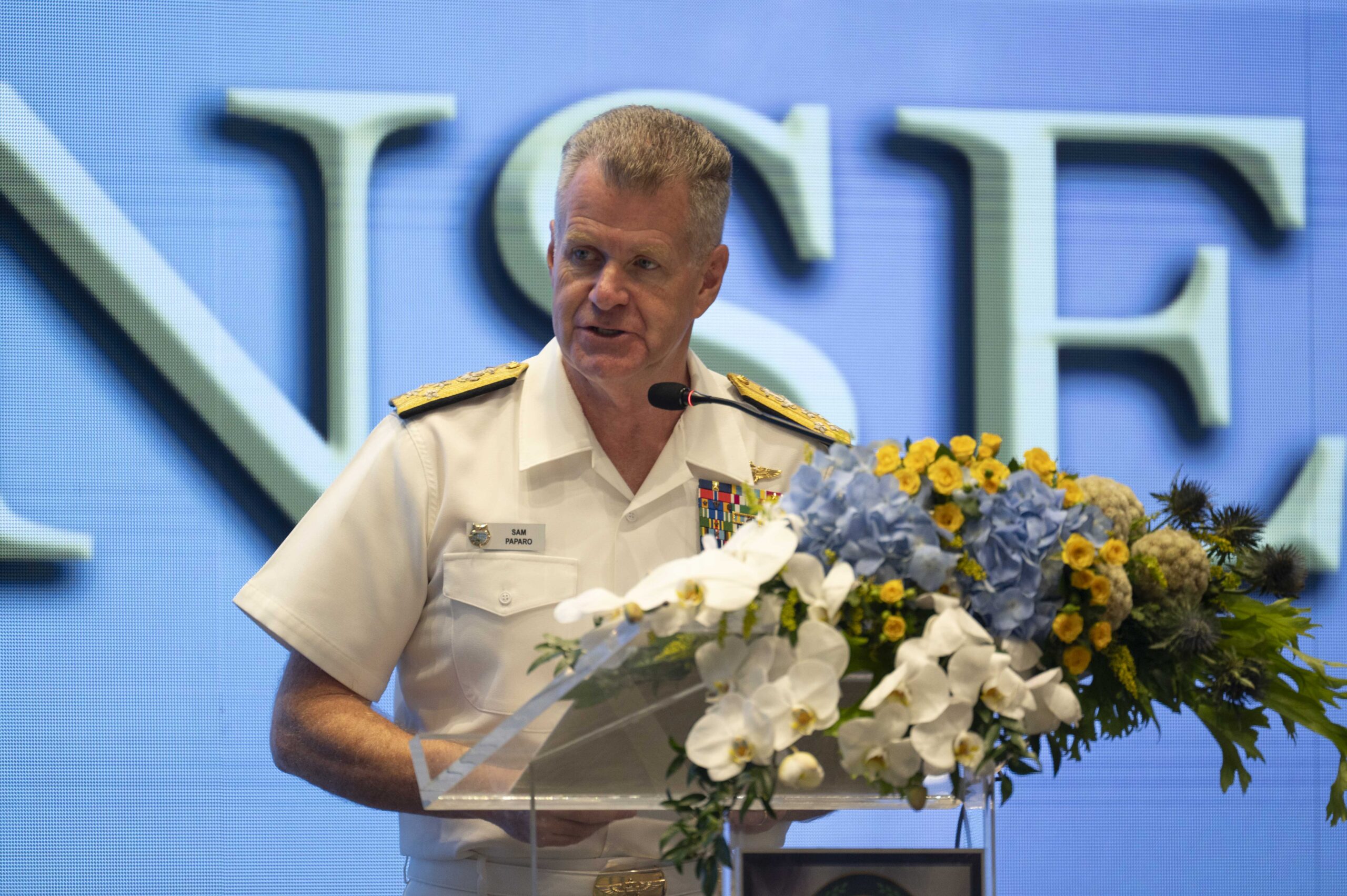
Admiral Samuel Paparo’s April 2026 posture statement to Congress is not simply a budget document or a diplomatic exercise in alliance management. It is a practitioner’s manifesto, a statement by a warfighting commander who has absorbed the hard lessons of evolving conflict and is pressing Congress and the defense establishment to move at the speed the threat demands. Reading it through the lens of kill web warfare and the broader transformation of how the Joint Force must fight, several themes stand out as genuinely significant. Not all of them are being discussed in the right terms inside the Beltway.
The Warfare Dynamics Section: A Kill Web Framework in All but Name
The most analytically significant section of the testimony is the discussion of what Paparo calls “meta trends” in the changing character of warfare. He identifies three: the growing strategic effect of information, influence, cognitive, and cyber operations, the commoditization of cheap, massed, unmanned, and autonomous systems and the commoditization of long-range precision strike. These three trends, he argues, converge into a single mega-trend achieving information and decision superiority through space proliferation, data, compute, AI application, and human adoption.
This is the kill web framework expressed in doctrinal language appropriate for a congressional audience. The requirement to “observe, orient, decide, act, assess, and adapt faster than the adversary while integrating seamlessly with allies and partners” is precisely the operating logic of a distributed, networked kill web, one that replaces the sequential, platform-centric kill chain with a concurrent, multi-nodal decision architecture. Paparo does not use those words, but the operational logic is unmistakable to anyone who has followed this intellectual thread.
The emphasis on decision superiority as the central competitive requirement is particularly notable. In a theater as vast as the Indo-Pacific, against a Chinese military that has invested heavily in its own C2 modernization and information warfare capabilities, the ability to collapse decision timelines while expanding the adversary’s decision burden is not a theoretical aspiration. It is the operational imperative. Paparo is pressing for AI-enabled Common Operating Picture tools, the INDOPACOM Mission Network’s Zero Trust Architecture, and AI-accelerated sustainment decision tools not because these are interesting technologies, but because without them the Joint Force will be outpaced in the decision cycle that matters most.
Intelligent Mass vs. Exquisite Scarcity: The Munitions Reality
If there is a single operational gap that runs as a thread through Paparo’s entire testimony, it is the mismatch between current munitions production timelines and operational expenditure rates in a high-intensity conflict. This is the “intelligent mass versus exquisite scarcity” problem in concrete form.
Paparo calls explicitly for expanding production of heavyweight torpedoes, the Joint Air-to-Surface Standoff Missile-Extended Range, the Long Range Anti-Ship Missile, Maritime Strike Tomahawk, Precision Strike Missile, and Standard Missiles 3 and 6. He also presses for accelerating affordable hypersonic options and increasing throughput of low-cost drones and advanced maritime mines. The phrase he uses “current production timelines are misaligned with operational expenditures and the threats we face” should be read as an alarm, not a bureaucratic observation. Operation Epic Fury, the ongoing operation in the CENTCOM AOR referenced at the close of the testimony, is consuming munitions at rates that stress current industrial capacity. Paparo is watching this in real time and drawing the necessary conclusions.
The counter-UAS dimension is equally pointed. He notes that the changing character of warfare demands counter-unmanned aircraft system solutions that “move the cost curve to our advantage — we require cheaper defensive kill against enemy cheap kill.” This is the crux of the drone warfare problem as validated in Ukraine, the Red Sea, and now the Iran conflict. The legacy approach of using expensive interceptors against inexpensive threats is fiscally unsustainable and operationally untenable at scale. Building intelligent mass means not only deploying cheap offensive systems but constructing cheaper, networked defensive solutions that can handle volume. The Guam Defense System, described as a pathfinder for the Golden Dome homeland defense architecture, is the visible tip of this problem.
Operation Epic Fury and the Validation of Concepts
The section on Operation Epic Fury is brief but revealing. Paparo states that INDOPACOM forces operating in the CENTCOM AOR are building effective global deterrence through demonstrated capability and will, and that these forces will return to the Indo-Pacific “better trained and more capable for any future conflict.” He frames their employment in CENTCOM as strengthening the theater operational approach of deterrence by denial in the Indo-Pacific.
This is a significant framing choice. Rather than treating the CENTCOM operation as a distraction from the pacing challenge in the Pacific, Paparo treats it as an operational laboratory and a deterrence demonstration. The mention of “big bets on next generation munitions including low-cost hypersonic seeker enabled weapons launched from air, land, and sea-based platforms” emerging from the Epic Fury experience connects directly to the intelligent mass framework. Real operations under real conditions are producing requirements and validating concepts that no exercise can replicate.
The pattern here is consistent with what I have observed in field research going back decades: the most reliable innovation driver is operational experience under pressure, not requirements documents generated in peacetime. Epic Fury is doing for munitions and autonomous systems integration what combat operations have always done:it is burning away the theoretical and forcing the practical.
Alliance Architecture: From Aspiration to Operational Reality
What distinguishes Paparo’s treatment of alliances from many Washington analyses is its operational granularity. He is not describing partnerships in the language of diplomatic aspiration. He is describing them in terms of combined exercises with measurable outcomes, specific infrastructure investments under the Enhanced Defense Cooperation Agreement with the Philippines, submarine rotational force timelines under AUKUS, and the new Indo-Pacific Quadrilateral Chiefs of Defense Cooperation Council as an operationalized forum.
The Japan section is particularly notable. The emphasis on coordinated Command and Control, deployment of sensing systems and fires on Ishigaki and Yonaguni Islands, Japan’s new Joint Operations Command standing up, and the transition of U.S. Forces Japan to a Joint Force Headquarters, this is a structural transformation of the U.S.-Japan alliance at the operational level. Exercise KEEN EDGE in February 2026 is described as a milestone event in bilateral coordination. These are not symbolic gestures. They are the building blocks of an integrated kill web architecture that extends across the First Island Chain.
Australia’s role is similarly concrete: bomber deployments, SSN rotations at HMAS Stirling, the Guided Weapons and Explosive Ordnance Enterprise as a co-production pathway, and the AUKUS Pillar II cooperation on capabilities development. The Republic of Korea’s commitment to raise defense spending to 3.5 percent of GDP, combined with shipbuilding and maintenance cooperation, reflects a burden-sharing evolution that Washington has demanded for decades and is now materializing under strategic pressure. These are the empirical data points that matter. The alliance network Paparo describes is not a political talking point. It is a distributed warfighting architecture in progressive stages of construction.
The Authoritarian Axis and Opportunistic Aggression
Paparo’s treatment of China, Russia, and North Korea as a converging challenge is nuanced in a way that much of the Washington commentary is not. He acknowledges the structural constraints on their cooperation, historical mistrust, non-aligned goals, resource limitations, while being clear-eyed about the opportunistic danger. Each country, he argues, could exploit a regional crisis to advance its own objectives. The concern is not a formally coordinated axis so much as a pattern of mutual reinforcement and opportunistic exploitation.
The North Korea-Russia dynamic is particularly significant. North Korea has supplied ballistic missiles, rockets, and munitions to Russia’s war in Ukraine. North Korean forces actively engaged in combat in the Kursk region, adapted their tactics under fire, and are now seeking Russian assistance in developing space launch vehicles, military satellites, one-way attack drones, and advanced submarine propulsion. This is a real-time military learning exchange conducted under combat conditions. The implications for deterrence in Northeast Asia are direct and underappreciated in most public commentary.
China’s force design, Paparo notes, portends ambitions well beyond the first or second island chain. The PLA is being transformed into an integrated, joint, network-centric military capable of sustained all-domain, high-intensity conflict at greater distances. The nuclear modernization trajectory, the 2020 yield-producing test near Lop Nur and the 2024 ICBM test into the Pacific, the first such launch in more than four decades , signals a fundamental shift in strategic intent. This is not a military designed solely for Taiwan contingencies. It is a military being designed for global power projection.
What the Testimony Actually Asks For
Stripping away the diplomatic preamble and the statutory requirements of a posture statement, what Paparo is actually asking for is a coherent industrial mobilization in support of a distributed warfighting architecture. More munitions, faster. A bigger tanker fleet. Submarines, carriers, surface combatants, amphibious ships at sufficient numbers and readiness to matter. Congressional construction authorities and visa exemptions that prevent Indo-Pacific posture investments from being strangled by bureaucratic and labor market constraints. Continued investment in AI-enabled decision tools and resilient space architectures.
None of this is glamorous. Much of it does not fit neatly into the political narratives that dominate defense coverage. But it is the operational foundation of everything else Paparo describes, the exercises, the alliances, the deterrence demonstrations, the experimentation campaigns. Without the industrial and sustainment base to support distributed operations across a theater the size of the Indo-Pacific, the conceptual architecture of kill web warfare remains a framework rather than a capability.
The Indo-Pacific commander is telling Congress that the window for getting this right, at acceptable cost and without conflict, is not indefinitely open. The investments made now determine whether the United States deters through credible strength or faces war under conditions it has not adequately prepared for. That is not rhetoric. It is an operational assessment from a commander who is watching the threat mature in real time.
Featured Image: Admiral Samuel J. Paparo, commander of U.S. Indo-Pacific command gives remarks during the 27th annual Indo-Pacific Chiefs of Defense conference, in Hua Hin, Thailand, Aug. 27, 2025.
Photo by Staff Sgt. Angel Heraldez
U.S. Indo-Pacific Command