
Epochal Change and the Transformation of Questions
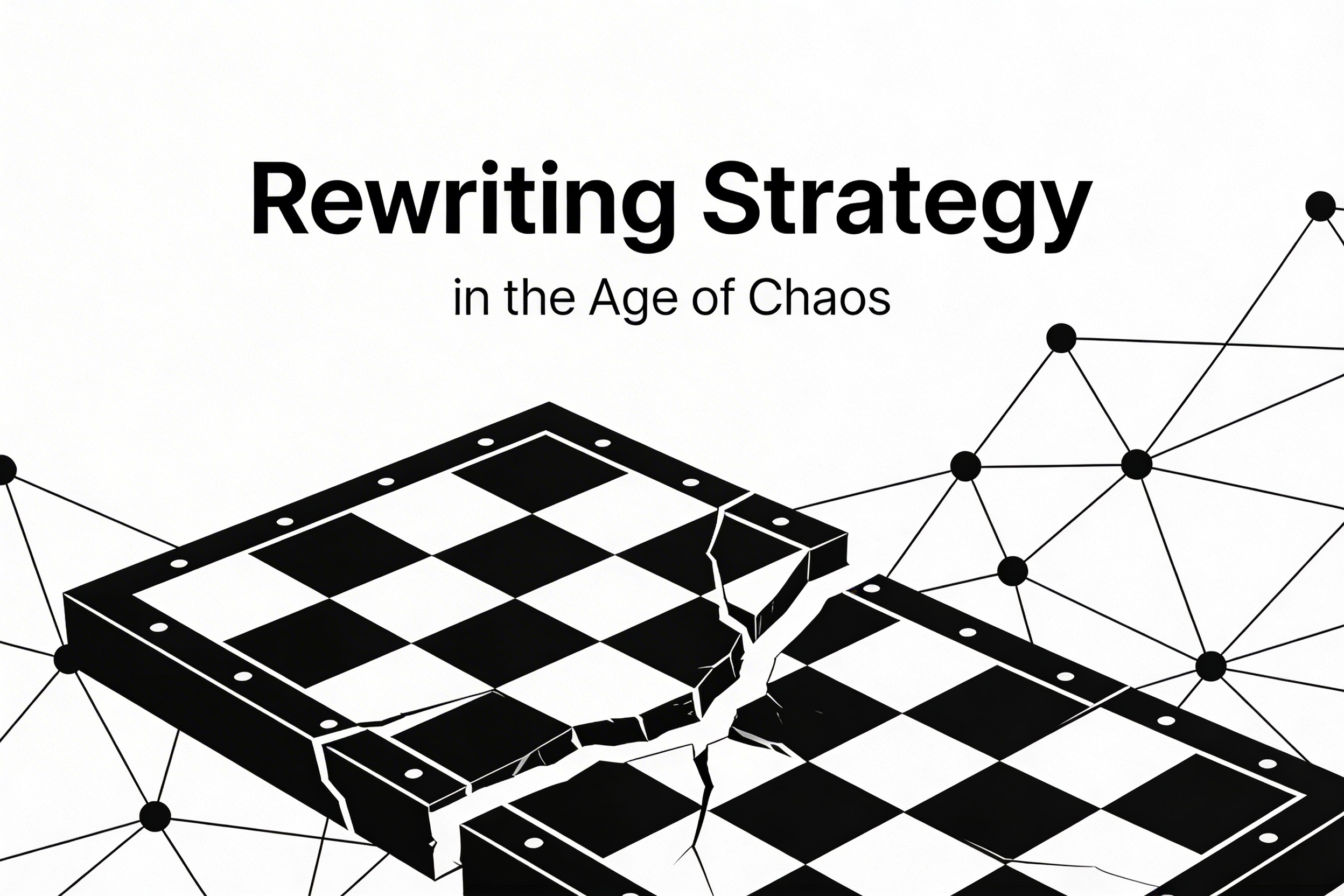
We tend to measure historical change by its products: new weapons systems, new doctrines, new institutions, new alliances.
The question we ask is always some variant of — what changed?
But there is a more fundamental level at which epochal transitions operate, one that most analysts miss or take for granted.
What changes most profoundly in a genuinely epochal transition is not the answers societies hold, but the questions they consider worth asking.
That distinction is not semantic.
It determines whether an analyst working through a period of fundamental change can see what is actually happening, or whether he is merely recording old answers in new language.
I have spent four decades watching Western democracies struggle with strategic transitions — from the Cold War to the post-Cold War, from the post-Cold War to the networked era, and now into what I call the Age of Chaos.
In each of these passages, the deeper failure was almost never a failure of technology or resources.
It was a failure of questions, an inability to abandon the conceptual architecture of the preceding era and inhabit the one actually forming around us.
This piece draws on three intellectual traditions that illuminate why epochal change operates first at the level of questions: Thomas Kuhn’s analysis of scientific paradigms, Michel Foucault’s concept of the episteme, and the philosophy of history’s engagement with epochal consciousness. These are not academic exercises. They are diagnostic tools for understanding the strategic moment we are living through.
Kuhn and the Problem Space
Thomas Kuhn’s The Structure of Scientific Revolutions gave us the language of paradigm shifts, and that language has been so thoroughly popularized that its analytical edge has been largely dulled. What Kuhn actually argued was more precise and more unsettling than the cliché suggests. A paradigm, for Kuhn, is not just a dominant theory. It is an entire operative framework — a set of shared exemplars, standard methodologies, and tacit commitments that defines what counts as a legitimate problem within a discipline. The paradigm does not just answer questions. It generates them. It tells practitioners what phenomena deserve attention, what anomalies can be safely ignored, and what methods constitute valid inquiry.
This means that the deeper transformation in a scientific revolution is not the replacement of one answer with a better one. It is the reorganization of the problem space itself. When Copernicus displaced the Ptolemaic model, it was not simply that a wrong answer was corrected. The entire framework within which astronomical questions had been posed and within which the Ptolemaic answers had been meaningful was dissolved. Newtonian mechanics did not merely answer questions that Aristotelian physics had failed to answer. It made Aristotelian questions mostly irrelevant and constituted a new field of inquiry in which different questions were foundational.
What does this mean for strategic analysis?
It means that periods of genuine strategic transformation are not, at their core, about finding better answers to the questions the previous era asked.
They are about recognizing that the old questions no longer organize the operational and political reality you are trying to understand and about having the intellectual discipline to identify and inhabit the new question space. The United States military spent the first decade after the Cold War largely trying to answer Cold War questions about force structure and forward presence with post-Cold War resources.
The failure was not primarily a resource failure. It was a paradigm failure.
Foucault and the Architecture of the Thinkable
Michel Foucault approached the same problem from a different angle. In The Order of Things, he introduced the concept of the episteme, the underlying structure of a given epoch that defines what can be known, said, and thought within it. The episteme is not a paradigm in Kuhn’s sense, tied to a discipline. It is the deeper epistemological field that shapes an entire culture’s cognitive horizon: what distinctions are self-evident, what problems are urgent, what entities are real.
Foucault’s insight, and it is genuinely powerful even if you resist much of his framework, is that this structure is largely invisible to those living inside it. Participants in a given episteme do not experience their questioning framework as historically contingent. They experience it as common sense, as obvious, as the way things are. The distinctions that the episteme makes possible, between normal and pathological, civilized and primitive, rational and irrational, do not appear as constructed.
They appear as natural. This is precisely why epochal transitions are so disorienting: not because the answers change, but because the framework within which questions had appeared self-evident suddenly no longer holds.
The strategic application of this insight is concrete. Consider the concept of deterrence as it operated during the Cold War. The episteme of Cold War strategy made certain questions thinkable: How do we credibly threaten second-strike capability? How do we manage escalation ladders? What is the minimum force for mutual assured destruction? and made other questions effectively unthinkable or marginal.
Questions about distributed autonomous systems, networked kill webs, the convergence of commercial and military technology, or the strategic implications of real-time global surveillance did not register as primary within that framework. They could not, not only because of technology but because the epistemic architecture of the era organized inquiry differently.
We are living through precisely such a transition now.
The episteme that governed Western strategic thought from roughly 1945 to 2015, built around state actors, formal alliances, industrial-age platforms, and relatively slow information cycles is fragmenting.
The questions it generated are not wrong exactly, but they are increasingly insufficient.
New questions are pressing: about the integration of cognitive and kinetic operations, about the strategic implications of drone proliferation, about the management of what I have elsewhere called the kill web rather than the kill chain, about how liberal democracies maintain coherence in an information environment designed to dissolve it.
These are not refinements of Cold War questions.
They constitute a different problem space.
Epochal Consciousness and the Demand to Re-Ask
The philosophy of history adds a third dimension to this analysis, one that Kuhn and Foucault largely bracket: the experience of living through an epochal transition from the inside.
What does it feel like, institutionally and intellectually, to inhabit the passage between one epoch’s question-architecture and another’s?
The tradition of epochal consciousness, drawing on figures from Karl Jaspers through more recent work in the philosophy of the Anthropocene, suggests that the defining experience of such a transition is a demand — urgent and disorienting — to re-ask foundational questions.
The old frameworks do not disappear immediately. They persist as inherited commitments, institutional structures, professional norms, and analytical habits.
But they lose their capacity to organize emerging reality. Phenomena accumulate that the inherited framework cannot accommodate without distortion. The analyst who remains loyal to the old question-space increasingly produces answers that feel slightly off, technically competent but somehow beside the point.
This is precisely the condition of much Western strategic analysis today.
The frameworks of the post-Cold War liberal international order built around questions of democratization, institution-building, norm diffusion, and the management of failed states have not been refuted by new evidence exactly.
They have been overtaken by a reconfiguration of the fundamental strategic environment.
The emergence of what I call the multipolar authoritarian world in which revisionist authoritarian states operate with sufficient coordination to challenge the assumptions of the liberal order without requiring formal alliance does not fit neatly into the post-Cold War question space.
It requires a different set of questions about strategic competition, about the nature of deterrence in multi-domain environments, about the relationship between internal political resilience and external strategic credibility.
The demand to re-ask is not comfortable. Institutions built around the old question-space resist it. Professional incentives in defense establishments, think tanks, and government favor incremental refinement of existing frameworks over genuine reconceptualization.
The analyst who says ‘we are asking the wrong questions’ is always at risk of being dismissed as a philosopher when what the institution wants is an operator.
But the history of strategic failure and I would argue that the first two decades of the 21st century have provided an extensive case study is largely a history of institutions that answered the old questions very well while the operational reality had already moved on.
The Age of Chaos and the Grammar of Inquiry
I have argued elsewhere that we have entered an Age of Chaos, a period in which the structural conditions that made the post-Cold War order thinkable and manageable have dissolved, and in which the new ordering principles have not yet stabilized.
This is not pessimism. It is a diagnostic claim about the question environment we are operating in.
What unites Kuhn’s paradigms, Foucault’s epistemes, and the philosophy of history’s engagement with epochal consciousness is precisely this: that the deepest transformations in historical epochs occur at the level of what is taken to be a fundamental problem.
The questions a society considers urgent, legitimate, and tractable are not neutral. They reflect and reinforce a particular organization of knowledge, power, and possibility. When that organization fractures — as it is fracturing now — the work of analysis becomes, at one level, the work of identifying which questions are still worth asking and which new questions the emerging reality is pressing upon us.
This is not merely an intellectual exercise. In defense and security policy, the transition between question-spaces has direct operational consequences. The difference between organizing your force around the question ‘How do we sustain a linear kill chain against a peer competitor?’ and the question ‘How do we build a distributed kill web that can operate resiliently under contested conditions?’ is not a difference in doctrine. It is a difference in what kind of force you build, what kind of training you invest in, what kind of industrial base you sustain, and what kind of partnerships you form with allies.
The Indo-Pacific theater is currently the most consequential arena in which this transition is being worked out. The questions that organized U.S. strategy in the Pacific for the first generation after the Cold War, about access, forward presence, and conventional deterrence of a relatively linear Chinese military threat, are being overtaken by a different question space shaped by Chinese anti-access/area-denial capabilities, the proliferation of precision strike, the integration of space and cyber with conventional operations, and the challenge of sustaining allied cohesion across a geographically dispersed theater. Australia, Japan, and South Korea are each, in their own way, navigating this transition between question-spaces and the quality of their analysis depends significantly on whether they have the intellectual discipline to recognize that the old questions, however well-answered, are no longer organizing the strategic challenge they face.
Conclusion: The Stakes of the Question
The claim that epochal change is primarily a transformation of questions rather than answers is not an invitation to abandon empirical rigor. Kuhn’s paradigms are grounded in experimental practice. Foucault’s epistemes are documented through archival analysis. The question-spaces of strategic analysis are accountable to operational reality.
The point is not that answers do not matter. It is that answers are only as good as the questions that generate them and that in periods of genuine epochal transition, the deepest intellectual work is the work of identifying which questions the new reality is actually posing.
We are in such a period.
The Age of Chaos is not a period in which the old answers have been proven wrong. It is a period in which the questions that generated those answers have become insufficient.
The task for strategic analysts, defense planners, and policymakers is not simply to find better answers to the questions the post-Cold War order posed. It is to develop the conceptual discipline to inhabit the new question-space, to ask, with rigor and without nostalgia, what the emerging strategic environment is actually demanding of us.
That is a harder task than it sounds. It requires not just new knowledge but a willingness to hold old frameworks lightly enough that new questions can form.
That is the work of the analyst in an age of epochal transition.
It is also, I would argue, the only kind of analysis that is actually useful in the world we are now living in.
Bibliography
Foucault, Michel. The Order of Things: An Archaeology of the Human Sciences. New York: Vintage Books, 1994. (For episteme and the structuring of knowledge spaces.)
Kuhn, Thomas S. The Structure of Scientific Revolutions. 2nd ed. Chicago: University of Chicago Press, 1970. (For paradigms, normal science, and scientific revolutions.)
Olson, Alan M. “Epochal Consciousness and the Philosophy of History.” In Proceedings of the Twentieth World Congress of Philosophy, vol. 8, 159–172. Bowling Green, OH: Philosophy Documentation Center, 2000.
“Knowledge and Power in Foucault.” The Atlas Society. February 26, 2011. (Overview of Foucault’s concept of episteme as an epistemological field.)