
Air Combat Group: Building the Fight Tonight Force

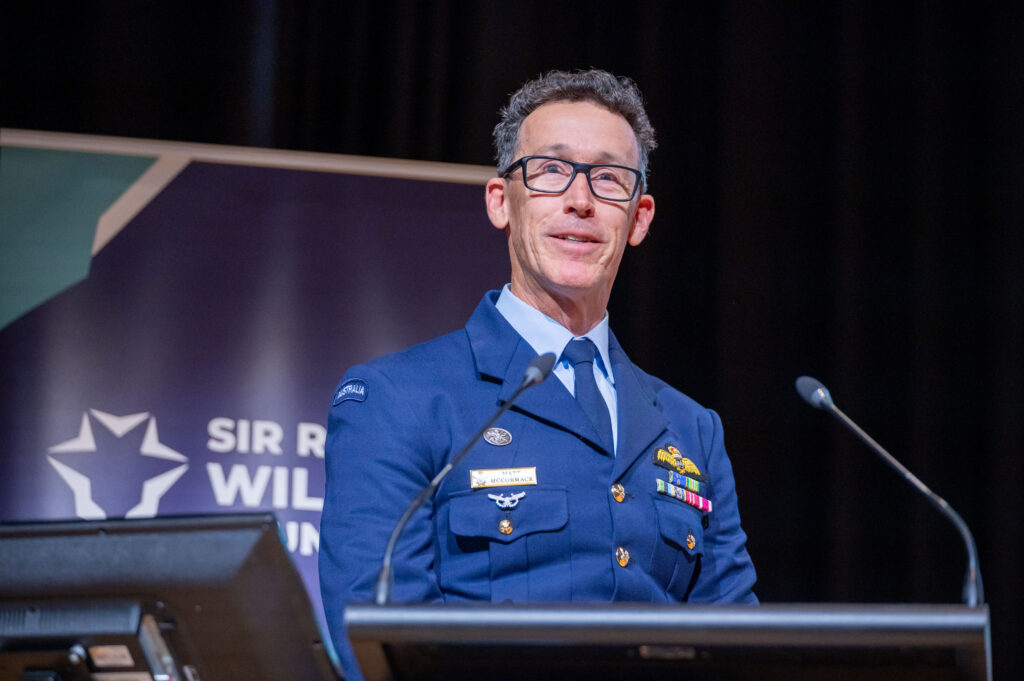
At the Sir Richard Williams Foundation seminar “Fight Tonight: Exploiting Australia’s Strategic Advantage,” AIRCDRE Matthew McCormick, Commander Air Combat Group, delivered what amounted to a practitioner’s manifesto for what it means to build and sustain a credible combat force in a resource-constrained but threat-enriched environment. His remarks were direct, candid, and grounded in the operational realities facing the Royal Australian Air Force today.
McCormick opened with a clear statement of purpose. The Air Combat Group’s mission is to generate and deliver control of the air, strike from the air, and special operations air warfare to an integrated and focused force. That is the task. Everything else flows from it.
And notably, he drew a sharp distinction between aspiration and execution: “We are laser focused on making the most of what we have here.” In an environment where defense budgets are constrained across the Western alliance, that is not a counsel of despair. It is a statement of operational discipline.
The framing matters. McCormick is not describing an Air Force in retreat. He is describing one that has completed its transition phase, the long years of introducing new platforms following the departure of the F-111, and has entered what he called a “period of spiral upgrading.” That is a fundamentally different posture. Transition consumes energy and attention. Spiral upgrading, by contrast, builds on established capability. The F-35 fleet is now the backbone of ACG operations, and the focus has shifted from standing up the platform to maximizing what it can do.
Deterrence Through Demonstrated Competence
McCormick grounded his discussion in the three pillars of the National Defense Strategy: deter, shape, and respond. For Air Combat Group, deterrence is not an abstract policy position. It is something you demonstrate through performance. “We need to maintain the highest standards of any air force in the world, so that we are seen by any potential adversary as a challenge.” The way you do that, he argued, is by showing what you can do across multiple mission roles, at home and abroad, consistently.
This is a point worth underscoring. Deterrence in the contemporary strategic environment is not simply a function of possessing advanced platforms. It is a function of what you can credibly do with them, how quickly you can do it, and whether a potential adversary believes you will. McCormick’s ACG is working systematically to build that credibility, not through press releases, but through demonstrated performance in the most demanding training environments available.
The centerpiece of that effort is participation in the Joint Simulation Environment, the tri-national (US, UK, Australia) synthetic training system operated at Pax River on the U.S. East Coast. The JSE is not designed to be comfortable. It is designed to replicate the fog, complexity, and lethality of high-end combat operations. McCormick was candid about what that means in practice: pilots arrive thinking they know what they are doing and leave the first few mission sets with their confidence appropriately recalibrated. By the end of the week, however, they are performing at a level that places them among the best in the world.
The numbers McCormick cited are sobering and important. The kill ratios that defined the Top Gun era, ten to one, are gone. Against a peer adversary today, the ratio is closer to two to one. For a small air force, that math is unforgiving. It is precisely why ACG is investing so heavily in the most rigorous training environments available, and why the performance of Australian teams in those environments matters so much. At the most recent JSE event, the ACG team achieved the highest score for the year—against a field dominated by US weapons school students and instructors. That result is not incidental. It reflects a culture of preparation and a willingness to be tested against the best.
Shaping Through Partnership
The second pillar — shaping — is where Australia’s geographic position and relationship architecture become decisive enablers. McCormick walked through a regional partnership map that has expanded significantly in recent years. Six Squadron has deployed to India. Relationships with the Japan Air Self-Defense Force are deepening through a series of exercises under the Bushido Guardian banner. Regular interactions continue with Indonesia, Singapore, Malaysia, Thailand, and the Philippines.
The Bushido Guardian series deserves particular attention. What began in 2023 with Australian F-35s deploying to Japan and working with Japanese F-15s has evolved into something qualitatively different. In the most recent iterations, Australian and Japanese F-35s are now operating from a shared base in Japan, co-located with US F-35 forces, at matching security classification levels.
The result is genuine integration, not the old model of an Australian four-ship flying alongside a Japanese four-ship, but mixed-nation formations assembling organically from whoever is airborne. An Australian pilot finds three Japanese or American F-35s in the same piece of sky and they execute together. That is interoperability in its most demanding form.
This capability is being expanded further through Southern Cross, a new activity that will see U.S. and Japanese F-35 forces come to Australia, continuing the close integration work that Bushido Guardian has pioneered. Pitch Black continues to grow as well, with McCormick noting its value not just as a training event but as a statement about Australia’s trustworthiness as a partner: “When the chips are down, they know what they can expect from Australia.”
Underpinning all of this is a significant shift in how tactics are developed. ACG is no longer developing Australian-specific tactics for Australian systems in isolation. It is now embedded in the tri-service standardization boards that develop and publish tactics for platform types across the alliance. When Australian forces need to integrate with partners in the region, the tactics are already shared. The seams that used to complicate coalition operations have been systematically reduced.
Response Readiness and the Pre-Combat Mindset
The response pillar is where McCormick’s remarks took on their sharpest edge. Advanced weapons integration into the ACG fleet is continuing at pace. Agile combat employment, including forward arming and refueling procedures in the top end, is being normalized. ACG is working through how to operate effectively in contested, denied, and operationally limited environments, including scenarios where communications are degraded or cut. The point McCormick made is fundamental: “I just don’t need the JFAC at the time in my cockpit telling me exactly what to do, and we can still execute.” Mission command, not procedural dependence.
But the most important capability, McCormick argued, is people. He was direct about this. Platforms matter, but without the people to operate them at the edge of their capabilities, they are expensive hardware. The culture within ACG, he said, is focused, professional, and, notably, free of the anxiety some express about the younger generation. The people coming through the system today, McCormick observed, put their predecessors to shame in terms of dedication, focus, and the ability to manage complex systems while delivering operationally useful solutions.
The generational element matters for a deeper reason. ACG is working to ensure that the culture of excellence is not dependent on the current cohort of experienced operators. The skill sets and the mindset need to be embedded in the institution, not held by individuals who will eventually leave. That is the difference between a flash-in-the-pan performance and a sustainable combat organization.
McCormick was equally candid about the challenges. The shift from a peacetime Air Force to what he called a “pre-combat mindset”, where the transfer of authorities and responsibilities is calibrated for conflict conditions rather than peacetime governance, is unfinished business. “Coming from an Air Force that is used to lovely governance and safe risk management, a transition to a pre-combat mindset…is what the service and Air Combat Group need to look at to make sure we are not winging it when required.” That is a frank acknowledgment, and it applies well beyond Australia.
The size of the force remains a constraint. Workforce challenges, uniformed, Australian Public Service, and contractor, are eroding the organizational buffer that absorbs the unexpected. And the challenge of remaining sufficiently common with U.S. equivalent platforms, so that spiral upgrades keep ACG interoperable rather than divergent, is a permanent item of concern.
In short, the Australians have a long tradition of doing more with less, of finding asymmetric solutions to resource constraints, and of performing at a level that surprises adversaries and reassures partners. McCormick is not counting on tradition, however. He is building the institutional conditions, the training rigor, the partnership depth, the tactical integration, the cultural continuity, that make that tradition sustainable. That is what a fight tonight force looks like from the inside.