
Australian Defence 2026: The Sir Richard Williams 23 April 2026 Seminar Report
This report argues that Australia must treat “fight tonight” as an immediate, whole‑of‑nation standard and shows how air, maritime, space, industrial and alliance choices over the next few years not the 2030s will determine whether its strategic advantages are realized or squandered.
The report opens by reframing high‑end war from a distant contingency to an urgent planning case for Australia, driven by China’s rapid military build‑up, compressed warning time, and the risk of overlapping crises in Europe and the Indo‑Pacific. “Fight tonight” is defined not as a slogan or checklist, but as a stringent test of what Australia can actually bring to bear and sustain in the opening days, weeks and months of a major conflict, especially if allied bandwidth is stretched. Geography is recast from comfortable buffer to operational problem: a continent‑sized archipelago with vast distances, thin infrastructure and long, exposed lines of communication that must be actively defended and exploited.
From the outset, the report insists that readiness cannot be understood in platform or sortie terms alone but as whole‑of‑nation readiness that reaches into industrial mobilisation, national support bases, critical civilian infrastructure, cognitive resilience and alliance design. Lessons from Ukraine feature heavily, particularly the contrast between societies that invested early in sovereign capacity and adaptation and those that assumed just‑in‑time mobilisation would work in a crisis.
Drawing on the earlier volume Fight Tonight Force and the Williams Foundation’s 2025 seminar, the report distils recurring practitioner themes: deterrence through demonstrated capability; the impossibility of crisis‑only industrial mobilisation; the tyranny of compressed timelines; and the need for forward defence and distributed, multi‑domain operations. Senior ADF logisticians and commanders highlight the national support base, industry, workforce, social cohesion and institutional decision‑making, as decisive to any serious concept of readiness. This pushes planning beyond force‑on‑force models to include airlines, telcos, fuel, port and rail operators as integral elements of defence, whose resilience and crisis decision processes matter directly to combat outcomes.
Industrial mobilisation is treated as a core capability rather than an adjunct. Historical contrasts between U.S. wartime mobilisation and Australia’s pre‑war frustrations, and Ukraine’s eight‑year industrial adaptation after 2014, are used to show that money cannot buy back lost time once conflict begins. The report describes Australia as running a “two‑speed defence economy,” trying to fund both near‑term readiness and big‑ticket recapitalisation through peacetime bureaucratic processes that reward efficiency over surge capacity. It argues that sovereign capability must be deliberately invented—by bringing local firms into supply chains early, accepting managed risk, and prioritising scale and exportability—rather than assembled at the last minute.
Operationally, the Royal Australian Air Force is presented as the leading edge of near‑term “fight tonight” capability, having completed its generational shift to a fifth‑generation force built around F‑35A, Super Hornet and Growler. Air Combat Group’s experience at high‑end exercises and in live operations demonstrates an ability to “get night one right,” but the report is frank about the harder question of sustaining operations into “next week” under missile, drone and cyber attack. Agile basing, hardened shelters, distributed operations and resilient fuel and logistics systems are identified as pre‑conditions for continuing to generate airpower at tempo, not optional extras.
Air Marshal Stephen Chappell frames deterrence as “demonstrated competence,” arguing that continuous proof of the ability to degrade, disrupt, destroy and defeat, through high‑end training, realistic exercises and visible integration with allies, is more persuasive than promises of future capability. His “six Cs” of deterrence — capability, credibility, being comprehended and communicated, collectively and consistently — underscore the cognitive dimension: adversaries must be convinced that Australian and allied forces are real, integrated and politically backed. Uncrewed and autonomous systems such as Ghost Bat and Ghost Shark are presented as critical multipliers that add mass, resilience and reach to a small manned force, absorbing risk that would otherwise fall on irreplaceable crews while amplifying existing platforms rather than replacing them.
The report also stresses the cognitive and political foundations of readiness. It warns that digital technologies and AI may erode attention, judgement and resilience in democracies, just as compressed timelines demand hard decisions at speed. The answer, it suggests, lies in “augmented intelligence” and in deliberately building cognitive resilience, education, training, decision‑making cultures so that commanders and governments can exploit technology without being overwhelmed by it.
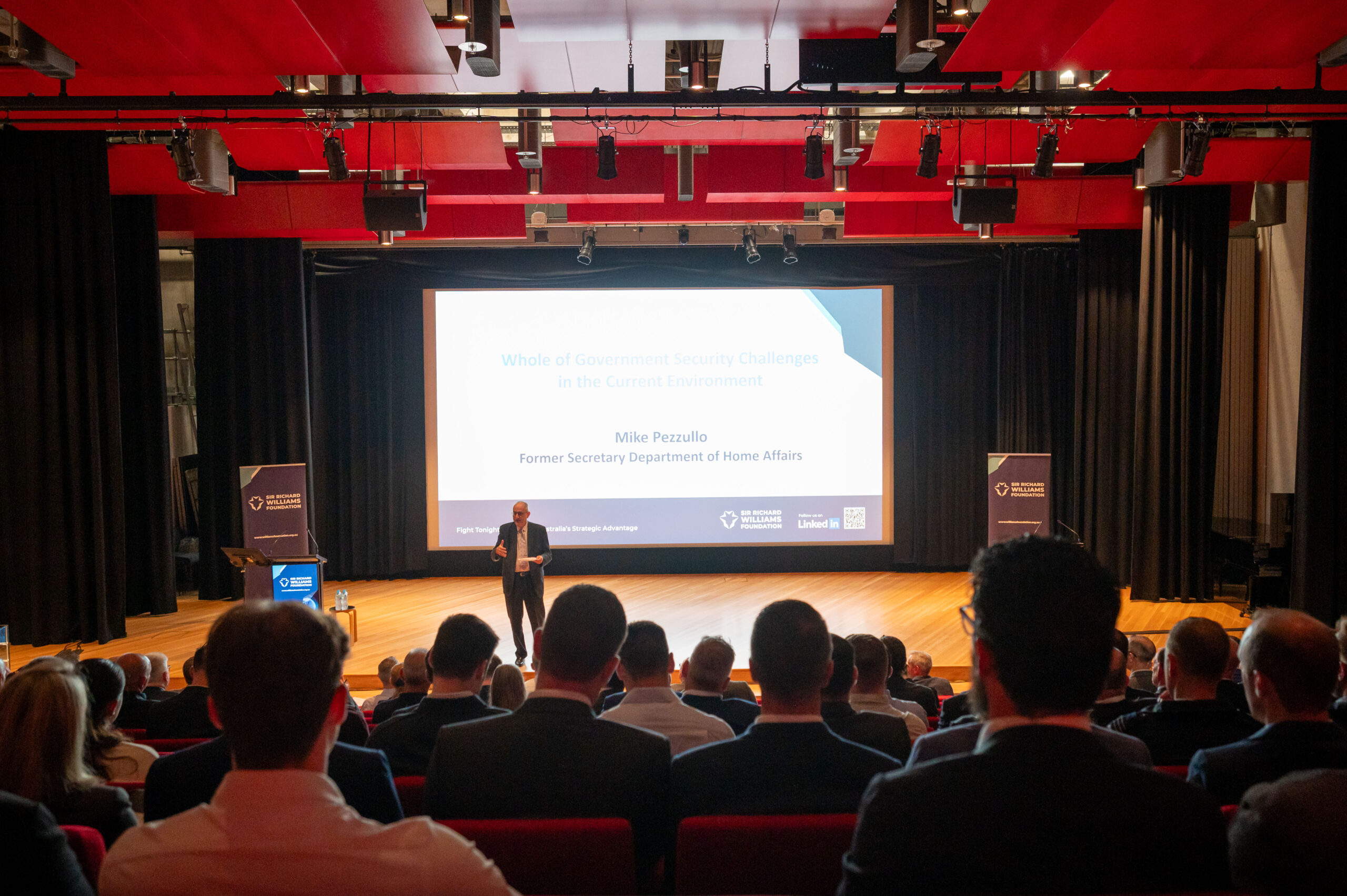
Mike Pezzullo’s intervention provides the report’s sharpest temporal edge. He argues that Australia is preparing for “the wrong war on the wrong timeline,” noting that the dominant ten‑year planning horizon in force‑design documents does not match the window of strategic risk created by PLA modernisation and leadership directives to be ready for a Taiwan option by 2027. Pezzullo assigns a non‑trivial probability to coercive or kinetic scenarios in the 2026–27 timeframe and anchors his “ten‑month clock” in allied intelligence assessments and public statements by U.S. commanders and officials.
His prescription has three main elements. First, commission a modern national “war book” that addresses fuel, pharmaceuticals, critical infrastructure now in private hands, the status of undersea cables and internet connectivity, and the treatment of vulnerable populations in exposed northern cities. Second, restructure diplomacy for a coalition fight in which the United States and China are the principals, with brutally honest conversations in both Beijing and Washington about Australia’s role, command arrangements and expectations. Third, produce a ten‑month readiness plan in parallel with ten‑year recapitalisation, focused on what the ADF can do with what it has now: unit proficiency, platform readiness, munitions stockpiles and the institutional capacity to command and sustain operations under fire.
This “strategic clock” concept is then applied across domains. In air and missile defence, analyst Justin Bronk dissects lessons from Ukraine and recent Gulf operations, debunking the myth of “cheap mass” and highlighting the staggering cost and quantity of interceptors consumed in modern IAMD. He concludes that Australia and its partners cannot afford to buy defensive stockpiles at the scale implied by shoot‑shoot‑look doctrines, and must therefore lean more heavily on passive defence, hardening, dispersal, rapid repair, and offensive precision strike that denies the adversary a theory of victory.
Rear Admiral Matt Buckley’s contribution shows a Navy defined by two intertwined imperatives: availability and lethality. On any given day, around half the fleet is at sea, with more than twenty ships routinely deployed, embodying readiness as practiced behaviour rather than a paper plan. Programs to integrate Tomahawk, NSM, SM‑6 and Aegis Baseline 9 onto surface combatants are turning them from presence platforms into serious contributors to joint deterrence, even as the Navy faces the challenge of expanding by roughly a quarter in people and platforms over the next decade. Buckley’s confidence rests heavily on the quality of personnel, illustrated by Australian nuclear technicians excelling in U.S. training pipelines—an example the report uses to argue that human capital is the ultimate constraint and advantage.
Space emerges as a “fight tonight” domain in its own right. The report notes that any force that loses assured access to space loses the ability to integrate joint effects at scale, and highlights the rapid proliferation of counter‑space capabilities alongside the dominance of commercial constellations. This drives a logic of resilience‑by‑design: hybrid military‑commercial architectures, sovereign control of critical ground infrastructure, and industrial integration that delivers at “commercial speed” rather than traditional multi‑year acquisition tempo.
Industry voices reinforce the centrality of corporate decision‑making to national readiness. BAE’s Kris Christensen introduces a back‑casting methodology, imagining a 2027 crisis and asking what workforce, business and capability decisions leaders will wish they had made in 2026, to test organisational readiness across three axes: workforce (people, clearances, surge capacity), business (contracts, delegated authority, ability to decide at speed) and capability (spares, tooling, dual‑sourced suppliers). Northrop Grumman’s Richard Morris argues that in a zero‑warning world margin must come first, because profits fund investment, investment builds factories, and factories generate combat mass; on this view, Australia’s attractiveness to multiple foreign primes is itself a strategic asset if harnessed to build sovereign capacity before crisis.
All of this is nested within a re‑examined alliance architecture. The report acknowledges fraying post‑Cold War assumptions about uncontested U.S. support and stable institutions and calls for “deliberate incrementalism”: deepening cooperation with the United States and like‑minded partners while preserving national freedom of action. It argues that alliances are a genuine asymmetric advantage only if translated into pre‑positioned stockpiles, shared industrial capacity, realistic combined exercises and frank communication about what each partner can and cannot do. It also stresses the need to build alternative security networks in the region—such as with the Philippines—that complement traditional alliances and spread operational and political risk.
Across its parts, the report converges on a stark choice for Australia. Enhancing the “fight tonight” force is not about achieving a notional state of perfect readiness or relying on a handful of exquisite acquisitions; it is about deciding, in relative peace, to treat defence as a long‑term whole‑of‑society endeavour. That entails treating industrial mobilisation as a core capability and investing early in sovereign capacity even when the peacetime business case is weak; expanding readiness to include national support bases, cognitive resilience and decision‑making institutions; using airpower, uncrewed systems and forward partnerships as pathfinders for distributed, resilient, multi‑domain operations; and shaping alliance structures and regional ties that enhance deterrence while preserving genuine autonomy in crisis decisions.
The seminar and the report do not claim to close the gap between rhetoric and readiness; they aim to define it clearly and to compress the timeline on which it must be addressed.
The underlying message is that Australia can either begin serious industrial and societal preparation now, or accept strategic dependence and improvisation under fire later, a choice that, by definition, must be made before events force the issue.
For a podcast discussing the report, see the following:
For a PDF version of the report, see the following: