Exploiting Australia’s Strategic Advantage: The Panel Discussion at the Williams Foundation Seminar

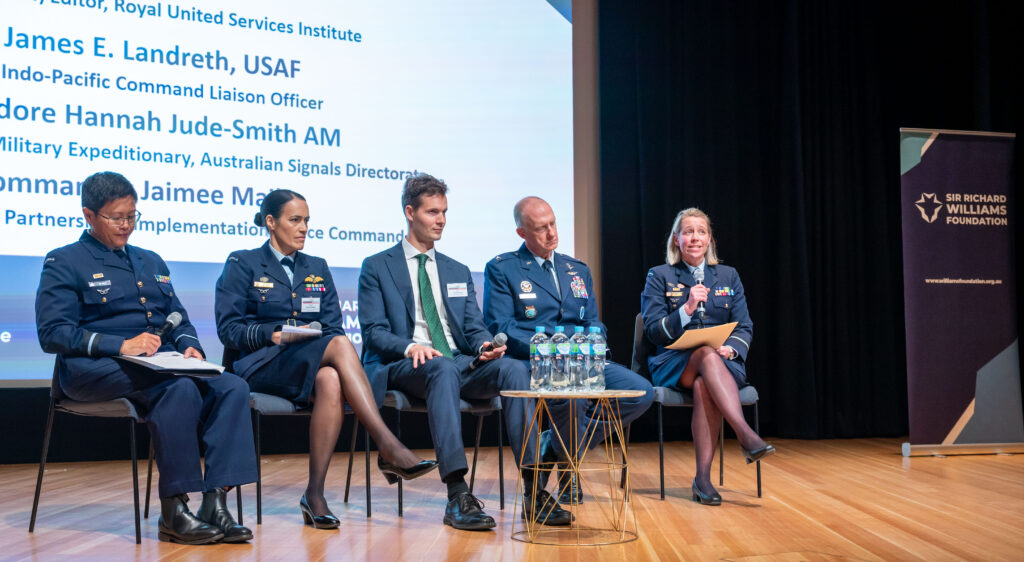
The panel discussion that concluded session two of the seminar brought together practitioners and analysts who have spent careers navigating the intersection of geography, technology, alliance politics, and the hard realities of combat power. What emerged was not a checklist of capabilities Australia needs, but a serious examination of what it means to exploit advantage in a strategic environment where the rules of the game are changing faster than most institutions can adapt.
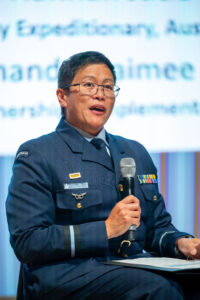
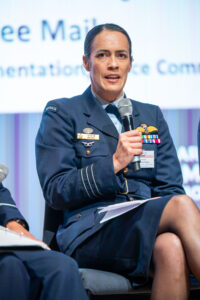
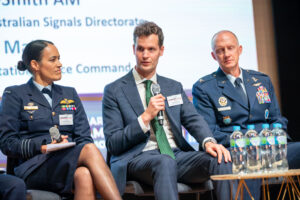
The panel was moderated by AIRCDRE Jo Brick, Director General Pacific in the Strategy Policy and Industry Group. The panelists were Professor Justin Bronk of RUSI, Col James Landreth, the USAF USINDOPACOM Liaison Officer, AIRCDRE Hannah Jude-Smith, Assistant Director General Military Expeditionary at the Australian Signals Directorate, and WGCDR Jaimee Maika, Deputy Director Futures, Partnerships and Implementation at Space Command. Each brought a distinct vantage point. Together they mapped a picture of Australia’s strategic situation that was simultaneously encouraging and demanding.
The Starting Point: What Kind of Advantage?
Professor Bronk opened by making a point that gets under appreciated in much of the strategic commentary about Australia: the relative predictability of the threat axis. Compared to European allies, who face an adversary with multiple potential attack vectors and a vast potential permutation of approaches, Australia’s non-discretionary planning scenarios are more circumscribed. A primarily maritime, air, and missile-based coercive approach from China is not easy to address, but it is at least bounded. That focus is itself a form of strategic advantage. It allows investment and planning effort to be concentrated rather than dispersed.
Bronk also flagged what he called the foundation strength: Australia’s Air Force has recapitalized, meaning the service enters the current period from a position of relative modernization rather than having to simultaneously recapitalize and build new capabilities. That is not a trivial advantage.
In the UK, he noted, the Air Force finds itself in a similar position, while the Army and Navy remain largely irrelevant to the primary attack surface. The challenge and the opportunity is to optimize within that recapitalized force for what the Australian Defence planning documents call the enhanced force in being and objective integrated force phases.
This framing matters because it sets the analytical agenda: the question is not whether Australia has assets, but whether it is organizing, integrating, and operating those assets in ways that translate into credible combat power at the moment of decision. That is precisely what “fight tonight” demands. Not aspirational capability by some future date, but a force that can operate decisively with what it has right now.
Intelligence as the Foundation of Integrated Operations
AIRCDRE Hannah Jude-Smith brought what may have been the most operationally grounded perspective of the panel. As an intelligence officer whose career has moved through electronic warfare, signals intelligence, and cyber, she understands the architecture through which decision advantage is created and sustained. Her emphasis was less on specific capabilities and more on the coherence of the system that delivers intelligence to decision-makers.
Her central argument was deceptively simple: intelligence is not intelligence unless it reaches the right decision-maker at the right time. Data that arrives late, arrives in the wrong format, or cannot be communicated securely across the joint force is not intelligence. It is information that has failed the operational system.

The challenge she identified is the vastness and interconnectedness of the data environment, combined with the difficulty of maintaining secure pathways as partners and connectivity structures change. The technical trust required to sustain those pathways is hard to build and easy to lose.
What struck me about her framing was the emphasis on foundations. In an era when every discussion of defense capability gravitates toward next-generation systems, AI integration, and emerging-domain competition, Jude-Smith kept returning to the primacy of getting the basics right. The force that will succeed is the force that can learn and adapt fastest and learning and adapting fastest requires doing the foundational work well enough, repeatedly enough, that the organization has genuine institutional knowledge rather than just theoretical awareness.
Her comment about Australia’s intelligence community serving as a kind of laboratory for the United States was worth examining carefully. A smaller force, she noted, can trial approaches that the Americans would then take to scale. That is a real contribution to the alliance architecture, and it reflects a broader principle: Australia’s value to its partners is not just about geography or bases or combined logistics.
It is also about the willingness and capacity to experiment, to take risks in the conceptual and operational space, and to generate insights that larger organizations find harder to produce. The ASD’s approach to AI, rolling it out in discrete, bounded scenarios with heavy human-on-loop requirements, building trust incrementally, reflects exactly that experimental orientation.
The electromagnetic spectrum and cyber domains are where information advantage will be won or lost. Jude-Smith’s framing of the challenge there was sobering: as operations in both domains expand, the question of deconfliction becomes critical. How does the force ensure that offensive cyber operations and electronic attack are doing more to the adversary than to itself?
That question does not have a clean technical answer. It requires organizational discipline, shared situational awareness across the joint force, and the kind of continuous exercise and repetition that builds real operational confidence rather than theoretical capability.
Space: From Enabler to Prerequisite
WGCDR Jaimee Maika’s contribution was the most architecturally comprehensive of the panel. Her core argument deserves to be stated plainly: assured access to space is no longer an enabler to advantage. It is a prerequisite for credible combat power.
Any force that loses access to space loses its capacity to integrate joint effects at scale, maintain persistent regional presence, and operate as part of a combined allied architecture. That is not a future problem. It is a current operational reality.
Australia’s geography, which is both its greatest challenge and its greatest advantage, becomes a strategic asset in the space domain in ways that are not always appreciated in the broader strategic debate. The continent provides ideal locations for sensors looking up to space and for the ground segments that allow satellites to connect down. Australia’s southern latitude complements allied space architectures.
Critically, a distributed ground infrastructure across a vast continent complicates adversary targeting and builds resilience into the overall allied architecture in ways that a more geographically concentrated ally cannot provide.
Maika’s point about the evolution required in the partnership model was sharp. The current architecture reflects the U.S. preference for bilateral arrangements, which produces a hub-and-spoke model: each ally connects to Washington, but the spokes do not connect robustly to each other.
That model made sense when the U.S. was clearly the dominant and unchallenged architect of the space security architecture. In the current environment, where the scale of the challenge demands genuine collective monitoring and response across a global network, the hub-and-spoke model creates fragility. Australia, she argued, should be working deliberately to strengthen lateral connections with Canada, the UK, New Zealand, and Japan moving from a hub-and-spoke architecture toward what she called an allied-by-design model.
That framing has implications well beyond the space domain. It captures something important about how the entire allied architecture needs to evolve. The question is not whether Australia can maintain its relationship with the United States. That relationship is foundational and, as Colonel Landreth emphasized, operationally deep and functionally integrated in ways that cannot be replicated. The question is whether the broader allied architecture can develop the resilience and density of connection that a high-end conflict would demand.
The conversation about launch capacity was also instructive. The dramatic reduction in the cost of reaching orbit, two orders of magnitude over the past fifteen years or so, driven primarily by the commercialization of launch through programs that began with NASA’s commercial resupply contracts in 2008, transforms the strategic calculus for space.
Disaggregated, proliferated architectures of smaller, cheaper satellites are inherently more resilient than the large, bespoke, expensive systems that defined the earlier era. Australia’s geography gives it a natural role in the launch and reconstitution architecture. The presence of a capable launch provider in nearby New Zealand is a resource the combined partnership has not yet fully exploited.
The Alliance as Combat Multiplier
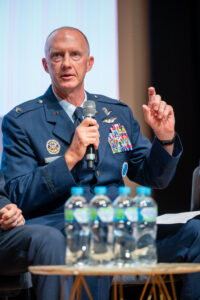
Colonel James Landreth’s contribution was organized around three primers, and he delivered them with the directness of someone who has spent thirty-one years in the Air Force and fifteen years in overseas postings, including multiple tours in Japan, Hawaii, and Korea. His current role as the USINDOPACOM liaison officer to Headquarters Joint Operations Command puts him at the operational seam where the alliance either functions or it doesn’t.
His first primer was the simplest: the U.S.-Australian alliance is an asymmetric advantage that adversaries cannot replicate. That is not rhetoric. The depth of integration, operational, logistical, intelligence, and institutional, reflects a century of shared sacrifice and a level of interoperability that is genuinely not available to authoritarian partnerships built on coercion rather than shared values. That integration enables the combined force to operate at a moment’s notice in ways that require sustained investment to maintain and that cannot be improvised under pressure.
His second primer addressed strategic depth and sustainment. Australia as a theater provides distributed logistics capacity that directly mitigates the tyranny of distance. Pre-positioning critical munitions, fuel, and supplies on Australian soil transforms the operational equation. His point about the integration of industrial bases, transforming Australia into an in-theater maintenance and sustainment hub for allied platforms, reflects a direction of travel that the Enhanced Force Posture initiatives have been developing for years. The question is whether the pace of that development matches the pace at which the strategic environment is deteriorating.
His third primer, on force posture and power projection, identified the Marine Rotational Force in Darwin and enhanced Air Force bomber rotations as key elements of a fight-tonight posture that turns geographic advantage into operational reality. Large-scale exercises like Talisman Sabre which in 2025 involved over 40,000 troops from 19 nations are the mechanism through which combined force readiness is validated and the operational seams are identified and addressed.
His most practical piece of advice, however, was about communication. Clear, correct, concise communication between the two countries at all levels. Knowing what each partner can and cannot do. Being honest in both directions about the gaps in plan execution. That sounds simple. It is not. The institutional habits required to make that communication work under pressure are built over time, through the kind of continuous engagement and repetition that AIRCDRE Jude-Smith was also emphasizing from the intelligence perspective.
Munitions: The Hard Constraint That Cannot Be Reasoned Away
The most consequential exchange of the panel was Professor Bronk’s intervention on munitions. He did not frame it as analysis. He framed it as an imperative: buy as many munitions as you can, as fast as you can.
The logic behind that statement is worth unpacking. For three decades, allied planning for high-intensity conflict has been predicated on the assumption that the United States, with its vast stockpiles and industrial base, would function as the arsenal of last resort. When a coalition ally ran short of critical munitions in an active conflict as has happened repeatedly urgent requests to Washington produced results. C-17s arrived. Common stockpiles were accessed. The bill was paid later.
Bronk’s argument is that this assumption is no longer operationally valid. His evidence was immediate: Estonia, which U.S .Defense Department officials have publicly cited as a model ally, has been informed that GMLRS and Javelin orders it has already paid for will not be delivered on schedule because the United States has decided to retain those munitions for its own requirements. Finland has made unusual public statements preemptively distancing itself from potential supply disruptions—which itself signals that conversations about delivery timelines have been taking place at official levels.
This is not a partisan observation about the current U.S. administration. It is an observation about the structural reality that the United States is now engaged in a level of strategic competition that places its own stockpile requirements in tension with its historical role as the allied arsenal. That tension will not resolve in Australia’s favor automatically.
The implication is that Australia’s munitions requirements at the start of any conflict are effectively its munitions requirements for the duration of that conflict. Planning around resupply from US stockpiles is planning around an assumption that may not hold.
That reality connects directly to the broader question of industrial base integration that Colonel Landreth raised. The goal is not just pre-positioning existing U.S. stocks in Australia. It is building the in-theater maintenance and production capacity that gives the combined force operational sustainability in an environment where trans-Pacific resupply cannot be assumed.
AI Integration: Capability, Caution, and the Institutional Challenge
The discussion of artificial intelligence was the most technically complex part of the panel, and the most philosophically interesting. Three distinct perspectives emerged.
AIRCDRE Jude-Smith described an approach characterized by disciplined incrementalism: rolling out AI tools in discrete, bounded scenarios with heavy human-on-loop requirements, building institutional trust through experiential learning, expanding the scope of application as trust accumulates. ASD’s AI mentorship program helping individual officers apply AI tools practically to their specific roles reflects a bottom-up approach to building organizational capability that takes the institutional trust dimension seriously. The risk she identified is not the technology. It is the governance: ensuring that AI is used within the bounds of what the government expects, in ways that the intelligence community and the public can trust.
Colonel Landreth’s perspective was pragmatic. The United States is pursuing AI in every domain, and INDOPACOM is actively using AI tools in exercise assessment. His emphasis was on the accountability question: AI is a tool, and the officer who acts on AI-generated analysis remains accountable for the decision. The cautionary note he raised was about synchronization across the enterprise, the risk that one part of the joint force moves fast on AI integration while another part does not, creating operational desynchronization at exactly the moment when coherent joint action matters most.
Bronk’s contribution was the most challenging. He raised three structural problems with AI as a source of military advantage that deserve serious engagement.
First, AI cannot account for what is not digitizable. A significant portion of human knowledge, particularly the tacit knowledge embedded in experienced practitioners, the institutional memory of organizations, the contextual understanding that comes from deep engagement with a specific operational environment, has never been digitized and therefore does not exist as far as any AI system is concerned. Decisions that depend on that knowledge cannot be reliably delegated to AI.
Second, the data quality problem is getting worse, not better. The accelerating production of LLM-generated content is degrading the data sets on which AI systems are trained. The more of that content exists, the less reliable the underlying data, and the less able human reviewers are to check AI outputs against independent knowledge. The optimistic response that AI will improve fast enough to overcome this problem assumes that the improvement will outpace the degradation, which is not self-evidently true.
Third, and most fundamentally: AI does not provide an asymmetric advantage if the adversary has it too. China has AI. China has very large data sets. China is investing heavily in AI integration across its military. In the cyber domain, where AI applications are most immediately relevant, an Australian or allied system that is doing something the Chinese are not doing is a target for intelligence collection and reverse engineering. The speed at which capabilities can be copied in the digital domain is orders of magnitude faster than in the physical domain.
None of this argues against AI integration. It argues against the kind of naive optimism that treats AI as a technological fix for institutional problems, a substitute for hard thinking, or a source of sustainable advantage independent of the human and organizational systems that employ it.
Whole of Government: The Hardest Problem
The discussion of whole-of-government approaches revealed what is perhaps the deepest strategic challenge Australia faces. The technical and operational questions, how to integrate space, cyber, intelligence, and kinetic effects into a coherent joint architecture, are difficult but tractable. The institutional and social questions are harder.
Jude-Smith’s observation about the gap between the national security community and the broader Australian public was honest and important. Australia has not experienced the kind of direct, persistent geographic threat that would naturally generate popular engagement with defense preparedness. Most Australians feel secure. That security is itself partly a product of the strategic architecture, geography, alliances, capable defense forces, that sustained investment has created. But it also means that the case for sustaining and expanding that investment has to be made in the absence of visible, immediate threat.
She pointed to the NDS as a coalescing framework that at least creates the vocabulary for a whole-of-government conversation. The challenge is extending that conversation into other government departments and ultimately into the broader society. Finland and Sweden were cited as models, countries where mature, straightforward conversations from political leaders about specific, bounded threats have enabled whole-of-society preparedness. The precondition for that kind of political courage, as Bronk noted, is a military with robust plans and credible capabilities that politicians can point to as the foundation of the national response.
That is the chain of responsibility: capable forces make political leaders more willing to have honest conversations with their publics;. Honest conversations with the public generate the political support for maintaining capable forces.
Breaking into that loop requires someone to go first. The Williams Foundation seminar is one of the mechanisms through which that conversation gets started. The hard work of extending it belongs to everyone in the room.
The Southern Approaches: Information Depth as a Substitute for Geographic Depth
One of the most analytically interesting exchanges came on the question of Australia’s southern approaches. A question from the floor noted that what has traditionally been a geographic advantage, the remoteness and vast oceanic expanse between Australia and Antarctica, is being eroded by the extension of adversary reach.
Jude-Smith’s response reframed the problem productively: if geographic depth is being compressed by longer-range systems, the answer is to build information depth. The more comprehensively Australia can lay intelligence sensors on the southern approaches, classified and unclassified, Five Eyes and third-party partners, the more decision time it creates. Knowing what is happening in advance, and knowing it with enough confidence to act on that knowledge, is a form of strategic depth that cannot be taken away by a longer-range missile.
Bronk’s contribution to that exchange was characteristically concrete. He identified specific capabilities, the Long Range Anti-Ship Missile integrated into Australia’s Super Hornets and being integrated into the F-35, along with the broader stockpile of advanced munitions, as tools that create genuine operational problems for a Chinese maritime task force or submarine operating close to Australian shores without the overlapping land-based coverage it would have within the first island chain. The P-8 maritime patrol program was cited as a mechanism for maintaining maritime situational awareness across an area of responsibility of enormous scale. Australia’s position, he suggested, is better than many in the strategic debate acknowledge.
That is not a counsel of complacency. The munitions stocks that make those capabilities credible require sustained investment to maintain. The intelligence architecture that turns them from a potential capability into an operational reality requires the kind of foundational work that Jude-Smith was describing. The partnership architecture that backs them up requires the deliberate investment in communication, integration, and trust that Colonel Landreth was emphasizing. But it is worth noting that the foundation is real, and the question is whether Australia has the strategic clarity and institutional discipline to build on it.
Concluding Assessment
What this panel conveyed, cumulatively, is a picture of a country with genuine strategic advantages that require active work to exploit and that can be eroded by complacency, under-investment, or institutional failure. Geography is a fact, but it is not a strategy. Partnerships are a foundation, but they require constant maintenance. Recapitalized forces are a starting point, but they need to be organized and operated in ways that translate into integrated combat power.
The fight-tonight standard is demanding precisely because it closes the gap between capability and readiness. It requires not just the right platforms and weapons, but the right behaviors, the right training regimes, the right intelligence architectures, the right communication habits between allies, and the right munitions stockpiles.
Each of those elements is manageable in isolation. The challenge is managing them simultaneously, as a coherent system, under the pressure of a strategic environment that is not going to wait for the Australian defense establishment to finish its organizational debates.
AIRCDRE Jude-Smith’s emphasis on behaviors as the fundamental variable captures something important. The force that learns and adapts fastest will be the more successful force. That applies at every level, from the individual intelligence officer applying AI tools to their specific analytical problems, to the joint task force commander integrating effects across space, cyber, and kinetic domains, to the alliance managers maintaining the communication discipline that makes combined operations possible.
The task now is to translate that thinking into the operational realities that fight tonight demands.