
The Royal Australian Navy and the Fight Tonight Imperative: RADM Matt Buckley at the Williams Foundation Seminar

The Sir Richard Williams Foundation seminar, “Fight Tonight: Exploiting Australia’s Strategic Advantage,” held at the National Gallery of Australia in Canberra on April 23, 2026, brought together a significant gathering of Australian and allied defense professionals.
Among the most substantive presentations of the day came from Rear Admiral Matt Buckley, Acting Chief of Navy, who offered a clear-eyed and operationally grounded account of where the Royal Australian Navy stands today and where it must go. His remarks were not the abstract strategic musings one sometimes encounters in these settings. They were a practitioner’s assessment, shaped by three decades at sea, much of it in the submarine force.
Buckley opened with an observation that sets the tone for everything that follows in Australian maritime strategy: what has changed is not Australia’s fundamental dependence on the sea, but the degree of contestation within it. “Access that could once be assumed can no longer be taken for granted,” he said.
For a nation whose prosperity is carried on the ship’s deck as much as it is dug from the ground, that shift from assumed access to contested access is strategic in the deepest sense. An adversary need not attack Australia directly to impose strategic harm. Disrupting sea lines of communication would be sufficient. That is the vulnerability Buckley’s Navy is organized to address.
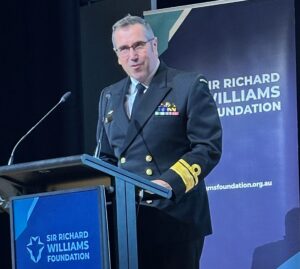
The framing Buckley offered is worth unpacking, because it reflects a more sophisticated understanding of deterrence than the one that often dominates defense discourse. Deterrence, in his formulation, is not a single platform or a single capability. It is an integrated, all-domain effect generated by persistent posture and credible lethality.
The two variables that matter most for a navy are availability and lethality. A ship that is lethal but not available does not deter. A ship that is available but lacks credible lethality invites challenge. The Navy’s task, then, is to hold both dimensions simultaneously.
As he spoke, 23 ships were at sea and more than 1,600 sailors were deployed roughly half the fleet underway at any given moment. Over the course of the year, the weekly brief the Chief of Navy receives never shows fewer than ten ships at sea, and can surge above thirty. That is a sustained operational tempo that compares favorably with global peers. It is readiness as a practiced reality, not a planning assumption.
And it is the product of exactly the kind of discipline, technical competence, and engineering rigor that Buckley argued must be prioritized over speed for its own sake. “Doing things right is doing them fast,” he said, a formulation he credited to his engagement with U.S. Naval Reactors. When systems are introduced properly, maintained correctly, and integrated deliberately, readiness can be meaningfully sustained. When corners are cut, speed is illusory and fragility follows.
Buckley’s account of what the Navy has accomplished through the Enhanced Surface Combatant Lethality Program makes the case in concrete terms. Over the last two years, the RAN has integrated the Tomahawk land attack cruise missile onto its surface combatants, providing long-range strike that holds high-value targets at risk. The Naval Strike Missile delivers survivable long-range maritime strike. SM-6 enhances integrated air, surface, and missile defense. And the Aegis Baseline 9 upgrade to the Hobart-class destroyers will enable simultaneous multi-domain engagements in complex threat environments.
These are not conceptual ambitions. They are operational realities delivered on today’s platforms, at pace and with relevance to the actual threat environment. The surface combatants that once served primarily as presence platforms are being transformed into genuine contributors to joint and integrated deterrence.
What makes this noteworthy is the sequencing logic Buckley articulated. Australia does not have the luxury of stopping the use of what it currently operates in order to begin operating what comes next. The transition from the fleet in being to the future fleet, Mogami-class frigates, Hunter-class frigates, Virginia-class and AUKUS SSN submarines, is a methodical process of complementing today’s capability and then, over time, replacing it.
The same logic applies to remote and autonomous systems. The Ghost Shark extra-large UUV, the C2 robotics UUVs and the Blue Bottle remote surface vehicle are not replacing ships and submarines. They are extending them, increasing persistence, presence, and deterrence while reducing risk to personnel. These systems complicate adversary planning in ways that matter strategically. They expand sensing and awareness. And they are being introduced as part of an integrated force operated by sailors, not as standalone curiosities.
Underneath all of this lies the workforce challenge, and Buckley did not minimize it. The Navy must grow by approximately 25 percent in people and platforms within a decade, roughly 4,000 additional personnel, or 4,500 counting the reserve force. He described the challenge plainly: you have to operate the trains efficiently and effectively while building a whole bunch of new railroads.
The complexity of the platforms involved makes this more than a numbers problem. It is a professionalization and integration challenge. And yet Buckley’s confidence in the force was evident and evidenced. He described receiving a signal the night before from the United States: a young Australian sailor, a nuclear technician in just her second year, had achieved the highest score ever recorded at U.S. Nuclear Power School for a sailor of her category. The Americans are putting up a plaque. It is a small story, but it carries a lot of weight. Australia’s strategic advantage in the maritime domain rests first and foremost in its people.
The partnerships dimension of Buckley’s remarks deserves attention, particularly given the seminar’s focus on exploiting Australia’s strategic advantage. He was direct about the strategic logic: partnerships are necessary but not sufficient. Credibility within alliances depends on national contribution. A more capable, resilient, and self-reliant Australian Defense Force does not mean one that acts alone—it means one that brings something to the table.
The realization of Submarine Rotational Forces West, at HMAS Stirling, is the operational expression of that logic. Buckley described personally witnessing Australians, Americans, and Brits conducting extensive maintenance on Virginia-class and Astute-class submarines alongside each other over the last twelve months. That interoperability is not achieved by aspiration. It is achieved by practice by operating, exercising, deploying, and sustaining with allies and partners, consistently, over time.
What emerges from Buckley’s presentation is a picture of a Navy that understands the strategic moment it is in and is moving with both discipline and urgency to meet it. The National Defense Strategy’s three objectives — deter, shape, respond — are not abstractions for the RAN.
They are the organizing logic for everything from fleet availability rates to workforce development pipelines to integration with the joint force and allied navies. The fleet in being is ready, integrated, and credible. The transition to the future fleet is underway. The question is whether the broader Australian defense enterprise, industrial base, workforce development, sustainment infrastructure, political will. can sustain the pace that strategy demands.
The Williams Foundation seminar exists precisely to pressure-test these questions in a setting where practitioners, strategists, and industry leaders can engage honestly. Buckley’s presentation was a contribution to that effort in the best sense: grounded in operational reality, clear about what the Navy can deliver today, and honest about the scale of the transition required.