
Training as the Key Proving Ground for AI Enablement
Article Summary:
The article’s most original contribution is its focus on operational preparation rather than operations themselves. Conversational AI transforms training by enabling rapid iteration of planning scenarios (wargaming), generating adaptive adversaries (“Red Teams”), and broadening the exploration of multi-domain options that would be impossible to rehearse at scale in traditional exercises. It draws on U.S. Army CGSC experiments (November 2025), Johns Hopkins APL’s GenWar initiative, and French exercises (ORION, Topaze) to argue that the same infrastructure used in peacetime training can seamlessly transition to live operations, closing the gap between preparation and execution, serving the “Fight Tonight” imperative. The article also highlights predictive logistics as an under appreciated dimension: AI-assisted wargaming can help commanders internalize the logistical consequences of tactical decisions before they are made.
Many observers report the use of AI in the planning of recent military operations conducted by the United States, from Absolute Resolve in Venezuela to Epic Fury in Iran. This use was officially confirmed by the commander of US CENTCOM, Admiral Cooper.
Several systems have been used, such as Maven Smart Systems, whose impact is described as a catalyst for the shift from linear engagement chains (“kill chains”), corresponding to the intelligence–decision–action chain in French doctrine—toward networked architectures (“kill web”), akin to the concept of collaborative combat. These developments have notably served to accelerate the operational loop, traditionally described by the six phases “find, fix, track, target, engage, assess.”
This evolution is part of the broader framework of multi-environment, multi-domain (M2MC) and multi-domain operations (MDO), which aim to synchronize actions across all environments—land, air, sea, space, and cyberspace—to produce convergent effects at the decisive time and place.
Whereas joint operations still relied largely on coordination between distinct components, M2MC/MDO tends to blur these boundaries in favor of functional integration, in which sensors, effectors, and command systems are linked in near real time.
General Toujouze, former Commander of Land Forces and Operations and currently Director of the Land Observatory at the Mediterranean Foundation for Strategic Studies (FMES), summarizes this ongoing revolution and virtuous cycle as follows:
This structuring of military operations around data serves as an efficiency multiplier within the concept of Multi-Domain and Multi-Field Operations (M2MC, or Multi-Domain Operations, MDO). This concept is based on the integration of combat across traditional military domains—land, sea, and air—or special domains, supplemented by the new fields of space, cyberspace, and influence. The data revolution makes this possible.
The former “command and control” of the armed forces is evolving into a command system that addresses all components of C5ISR, integrating within a single framework and in real time the challenges of pure command (formulation, decision-making, and transmission of decisions), control (ensuring accurate interpretation of events on the ground and managing their effects), communication (real-time links between actors and, now above all, a continuous flow of digitized data transmission), processing (databases), and intelligence, surveillance, and reconnaissance (organization of all systems capable of capturing information on the adversary).
The combination of massive data collection, the organization of data flows to bring them back, and the establishment of massive processing centers, powered by AI-backed algorithms, is becoming the primary asset of modern warfare. The question of the appropriate level of autonomous and/or sovereign, and/or sufficient control over this combination is at the heart of the debate.
Conversational artificial intelligence as a tactical learning tool
Beyond its contributions to information processing, conversational artificial intelligence opens up new possibilities in the field of operational readiness by transforming the very methods of tactical learning.
Traditionally, the training of staffs and units relies on planned exercises, the complexity of which depends heavily on available resources, the time devoted to preparation, and the ability to simulate a credible operational environment. In this context, the exploration of courses of action (COA) is often constrained, both by the limited number of scenarios studied and by the time required to develop them.
The introduction of tools based on large language models significantly alters this dynamic. By enabling operators to query operational, doctrinal, or logistical databases using natural language, these systems facilitate access to relevant information and, above all, allow for the rapid generation of multiple courses of action from a given situation.
In a training context, working from a given tactical scenario, a section leader or staff officer could thus test various possible maneuvers in a matter of minutes, exploring their logistical implications, potential effects in other domains (cyber, electromagnetic, space), and associated risks. Whereas a traditional exercise allowed for in-depth exploration of a limited number of options, conversational AI opens the door to a much broader exploration of the range of possibilities.
Recent experiments conducted within the U.S. armed forces show, for example, that AI-assisted “wargaming” not only accelerates the pace of the exercise but, more importantly, significantly expands the number of options explored and their effects, while reinforcing planners’ doctrinal understanding, as described in an article published in January 2026 titled “AI-Enabled Wargaming at the U.S. Army Command and General Staff College: Its Implications for PME and Operational Planning”:
Recent U.S. military experiments highlight this potential. The U.S. Air Force’s ‘Decision Advantage Sprints’ exercises used AI to simulate human-machine collaboration in wargames, thereby reducing evaluation time from several hours to just a few minutes. Similarly, the GenWar initiative at the Johns Hopkins Applied Physics Laboratory (JH APL) uses large-scale language models (LLMs) to automate the generation and review of scenarios, thereby addressing the highly labor-intensive nature of traditional exercises. At the U.S. Army Command and General Staff College (CGSC), where faculty have spearheaded the integration of AI into military training, similar innovations led to a war game exercise in November 2025, during which AI not only increased throughput but also fostered a deeper doctrinal application among novice planners. ( …)
The [U.S.] Army faces a clear imperative. AI-based war games must become the default method in all CGSC planning exercises starting with the 2026–2027 academic year. This echoes the institutionalization of the military decision-making process three decades ago. Professional military training must teach every field officer three fundamental skills:
- The design and management of augmented retrieval agents using platforms such as Vantage [editor’s note: the U.S. Army platform];
- Prompt and context engineering to incorporate doctrinal constraints;
- Rapid validation and overriding of AI results, including the detection of hallucinations.
This capability for rapid iteration is of particular interest in the context of multi-domain, multi-theater operations (M2MC), characterized by increasing complexity and the need to coordinate effects across multiple domains simultaneously. As highlighted in the doctrinal literature, this complexity is not additive but multiplicative: each option considered can have repercussions across multiple domains, making the assessment of consequences particularly cognitively demanding. In this context, conversational AI can serve as a comprehension-assistance tool, enabling faster visualization of interactions between domains and the identification of second-order effects.
Beyond generating options, these tools can also help enhance simulation systems by introducing more responsive and adaptive adversaries. By leveraging models capable of generating plausible behaviors, it becomes possible to expose trainees to enemy reactions that are less scripted, closer to operational reality, and therefore more effective for training.
Lieutenant Colonel Eric Wismar, a military chaplain and founder of the Connecticut National Guard’s AI working group in the United States, describes the impact of AI in the field of simulation and wargaming as follows:
The integration of AI into war games and crisis simulations is transforming professional military education (PME) by introducing real-time adaptability, autonomous adversaries, and predictive analytics. Traditional war games rely on pre-established scenarios with fixed outcomes, which limits their ability to replicate the complexity of modern warfare. AI, on the other hand, dynamically adjusts scenarios based on participants’ decisions and adversaries’ responses, thereby creating an evolving, data-driven training environment.
Autonomous AI-driven “Red Team” simulators outperform traditional instructor-led adversary models by using reinforcement learning and neural networks to mimic real-world enemy decision-making. These AI-based systems analyze intelligence in real time, adjust force postures, and generate adaptive dilemmas, forcing Air Force personnel to develop strategic agility. (…)
AI will transform leadership training by tracking decision-making styles, communication patterns, and stress responses, thereby providing instant feedback on command effectiveness. (…)
To mitigate these risks, professional military training must ensure a balanced integration of AI and human elements while upholding ethical standards and cybersecurity. To maximize the benefits of AI while mitigating its potential drawbacks, leadership training should focus on:
- A balanced collaboration between AI and humans: AI must enhance, not replace, human expertise, preserving leadership intuition and ethical decision-making.
- Rigorous ethical and cybersecurity measures: AI executives must prevent automation biases, misinformation, and over-automation to ensure the reliable integration of AI.
- Continuous and incremental AI innovation: training curricula must adopt AI ecosystems capable of evolving in step with technological advancements and global threats, to avoid stagnation and ensure cutting-edge military training.
Finally, one of the most significant contributions lies in the possibility of establishing a form of continuous dialogue between the operator and the system. Whereas traditional simulation tools often provide static results, conversational AI allows users to question, clarify, challenge, or rephrase an analysis. This interaction fosters a more active engagement with the lessons learned and helps develop key skills, such as the ability to articulate an intention, explain a line of reasoning, or challenge a recommendation.
However, this evolution is not without its challenges. By facilitating access to structured recommendations, these tools could also pose a risk of cognitive dependence or automation bias, particularly among less experienced users. Their integration into training systems therefore requires appropriate doctrinal and pedagogical guidance, aimed at making them aids to judgment rather than substitutes for decision-making.
This analysis aligns with the recent conclusions of related studies—the Atlantic Council’s Transatlantic Security Initiative in partnership with NATO’s Office of the Chief Scientist—which emphasize the need to integrate artificial intelligence into the core of command and control architectures, while developing the human skills necessary for its use. Viewed in this light, conversational artificial intelligence is not limited to a performance optimization tool, but becomes de facto an instrument for training tactical reasoning, capable of profoundly transforming the way forces prepare to decide and act in increasingly complex and uncertain environments.
This approach to expanded training is, moreover, part of a trend already evident in recent military exercises—whether conducted by U.S. forces, NATO, or the French armed forces—where the dimensions of support, maintenance, and operational risk management (ORM) are now fully integrated into the scenarios. Exercises such as Orion or Topaze on the French side, as well as NATO initiatives like Steadfast Defender, or U.S. exercises such as Project Convergence, are no longer limited to tactical maneuvers alone: they aim to test the forces’ ability to sustain operations in a contested environment, by incorporating constraints related to equipment availability, logistics flows, repairs in degraded environments, and the vulnerability of support chains.
The French armed forces have, in fact, begun testing this expanded integration during exercises such as ORION 23, whose Phase 4 had already been explicitly designed as a “true logistical challenge” entrusted to a divisional support group tasked with continuously providing resupply, medical support, and maintenance for the engaged division. Subsequent iterations, such as ORION 26—a high-intensity joint exercise mobilizing the entire defense establishment, extend this approach by testing the forces’ ability to sustain operations and regenerate deep in the theater.
As for the Air and Space Force, exercises such as Topaze have served as a testing ground for “regeneration bases” bringing together forces and industry to test, under degraded conditions, systems for maintaining operational readiness as close as possible to the forces. These mechanisms thus reflect a growing awareness of the central role of support in operational performance across the entire defense industrial and technological base.
In this context, conversational artificial intelligence could serve as an additional lever to better understand and mitigate this operational risk by enabling training stakeholders to more systematically explore the interactions between tactical decisions and support constraints, anticipate second-order effects on operational readiness, and iteratively test workarounds or adaptation strategies.
Ultimately, the goal is to use AI-assisted training to reinforce a form of cognitive reflex that fully integrates logistical and technical considerations into operational decision-making.
On the U.S. side, experimental campaigns such as Project Convergence are already integrating next-generation command and control capabilities, combining AI, data analysis, and predictive logistics to test the sustainability of operations in a contested multi-domain environment. In such a context, a conversational assistant could become a tool for logistical “wargaming,” enabling the systematic testing of the impact of tactical choices on the duration of the engagement and the robustness of the MCO.
The goal of achieving a Common Operating Picture (COP)—that is, a shared, real-time representation of the situation—now more than ever incorporates predictive maintenance, especially when operations are extended over long periods. Colonel Tyler Olsen (U.S. Army) explains the lessons learned in this area from the Convergence Capstone 5 project:
“During the final phase of the Convergence project (Capstone 5), soldiers and commanders tested a new way of fighting, in which decisions were not based on time-delayed reports, but on real-time data transmitted through a digital infrastructure called ‘Next Generation Command and Control’ (NGC2).
The Army’s latest doctrine clearly explains why this is important. Field Manual 4-0, “Sustainment Operations,” identifies predictive logistics as a doctrinal imperative, essential for precision support, decision-making mastery, and resilience in contested environments. The manual advocates shifting from reactive resupply to anticipatory support, where commanders and support officers use integrated data and forecasting tools to maintain operational tempo and range. In the context of large-scale combat operations (LSCO) , this shift is critical because forces capable of anticipating needs and acting faster than the enemy will maintain their momentum.
NGC2, initially developed as part of an experimental initiative under the Army Futures and Concepts Command, is now entering a prototyping and acquisition phase as the core architecture designed to realize this vision. Its goal is to integrate data, artificial intelligence (AI), and resilient communications within a single decision-support framework. For logistics commanders, this means moving from a fragmented, delayed, unit-based reporting system to a common operational picture that is timely, accurate, and actionable. It is important to note that the role of NGC2 in predictive logistics is still under development. The Army is actively testing the system with the 4th Infantry Division (4ID), refining its capabilities and concepts as it prepares for the Convergence Capstone 6 project.
It is precisely this gradual integration of support requirements into tactical decision-making that AI-assisted training tools now make it possible to systematize. This marks a major shift from reactive support to proactive support, which is now at the heart of operational performance.
From Operations to Training: Toward System Continuity
When transposed into training environments (simulators, LVC systems for “Live, Virtual, Constructive”. AI-assisted “wargaming”), the scenarios used effectively allow for multiple iterations of planning and decision-making, and thus enable much more intensive training of leaders’ “cognitive muscles”—including under pressure—in the spirit of command by intention.
The diagram below illustrates this evolution by depicting the shift in cognitive effort driven by artificial intelligence. Whereas, traditionally, the bulk of human work focused on data collection and processing, AI now makes it possible to largely automate these tasks, allowing operators to refocus their attention on higher levels of the cognitive hierarchy: situational understanding, formulation of intent, and sharing of that understanding. In both operational and training contexts, this relative reduction in the data-related workload paves the way for enhanced tactical reasoning and decision-making.
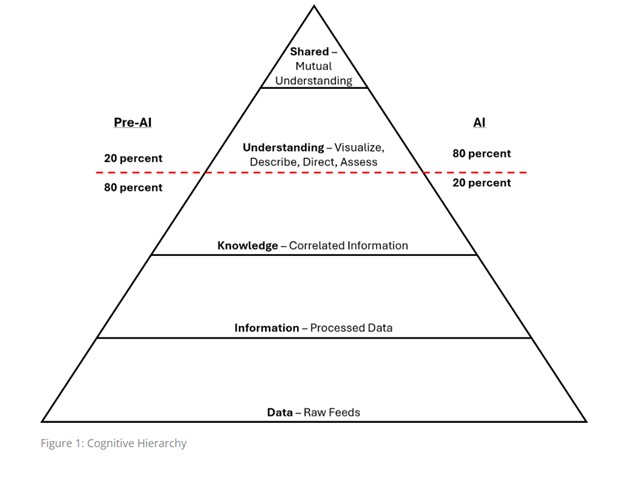
© Modern War Institute at West Point
This evolution directly sheds light on the transformations observed in training systems. From this perspective, conversational AI is not so much a doctrinal revolution as a powerful facilitator of this transformation: by streamlining the flow of information and accelerating the generation of options, it helps transform sequential chains into networked architectures capable of simultaneously exploiting multiple opportunities across different domains. Combat thus becomes not only “network-centric” but fully “data-centric,” with data now serving as the linchpin between perception, decision-making, and action.
If units have a better understanding of the situation and can rapidly identify options, they can act more effectively in line with the commander’s intent, even in a distributed operational environment.
Conversational artificial intelligence is not an isolated capability, but the human interface layer of a system in full convergence, linking decision support, autonomous systems, and M2MC/MDO orchestration. By enabling operators to interact in natural language with complex architectures, it makes a combat system that has become intrinsically “data-centric” scalable.
The same infrastructure can thus be mobilized in peacetime for operational readiness—by injecting simulated data streams—and then switched to “live” mode during operations, which helps align training and actual deployment very closely. This continuity between training and operational deployment is undoubtedly one of the most transformative developments in these systems, bridging the traditional gap between preparation and actual action, and meeting the “Fight Tonight” (“be ready now”) requirements that the new international environment increasingly imposes on armed forces.
This, in turn, implies a profound transformation of force training, which must increasingly incorporate a form of AI literacy, as well as operational readiness and preparedness in this domain (“AI Readiness”). This implies not merely training specialists, but familiarizing all levels of command and operators with AI-based decision-support systems: understanding the limitations of the models, the ability to query data, interpret recommendations, and, where necessary, challenge them.
This evolution is now explicitly addressed in allied guidelines, with NATO emphasizing in its revised AI strategy the need to develop human competencies enabling the responsible and effective use of these technologies, while U.S. forces are gradually integrating these tools into their training and experimentation programs to familiarize decision-makers with an environment where decisions are increasingly co-constructed with machines.
By aggregating information more quickly, AI clearly has the potential to save lives—through greater strike precision and automatic enforcement of rules of engagement; however, this growing role of AI within military decision-making reignites an ethical debate, as reflected in recent exchanges between the Pentagon and the company Anthropic.
For the original French article, see the following:
Bibliography
AD2S Bordeaux. 2026a. “Haute Intensité: Préparer le MCO de Combat Côté Industrie.” https://ad2s-bordeaux.com/index.php/fr/actualites/archives-actualite/126-podcast-ad2s-haute-intensite-preparer-le-mco-de-combat-cote-industrie.
AD2S Bordeaux. 2026b. “ORIONIS 26: Le MCO Aéronautique à l’Épreuve de la Haute Intensité.” https://ad2s-bordeaux.com/index.php/fr/actualites/archives-actualite/129-orionis-26-le-mco-aeronautique-a-lepreuve-de-la-haute-intensite.
Chief Digital and Artificial Intelligence Office (CDAO). 2026. “Pathway to AI Readiness: Workforce Training.” U.S. Department of Defense. Accessed 2026. https://www.ai.mil/About/Resources/Pathway-to-AI-Readiness-Workforce-Training.
DefenseScoop. 2026. “U.S. Military Using AI against Iran in Operation Epic Fury, Adm. Cooper Says.” March 11, 2026. https://defensescoop.com/2026/03/11/us-military-using-ai-against-iran-operation-epic-fury-adm-cooper.
Delaporte, Murielle. 2020. “VOLFA 2020: Preparing Bodies and Minds.” Opérationnels, October 28, 2020. https://operationnels.com/2020/10/28/volfa-2020-preparer-les-corps-et-les-cerveaux.
Eurosatory. 2026a. “Cubic Defence UK: Maîtriser un Champ de Bataille Aujourd’hui Dominé par l’Intensité des Feux Grâce à un Système d’Entraînement Intégré.” https://www.eurosatory.com/cubic-defence-uk-maitriser-un-champ-de-bataille-aujourdhui-domine-par-lintensite-des-feux-grace-a-un-systeme-dentrainement-integre.
Eurosatory. 2026b. “Cubic Defence UK: Maîtriser un Champ de Bataille Aujourd’hui Dominé par l’Intensité des Feux Grâce à un Système d’Entraînement Intégré (II/II).” https://www.eurosatory.com/cubic-defence-uk-maitriser-un-champ-de-bataille-aujourdhui-domine-par-lintensite-des-feux-grace-a-un-systeme-dentrainement-integre-ii-de-ii.
Eurosatory. 2026c. “Soutenir la Prise de Décision Militaire Grâce aux Avancées des Technologies de Modélisation et Simulation.” https://www.eurosatory.com/soutenir-la-prise-de-decision-militaire-grace-aux-avancees-des-technologies-de-modelisation-et-simulation.
Joint Warfare Centre (NATO). 2026. “AI Reshaping Military Wargaming.” https://www.jwc.nato.int/article/ai-reshaping-military-wargaming.
Kunertova, Dominika. 2026. “How NATO Can Integrate AI to Prevail in Future Algorithmic Warfare.” Atlantic Council, March 30, 2026. https://www.atlanticcouncil.org/in-depth-research-reports/report/how-nato-can-integrate-ai-to-prevail-in-future-algorithmic-warfare.
Mingus, James, and Zak Daker. 2026. “Ascend the Cognitive Hierarchy—Don’t Waste Time in the Data Layer.” Modern War Institute at West Point, February 10, 2026. https://mwi.westpoint.edu/ascend-the-cognitive-hierarchy-dont-waste-time-in-the-data-layer.
Ministère des Armées. 2023. “ORION 23, Phase 4: L’Opération d’Envergure.” Updated 2023. https://www.defense.gouv.fr/operations/actualites/orion-23-phase-4-loperation-denvergure.
Ministère des Armées. 2026. “ORION 26: Grandes Évolutions d’ORION 2023.” Updated 2026. https://www.defense.gouv.fr/operations/actualites/orion-26-grandes-evolutions-orion-2023.
Olsen, Tyler D. 2026. “NGC2 at the Tactical Edge: Enabling Predictive Logistics for Decision Dominance.” U.S. Army, January 29, 2026. https://www.army.mil/article/290032/ngc2_at_the_tactical_edge_enabling_predictive_logistics_for_decision_dominance.
Opérationnels. 2026. “De Topaze à ORION 26: Vers une Préparation Opérationnelle Intégrée.” February 13, 2026. https://operationnels.com/2026/02/13/de-topaze-a-orion-26-vers-une-preparation-operationnelle-integree.
U.S. Army. 2022. “Project Convergence 22: Sustaining the Future Fight.” 2022. https://www.army.mil/article/261643/project_convergence_22_sustaining_the_future_fight.
Wild Blue Yonder (Air University). 2025. “Future-Proofing PME: How AI Is Redefining Adaptive Wargaming and Strategic Readiness.” By Eric A. Wismar. June 20, 2025. https://www.airuniversity.af.edu/Wild-Blue-Yonder/Article-Display/Article/4221801/future-proofing-pme-how-ai-is-redefining-adaptive-wargaming-and-strategic-readi.
Williams, Timothy J., Anthony A. Joyce, Seth Lavenski, Jody Colton, Regina Ebell, and Tyree Meadows. 2026. “AI-Enabled Wargaming at the U.S. Army Command and General Staff College: Its Implications for PME and Operational Planning.” Small Wars Journal, January 16, 2026. https://smallwarsjournal.com/2026/01/16/ai-enabled-wargaming-cgsc.
YouTube. 2026. “The Military AI Running America’s Fight with Iran – Maven Sandboxx.” Video, March 27, 2026. https://www.youtube.com/watch?v=7rR-PlHut2w.
Toujouse, Bertrand, Lieutenant General (2S). 2026. “C2 and Decision-Making Processes.” Revue Défense Nationale 2026, no. 887 (March): 29–34. https://www.defnat.com/sommaires/sommaire.php?cidrevue=887.
Conversational AI and Intent Based Command: Training at the New Frontier of Command