
Guam’s Missing Link: Why the Logistics Gap Undercuts the Webs of Security, Deterrence, and Kill
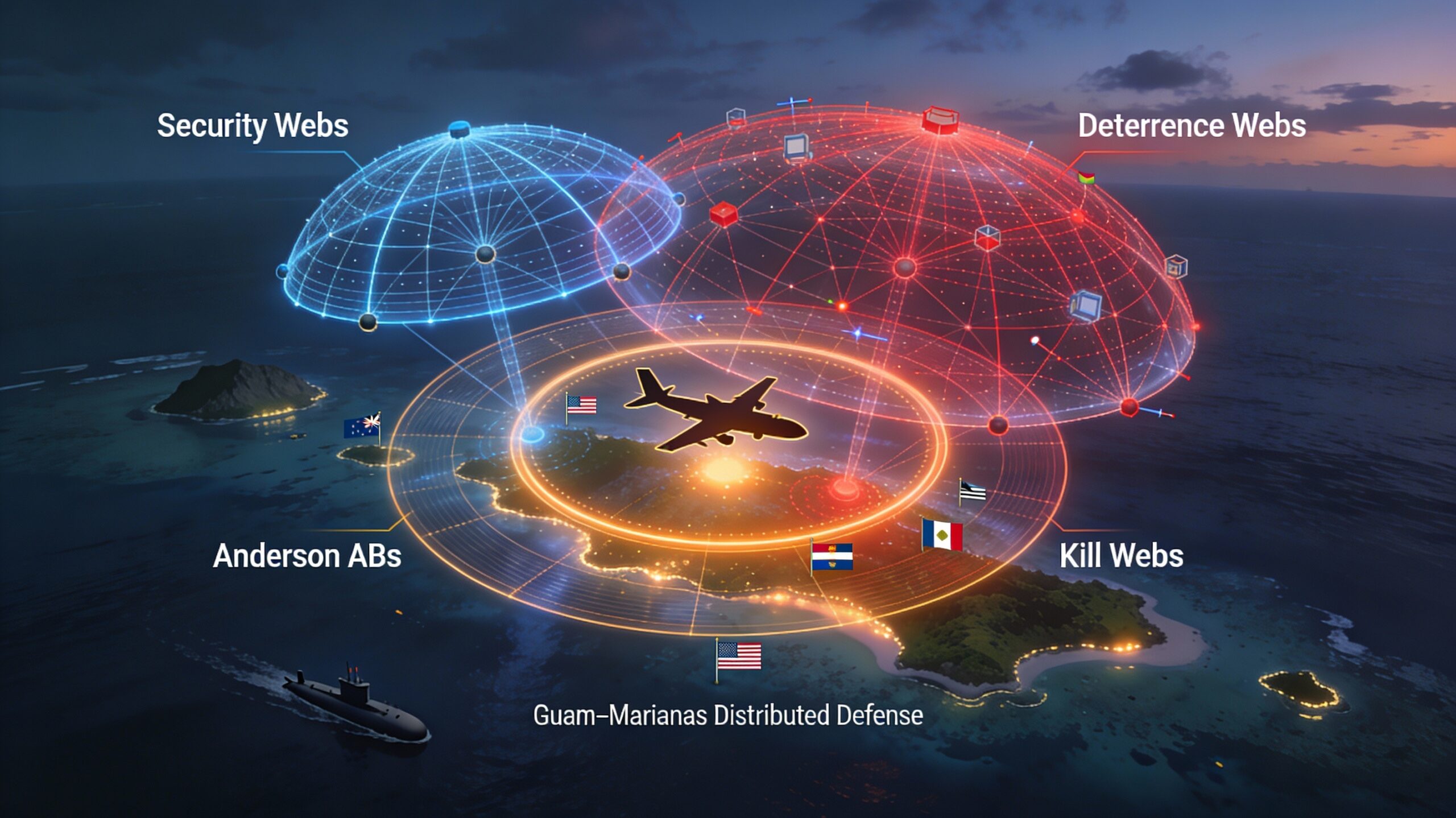
Guam’s transformation from a fixed forward base into a resilient network node rests on three interlocking architectures: security webs that let forces survive and regenerate under attack, deterrence webs that complicate an adversary’s planning and impose costs on aggression, and kill webs that turn distributed sensors and shooters into a faster decision cycle than the enemy can match. We have also argued, going back to our 2013 book on rebuilding American military power in the Pacific, that Guam has evolved from one vertex of a Cold War strategic triangle into a coordinating hub within a distributed engagement zone stretching across the Marianas.
A recent analysis published by CIMSEC, written by Lieutenant Crispinus “Cris” Lee and Commander Joe Schwartzstein of the Navy Reserve’s Strategic Sealift Officer Force, forces a hard look at whether that architecture can actually be sustained. Their argument, stripped to its essentials, is that the Port of Guam and the island’s broader logistics infrastructure are nowhere close to what a Pacific conflict would demand, and that no amount of clever operational concept-building compensates for a port that cannot move enough cargo, store enough fuel, or berth enough ships.
It is worth taking their case seriously, not because it invalidates the webs framework, but because it identifies precisely where that framework’s foundation is weakest.
The Webs Framework Assumed Logistics Would Follow
When we laid out the security web, deterrence web, and kill web architecture, we treated logistics and sustainment as the “unglamorous foundation” beneath all three. Hardened infrastructure means little if forces cannot be resupplied. Distributed shooters cannot sustain tempo without fuel, munitions, and spare parts positioned where they are needed. Allied integration multiplies capability only if the ports, airfields, and depots exist to receive it. We wrote that logistics architecture determines operational reality more than platform capabilities or clever operational concepts, and that Guam’s evolution demonstrated what must be built to enable distributed operations rather than simply hoped for through efficiency gains.
The CIMSEC piece takes that assumption and tests it against numbers, and the numbers are not encouraging. The Port of Guam, the island’s only deep-water port, handles roughly 85,000 to 86,000 containers a year, moves through four piers along 2,700 feet of linear wharf space, and relies on three rail-mounted gantry cranes that are four decades old. That is a peacetime civilian and light-military logistics footprint. It is not remotely close to a wartime sealift footprint. Lee and Schwartzstein point out that during the Gulf War and Operation Iraqi Freedom, the United States needed to move well over a million tons of breakbulk and containerized cargo annually to sustain a large land campaign against an adversary with essentially no ability to contest the sea or air lanes of communication. Even multiplying Guam’s current throughput tenfold would not match what TRANSCOM moved in a single year of either Iraq campaign, against a far less capable opponent than the one Guam’s defense architecture is built to deter.
This is the kind of comparison that practitioners find clarifying and briefing-slide strategists find inconvenient. It is one thing to describe Guam as a “coordinating hub” in a distributed network. It is another to ask whether that hub can actually move the tonnage a Taiwan contingency would require, under fire, without allied or contested sea lines of communication behind it.
The Falklands Analogy, and Why It Cuts Both Ways
The CIMSEC authors reach for the Falklands War as their closest historical analogue, and it is an instructive choice for anyone thinking through the webs framework. Argentina fielded a capable air force and navy against a diminished Royal Navy operating 8,000 nautical miles from home, with Ascension Island as the only forward staging point. Ascension had no real port, only a jetty and an anchorage, yet it sustained roughly 30,000 British service members through more than 13,000 helicopter and fixed-wing sorties, moving thousands of tons of fuel, ammunition, and equipment. The loss of a single ship, the MV Atlantic Conveyor, wiped out most of the force’s heavy-lift helicopter capacity in one stroke.
Lee and Schwartzstein cast Guam as the Ascension Island of a Taiwan contingency, with Taiwan playing the Falklands. The analogy is useful, but it actually understates the challenge in one important respect and overstates it in another. It understates the challenge because, unlike Ascension, Guam itself sits inside the threat ring. The authors are right that Chinese conventional and, potentially, nuclear-capable missiles can strike Guam directly, not merely the ships and aircraft flowing through it. That is precisely the vulnerability our security web analysis addresses: the Guam Defense System’s 360-degree layered air and missile defense, the earth-covered munitions magazines, the distributed fuel storage, the hardening investments meant to let infrastructure survive and regenerate rather than simply absorb a first strike.
But the analogy also somewhat overstates the challenge, because it treats Guam as a single node the way Ascension was a single node. Our argument, and Under Secretary of the Navy Hung Cao’s framing during his own visit to Guam and the Marianas, has been that the addition of Saipan, Tinian, and Rota expands the operational area by more than eighty percent, creating dispersion options Ascension never had. A distributed logistics architecture across the Marianas is not the same problem as a single overtaxed jetty in the South Atlantic. The security web concept exists precisely to prevent the Ascension Island scenario, where degrading one node cascades into total mission failure.
Even so, dispersion across the Marianas does not solve the problem CIMSEC is actually raising, which is aggregate throughput, not just single-point vulnerability. Spreading inadequate capacity across four islands instead of one does not create adequate capacity. This is where the logistics critique lands hardest on the webs framework: distribution is a survivability strategy, not a capacity strategy. The two have to be pursued together, and right now only the first is receiving serious institutional attention.
What the Numbers Say About Prepositioning
The most damaging part of the CIMSEC analysis, from my vantage point, concerns prepositioning rather than daily throughput. Prepositioned stocks exist so that combatant commanders do not have to wait weeks for equipment and supplies to transit from the continental United States to a crisis theater. The Army’s prepositioned stock facility at Leghorn in Livorno, Italy, maintains roughly 750,000 square feet of humidity-controlled warehouse space across sixteen buildings. Guam has nothing comparable, and the authors argue persuasively that it could not easily build something comparable without addressing power generation, water treatment, road infrastructure, and pier space simultaneously.
Consider the specifics. The U.S. military currently draws on about a fifth of the island’s electrical power, and Guam’s own power authority has acknowledged difficulty keeping its aging plants reliable even at that level of demand. Any serious expansion of prepositioned stocks, humidity-controlled warehousing, refrigeration, security lighting, would compete directly with civilian electrical capacity that is already strained. Guam’s water utility recently settled with the Environmental Protection Agency over Clean Water Act violations tied to an aging and overburdened sewage system. The Department of Defense’s own report to Congress has flagged inadequate bridges, flood-prone roads, and tight corners as obstacles to moving heavy equipment around the island. None of this is exotic or classified information. It is the kind of unglamorous infrastructure reality that gets skipped over in strategic PowerPoint decks because it does not photograph well next to a B-2 on the Andersen flight line.
This is precisely the terrain our chaos management argument is meant to address, but it also exposes where that argument has been more aspirational than operational. We have written that forces which can continue operating despite disruption gain decisive advantage over forces that require stable conditions to function. That principle holds.
But continuing to operate despite disruption still requires enough capacity in the system before disruption occurs. A kill web with insufficient fuel, insufficient spare parts, and insufficient pier space to receive prepositioned equipment is not resilient. It is merely distributed and empty.
Why This Reinforces Rather Than Refutes the Webs Argument
None of this means the security web, deterrence web, and kill web framework is wrong. It means logistics has to be understood as a fourth architecture running underneath and through the other three, rather than as a supporting function that gets addressed once operational concepts are settled. This is consistent with what we have argued elsewhere: that Guam’s transformation demonstrates strategic geography intersecting with military transformation only when practitioners, not just planners, force institutional change by confronting operational necessity directly.
The Lee and Schwartzstein analysis is itself an example of practitioner-driven clarity. A Surface Warfare Officer who served aboard USS Cole and USS Gladiator, and a Strategic Sealift Officer who holds a Coast Guard First-Class Pilot license, are not writing from a briefing-slide vantage point. They are writing from the vantage point of people who have to actually move ships, cargo, and fuel through constrained infrastructure under real-world conditions. That is exactly the kind of ground truth that has shaped our own approach to Guam over the past decade, whether through interviews with Marines relocating from Okinawa, submarine support facility expansion at Naval Base Guam, or the practitioner accounts embedded in our broader work on military transformation.
Their recommendations, in fact, track closely with what a mature security web and kill web architecture would require. They call for expanding the Port of Guam to handle four Ultra Large Container Vessels simultaneously, dredging berths to forty-five feet, adding 250 to 300 acres of container storage, and building sufficient Roll-on/Roll-off berthing and marshaling space, on the order of 500 to 900 acres, to approach what TRANSCOM actually moved during the Gulf War. They call for tanker berthing sufficient to handle the Department of Defense’s daily fuel throughput requirements, additional harbor tugs, and expanded familiarization training for the Navy Reserve’s harbor pilot detachment. These are not abstract asks. They are the specific, measurable infrastructure investments that would let the security web’s hardening and redundancy principles actually apply to sustainment rather than stopping at munitions storage and communications links.
The Civilian Dimension Sharpens, Rather Than Softens, the Case
There is also a civilian dimension here that deserves more attention than it typically receives in defense-focused writing, including our own. The Port of Guam handles roughly ninety percent of the island’s civilian imports and serves more than half a million residents of Guam and Micronesia. Any wartime mobilization of the port for military sealift would, as the CIMSEC authors bluntly note, effectively shut down civilian resupply for an island population that already lives inside the threat ring of Chinese precision-strike systems. This is not a footnote. It is a design constraint that has to shape how prepositioning and port expansion are planned now, in peacetime, rather than discovered as a crisis unfolds.
This reinforces a point we have made about Guam’s civilian dimension more generally: that planning which ignores civilian well-being, environmental impact, and infrastructure continuity will generate friction that constrains operational effectiveness regardless of military necessity arguments. A port expansion that treats civilian throughput as an afterthought to be sacrificed in wartime is not a resilient design. It is a single point of failure with a population attached to it.
What Should Change
If the webs framework is going to describe operational reality rather than aspiration, three things need to happen, and none of them are new ideas so much as overdue commitments.
First, port and sealift capacity has to be funded and built at the scale the CIMSEC analysis specifies, not at the scale that current appropriations comfortably allow. The federal government’s existing plans to expand the Port of Guam to accommodate four Ultra Large Container Vessels, additional Roll-on/Roll-off berths, and product tankers are a start, but the acreage and dredging requirements Lee and Schwartzstein lay out are considerably larger than what is currently funded. This is a case where the deterrence value of visible, funded construction may matter as much as the eventual capability, because adversary planners watching Guam’s port expansion are themselves calculating whether a contested logistics fight is winnable.
Second, prepositioning has to be treated as an infrastructure problem before it is treated as a stocking problem. Power generation, water treatment, and road capacity are the actual constraints on whether Guam can host meaningful prepositioned stocks, not the availability of the equipment itself. This means Guam’s civilian utility investments and its military logistics investments are now the same investment, and should be planned and funded that way rather than through separate defense and territorial budget processes that rarely talk to each other.
Third, allied logistics integration deserves the same attention we have given to allied operational integration. Japan, Australia, and Singapore already contribute to Guam’s deterrence web through exercises, rotational forces, and interoperability investments. Extending that cooperation into shared sealift capacity, regional port access agreements, and distributed fuel and munitions storage across the broader alliance network would do for logistics what allied fighter detachments and submarine operations already do for deterrence: multiply capacity without requiring the United States to build everything unilaterally on a single, exposed island chain.
Chaos Management Requires Enough to Manage
We have argued that the strategic shift underway across the Pacific is a move from crisis management, which tries to prevent disruption through deterrence and perfect defense, toward chaos management, which accepts disruption as inevitable and builds resilience to operate through it. That shift is correct, and Guam remains the clearest existence proof of it in the American defense architecture.
But chaos management is not the same as operating on empty. A security web without adequate fuel storage, a deterrence web without the sealift to sustain the forces it postures forward, and a kill web without prepositioned munitions to feed distributed shooters are not resilient architectures. They are elegant frameworks waiting on infrastructure that does not yet exist.
The CIMSEC analysis by Lee and Schwartzstein does not undercut the case for security webs, deterrence webs, and kill webs around Guam and the Marianas. It identifies, with the specificity that only people who have actually moved ships and cargo can provide, exactly where that case has to be made good on before the next contingency arrives rather than during it.
That is the unglamorous work ahead, and it deserves the same sustained attention we have given to the more visible elements of Guam’s transformation into a distributed hub for Pacific defense.
Guam and the Marianas: Engineering Resilience Through Security Webs, Deterrence Webs, and Kill Webs