
The Informal Empire and Its Hard Edge: Extending the Argument to China’s Military Reach
For the past several years, Western policymakers have comforted themselves with a story: that economic interdependence with China would eventually civilize the relationship, that trade would do the work diplomacy could not, and that rising Chinese power would express itself the way past rising powers did, through fleets, flags, and borders redrawn by force.
Ken Maxwell and I did not write our new book, The Australian, Brazilian, and Chinese Dynamic: An Inquiry into the Evolving Global Order, to confirm that story. We wrote it because that story is wrong, and because getting it wrong is expensive for every resource-exporting democracy, not just the two we studied most closely.
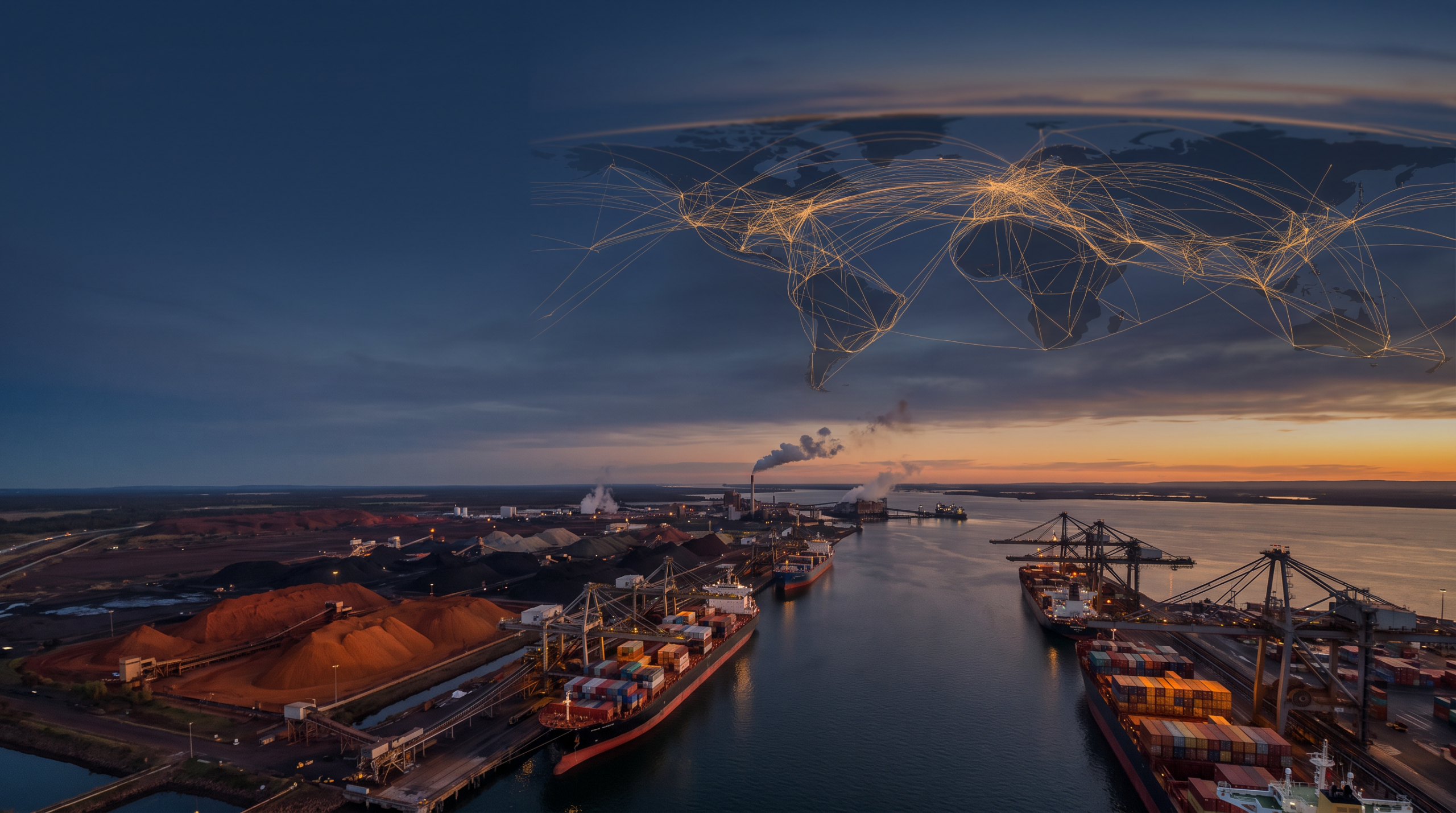
China is not building an empire the way empires have historically been built. What China has built instead is quieter and, in some ways, more durable: a structure of dependence assembled out of ore refineries, container terminals, shipping contracts, and processing monopolies, an architecture engineered so that the cost of defying Beijing rises steadily over time, while the cost of accommodation quietly disappears into the ordinary texture of doing business.
We call this China’s informal empire. It does not need to conquer anyone. It only needs patience, and enough control over the chokepoints of trade that most nations find resistance an increasingly difficult case to make to their own citizens.
To understand how this actually works, not as theory but as lived national experience, we built the book around a close comparison: Australia and Brazil. Two democracies. Two resource-rich, commodity-exporting economies in the Southern Hemisphere. Two nations that share a great deal structurally, and that nonetheless arrived at different points on the spectrum between resistance and accommodation. That is not a verdict on either country’s character or wisdom.
It is a case study in how differently the same architecture of dependence can play out depending on the specific commodities involved, the alliances already in place, and decades of prior investment that neither country’s current leadership fully controls.
But the book also contains, in places where it functions as supporting evidence rather than as the argument itself, the raw material for a second and harder question: what happens when that same architecture of dependence turns out to be the physical substrate of something else entirely, the logistics grid, the intelligence-collection network, and the forward-basing structure of a rising military power?
That question deserves its own treatment, and I take it up in the second half of this article, after laying out what the book itself establishes.
Retiring a Useless Term
Before making the Australia-Brazil comparison honestly, we had to clear away a piece of vocabulary that has outlived its usefulness: the “Global South.” It is one of the most overworked and analytically misleading phrases in international commentary, a term that implies a coherent bloc of the historically marginalized standing in solidarity against Western dominance, when in practice it has become a rhetorical costume that great powers put on when it suits them.
Australia and Brazil are, in our framework, the genuine article: nations shaped by histories of colonial extraction, still structurally dependent on commodity exports, still exposed to the pricing power of whoever happens to be buying their ore or their soybeans this decade. China, Russia, and increasingly India are something else, established or rising great powers with imperial histories, permanent seats at the table of global institutions, and, in China’s and Russia’s cases, an active project of rewriting the borders and rules of the current order. Calling all of these actors members of the same “Global South” doesn’t clarify anything.
It flattens the world into a false symmetry in which a soybean exporter and a nuclear-armed permanent member of the UN Security Council are treated as fellow travelers. They are not.
And that confusion is not accidental. It is one of the softer instruments in the informal empire’s toolkit, useful precisely because it discourages countries like Australia and Brazil from recognizing how much they actually have in common as targets of the same strategy.
The Architecture of Dependence
Strip away the diplomatic language, and China’s strategy toward resource economies rests on a single insight: control the processing stage, not just the resource. Extraction is not where the leverage lives. Refining is.
Take rare earths. China accounts for roughly two-thirds of global extraction, but it controls more than four-fifths of global refining capacity, and it has already shown a willingness to weaponize that gap, restricting exports of gallium and germanium, inputs critical to both advanced manufacturing and defense production. Or take lithium, where Australia produces a substantial share of the world’s raw supply and yet finds the economic value of that resource largely trapped until the ore is routed through Chinese refineries. Owning the mine turns out to matter far less than owning what the ore becomes. That is the entire logic of vertical integration, and it applies with equal force to any commodity exporter, regardless of which government happens to be in Brasília or Canberra in a given year.
Layer onto this a physical logistics grid, a Chinese-financed deep-water port in Peru designed to anchor a transcontinental corridor linking Pacific and Atlantic trade, clustered Chinese-linked operations at both entrances to the Panama Canal, and a pattern emerges: infrastructure quietly engineered so that certain trade flows become, over time, not just convenient but effectively mandatory.
There is also a darker layer beneath the formal one.
In Brazil, low container-inspection rates and the opacity of vertically integrated port operations have created conditions exploited by transnational criminal organizations like the Primeiro Comando da Capital, which move illicit goods alongside legitimate agricultural exports. This is not a Brazilian failure of governance so much as a structural byproduct of a logistics system designed elsewhere, for someone else’s benefit. It echoes an eighteenth-century Brazilian colonial economy documented in the Arte de Furtar — “The Art of Stealing” — in which condoned illegal trade was not a lapse but an embedded feature of an externally imposed system, one that kept local elites dependent on, and loyal to, an outside power. The Methuen Treaty tells a version of the same story: privileged access secured through informal channels, dependency dressed up as commerce.
China did not invent this pattern. It has rebuilt it at a scale no eighteenth-century empire could have imagined.
Brazil: A Deep Integration, Not a Simple Choice
The scale of Brazil’s integration with China is genuinely difficult to overstate: bilateral trade exceeded $181 billion in 2023. By 2024, China was absorbing 73 percent of Brazil’s soybean exports and more than 71 percent of its iron ore. That same year, oil became Brazil’s single largest export product, with 44 percent of shipments bound for China.
It is important to be honest about how this came to be. Brazil did not simply decide, one morning, to subordinate its economy to Chinese demand. The Cerrado, a vast interior savanna once considered too acidic for serious agriculture, was transformed over decades, through enormous technological and infrastructural investment, into one of the most productive farming regions on earth, at a moment when Chinese demand for soy and protein was surging and few other buyers could absorb volumes at that scale.
Brazilian companies like Vale, JBS, and CBMM, the latter controlling roughly 97 percent of the world’s niobium supply, are genuinely formidable global players in their own right. Brazil’s integration with China reflects real comparative advantages in agriculture and mining, developed and pursued in good faith as a legitimate development strategy, not merely a surrender of sovereignty.
The cost of that trajectory, though, deserves equally honest treatment.
We track a documented process we call territorial reprimarization: growth concentrating in commodity-export regions while the industrial core contracts. Manufacturing’s share of Brazilian GDP fell from 25.6 percent in 2000 to 20.8 percent in 2022, and a trade surplus in manufactured goods has become a substantial deficit. Chinese investment in Brazilian EV manufacturing is often framed domestically as a sign of progress; we think it deserves a closer look, since early-mover advantages captured by Chinese firms can make it harder for Brazil to build that same industrial capacity independently down the road.
None of this makes Brazil’s diplomatic positioning including its stance on the Ukraine peace framework, its criticism of dollar dominance, or its reversal on Huawei’s role in 5G simply a matter of principled nonalignment, as it is often described in Brasília.
But nor is it simply capitulation. It reflects the genuine and difficult position of a country whose leading agricultural and mining constituencies depend heavily on Chinese demand, operating within a democratic system that has to answer to those constituencies at the ballot box.
This is the Middle Power Trap we describe in the book: not a single bad decision by any one government, but an accumulation of individually rational choices, made under real economic pressure, that collectively narrow a country’s future room to maneuver.
It is a trap that could close around any commodity-dependent democracy, including Australia, in sectors where it does not currently hold the leverage it holds in iron ore.
Australia: A Different Set of Cards
Australia’s experience offers an instructive counterpoint and not because Australian policymakers were wiser or more resolute, but because Australia happened to be holding a different hand.
In 2020, Canberra called for an independent investigation into the origins of COVID-19. Beijing’s answer was swift and severe: sweeping restrictions on Australian barley, wine, coal, beef, lobster, copper, and timber, calibrated to inflict maximum economic pain and force a political retraction. Australia weathered the pressure. Exporters redirected shipments, coal cargoes changed course mid-voyage, winemakers rebuilt distribution across the UK, India, and Southeast Asia. Canberra pursued what we call managed dualism: deepening security commitments through AUKUS, the Quad, and Five Eyes, while maintaining pragmatic commercial engagement with Beijing wherever trade remained open.
But intellectual honesty requires naming the structural advantage underneath that success.
Iron ore, the one commodity conspicuously absent from Beijing’s sanctions list, supplies a significant share of the raw material behind China’s own construction and military-industrial base. That is not a market Beijing can walk away from without inflicting serious damage on itself. Australia’s leverage came, in large part, from geology it did not choose and decades of prior alliance investment made by governments long since out of office. Brazil’s principal exports, soy, iron ore sold into a more diversified but still China-dependent chain, and now oil — have not, so far, handed it a comparably irreducible chokehold on any single Chinese sector.
That is a difference in the cards each country was dealt, not a difference in resolve.
The Argument’s Missing Half: From Economic Architecture to Military Reach
The comparison above is the book’s spine, and we stand by it.
But readers who look closely will notice that the evidence for a second, harder argument is already sitting inside the book, functioning as support for other points rather than as a throughline in its own right.
It is worth pulling that thread out here, because a strategy built on economic architecture and political coercion has always had a second track running alongside it: the hard power that stands behind the soft coercion and gives it its teeth.
China’s informal empire is not simply a commercial phenomenon that happens to have security implications. It is increasingly the leading edge of a military buildup that is reshaping what those commercial relationships actually mean. A container terminal is a container terminal until the day it is also a naval replenishment point. A satellite ground station is a communications asset until it is also an intelligence-collection node feeding a targeting architecture. The infrastructure comes first, commercially justified and individually defensible. The military utility arrives later, often quietly, and by the time it does, the relationship has already been normalized.
The Chancay case is the clearest example, and the book already flags it without pushing it to its full implication.
We describe the Chinese-financed, COSCO-majority-owned port terminal in Peru as a “dual-use node,” and cite General Laura Richardson’s warning that the facility sits on “America’s twentieth-yard line”, a phrase that only makes sense if the port is understood as something more than a shipping-time efficiency for Asian trade. Richardson was not talking about container throughput. She was talking about a facility positioned to support naval logistics, signals collection, and power projection into a hemisphere the United States has treated as its own strategic backyard since the Monroe Doctrine.
The question that quote demands, and that the book does not linger on, is this: what does it mean that the economic architecture of the informal empire and the logistics architecture of a blue-water navy are, in case after case, the same architecture?
The Huawei material does similar work without being pushed to its full implication either. Australia’s 2018 exclusion of Huawei and ZTE from its 5G rollout was a seminal moment, grounded in China’s 2017 National Intelligence Law, which obligates every Chinese firm to support state intelligence work on demand. That law is the legal mechanism by which any piece of Chinese-built infrastructure, anywhere, can be converted from commercial asset to intelligence or military asset without a single physical change to the equipment. It is worth dwelling on because it is the general theory of the informal empire’s military potential in a single statute: ownership is not necessary for control, and commercial function is not a permanent boundary on strategic function. The switch can be thrown by decree.
And the deterrence material already in the Australia chapters, the discussion of kill web force design, dispersal, and coalitionability; the account of the 2024 National Defence Strategy; the defense budget and personnel figures; the Chinese ambassador’s pointed reminder to Canberra about market access alongside a naval circumnavigation that ASPI’s Justin Bassi characterized as “intelligence preparation of the battlespace” is the response side of the equation, already gathered, already sourced, already interview-grounded.
What it is not yet connected to, explicitly, is a parallel account of what China has actually built: the scale of the PLA Navy, now the largest by hull count in the world; a shipbuilding capacity that outproduces the United States by a wide multiple; the DF-21D and DF-26 missile forces built specifically to hold surface fleets and forward bases at risk; the pace and permanence of militarized outposts in the South China Sea; the expansion of overseas logistics and basing arrangements from Djibouti to Ream.
The book assembled the evidence for a hard-power argument in service of an economic one. It is worth letting the hard-power argument stand on its own two feet, and then showing how it fuses with the economic one to produce something more dangerous than either alone.
Two Tracks, One Strategy
The analytical move worth making explicit is this: informal empire and military buildup are not competing explanations of Chinese strategy toward middle powers. They are sequential, mutually reinforcing phases of a single strategy, and treating them as separate stories, trade desk versus defense ministry, economic statecraft versus military modernization, is exactly the compartmentalization that lets the strategy work.
The sequence runs roughly like this. Commercial engagement arrives first, individually defensible and difficult to refuse: a port concession, a mining joint venture, a satellite cooperation agreement, a Belt and Road loan for a rail corridor. Each transaction is judged, reasonably, on its commercial merits, and refusing it carries a real economic cost that most governments are unwilling to bear for a single deal. Over time, the accumulation of these transactions creates the architecture of dependency the book describes, not a single chokepoint but a distributed set of relationships whose collective weight raises the cost of any future government choosing genuine independence.
The half that needs adding is this: that architecture of dependency is simultaneously an architecture of access.
The port that reduces shipping times is also a facility that can, on short notice or under legal compulsion, accommodate naval assets or host intelligence collection. The rail corridor that moves ore to a Chinese-financed terminal is also a logistics spine that would matter in a contingency. The satellite ground station that supports a partner country’s communications is also a node in a broader space-based command-and-control system.
None of this requires China to have planned each individual project as a military asset from the outset. It only requires that the commercial infrastructure exists, that Chinese law gives Beijing the authority to compel its cooperation, and that a crisis or a deliberate escalation can convert latent capability into active use on a timeline that is Beijing’s to choose, not the host country’s.
This is why the two tracks reinforce rather than compete with each other.
The economic architecture makes coercion cheap and deniable in peacetime, market access threats, investment reviews, diplomatic pressure, the fourteen grievances presented to Australian journalists in 2020. The military buildup makes the threat behind that coercion credible rather than merely irritating.
A middle power that has absorbed the lesson of 2020s Australia knows that resisting Chinese economic pressure is survivable; market flexibility and allied support can absorb the shock, as we document in detail. What the military dimension adds, once it is folded in, is a second and much starker question sitting underneath the first: is the infrastructure I have allowed into my country also quietly building the platform from which the credible threat, if it ever needs to be hard rather than soft, would actually be launched?
What This Does to the Middle-Power Calculus
This reframing changes the stakes of the Australia-Brazil comparison without collapsing it into the stark “Australia resisted, Brazil failed” framing we were right to avoid in the book itself.
Australia’s response, AUKUS depth, kill web force design, the deterrence-through-alliance model, reads differently once it is understood as calibrated to a proximate and materially demonstrated military threat, not merely an economic one. Australia sits inside the operational reach of the capabilities being built: the South China Sea militarization, the missile forces, the naval circumnavigation exercises ASPI read as reconnaissance. The defense budget figures already in the book — the $154 billion to $152.5 billion core funding trajectory, the AUKUS decade commitment, the Navy running 6.5 percent below strength even as the strategic environment sharpens — take on a different character when read against what the adversary side of the ledger is actually building.
Australia is not over-responding to an abstract threat. If anything, our own data suggests it may be under-resourcing a response to a threat whose material buildup is outpacing it.
Brazil’s position looks genuinely different once the hard-power track is made explicit, and this is where the comparison can be sharpened without moralizing it, exactly as we intended in the book. Brazil does not sit inside the operational geometry of the South China Sea or the Taiwan Strait.
Its exposure to the informal empire is real and well documented, the port concessions, the panda bonds, the BRICS financing architecture that serves Beijing’s agenda more than Brasília’s, but it is not, today, exposure to a proximate military threat in the way Australia’s is. That is a structural fact, not a judgment about Brazilian resolve.
But the harder question is worth asking anyway: does the absence of a proximate military threat today mean the infrastructure being built in Brazil, and across Latin America and the South Atlantic more broadly, is strategically inert or does it mean the military dimension simply has not yet been activated, because it does not need to be?
The Chancay case, sitting in Peru rather than Brazil, is the warning sign worth generalizing: SOUTHCOM did not wait for a Chinese warship to dock there before calling it a strategic threat. The facility’s military relevance was assessed from its design and ownership structure, not from its current use. If that logic is right, then the absence of an active military dimension in Brazil’s China relationship today is not evidence of safety.
It may simply be evidence that the buildup phase in the Western Hemisphere has not yet reached the point the Indo-Pacific buildup reached a decade ago. This is, in effect, an early-warning exercise for a hemisphere that has the luxury of watching the Indo-Pacific case unfold first.
Where the Argument Goes from Here
Extending the book’s argument this way does not require a different book.
It requires reorganizing the comparative method around a single throughline that is already implicit in the material: infrastructure precedes hardware. Every case study, port, cable, satellite agreement, mining concession, financing arrangement, can be assessed not only for its economic function but for its latent military and intelligence utility, and for the legal and institutional mechanisms, China’s National Intelligence Law chief among them, that make the conversion from one to the other a matter of political decision rather than physical reconstruction.
That extension runs in four directions.
The first is theoretical: laying out why commercially justified infrastructure investment is, under Chinese law and strategic practice, always latently dual-use, and why this makes the traditional separation between economic statecraft and military threat analytically obsolete for any government hosting Chinese-financed infrastructure.
The second matures the Indo-Pacific case, pairing a systematic accounting of what China has actually built militarily, PLA Navy scale and shipbuilding capacity, missile forces designed against forward bases and surface fleets, South China Sea outposts, naval activity in Australian approaches, directly against Australia’s AUKUS-era response, using the kill web material and the existing budget and personnel data as the empirical spine, to ask whether the response is keeping pace with the buildup or trailing it.
The third widens the aperture beyond Brazil to the broader pattern of Chinese port, mining, and financing investment across Latin America and the South Atlantic, Chancay foremost among them, but also the pattern of investment in Peru, Ecuador, and the wider Pacific coast — read through the same convertible-infrastructure lens applied to the Indo-Pacific.
The claim here is not that Latin America faces an imminent military threat comparable to Taiwan or the South China Sea. It is that the region is several years behind the Indo-Pacific on the same trajectory, and that SOUTHCOM’s Chancay warning is the kind of signal that was available in the Indo-Pacific a decade before the region’s governments took it seriously.
The fourth returns to the political-choice argument that anchors the book that structural exposure does not determine strategic response, political leadership does but applies it to the harder question of whether governments can act on convertible-infrastructure risk before the military utility is activated, rather than after.
The Verdict, Extended
Australia and Brazil are not opposite case studies in virtue and vice.
They are two data points on the same curve, shaped by the same architecture of dependence and separated mainly by which commodities each happened to hold, and what alliance and industrial investments prior generations had already made by the time the test arrived. Australia’s advantage rests on a geological accident and an alliance structure that must be continuously maintained, not a permanent or portable guarantee against more calibrated future pressure aimed at sectors where it holds no such leverage. Brazil’s position is not fixed either. Rebuilding manufacturing capacity and diversifying its trade relationships would require the kind of sustained, multi-decade investment that democratic electoral cycles make genuinely difficult to sustain, in Brazil or anywhere else.
What both cases make unmistakably clear is that the informal empire does not operate through conquest. It operates through the patient accumulation of structural leverage, in ports, in refineries, in trade contracts signed years before anyone notices the pattern, that can erode the sovereignty of any nation not paying close enough attention, regardless of that nation’s intentions or resolve.
What the military dimension adds is that the same patient accumulation is, in case after case, also building the physical substrate from which harder pressure could eventually be applied, on a timeline Beijing controls rather than the host government.
The room for strategic ambiguity that middle powers once enjoyed is closing for all of them, on both the economic and the military axis at once.
The question every resource-exporting democracy now faces, Brazil and Australia very much included, but far from alone, is not whether it will eventually be tested.
It is whether it will have built, well before that test arrives, the structural leverage, the military readiness, and the political room to choose its own answer.
The Australian, Brazilian, and Chinese Dynamic: An Inquiry into the Evolving Global Order, co-authored with Kenneth Maxwell, is out now.