
Two Wars, One Industrial Base: How Ukraine and Asia’s Engagement Are Rewiring European Defense
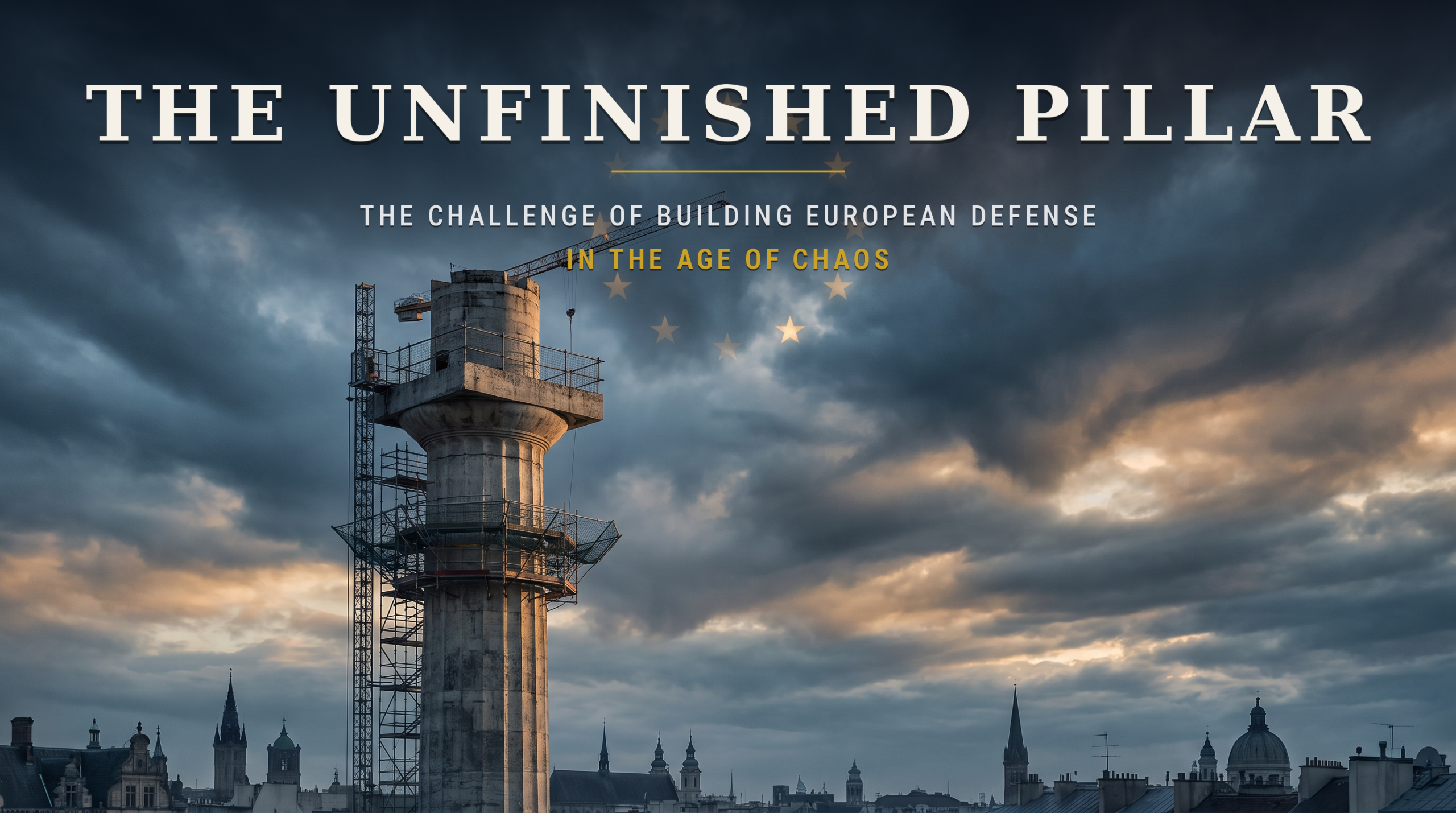
Europe’s defense industry is being remade by a war that is no longer purely European.
What began in February 2022 as a continental crisis has become a genuinely cross-regional industrial event, in which Asian states, as suppliers, as combatants by proxy, and as strategic competitors, have become as consequential to the shape of European rearmament as Brussels’ own funding instruments.
Record venture capital, a layered EU financing architecture, and a wave of Ukrainian-European industrial partnerships tell one part of the story: a genuine structural shift is underway in how Europe designs, funds, and fields weapons.
But that shift cannot be understood in isolation from what is happening in Asia. South Korea has emerged as Europe’s fastest and most consequential outside arms supplier since 1945, filling gaps in artillery, armor, and rocket fire that European industry could not fill at the speed the war demanded. North Korea has become, by Ukrainian and South Korean intelligence assessments, the supplier of roughly half of Russia’s frontline ammunition, a role that has directly shaped how much shell production capacity Europe now judges it needs to build for itself.
And China has assumed a genuinely dual position: the source of components sustaining Russia’s war machine even as Beijing’s export restrictions on magnets, drones, and rare earths are pushing Europe toward new partners, Taiwan chief among them.
The result is an industrial base that is simultaneously Europeanizing its funding and de-Europeanizing its supply chains, pulled toward Warsaw and Brussels on the financing side, and toward Seoul, Taipei, and unavoidably Beijing and Pyongyang on the materiel side.
The Reform That Outran Itself
The scale of the European response is not in question.
European defense, security and resilience startups raised a record $8.7 billion in venture capital in 2025, up 55 percent year-on-year and nearly four times the level of five years earlier, with artificial intelligence underpinning 44 percent of that funding. The United Kingdom led with $2.9 billion raised, Germany followed with $2.1 billion, and Munich emerged as Europe’s leading defense-tech hub. Brussels has stood up a layered financing architecture to match: the European Defence Fund’s 2026 work programme worth €1 billion, the European Defence Industry Programme’s €1.5 billion for 2026–27, and the €150 billion SAFE loan instrument, the first pillar of the €800 billion “ReArm Europe” plan. SAFE requires that no more than 35 percent of a procured system’s component cost originate outside the EU, EEA-EFTA states, or Ukraine, which is itself treated as an equal procurement partner and supplier under the instrument.
Yet a Bruegel policy brief published in March 2026 delivered the finding that has become the anchor data point for anyone assessing whether this money is actually changing who builds Europe’s weapons: the top ten contractors account for between 67 and 90 percent of military procurement in Germany, Poland, and the United Kingdom, compared with under 40 percent in the United States.
As recently as 2024, the contractor lists in the UK, Germany, and Poland contained only two startups between them. Reform is real, but it is early, and the dominant pattern so far is absorption rather than displacement, primes taking equity stakes in and forming joint ventures with the startups that might otherwise have competed with them. Saab holds five percent of Germany’s Helsing. Rheinmetall has a satellite-manufacturing joint venture with Finland’s ICEYE and, after a partially scaled-back Anduril collaboration, has engaged Auterion for autonomous-drone work. Airbus took a co-lead stake in Quantum Systems’ Series D in July 2026. With defense-tech IPOs at zero through 2025 despite an all-time high in M&A activity, acquisition by an established prime is currently the only realistic exit path for most European defense startups — a dynamic industry analysts have started calling the “bear hug” risk.
Ukraine as Co-Designer
The clearest sign that the relationship between Europe and Ukraine has changed is the volume: Ukraine went from fewer than ten defense companies in 2022 to roughly 1,500 by 2025, with unmanned aerial system output rising from 2,000 units in 2022 to 4 million in 2025 and a planned 7 million-plus in 2026. At Eurosatory in June 2026, Ukraine brought more than 80 companies, up from five just two years earlier, pivoting from showcasing its wartime improvisation to offering genuine co-production deals under the “Build with Ukraine” banner. Airbus’s memorandum with SkyFall on counter-drone interceptors, MBDA’s agreement with Ukrainian Armor on deep strike and counter-UAS systems, and the Quantum Frontline Industries joint venture between Germany’s Quantum Systems and Ukraine’s Frontline Robotics are all downstream of that shift as is Germany’s April 2026 cooperation agreement to manufacture thousands of AI-enabled strike drones annually with Ukraine.
That shift has not been frictionless.
The starkest expression of the culture clash came from Rheinmetall CEO Armin Papperger, who told The Atlantic in March 2026 that Ukrainian drone innovation amounted to little more than “playing with Lego,” dismissing housewives with 3D printers producing drone parts as something other than genuine innovation. The backlash, Zelensky’s retort that if Ukrainian housewives can build drones, they could all run Rheinmetall, crystallized what Friends of Europe has termed a values mismatch: Europe’s institutional preference for exquisite, high-end platforms against Ukraine’s wartime preference for cheap, mass-produced, iteratively improved systems.
KNDS executive Marcel Grisnigt’s public acknowledgment that Europe “can learn from Ukraine” on speed and mass, and EU Commissioner Andrius Kubilius’s now-widely quoted jab at Europe’s taste for “haute couture missiles,” mark the other pole of that argument, one that is, notably, increasingly being settled not by European industrial reform alone but by outside suppliers willing to build at the volume Ukraine’s war has proven necessary.
South Korea: The Arsenal That Actually Delivered
If there is a single Asian actor that has changed the material condition of European land forces since 2022, it is South Korea, and the relationship has evolved well past a simple arms sale. The original 2022 Polish framework with Hyundai Rotem and Hanwha envisioned roughly 1,000 K2-family tanks, up to 672 K9 self-propelled howitzers, 48 FA-50 light fighters, and Chunmoo rocket artillery — a package assembled specifically to replace the Soviet-era stocks Poland had shipped to Ukraine. By late 2025 Poland had confirmed delivery of 160 K2GF tanks, 192 K9A1 howitzers, and 126 Homar-K rocket launcher modules, with the first K9PL variant, built to Polish fire-control and protection specifications, shipping from Hanwha’s Changwon plant in July 2026. Hyundai Rotem has since reallocated its entire production line to the Polish contract, tripling its monthly tank output, while Poland’s own Bumar-Łabędy facility has begun assembling K2PL tanks under technology transfer, a first step toward the roughly 800 tanks Poland eventually intends to build domestically.
What makes the South Korean case distinct from a conventional export relationship is that Hanwha is now building inside the European Union.
Construction began in February 2026 on the Hanwha Armoured Vehicle Centre of Excellence in Romania’s Dâmbovița County — Hanwha’s first production base on EU soil, intended initially to support Romania’s own 54-howitzer K9 contract and then to serve wider regional demand, including possible export back out of the EU. Norway’s $922 million order for 16 Chunmoo launchers in February 2026 made it the first Northern European buyer of the full Korean rocket-artillery system, complementing K9 fleets already operated by Norway, Finland, and Estonia, a footprint that gives Hanwha a genuine sustainment network of shared spare parts and maintenance procedures across NATO’s northern and eastern flanks simultaneously.
Combined, Poland, Norway, Estonia, Finland, Romania, and Türkiye now account for more than 1,300 K9-family systems in service or under contract, out of more than 1,500 exported globally, making the K9 the most widely exported modern artillery system in the world. Hanwha’s ground-systems order backlog stood at roughly 52.3 trillion won as of early 2025, representing something close to five years of forward production visibility.
The strategic significance of this is not simply that Korea sold Europe a lot of hardware quickly, though speed was the initial draw. Warsaw needed to backfill equipment sent to Ukraine faster than European primes, running single-digit monthly production rates before the war, could plausibly deliver. It is that South Korea has now positioned itself as a second industrial base inside Europe’s own perimeter: Romanian and Nordic production sites, shared logistics chains, and per Hanwha’s own language at the 2026 Black Sea Defense and Aerospace exhibition in Bucharest, an explicit strategy of “localized production, integrated systems, and future-ready technologies” meant to enhance interoperability and supply-chain resilience across the EU and NATO, not simply to sell into it.
For an alliance industrial base that the Bruegel analysis shows remains dominated by a handful of incumbent national champions, an outside supplier willing to co-locate production, transfer technology, and iterate on customer-specific variants at Ukraine-war tempo has changed the competitive calculus facing Europe’s own primes as much as any EU funding instrument has.
North Korea’s Shadow Over Europe’s Ammunition Math
If South Korea has shown Europe what fast, at-scale arsenal production looks like, North Korea has shown Europe, from the other side of the war, what happens when an adversary’s coalition solves the ammunition problem that Europe itself struggled with for the first two years of the conflict.
South Korean and Ukrainian intelligence assessments now put North Korean supplies at roughly half of Russia’s frontline ammunition needs, delivered through a logistics relationship that a UN sanctions monitoring team estimated involved more than 20,000 shipping containers moving from North Korea to Russia from September 2023 onward. South Korea’s own Defense Intelligence Agency has assessed that North Korea may have supplied Russia with more than 12 million rounds of 152mm ammunition alone, alongside 170mm self-propelled artillery, 240mm multiple rocket launchers, and more recently KN-23 ballistic missiles and even a deployed missile unit reportedly equipped with up to 120 launchers.
North Korean troops, more than 10,000 of whom were sent to Russia’s Kursk region in 2024 with several thousand more rotated in since, are reported to be conducting artillery and rocket strikes directly against Ukrainian border communities as of early 2026, gaining live combat exposure to drone warfare and electronic-warfare coordination in the process, experience Pyongyang’s own weapons designers are then folding back into steadily improving missile accuracy.
The consequence for European industry is less about any direct North Korean interaction with Europe than about the demand signal
Pyongyang’s support has sent European planners regarding their own production math. Russia’s ability to sustain roughly 10,000 artillery shells fired per day, five times Ukraine’s rate through much of the war, has been substantially a function of North Korean resupply, not just Russian domestic output.
That reality has been a significant driver behind the urgency in Europe’s own ammunition-scaling efforts, from France’s Agence de l’Innovation de Défense reforms to Germany’s expanding loitering-munitions contracts with Helsing and STARK.
In effect, North Korea’s wartime industrial mobilization on Russia’s behalf has functioned as a demonstration effect for European planners of exactly the production volumes, millions of rounds annually, sustained over years that any credible European deterrent now has to be able to match, whatever the source.
China’s Double Game
China occupies the most structurally consequential and most contradictory Asian position in this story.
On one side, China has become what one regional-security analysis termed part of Russia’s logistics architecture: European officials assess Beijing is escalating both the quantity and sophistication of dual-use support to Moscow, from geospatial imagery to drone components to the magnets used in drone motors, even as Chinese officials publicly deny providing lethal weapons to either side. Zelensky himself has said Chinese-made Mavic drones remain available to Russian buyers while access for Ukraine and other European states has been curtailed, and Western officials report Chinese firms have simultaneously restricted certain component exports to the West while increasing them to Russia.
Beijing’s own December 2024 restrictions on gallium and germanium exports, ostensibly a domestic control measure, have been circumvented through transshipment via Turkey, Kazakhstan, and the United Arab Emirates, keeping supply lines to Russia’s military-industrial complex open through 2026 even as EU sanctions packages have added dozens of Chinese entities to restricted lists.
In July 2026, China’s commerce ministry retaliated against new EU sanctions by banning dual-use exports to fourteen EU companies, including Rheinmetall, Poland’s Vigo Photonics, and the Czech truck maker Tatra, a small but pointed demonstration of the leverage Beijing holds over inputs, particularly rare earths, that sit at the base of European defense manufacturing. The European Parliament Research Service found in late 2025 that the EU sources all of its heavy rare earth elements and 85 percent of its light rare earths from China, along with 98 percent of its rare-earth magnets.
On the other side of that same relationship, China’s tightening grip on drone-relevant exports has pushed Europe toward exactly the kind of Asian diversification South Korea has already modeled in land systems, this time centered on Taiwan.
Taiwanese firms exported nearly 130,000 drones to Poland and Czechia in 2025 alone, most of which were then re-exported to Ukraine, and first-quarter 2026 volumes to Central and Eastern Europe had already exceeded the full prior year’s total; one industry estimate put Taiwan’s drone export sector growth at 749 percent year-on-year. Czech monthly imports rose from negligible levels to roughly 20,000 units by October 2025 before doubling again to 40,000 by January 2026.
That growth has been accompanied by political normalization: European Parliament Security and Defense Committee chair Marie-Agnès Strack-Zimmermann led a delegation to Taipei in April 2026 to meet President Lai Ching-te and other senior Taiwanese officials, a visit that would have been unthinkable in the pre-2022 European defense-industrial conversation. Taiwan’s rise as a European drone-component supplier is, in a very direct sense, a byproduct of China’s own weaponization of its supply chain, Beijing’s attempt to sever Europe’s access to alternative component sources has instead accelerated the very diversification it was presumably meant to prevent.
The Sovereignty Gap That Asia Both Widens and Narrows
Taken together, these three Asian vectors pull European strategic autonomy in opposite directions at once.
South Korea and Taiwan are helping Europe build capability and diversify away from both Russian-linked and Chinese-controlled supply chains, but they are doing so by deepening Europe’s dependence on non-European industrial bases rather than eliminating outside dependency altogether, a Korean tank hull or a Taiwanese drone motor is not a Chinese rare-earth magnet, but it is still not built in the EU-27 without a foreign technology-transfer agreement attached.
China and North Korea, meanwhile, are sustaining the adversary’s war effort in ways that have forced Europe to confront just how far its own sovereign production base still lags what a committed wartime coalition, even one built around a heavily sanctioned economy like North Korea’s, can generate.
The Kiel Institute’s 2026 roadmap argues Europe can plausibly build a sovereign ISR and electronic-warfare “sensing layer,” and most serious analysts now put realistic technological sovereignty in software-defined systems five to seven years out, a timeline gated, as the underlying research notes, more by political will and industrial fragmentation than by any lack of technical capability. The collapse of the Franco-German FCAS fighter program in June 2026, over a leadership dispute between Dassault and Airbus, is the clearest recent illustration of exactly that fragmentation risk, even as dozens of smaller bilateral and trilateral projects continue to move forward.
What is emerging, then, is not simply a European rearmament story with an Asian footnote.
It is an industrial base being simultaneously built and exposed by the same underlying dynamic.
The war has generated a genuine demand signal, record funding, a stack of new EU financing instruments, a startup ecosystem, and a newly assertive Ukrainian defense sector offering itself as co-designer rather than aid recipient.
But three separate Asian relationships are doing much of the actual work of meeting, sustaining, and complicating that demand: South Korea supplying the mass-production capacity and now the co-located European manufacturing base that Europe’s own primes could not stand up fast enough; North Korea sustaining the adversary’s own mass-production war economy and, in doing so, setting the volume benchmark European planners now feel compelled to match; and China playing both roles at once, as the component supplier keeping Russia’s war machine running and the reason Europe is now courting Taiwan as an alternative source for the same category of goods.
None of this displaces the Bruegel finding that Europe’s own procurement system remains dominated by a small number of national champions, nor the reality that most of the money still flows through European or Ukrainian channels.
But any account of how the war has “rewired” European defense industry that stops at Brussels’ funding architecture and Rheinmetall’s boardroom politics is describing only half the machine.
The other half runs through Changwon, Pyongyang’s ammunition depots, and Shenzhen’s export-control office and it is arguably setting the pace for the European half as much as following it.
Bibliography
EU funding architecture, procurement reform, Ukrainian industrial base, primes-vs-startups (source brief)
- Kapstein, E., Ospital, N., and Wolff, G. “Reforming European defence procurement to boost military innovation and startups.” Bruegel Policy Contribution 04/2026, 5 March 2026. DOI: 10.64153/DRNO4343.
- Dealroom / NATO Innovation Fund, “European Defence, Security and Resilience venture funding,” February 2026 (as cited via Newfund Capital analysis).
- Shuster, Simon. “Interview with Rheinmetall CEO Armin Papperger.” The Atlantic, 27 March 2026.
- Friends of Europe / Snake Island Institute, reporting on Ukrainian defense-industrial growth and the “values mismatch,” 2026.
- European Commission, European Defence Fund (EDF) 2026 work programme; European Defence Industry Programme (EDIP) 2026–27 work programme; SAFE instrument documentation.
South Korea in Europe
- “Poland Receives New Shipment of South Korean K2 Tanks, K9 Howitzers.” DefenseMirror, 17 December 2024. https://defensemirror.com/news/38420/Poland_Receives_New_Shipment_of_South_Korean_K2_Tanks__K9_Howitzers
- “Poland confirms delivery of 160 K2 tanks, 192 K9 howitzers and 126 Homar-K rocket launchers from South Korea.” Army Recognition, 19 September 2025. https://www.armyrecognition.com/news/army-news/2025/poland-confirms-delivery-of-160-k2-tanks-192-k9-howitzers-and-126-homar-k-launchers-from-south-korea
- “First customized K9PL howitzers leave South Korea for Poland under second major artillery contract.” Army Recognition, 4 July 2026. https://www.armyrecognition.com/news/army-news/2026/k9pl-155mm-tracked-self-propelled-howitzer-poland
- “Poland to begin production of first K2PL tanks as part of new agreement with South Korea.” Army Recognition, 1 August 2025. https://www.armyrecognition.com/news/army-news/2025/poland-to-begin-production-of-first-k2pl-tanks-as-part-of-new-agreement-with-south-korea
- “Korean tanks for Poland.” Defenceturkey, 14 April 2026. https://www.defenceturkey.com/en/content/korean-tanks-for-poland-5400
- “South Korea’s Hanwha Aerospace plans to fuel Europe’s massive rearmament strategy at NATO Ankara Forum.” Army Recognition, 10 July 2026. https://www.armyrecognition.com/news/army-news/2026/hanwha-aerospace-nato-defence-industry-forum-ankara-2026
- “Hanwha showcases defense solutions at BSDA 2026.” Hanwha Aerospace newsroom, 12 May 2026. https://www.hanwha.com/newsroom/news/press-releases/hanwha-showcases-unmanned-and-ai-capabilities-at-bsda-2026-to-advance-european-partnerships.do
- “Hanwha Aerospace Opens K9 Production Site in Romania.” Hanwha Aerospace newsroom, 2 February 2026. https://www.hanwha.com/newsroom/news/press-releases/hanwha-aerospace-breaks-ground-on-k9-production-facility-in-romania.do
- “Korea Defense Industry 2026: The $37B K-Arms Export Boom.” Seoulz, 23 April 2026. https://www.seoulz.com/korea-defense-industry-2026/
- “With a focus on its European partnership, Hanwha showcases its K9A2 artillery system and K239 Chunmoo at Eurosatory 2026.” Zona Militar, 17 June 2026. https://www.zona-militar.com/en/2026/06/17/with-a-focus-on-its-european-partnership-hanwha-showcases-its-k9a2-artillery-system-and-k239-chunmoo-at-eurosatory-2026/
- “South Korean Arms Makers Invade Europe.” Asia Sentinel, 23 February 2026. https://www.asiasentinel.com/p/south-korea-hanwha-aerospace-europe
- “South Korea’s K9 howitzer gains ground in Europe with Finland deal.” UPI, 14 April 2026. https://www.upi.com/Top_News/World-News/2026/04/14/k9-defense-market-europe/9241776209951/
North Korea’s role sustaining Russia’s war effort
- “North Korean Soldiers Shell Ukrainian Border Areas With Artillery – Defense Intelligence.” Militarnyi, 4 February 2026. https://militarnyi.com/en/news/north-korean-soldiers-shell-ukrainian-border-areas-with-artillery-defense-intelligence/
- “How North Korean forces are bolstering Russia’s war against Ukraine.” Defense News, 7 August 2026. https://www.defensenews.com/global/europe/2026/08/07/how-north-korean-forces-are-bolstering-russias-war-against-ukraine/
- “Pyongyang’s Arsenal Comes to Ukraine.” Lviv Herald, August 2026. https://www.lvivherald.com/post/pyongyang-s-arsenal-comes-to-ukraine
- “N. Korea providing 50% of Russia’s ammunition, Ukraine says.” Reuters, via Yahoo News. https://www.yahoo.com/news/ukraines-military-spy-chief-says-134415914.html
- “North Korea may have supplied Russia with 12 million rounds of 152mm shells, South Korean intelligence says.” Yonhap, via Yahoo News. https://www.yahoo.com/news/north-korea-may-supplied-russia-045924960.html
- “North Korea to deliver at least 150 ballistic missiles and artillery to Russia in 2025, Ukraine’s intelligence reports.” The War Zone, via Yahoo News. https://www.yahoo.com/news/north-korea-deliver-least-150-080401972.html
- “Mapping North Korea’s discreet artillery ammo route to Russia.” Frontelligence Insight, Substack. https://frontelligence.substack.com/p/mapping-north-koreas-discreet-artillery
- “Ukrainian troops describe the North Korea problem.” Business Insider, via Yahoo News. https://www.yahoo.com/news/articles/ukrainian-troops-north-korea-problem-142351275.html
China’s dual-use role and the Taiwan pivot
- “China-Russia Dual-Use Cooperation Stays Resilient Amid Sanctions.” RSIS. https://rsis.edu.sg/rsis-publication/rsis/china-russia-dual-use-cooperation-stays-resilient-amid-sanctions/
- “China’s tech emerges as U.S. battlefield rival.” GIS Reports, 18 May 2026. https://www.gisreportsonline.com/r/china-russia-technology/
- “Dual-Use Drones? How About Dual-Use Materials.” Substack, early August 2026. https://fionakoh.substack.com/p/dual-use-drones-how-about-dual-use
- “China’s Sanctions Hit Europe’s Emerging Drone Doctrine.” The Diplomat, 30 April 2026. https://thediplomat.com/2026/04/chinas-sanctions-hit-europes-emerging-drone-doctrine/
- “China Tightens Dual-Use Export Controls on European Defense Suppliers.” The Defense Post, 28 July 2026. https://thedefensepost.com/2026/07/28/china-export-eu-defense/
- “Drone technology: EU sanctions Chinese companies.” Briefings, 26 April 2026. https://table.media/en/china/news-en/drone-technology-eu-sanctions-chinese-companies
- “Bloomberg: China cuts drone sales to Europe but continues supplying Russia.” Via Yahoo News. https://www.yahoo.com/news/bloomberg-china-cuts-drone-sales-145305368.html
- European Commission, “Sanctions on dual-use goods.” https://commission.europa.eu/topics/eu-solidarity-ukraine/eu-sanctions-against-russia-following-invasion-ukraine/sanctions-dual-use-goods_en
- European Parliament Research Service, briefing on EU rare-earth dependency on China, 24 November 2025.
- Kiel Institute for the World Economy, “Achieving European Defence Autonomy” roadmap, May 2026.
Note: several 2026 figures, the North Korean ammunition-share estimate, Taiwan’s drone-export growth rate, and some Chinese export-control details, come from wartime intelligence assessments and trade press that are difficult to independently verify. They are flagged here as such and worth corroborating against primary government or industry sources before publication.