
Base Is a Noun, Hub Is a Verb: Rethinking Guam’s Strategic Function
For most of the postwar Pacific, “base” was the only word that mattered. A base was a place: ground held, forces stationed, runways and piers defended. The word did real analytical work because it matched the strategic problem, or where to put things so as to reach a crisis fast enough.
Guam has been called a base for eighty years, and until recently that was an adequate description of what it did. It is no longer adequate, not because Guam has grown or hardened, but because “base” and “hub” describe two different theories of how a place generates military effect, and Guam is now trying to be the second thing while still carrying the vocabulary, and in places the design assumptions, of the first.
Two Different Verbs, One Broken Assumption
A base is a noun: it holds, and its value is measured by what sits on it and by how well it can absorb an attack aimed at what it holds. A hub is a verb wearing a noun’s clothing: its value is measured by throughput or what it sends out, how far, how fast, and what it can pull back in and turn around. A hub that is beautifully defended but cannot push forces outward under contested conditions has not solved the hub problem. It has built an expensive, well-guarded warehouse.
The distinction changes what gets built, bought, and measured as evidence of progress. A base posture optimizes for density and defense-in-depth around a fixed point. A hub posture optimizes for dispersal, reach, and cycle time or the speed with which a node generates outward effect and regenerates capability afterward.
The base model worked as long as adversary reach could not touch rear-area infrastructure with precision. Chinese intermediate-range missile forces removed that assumption: a concentrated point, however hardened, is now also a known, targetable point.
Guam’s response so far has mostly been more security architecture, such as layered air and missile defense, hardened and dispersed storage, redundant power and communications, and a wider defended footprint across the Marianas.
All of this is necessary, and none of it, by itself, answers the hub question. Defense buys a place the right to keep existing under attack. It does not give that place a reason to matter operationally once the shooting starts. A perfectly defended base that cannot project anything outward has succeeded at survival and failed at relevance.
What Functioning as a Hub Actually Requires
If a base is judged by what it holds, a hub has to be judged by three things: reach, cycle time, and the ability to do both while contested.
(1) Reach: Why the MV-75’s Range Is the Hub-Actualization Variable
Reach is the most basic requirement and the one most often waved away in strategic-level discussion. It is easy to say a location will “support distributed operations across the theater” and much harder to specify which aircraft, ships, and logistics chains actually have the legs to make that true.
The Pacific’s distances are the whole problem: the gap between Guam and a flashpoint in the South China Sea or the East China Sea runs into the hundreds of miles, the distance from Scarborough Shoal to Hainan alone is roughly 550 nautical miles, well beyond what much of the legacy inventory built for shorter-range, more permissive environments was ever designed to cover.
An aircraft like the Army’s Black Hawk fleet illustrates the gap cleanly: entirely capable within its designed envelope, and simply the wrong tool for hub-scale distances against contested airspace. That is not a marginal shortfall to be closed with careful routing or extra fuel; it is a category mismatch between the platform and the geography it is now being asked to operate across.
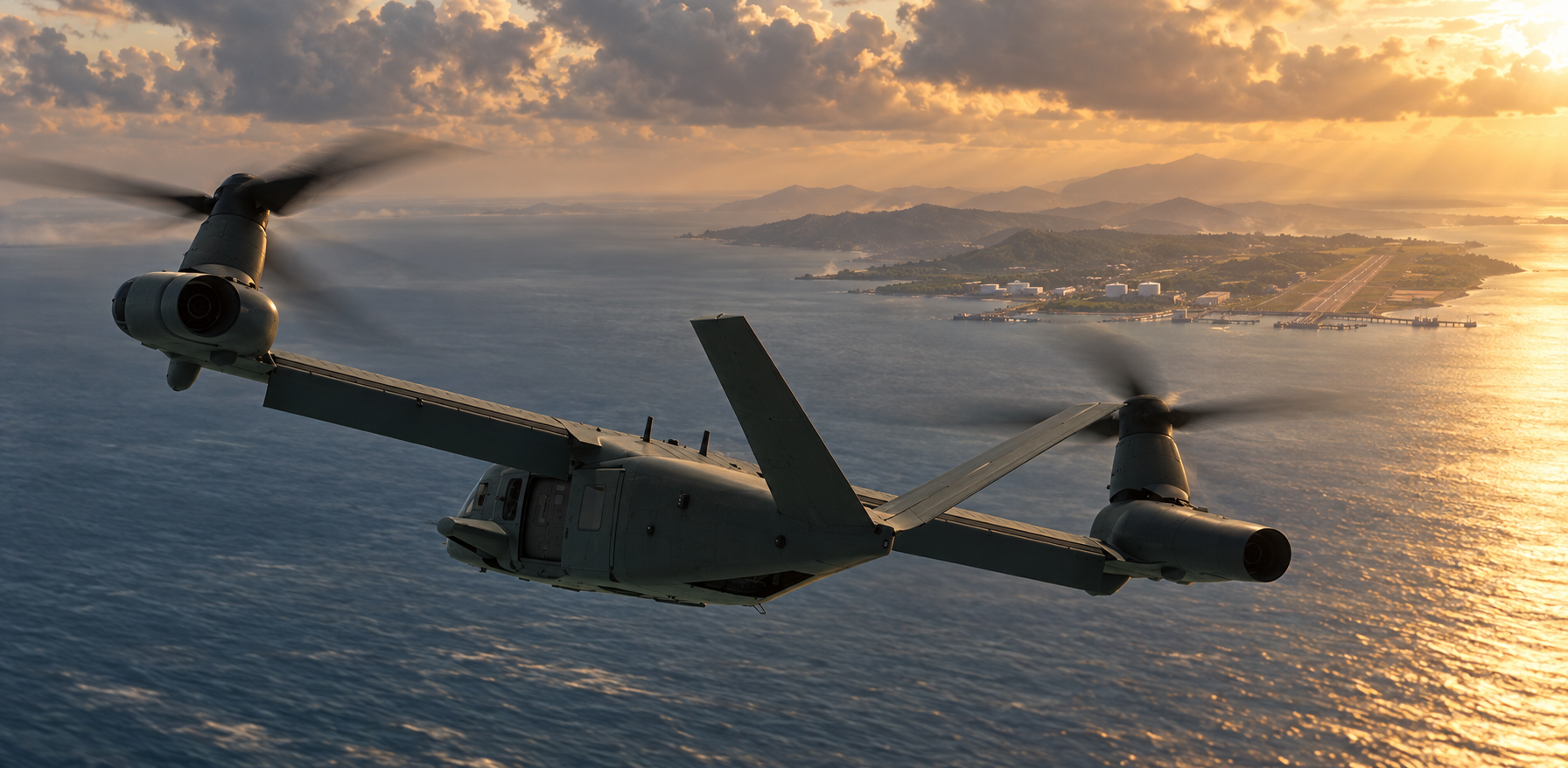
This is where range stops being a performance specification and becomes the variable that decides whether “hub” is a real description of Guam or an aspiration. The MV-75 tiltrotor, built to fly roughly two and a half times farther than the aircraft it replaces, at higher speed, with the electronic-warfare protection to operate in defended airspace rather than only permissive skies, is the clearest current example of a platform sized to the actual geography of hub operations rather than to the geography a base was originally built to serve.
Range is what turns Guam from a point that projects influence within a radius drawn on a map into a node that can actually reach the places distributed operations depend on, the Philippines, Japan, Okinawa, to resupply, evacuate casualties, insert small teams, and sustain forces operating from scattered, austere positions, rather than waiting behind its own perimeter for the fight to come to it.
A hub’s reach is not an abstract virtue; it is the specific set of range rings a specific set of aircraft can draw from that specific location, and those rings only widen when the platforms based there are built for the distances involved. Absent that range, “hub” is a description of ambition. With it, “hub” becomes a description of what the aircraft on the ramp can actually do on any given day, contested or not.
Range is also inseparable from survivability in a hub context in a way it was not in a base context. A short-range aircraft operating from a hardened, well-defended point can still be tactically safe and strategically irrelevant if it cannot get to where the fight is without refueling through contested airspace or staging through intermediate points that are themselves targets. Extending range without extending the ability to survive in defended airspace would simply move the vulnerability outward rather than closing it which is why the MV-75’s electronic-warfare protection matters alongside the raw distance figure, not instead of it. Reach, in other words, is a compound of how far an aircraft can go and how much of that distance it can cover without needing someone else to secure the route first.
(2) Cycle Time: Speed as a Multiplier on Combat Power, Not Just Transit Time
Cycle time is the less visible half of the hub problem, and it is where the MV-75’s added speed does work that goes beyond simply arriving sooner. A hub is not just an outbound launch point; it is a place that takes damaged platforms and depleted units back in, repairs and resupplies them, and returns them to the fight. Everything about that loop, pre-positioned stocks spread across multiple locations rather than concentrated at one, port and maritime capacity to absorb sea-based resupply when air access is contested, and increasingly autonomous logistics delivery to move material without proportionally increasing the number of people exposed at forward and rear nodes, determines whether “hub” is a real description of what happens at Guam or an aspiration written into a strategy document.
(3) Speed changes the arithmetic of that loop in three specific ways.
The first is the buildup of combat power at the far end. A faster aircraft compresses the time between a decision to reinforce a forward position and the arrival of the people, parts, or munitions that decision was meant to deliver. In a contested Pacific, the side that can convert a decision into physical combat power at a forward node faster than the adversary can react to it holds an advantage that has little to do with how many aircraft either side owns and everything to do with how quickly each side’s inventory can be turned into presence on the ground. A hub that can only push combat power outward at legacy speeds offers the same theoretical reach as a faster hub while delivering a materially slower buildup which, against an adversary working on compressed decision timelines of its own, is a real operational gap, not a rounding error.
The second is the distribution of critical supplies across a dispersed footprint. Distributed maritime operations and agile combat employment both depend on spreading forces across scattered, austere positions specifically so that no single location represents a concentrated, targetable mass. That dispersal only works logistically if the hub can keep every one of those scattered positions supplied without funneling everything through one vulnerable transit route. Higher aircraft speed means more of the dispersed network can be serviced within the same operational window, which is what actually makes dispersal a viable posture rather than a plan that quietly re-concentrates risk at whichever node is hardest to reach in time.
The third is sorties per airframe which is the metric that ties speed most directly to sustained operational tempo. A faster round trip between the hub and a forward position means each airframe can complete more resupply, casualty-evacuation, or personnel-movement cycles in the same calendar time, which is the difference between a fleet that generates a given level of sustained throughput and a larger fleet needed to generate that same throughput at legacy speeds. Under wartime attrition, where losses and maintenance downtime steadily shrink the available fleet, a platform that produces more sorties per available airframe is not a convenience; it is what allows a shrinking fleet to keep meeting the hub’s sustainment requirements for longer before the throughput math breaks down.
Taken together, these three effects are why cycle time belongs next to reach as a first-order variable rather than as a secondary efficiency gain layered on top of it. Range gets an aircraft to a forward position a legacy platform could not reach at all. Speed determines how many times that same aircraft can make the trip, how much combat power arrives in a given window, and how many scattered positions a single hub can actually keep alive which is the difference between a hub that can generate an initial effect and one that can sustain a campaign.
Doing Both Under Contested Conditions
Doing both under contested conditions is what separates a hub from a rear-area depot. The value of security architecture, the missile defenses, the hardened storage, the dispersed footprint across the Marianas, is that it buys the time and survivability needed for reach and cycle time to keep functioning after the first salvo, not that it substitutes for them. A hub’s defenses exist to protect its ability to act, not to replace the need to act.
Guam as the Test Case, Not the Exception
What makes Guam useful analytically is that it is not a special case. Rather, it is the place where the hub-versus-base distinction is being worked out in public, under real budget and platform constraints, in a way that will recur at every other node in a distributed Pacific posture.
The same question that applies to Guam applies to any location being asked to anchor expeditionary advanced base operations, distributed maritime operations, or agile combat employment: is this place accumulating defended mass, or is it generating outward reach and rapid regeneration?
The two are not opposites for a hub needs enough security architecture to survive long enough to matter but they are not the same investment, and a planning process that only counts what is garrisoned will keep producing well-defended bases that quietly fail the hub test.
The allied dimension sharpens this further. Japanese, Australian, and other partner forces rotating through and integrating with Guam-based operations are not simply adding presence. In hub terms, they add additional reach and additional cycle-time capacity that no single nation could generate alone, which is precisely why “hub” is a more honest description of what regional security architecture is becoming than “American base with foreign visitors.”
The Bottom Line
“Base” measures what a place holds. “Hub” measures what a place can send out, sustain at distance, and take back in for another cycle, under fire, not just in exercises. Guam’s missile defenses and hardened infrastructure earn it the right to keep existing in a contested Pacific.
Whether it earns a claim to strategic relevance depends on reach and regeneration and on platforms built for hub-scale distances, on logistics architecture built for dispersal rather than concentration, and on a planning culture willing to measure progress by what goes out and comes back rather than by what simply sits in place.
That is the test every other Pacific node will eventually face as well, and Guam is where the answer is being worked out first.