
From the Nacelle to the Kill Web: What CMV-22B Readiness Really Buys the Fleet
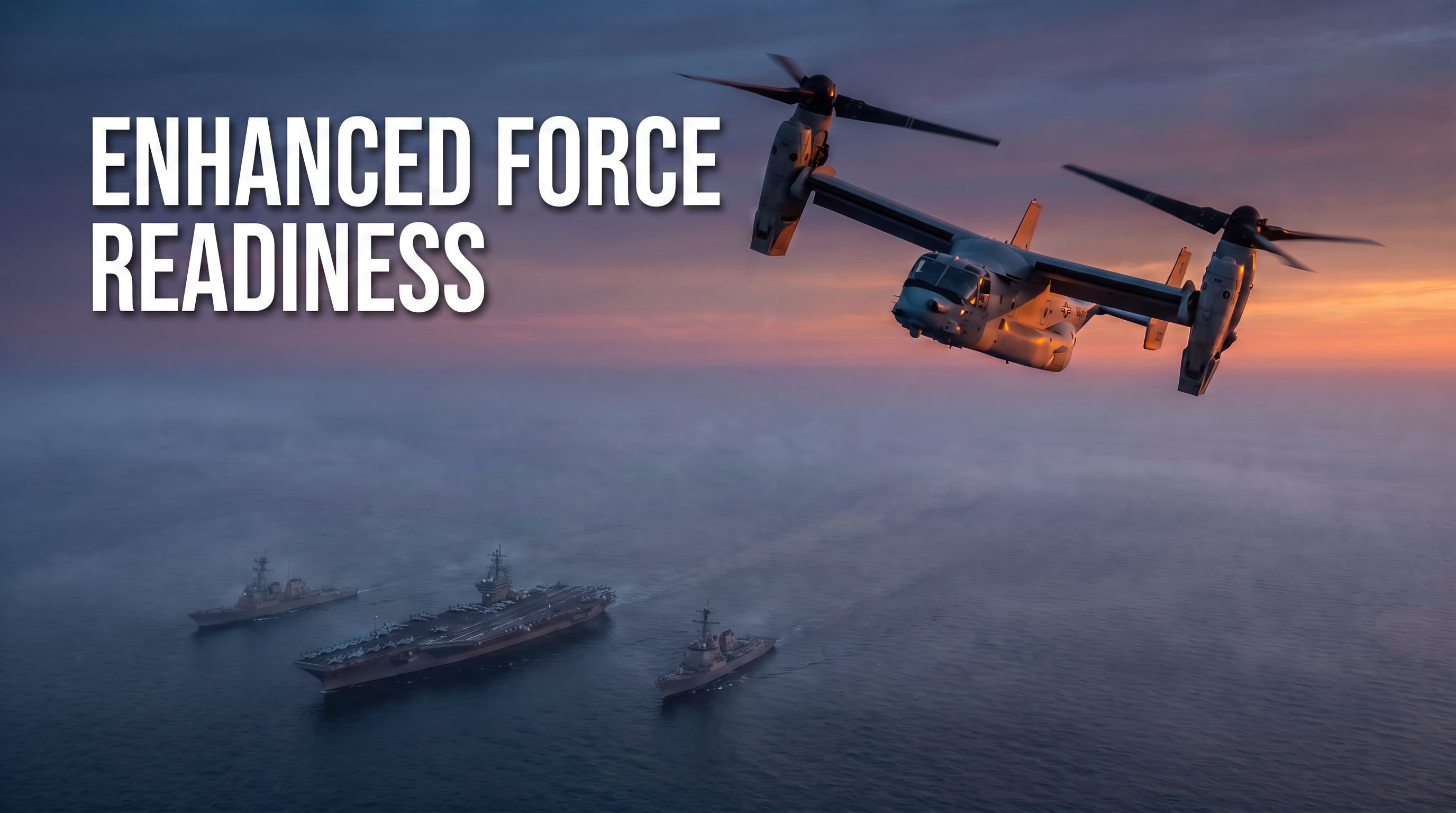
Capt. Christopher “Chet” Misner’s account of the Nacelle Improvement program in the Summer 2026 issue of The Hook makes a case that is, on its surface, about hardware: a redesigned point-to-point wiring system, a 43 percent reduction in harness count, an 80 percent cut in wire interface assemblies, locking connectors that no longer work themselves loose on a pitching flight deck.
The numbers are genuinely striking, a 10 percent readiness increase across the modified CV-22 fleet, a 75 percent reduction in maintenance time between critical part changes, more than 24,000 personnel-hours saved on just 31 of 51 Air Force tails. Lt. Gen. Michael Conoly’s testimony to double-digit gains in mission readiness is the kind of number program offices dream of being able to cite.
But read past the hardware, and the Nacelle Improvement program is telling a different and more consequential story, one about what it takes to keep a distributed, sensor-rich, network-dependent maritime force actually available to fight. The CMV-22B is not simply a transport aircraft that happens to need less downtime.
It is a mobility and connectivity node inside a carrier strike group’s kill web, and the difference between those two descriptions is the difference between judging a modernization program by its maintenance man-hours and judging it by what it enables the fleet to do.
The COD Mission Has Changed Its Character
Carrier onboard delivery has always sounded like a logistics footnote or the mundane business of getting mail, parts, and people to a ship that cannot pull into port. That description was adequate when the carrier strike group’s principal task was to project power from a relatively fixed, well-defended position and when the tempo of resupply could be measured in days rather than hours. It is no longer adequate.
The Indo-Pacific theater that the CMV-22B was built to serve is defined by distance, dispersion, and an adversary that has invested heavily in the ability to find and target concentrated naval formations. The strike group’s answer to that threat is to disperse and to operate as a networked collection of sensing and shooting nodes rather than a single hardened target, trading the predictability of a concentrated formation for the survivability of a distributed one.
That answer only works if the nodes can be resupplied, restaffed, and reconnected fast enough to keep the network coherent. COD stops being a logistics footnote and becomes a precondition for the entire operating concept. The Osprey’s speed, range, and runway independence, the very attributes the Hook article cites as the platform’s core value, are what make dispersion survivable rather than merely theoretical.
This is the point at which a nacelle-improvement story stops being about hardware and starts being about force design. An aircraft that spends 60 percent of its maintenance burden on a single subsystem, as the V-22 Joint Program Office’s estimate for the nacelle area suggests, is an aircraft whose availability is hostage to that subsystem’s condition. Fix the nacelle, and you are not just improving a maintenance statistic; you are improving the reliability of the connective tissue that lets a dispersed strike group behave as a single, coherent combat system rather than a set of isolated ships waiting on resupply that may or may not arrive on schedule.
Readiness as a Kill Web Input, not a Fleet Metric
The framework I have used across the Impact Force and Maritime Kill Web Force work draws a sharp distinction between kill chains and kill webs. A kill chain is a linear, platform-centric sequence — find, fix, track, target, engage, assess — that breaks if any single link fails. A kill web is a networked alternative in which multiple sensors, multiple decision nodes, and multiple shooters can be recombined on the fly, so that the loss or degradation of any one element does not collapse the whole. The strength of a kill web is not the strength of its best node; it is the reliability of the connections between nodes, and the speed with which the network can reconstitute itself when a node goes down.
Sustainment fits into that picture in a way that traditional readiness reporting does not capture well. A squadron readiness rate answers the question “how many aircraft are mission-capable today.” It does not answer the more important question for a kill web: “how confidently can the rest of the force plan around this platform being available three days from now, in a contested environment, without a friendly airfield within range.”
The Nacelle Improvement program’s real contribution is to that second question. Four times longer intervals between critical part changes and a 75 percent cut in the maintenance time required at each interval do not just raise a readiness percentage; they compress the uncertainty band around when a CMV-22B will next be unavailable. For a force that is trying to plan resupply cycles, casualty evacuation, and rapid parts transfer around a moving, dispersed set of ships, that compression of uncertainty is worth more than the raw percentage gain suggests. Predictable availability is what lets a strike group commander build COD into the tempo of operations rather than treating it as a contingency to be worked around.
The Nacelle Improvement program’s redesigned access panels and simplified routing are, in effect, a maintainability upgrade. They reduce not just how often the aircraft breaks but how long it takes maintainers to know what broke and fix it. That is a different and arguably more important axis of improvement than raw part life, because it shortens the loop between a fault appearing and a fault being resolved, which is precisely the loop that determines whether a dispersed node can be trusted to reappear on schedule.
The Enterprise Behind the Aircraft
The V-22 program’s ability to translate two decades of fleet operating data, the maintainer feedback the article credits for shaping redesigned access panels and simplified wiring routes, into a coherent modernization package is itself a capability, and one that is not automatic.
It requires an institutional willingness to treat maintainer input as engineering data rather than anecdote, a program office structure that can move fixes from the fleet through the joint program office and back out to both services, and a funding profile stable enough that a multi-year upgrade package does not get chopped into disconnected annual increments.
The article’s closing point about congressional funding that last year’s reconciliation package authorized $160 million to accelerate the program, but that uninterrupted appropriations matter more than any single infusion is not a throwaway line about budget process. It is the article’s real argument about what determines whether a modernization program succeeds: not the engineering, which is evidently sound, but the institutional discipline to fund it as a continuous program rather than a series of stop-start initiatives.
This is the same dynamic that shows up whenever a platform-level improvement is examined against the sustainment enterprise that has to deliver it at scale. The nacelle redesign is a point solution. What turns a point solution into a fleet-wide readiness gain is the enterprise’s capacity to certify it, install it across both the Marine Corps’ MV-22B fleet, the Navy’s CMV-22B fleet, and the Air Force’s CV-22 fleet, and then feed the resulting flight-hour and maintenance data back into the next iteration of the design. The Air Force numbers Capt. Misner cites, 31 of 51 aircraft modified, more than 10,000 flight hours recorded on modified airframes, are as much a statement about that enterprise’s execution capacity as they are about the nacelle itself.
What the Navy’s Version of This Story Adds
The Hook article is written from the vantage point of the CV-22’s readiness gains, with the CMV-22B positioned as the beneficiary of lessons the Air Force fleet has already learned. That sequencing is worth dwelling on, because it illustrates something the joint force does reasonably well and could do better: cross-service learning on a common airframe, where one service’s operational tempo generates data that another service’s fleet can use before it accumulates the same flight hours the hard way.
But the CMV-22B’s operating context is distinct enough from the CV-22’s that the readiness dividend is not simply transferable one-for-one. AFSOC’s CV-22 fleet operates a special operations mission profile with its own basing and tempo assumptions. The Navy’s CMV-22B is purpose-built around the carrier deck cycle, a fundamentally different maintenance environment, with different space constraints, different corrosion exposure from sustained sea-based operations, and a harder requirement that turnaround times fit inside a carrier’s flight-deck cycle rather than a land-based squadron’s daily schedule. Every hour a CMV-22B is unavailable for an unplanned nacelle fault is an hour in which the carrier strike group’s only fixed-wing COD asset is off the board, with no substitute readily available in most operating pictures.
That is worth stating plainly because it changes how the Nacelle Improvement program’s benefits should be read for the Navy fleet specifically. The reduction in maintenance man-hours matters everywhere, but the reduction in unplanned downtime matters disproportionately at sea, where there is no flightline of spare maintenance capacity to draw on and no alternative platform waiting in the wings.
The Navy’s stated intent to operate the CMV-22B “well into the future,” as the article notes, is not simply a procurement decision. It is a bet that the aircraft’s readiness trajectory will continue to improve rather than plateau, and the Nacelle Improvement program is the clearest evidence available that the bet is a reasonable one.
Sustainment as a Signal, Not Just a Statistic
There is a broader argument embedded in Capt. Misner’s closing paragraphs that deserves to be pulled forward rather than left as an aside. He writes that supporting CMV-22B modernization “can demonstrate that the Navy and the Department of War are committed to learning from experience across all service branches and sustaining critical platforms for the long term.” That is a signal argument, not a readiness argument, and it is worth taking seriously on its own terms.
A force that visibly reinvests in the unglamorous internals of a platform that has already been in service for years is making a statement, to its own workforce, to allied partners, and to potential adversaries, about how it intends to fight a protracted competition rather than a short campaign. Investments that show up in a nacelle rather than in a new airframe do not generate headlines, but they generate something a distributed, contested Indo-Pacific fight will need more of than any single new weapons system: confidence that the force can sustain tempo over time rather than surging briefly and then running out of available platforms.
Allied Implications of a U.S.-Only Readiness Story
There is one more dimension worth adding to Capt. Misner’s account, because it is easy to read a readiness story about a single U.S. platform as self-contained when it is not. The CMV-22B’s COD mission is embedded in a broader distributed maritime operating concept that increasingly assumes allied and partner contributions to sustainment, basing, and logistics resilience across the Indo-Pacific.
A carrier strike group operating on the assumption that its COD asset will be reliably available on a compressed cycle is also a strike group that can commit to shorter resupply windows for embarked allied liaison elements, faster transfer of time-sensitive parts to a partner nation’s forward-deployed assets, and tighter integration with allied logistics nodes that themselves depend on knowing when American lift will show up. None of that shows up in a maintenance man-hour statistic, but it is a direct downstream consequence of the same reliability the Nacelle Improvement program is buying.
This is also where the training and doctrine side of the story matters as much as the engineering side. A more reliable airframe changes what training commands can credibly build into a tactics syllabus, because a COD asset whose availability window is uncertain has to be planned around conservatively, while one with a narrower uncertainty band can be woven more tightly into a scheme of maneuver. Readiness gains of the kind described in the Hook article eventually show up not just in fleet statistics but in how confidently planners write COD dependencies into the concepts of operations that allied exercises and real-world contingencies are built around.
Read together, these threads point back to a single argument. The Nacelle Improvement program looks, on the page, like a maintenance story: fewer harnesses, sturdier connectors, shorter turnaround times.
But its real value lies downstream of the aircraft itself, in the confidence it lets a strike group commander place in COD, the discipline it demonstrates to Congress and to the workforce that sustains the fleet, and the planning margin it hands to allied partners who build their own logistics around when American lift will show up.
A modernization program measured only by its maintenance man-hours will always look smaller than it is.
Measured by what it buys the kill web, the Nacelle Improvement program is not a footnote to CMV-22B readiness.
It is the readiness story.