
From Truck to Toolkit: AUKUS Payloads and the Hull Gap Decade
Australia’s first public unveiling of the AUKUS Pillar II payloads for Ghost Shark, Speartooth and Bluebottle is the strongest evidence yet for the argument I made in May: the hull gap decade is a period for learning how to fight the hybrid fleet, not merely a period to be endured.
On October 19, Australia publicly unveiled for the first time the payloads it is developing and integrating into its uncrewed maritime systems under AUKUS Pillar II. They are being fitted to the Ghost Shark and Speartooth uncrewed underwater vehicles and to the Ocius Bluebottle uncrewed surface vessel, and some will take part this week in Exercise Maritime Big Play Pacific, an AUKUS Pillar II exercise in San Diego.
Defence Minister Richard Marles called payload development “a critical part of our work alongside the United States and the United Kingdom,” and said the exercise would let Australia “showcase its sovereign developments.” The platforms are modular. Examples of what they can carry include remote delivery of supply caches, sea mines and uncrewed aerial vehicles. Defence Industry Minister Pat Conroy said Ghost Sharks “capable of a range of complex missions operating far from our shores” are now “rolling off the line at an increasing rate” from a factory opened less than a year ago.
The money is substantial. Under the 2026 National Defence Strategy and Integrated Investment Program, Australia plans to invest up to A$5.8 billion over the decade in autonomous and uncrewed undersea warfare, including A$1.7 billion for a new fleet of Australian-designed and built Ghost Sharks. The work draws together the Royal Australian Navy, the Defence Science and Technology Group, the Advanced Strategic Capabilities Accelerator and industry, and it builds on three years of payload testing with AUKUS partners at earlier Maritime Big Play exercises.
Nothing in the announcement changes the arithmetic I laid out in May. Australia’s surface fleet today is three Hobart-class destroyers and a shrinking number of Anzac-class frigates, and the number available for operations at any moment is well below the number on paper. HMAS Anzac left service in May 2024 and HMAS Arunta is due to follow in 2026. The first general purpose frigate, based on the Mogami design selected in 2025, is not expected to be delivered until 2029 and operational until 2030. The first Hunter-class frigate arrives around 2032, and the nuclear-powered submarines run on a timeline measured in decades.
My argument was that waiting for those hulls and then learning the hybrid fleet is the hardest possible way to transform a force. A navy absorbing new platforms typically needs about five years to understand how to use them and close to ten to integrate them fully into the wider force. If Australia begins learning mesh fleets, kill webs and manned-unmanned teaming only when the new hulls arrive, it will be doing two hard things at once. The hull gap decade is the window in which it can do one of them first.
The significance of the announcement is the shift in focus from the vehicle to the payload. A large uncrewed underwater vehicle is a truck. Its military value depends on what it carries and how quickly that cargo can be changed to suit the mission. Mines, drones, pre-positioned supplies and seabed sensing are what turn Ghost Shark from a technology demonstrator into a tool for sea denial in Australia’s northern approaches and beyond.
This matters for the hull gap because it changes what Australia is buying time to learn. In May I argued that systems like Ghost Shark and Bluebottle were not prototypes waiting for doctrine to catch up. They were operational capabilities generating real data. Marcus Hellyer’s bolt-action rifle analogy made the point: treat them as precursors to something better and you miss the utility they offer now. Modular payloads extend that logic. A platform that can change its cargo can serve several of the operational problems the Navy already has, which lets the force learn across missions rather than inside one program.
It also fits the payload-centric thinking behind the capital ship questions I have been working through with Ed Timperlake. If target acquisition and target engagement can be bought separately, the hull matters less than what it hosts and how the whole mesh is orchestrated. An uncrewed vessel with swappable payloads is the early, affordable form of that idea.
In May I identified three operational problems Australia can already see and can begin solving with autonomous systems. The newly unveiled payload categories map onto each of them. The mapping below is my reading, not a statement of official program plans.
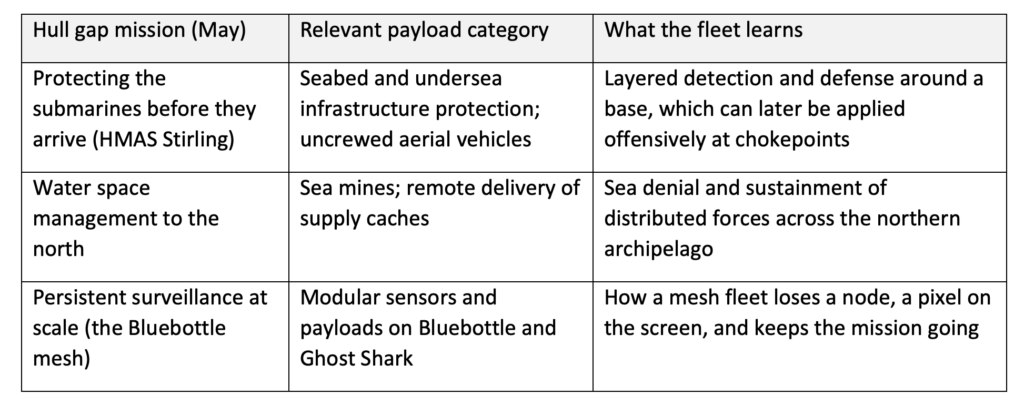
The government itself frames the systems as strengthening undersea warfare, seabed operations, sea denial and the protection of critical undersea infrastructure. That is close to the same list. The hull gap missions were never separate from the payload story. The payloads are how those missions get executed.
The announcement also shows what AUKUS Pillar II can deliver in practice. The submarine pillar runs on decades. Payloads tested together by three navies in a shared exercise can reach the fleet within years. That difference in tempo is exactly what a learning decade needs. Maritime Big Play Pacific is not a procurement milestone. It is a place where three navies can find out, in the water, what works, what breaks and what operators need.
The test is whether that integration produces common standards and interchangeable payloads across the three navies. If it does, the allies gain an undersea force they can build and replace in numbers, which matters as China invests heavily in its own undersea drone fleet. If it does not, Australia will have impressive national payloads and a coalition that cannot swap them. That is the difference between a toolkit and a collection of tools.
There is a second condition, and it is institutional rather than technical. In May I asked whether the Maritime Autonomous Systems Unit would rise to the operational moment or remain a development cell within Navy’s bureaucracy. Payloads that can be changed quickly only produce learning if operators can change them quickly, and if doctrine, training and command-and-control change at the same pace. Production rates matter, but the real constraint on the hybrid fleet will be how fast the Navy learns to use what is already coming off the line.
Three things will show whether the hull gap decade is becoming the opportunity I described in May.
- Standards across the three navies. Watch whether San Diego produces common interfaces and interchangeable payloads, or national solutions that happen to be tested side by side.
- Operational use, not demonstration. Payloads need to move from exercise showcases into the daily work of Maritime Border Command, the defense of Stirling and the northern approaches, so that operators generate the data and habits the new hulls will inherit.
- Institutional ownership. MASU, or whatever organization carries this work, needs the authority to set concepts of operation and training across the fleet, so that the hybrid force is built into the Navy before the Hunters and the general purpose frigates arrive.
The hulls will come. Whether Australia meets them with a navy that already knows how to fight as a mesh will be decided by what it does with the trucks, and what it puts on them, in the years before.
Sources
- “Government unveils AUKUS Pillar 2 payloads,” Australian Defence Magazine, October 19, 2026.
- Robbin Laird, “The Hull Gap Decade as Strategic Opportunity: Learning to Build the Hybrid Fleet Before the New Hulls Arrive,” Second Line of Defense, May 29, 2026.