
Geostrategic Perspectives: Securing Australia in a Fractured World

Professor Rory Medcalf opened the Sir Richard Williams Foundation’s October 1 seminar on air combat mass and depth in the Indo-Pacific by declining to do what the room expected of him, which was to start with the threat. He started with the public instead, and that choice carried the argument of his whole presentation: air power, like every other instrument of defence, is only as durable as the national will behind it.
Medcalf is Head of the National Security College at the Australian National University, a post he has held since 2015. His career spans diplomacy, intelligence analysis, journalism and the think-tank world. He served as a senior strategic analyst with the Office of National Assessments, was a diplomat posted to New Delhi and seconded to Japan’s foreign ministry, and was the founding director of the International Security Program at the Lowy Institute. His 2020 book Contest for the Indo-Pacific, published internationally as Indo-Pacific Empire, helped fix the Indo-Pacific as the organising concept for how Australia and its partners think about the region. The seminar’s moderator introduced him as the person best placed to set out the strategic realities that should shape assumptions about mass, depth and reach.
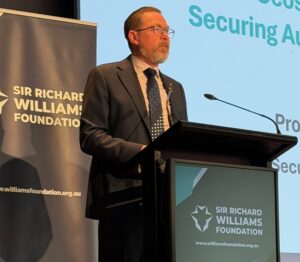
Medcalf was candid about the difficulty of the assignment. A geopolitical overview is a ritual at gatherings like this one, and most of what can be said in that vein is either obvious, already said many times, or speculative and hard to prove. In a security environment moving this fast, he observed, any description of the risk horizon is obsolete on delivery. So how does a strategic generalist add value to a room of air power specialists?
His answer was to ask not what he thinks, but what the nation thinks. Part of the reason is that Australia is a democracy and government serves the people. The harder reason is practical: no defence effort lasts without public understanding, consent and active support. He tied the point to remarks earlier this year by the Chief of Air Force on building fighting depth. A capability advantage in any domain, Medcalf argued, becomes a Maginot line if the public and political will to sustain a fight is missing. Fighting depth, in other words, begins well outside the hangar.
An Age of Anxiety: What Australians Expect
Australians already believe they are heading into an age of polycrisis, and they are right to be worried. That was the central finding of a two-year community consultation led by the National Security College, which included representative surveys of more than 20,000 people. Respondents were shown 15 plausible security issues. For most of them, a majority judged the threat likely within five years, serious in its consequences, and the nation underprepared. Medcalf noted that almost every item on the list would qualify, in business language, as a critical risk: high probability and high impact.
The numbers were stark:
• 87 per cent considered a critical supply chain disruption at least likely within five years.
• 89 per cent expected AI-enabled attacks in that window.
• 85 per cent considered an economic crisis at least likely.
• 69 per cent thought Australian forces were likely to be involved in military conflict overseas.
• 67 per cent rated a critical infrastructure attack likely, very likely or almost certain.
Medcalf offered these figures, as he put it, without judgement about whether the public, or for that matter the intelligence community, is making the right assessments. The point was the shape of public perception.
What Australians fear is not a single threat but several arriving together and feeding each other: economic shock, AI-magnified cyber intrusion, supply chain failure, infrastructure attack, disinformation, social unrest, foreign interference, terrorism, armed conflict, and the compounding effects of climate change and natural disasters.
The polling was done in mid-2025, well before this year’s Iran conflict made some of these fears real.
The finding most relevant to the room concerned war. Direct military attack on Australia was the only item on the list that fewer than half of respondents considered likely within five years, yet 45 per cent still did. When asked about consequences, the ranking inverted. Fully 80 per cent judged that a foreign military attack would have major or catastrophic consequences, the highest consequence rating of any threat tested.
For air power planners, Medcalf drew a practical conclusion. The public is open to a whole-of-nation conversation about security, including what he called the total sense of mass: the enablers, the infrastructure and the political will behind defence capability. The gap between what security planners worry about and what the public suspects is not large.
That gives government licence for a more open dialogue about preparing for conflict precisely in order to discourage it. He welcomed the signals on civil preparedness and resilience in the 2026 National Defence Strategy, calling them welcome if overdue, and said he looks forward to parliamentary scrutiny of how quickly that agenda can move.
The Planning Tripod Has Fallen
Australian defence planning, Medcalf reminded the room, long rested on a tripod of comfortable judgements. Geographic distance conferred a great protective advantage. Australia retained qualitative military superiority in its region. And there would be at least a decade of warning time while a potential aggressor modernised and mobilised its forces. Major power war was considered unlikely and direct threat remote.
That world, he said, is gone.
The public knows it, and government policy frameworks are coming to terms with it, even if their public-facing language remains cautiously worded. Each leg has weakened at once. Distance is eroding because cyber, quantum, AI and hypersonics erode the barrier geography once provided. The qualitative edge is under pressure because of the scale, quality and reach of Chinese military modernisation, and because of the growing difficulty of maintaining a broad-based capability advantage. Warning time, in his blunt phrase, has evaporated.
He then pointed to the language of government’s own strategic documents, which now contemplate forced projection and military coercion at levels not seen since the Second World War. He recalled the warning of the then Chief of the Defence Force a year ago that the nation must countenance scenarios of combat operations from its home territory. For an air combat audience, this is the operative sentence of the presentation. A force designed for a continent protected by distance and warning time is a different force from one designed to operate, sustain and regenerate under fire from home bases.
Medcalf also made a point that is easy to miss.
Even if Australia is never a frontline belligerent, its interests will be affected immediately and radically by a major conflict in the region. Trade routes, supply chains, energy, finance and the stability of near neighbours all sit within the blast radius. Preparing for conflict therefore means preparing for consequences that arrive before, and independently of, any decision to fight.
Four Trends Reshaping the Environment
Medcalf organised the government’s view of the changed environment around four interconnected trends.
The new geopolitics. Powerful states are acting with blatant self-interest. China remains Australia’s chief source of great power risk, and whatever the talk of stabilisation, there is no trust in the relationship with Beijing. Australia and China are in permanent contest for influence, especially in the Pacific. He added the dangerous reality of a Russia-China axis, which links the Eurasian and Indo-Pacific theatres of contest, underscored by China’s material support for Russia’s war against Ukraine.
The United States is part of this picture too. Faced with the blatant assertiveness of the Trump White House, Australia has stopped describing its alliance in terms of shared values and the upholding of a rules-based order. Yet the alliance is still needed. Medcalf observed that the Australian public, like the government, seems to be coping with the cognitive dissonance of depending on an ally it understandably has trouble fully trusting. He found a silver lining here: it lays foundations for a more mature conversation about national self-reliance.
The erosion of rules that protect smaller powers. Sovereignty, territorial integrity and the constraints on the use of force have favoured small and medium powers like Australia, and they are now under extreme threat. Canberra’s most frequent protests concern Russia’s invasion of Ukraine and China’s disregard for maritime law, including the UN Convention on the Law of the Sea and the codes that govern unsafe military encounters. Medcalf praised the professionalism with which Australian forces have handled repeated incidents involving PLA aircraft and ships. The fracturing of the order, he argued, both reflects and emboldens the use of force as an instrument of coercion, up to large-scale war. It is already a reality in Europe and the Middle East, and last year’s sharp, sudden air war between India and Pakistan showed it can erupt in Asia. The demonstration effect matters: war, from full invasion to undeclared hybrid operations, is becoming normalised. And such conflicts, once begun, tend to become protracted, placing immense pressure on munition stocks, economic resilience and political will.
The retreat of free trade. Medcalf mentioned this one only in passing, but the message was clear. Economic interdependence is being weaponised as a tool of statecraft, government is beginning to understand that national and economic security are deeply intertwined, and a world of fully free trade and investment is now no more desirable than it is attainable.
Disruptive technology. Here his concern was the shifting military balance in the Indo-Pacific. China’s capabilities are growing in scale, quality and reach, and Australia finds it increasingly hard to keep a broad capability edge. Cyber, quantum, AI and hypersonics threaten to neutralise the geographic barrier. The rapid weaponisation of drones and AI may lower the thresholds for conflict and escalation even as it offers asymmetric advantage to powers willing to seize it. Critical technologies are also an avenue of opportunity for Australia, whether in its own capabilities or as part of regional and allied supply chains.
In aggregate, Medcalf concluded, these trends mean the potential for major conflict is rising, including in Australia’s own region.
Compromised Sovereignty in China’s Coercive Shadow
China, Medcalf said, remains the paramount strategic concern: Chinese power, the way it is being used, and its growing presence in Australia’s immediate geography. It is no longer controversial to argue that Beijing seeks hegemony in East Asia and perhaps the wider Indo-Pacific. For a decade, the driving concern of Australian grand strategy, whatever its public utterances, has been to prevent Chinese dominance of the Indo-Pacific, preferably without war.
The vital questions follow.
• To what extent might Beijing risk escalation to armed conflict to achieve its objectives, from seizing Taiwan to broader hegemony?
• Are the risks of miscalculation and escalation manageable? What can Australia feasibly do?
Medcalf stressed that these are not abstract questions. They go to whether Australia’s trade and investment are conducted on terms negotiated rather than dictated, to the maximum preservation of sovereignty and diplomatic freedom of action, and to Australia’s identity as a liberal democracy free from coercion and interference.
He corrected a common misreading. Australian concern about China is sometimes caricatured as a paranoid fear of invasion. The more accurate picture is a fear of permanently compromised sovereignty in China’s coercive shadow.
There are many ways short of invasion to subjugate a country: maritime blockade, economic coercion, political interference, disinformation, subversion and critical infrastructure sabotage, used in combination. That is why Australia studies Europe’s experience of Russian hybrid warfare so closely. The interest is not only solidarity among democracies; Europe is, in his word, a laboratory for what could be waged in the Indo-Pacific.
It also explains where Australia has put its diplomacy, development assistance and infrastructure financing: countering Chinese influence in the South Pacific and obstructing a permanent Chinese security footprint there. A Chinese military presence east of Australia, such as a base in one of several island nations, could block sea lines of communication to the United States, tie up Australian forces and hold targets at risk along a largely undefended east coast.
The military reach to match is arriving. Even open-source analysis indicates that China’s missiles, navy and air force, including systems based on militarised artificial islands in the South China Sea, can increasingly target Australian territory. Last year’s far-from-friendly circumnavigation of the continent by a PLA naval task group was a reminder, Medcalf said, that Australia cannot afford to look only northward.
Deterrence, Mass and Reach for a Lonely Middle Power
Medcalf was careful to say that a strategic snapshot cannot itself define the optimum capabilities for the Australian Defence Force. What it does is reinforce the case that credible deterrence is fundamental to the statecraft of conflict prevention, that risks may rise sooner than planners assume, and that Australia cannot afford to hold defence investment at the recent levels of cautious ambition.
He placed that argument inside a distinctive Australian predicament. Australia is a democratic middle power in a vast region with no natural bloc of partners: no NATO and no European Union. Japan, another capable but lonely power, is now Australia’s most valued regional partner of any real strategic weight.
At the same time, like other American allies, Australia faces new uncertainty about the character, motivations and reliability of the superpower. The diplomatic web of partners and alliances is deepening and diversifying, and that is welcome. But diplomacy alone does not carry weight in a crisis.
This is where he linked the geopolitical picture to the seminar’s subject. Australia’s own military weight, he argued, must be treated as a critical element of an all-arms approach to statecraft. Close-in friends, from Japan to Indonesia, along with a growing arc of Pacific partners, will see Australia as a more credible partner if it does not deny itself the ability to project power in a crisis, power that would serve their interests as well as its own. That is a notable framing for air power. Reach is not only an operational attribute; it is part of what makes Australia a security partner worth having.
There is also a question of time. Medcalf acknowledged the logic of acquiring strategic weight over the long term, and not only through AUKUS.
But the confronting reality is that an Australian government will need options to deal with a breakdown of the regional order in the short run. Such a conflict could be protracted, and Australia’s geography would be a critical factor in how events unfold. The old comfort that distance would buy time has become a planning condition to be managed, with geography now cutting both ways: it is a barrier no longer, yet it remains the stage on which any sustained campaign would be fought and sustained.
The seminar’s agenda was capability and deterrence, high-end conflict, and the need to prevent it by being prepared to fight. Medcalf’s contribution was to set the conditions under which those technical debates must be conducted.
The public already expects trouble and wants to hear more from government about what defence capabilities are for. The planning assumptions that once justified modest ambition have collapsed. China’s coercive shadow is a more subtle and more probable danger than invasion, and the force that deters it must be able to act in the short run as well as the long one.
Mass, depth and reach, on this reading, are national propositions as much as air force ones. They depend on aircraft and munitions, and equally on infrastructure, industry, civil resilience and a public that understands why it is being asked to invest.