
Mass, Depth and Reach: The Williams Foundation Asks Whether Australia’s Air Force Is Built Effectively for the Indo-Pacific Fight

The second Sir Richard Williams Foundation seminar of 2026 opened with a question its organizers said has no simple answer. What does sufficient air combat mass and depth look like for Australia, and is the country building it?
The seminar, “The Requirement for Air Combat Mass and Depth in the Indo-Pacific,” sat deliberately apart from the Foundation’s recent work. For the past eighteen months its seminars have concentrated on the Australian Defence Force’s ability to “fight tonight.” That meant the force’s readiness to compete this afternoon, fight tonight, and survive and win tomorrow, with 2027 looming as the planning milestone. This seminar stepped back to first principles: the strategic, operational and tactical requirements of a high-end fight in the Indo-Pacific specifically.
The shift matters. A force can be tuned very precisely for the next crisis and still be poorly shaped for a prolonged one. Readiness answers the question of what the force can do now. Mass and depth answer a harder question: what it can keep doing once the fight is no longer short, and once the adversary has had a vote.
Not the Middle East, not Ukraine
Air Chief Marshal Mark Binskin (Retd), Chairman of the Foundation, opened the day with an observation about the Australian debate. In Australia, the moment air power comes up, the conversation turns to the Middle East or Ukraine. Those theaters offer important lessons, but they are not the Indo-Pacific. They do not involve the ranges across which Australian air power would have to operate in a regional high-end fight.
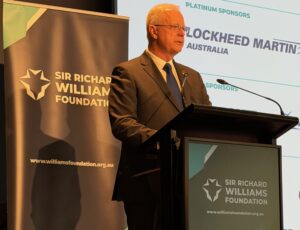
That framing ran through the whole day. Binskin pointed attendees back to George Kenney’s wartime reports, which he called a great summary of how to fight a war in the Indo-Pacific. Technology has changed since, but “the basics are still there”: distance, logistics, basing and the unforgiving geography of the theater. The Foundation’s concern is that these issues are not as broadly understood in Australia as they need to be.
Binskin said the seminar would examine the “realities that our people face in this complex environment” through air combat mass, depth and reach. The three words were chosen with care. Mass is what most people picture. Depth is what keeps mass useful over time. Reach is the reminder that, in this theater, none of it counts unless it can be delivered across the distances involved.
Reframing the question
Wing Commander Sally Knox, Commanding Officer of No. 6 Squadron and the day’s MC, supplied the analytical frame in her opening. She started from the strategic environment described in the 2026 National Defence Strategy and its commitment to deterrence by denial. If Australia is serious about denial, she argued, it must ask whether the force it is building has sufficient mass, depth and reach to deliver it.
She listed the Indo-Pacific realities: distance matters, access matters, and basing, survivability and sustainment all matter. Meanwhile, demand for air capability is growing along three lines:
• Protecting the integrated force and critical infrastructure;
• Gaining and maintaining control of the air; and
• Delivering sustainable strike at range.
Knox then made the point that shaped the rest of the day. This was “not simply a conversation about whether air force needs more aircraft.” Sufficient combat mass has to be assessed across the whole system, which she defined as platforms, weapons, people, training infrastructure, logistics, ISR and the space capabilities that enable them. An air force can have an impressive aircraft count and still lack the weapons stocks, the maintainers, the airfields or the data links to turn that count into sustained combat power.
It is a useful corrective to the way such debates usually run. A count of aircraft is easy to publish and easy to compare. The other items on Knox’s list are harder to see, harder to measure and slower to build, which is precisely why they tend to be undercounted.
The shape of the day
In her opening remarks, Knox laid out a program that moved from strategic context to the future force.
Session one began with the geostrategic environment and what it means for Australia’s future air combat requirements. It then turned to collaborative combat aircraft: where CCAs fit in the broader force, what they offer in mass, survivability and operational effect, and how defense and industry can deliver them together. Industry perspectives on the supporting capabilities and systems followed.
Session two, after morning tea, addressed deterrence and national defense. It looked at contemporary air power and space lessons, and at what those lessons mean when applied to Indo-Pacific distances, threats and operational demands.
The afternoon looked further ahead. It began with the Royal Air Force’s perspective on developing and delivering a sixth-generation force. It then turned to the gaps, risks and opportunities in generating air combat mass and depth, and closed by bringing the discussion back to Australia: what the national defense strategy means for the Air Force and its contribution to the integrated force.
The sequencing was itself an argument. The day began with geography and strategy, moved through the new technologies, and only then asked what a future force requires. Platforms were not the starting point. They were something to be fitted into a larger problem.
Crafting a sustainable air enterprise
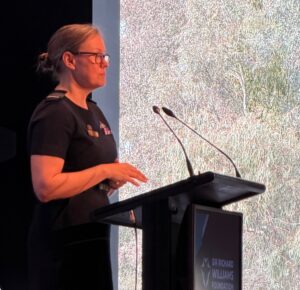
Sally Knox presenting at the Sir Richard Willliams Foundation Seminar October 1, 2026
Knox returned for the closing and distilled the day into a few conclusions, which function as the seminar’s argument in compressed form.
First, air combat mass is “much more than numbers of aircraft.” It is the whole system that generates combat power: people, platforms, weapons, networks, training, infrastructure, logistics and industry. The decisive test is whether that system has the depth to absorb disruption, adapt and keep operating. In a high-end fight, disruption is a given. What matters is whether the force can keep operating through it.
Second, technology will change how mass is generated. Collaborative combat aircraft, autonomy and related capabilities, she said, “offer enormous potential.” But technology does not dissolve the enduring demands of geography, sustainment, preparedness and workforce, and those demands bite hardest across the distances of the Indo-Pacific. An uncrewed aircraft still needs fuel, weapons, a runway or a launch point, and people to maintain and employ it. The conceptual gains of autonomy do not exempt it from logistics.
Third, and most pointedly: “technology does not equal strategy.” It is easy to confuse acquiring capabilities with having a way of using them. Knox implied that the harder question is what the force is for, how it will be sustained, and how it fits the national strategy.
What the Foundation is pushing against
Australia’s debate about air power often defaults to platform counts and, increasingly, to the promise of autonomous mass. The Foundation’s organizers pushed against both. Their view is that mass without depth is brittle, and that depth is mostly unglamorous: weapons stockpiles, trained people, logistics chains, resilient bases, space and ISR connectivity, and an industrial base able to sustain operations over time.
Neither of the two temptations is foolish. Aircraft numbers matter, and autonomy may well change the economics of generating mass. The danger lies in treating either as the answer rather than as one input. A large fleet that cannot be sustained, or a cheap uncrewed one that cannot be based, supplied and protected, offers the appearance of strength rather than the substance.
The reference to George Kenney is telling. Kenney’s air campaigns in the Southwest Pacific succeeded through improvisation, forward basing and logistics innovation as much as aircraft numbers. The Foundation is effectively reminding its audience that the Indo-Pacific rewards those who solve the geography problem, and that today’s lessons from other theaters do not carry over unchanged to this demanding theater of operation.
A takeaway: The enterprise, not the platform
My own takeaway was that the seminar offered a very different take on next-generation airpower. Rather than concentrating on a platform – a sixth-generation platform, whatever that turns out to mean – the focus was on a recrafted airpower enterprise. One might call it regenerative airpower: a force whose strength lies in its ability to absorb loss, recover, reconstitute and keep generating combat power, and not merely in what it can put in the air on the first day.
In other words, the next generation of airpower is an enterprise, not a platform. That is a harder thing to procure, to announce and to photograph. It is also the thing that determines whether a force still counts for anything in the fourth week of a conflict.
But more on that in a later chapter.