
Putin’s Choice: How The Global War in Ukraine Explains Sikorski’s Kaliningrad Gambit
On September 11, 2026, at the Yalta European Strategy conference in Kyiv, Polish Foreign Minister Radosław Sikorski said something that deserved more attention than it received. He argued that Kaliningrad, the heavily militarized Russian exclave wedged between Poland and Lithuania, has been quietly stripped of troops as Moscow feeds reinforcements into the Ukrainian meatgrinder, and that NATO should exploit the gap.
Sikorski stated that Poland monitors the Russian exclave closely and observed that Moscow has left the heavily militarized territory virtually depleted of conventional ground forces to replenish combat losses in Ukraine. His proposed remedy was not seizure but pressure: aggressive NATO drills calibrated to make Vladimir Putin uncertain enough about allied intentions that he would be compelled to pull forces back out of Ukraine to cover his own flank. “Putin knows, or assumes, that NATO is a peaceful alliance and we will not take advantage of his local weakness. And, perhaps, that is a mistake,” Sikorski told conference participants.
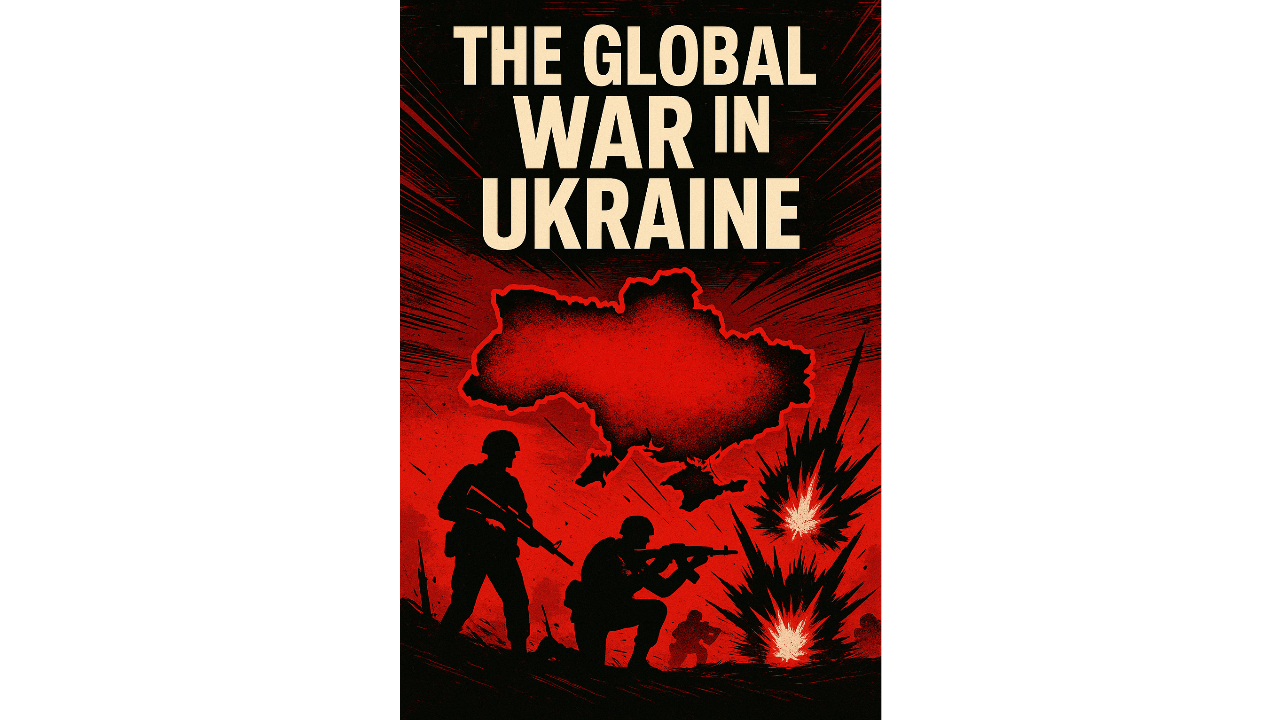
That single proposal, asymmetric pressure applied at the seam of Russia’s own strategic geography, is worth taking seriously not as a one-off diplomatic flourish but as the logical endpoint of an argument Sikorski has been building for two years: that Putin was never fighting a contained war against Ukraine. He was choosing, deliberately and repeatedly, to escalate a regional conflict into a campaign against the whole of Europe’s political and social fabric. Sikorski has said Europe is “under assault from Russia,” with hybrid attacks ranging from political murders and cyberwarfare to acts of sabotage and weaponized migration. That is precisely the trajectory laid out at length in The Global War in Ukraine: 2021–2025, and reading Sikorski’s Kaliningrad remarks against that book’s core argument that Putin had a path available to him that did not lead to confrontation with the entire continent, and rejected it deliberately, repeatedly, and consequentially sharpens both.
The Path Not Taken
The most important thing to understand about the current confrontation is that it was not inevitable. In the book’s opening analytical chapter, “The Path Not Taken,” I trace how Russia spent more than a decade after the Cold War as an active, constructive participant in European security architecture, not a bystander coerced into cooperation, but a willing partner in it. Russia formally joined NATO’s Partnership for Peace program in June 1994 and remained engaged for over a decade: Russian officers trained at NATO staff colleges, Russian forces served under NATO command in Bosnia, and by the early 2000s the alliance and Moscow had built what may have been the most substantive experiment in East-West military cooperation since 1945.
That history has been almost entirely erased from contemporary Russian political discourse, and Western commentary has largely let it disappear along with it. Putin’s narrative of NATO as an inherently hostile, encircling institution requires forgetting the decade in which Russian troops trained alongside NATO’s own forces and Moscow helped shape the very security order it now claims to be defending itself against.
The same choice repeated itself in the economic sphere. Russia in the early 2000s sat on a historically unique combination of energy wealth and a highly educated, technically capable population, resources that could have supported a Norway-style model of full sovereignty paired with deep institutional and economic integration with Europe.
Instead, Putin’s government treated energy exports as an instrument of coercion rather than a foundation for mutual prosperity: cutting gas supplies to Ukraine in 2006 and 2009, disrupting deliveries to multiple European states, and explicitly linking energy contracts to political compliance. Where Germany’s postwar integration into Western Europe or Japan’s alliance with the United States each transformed a former adversary into a prosperous partner, Russia chose dominance over integration at every decision point where the alternative was available.
The book’s argument is that this pattern reflects something deeper than security anxiety about NATO enlargement. It is that the European Union not NATO represents the actual existential threat to Putin’s model of restored Russian empire, because a successful, prosperous, European-integrated Ukraine would prove that former Soviet states could prosper independently of Moscow and under a different political model entirely. That is a threat no amount of security guarantees or neutrality pledges from Kyiv could have neutralized, which is why proposals for Ukrainian neutrality consistently failed to reduce the underlying tension: a neutral but successful Ukraine was nearly as dangerous to Putin’s system as a NATO member would have been.
From a Regional War to a Continental One
This is the frame through which Sikorski’s recent statements make analytical sense, and it is the frame the book applies directly to the question of how the war’s character has changed since February 2022. In the chapter “Russian Options,” written against the backdrop of October 2025, the question was posed explicitly: how does a war that began as a contained regional conflict evolve into one “pitting the authoritarian versus the democratic powers,” and what does that shift do to Putin’s available choices going forward?
The honest answer, by late 2025 and into 2026, is that the shift had already happened and Sikorski’s public statements are essentially a diplomat’s real-time confirmation of an analytical trend the book documents in granular detail. Sikorski has pointed to the 2019 Berlin assassination and alleged political assassinations in the United Kingdom, alongside sabotage incidents in Czechia, Lithuania and Poland, as evidence of a coordinated Russian campaign against European security that reaches well beyond the immediate war zone. He has connected the annulled first round of Romania’s presidential election after the unexpected victory of a little-known pro-Russian candidate to paid social-media interference, calling it a “wake-up call” for the rest of Europe.
None of this is speculative.
The book documents the mechanism in detail: European security services in Latvia, Germany, and Poland have arrested individuals recruited through Telegram channels, instructed on photographing military installations, buying local maps, and using local SIM cards to avoid detection, to conduct surveillance, arson, and sabotage against military infrastructure and supply lines. This is not old-fashioned handler-run espionage. It is a democratized, decentralized model of low-cost, low-risk recruitment that lets Russian intelligence services activate sympathizers across the continent with minimal exposure. Lithuania alone faced nearly 600 contraband balloon incursions from Belarus in a single year, forcing repeated closures of Vilnius airport, a method whose banality (balloons carrying cigarettes) is precisely the point: it tests response thresholds, imposes costs, and normalizes boundary violations without crossing the line that would trigger Article 5.
The same logic runs through Finland’s experience of weaponized migration, the persistent GPS jamming that affects Baltic civil aviation and maritime navigation, and the disinformation campaigns amplifying social division across multiple democracies simultaneously. None of these instruments are confined to the immediate NATO-Russia border. They are calibrated specifically to operate in the gray zone across the whole of Europe, precisely because that zone offers the political effect Moscow wants, destabilization, doubt, division, without providing the clean trigger for collective defense that a conventional attack would.
The Airspace Dimension and Kaliningrad’s Place in It
Where the book’s analysis intersects most directly with Sikorski’s specific Kaliningrad proposal is in the chapter documenting the escalating pattern of Russian airspace violations along NATO’s eastern flank through September 2025, the immediate strategic backdrop against which Sikorski’s remarks a year later should be read.
The most serious incident came on the night of September 9–10, 2025, when nineteen to twenty-three Russian drones violated Polish airspace during a large-scale strike on Ukraine, triggering a Quick Reaction Alert response involving Polish F-16s, Dutch F-35s, Italian AWACS aircraft, and German Patriot batteries — the first time NATO forces had fired shots since the war began. That incident was not isolated. Three Russian MiG-31 combat aircraft transited Estonian airspace for twelve minutes en route to Kaliningrad on September 20; a Russian drone breached Romanian airspace on September 13, the eleventh such incident that year according to Romania’s own Ministry of Defense. NATO’s Secretary General characterized the pattern as reckless and “increasing in frequency,” and the alliance responded on September 12 with Operation Eastern Sentry, a comprehensive eastern-flank air defense mission, alongside EU-backed plans for a continent-spanning “drone wall.”
That is the environment in which Poland has been building what the book describes as a highly layered, missile-centric defense posture, Patriot batteries under the Wisła program, an unprecedented HIMARS acquisition under Homar-A, all explicitly framed against a perceived Russian missile, rocket, and drone threat originating from Kaliningrad and Belarus as much as from the Ukrainian battlespace itself.
Poland’s defense planners have been treating Kaliningrad as a standing threat vector for years before Sikorski’s Kyiv remarks which is exactly why his September 2026 proposal is notable. He was not describing a hypothetical vulnerability; he was describing a known one, and proposing to invert it. Sikorski noted that Russia’s invasion of Ukraine has resulted in the Kremlin lowering its defenses in the exclave, and that while NATO should not take offensive action there, an intensification of allied drills around the area could force Russia to withdraw troops from Ukraine. He described visiting a Polish tank company in Latvia three days earlier and finding no corresponding Russian troop presence across the border, adding that Kaliningrad itself now holds “hardly any troops.”
This is deterrence through calibrated ambiguity rather than escalation for its own sake, a distinction Sikorski was careful to draw. He framed the proposal as drills “so aggressive” that Putin would be left uncertain of allied intent, without NATO ever crossing into actual offensive action against the exclave. It is a textbook application of the asymmetric-pressure logic the book’s “Russian Options” chapter identifies as Russia’s own preferred instrument, using ambiguity, calculated risk, and gray-zone action to generate strategic effect without triggering formal collective defense — turned back on Moscow at the one point in its own strategic geography where the math currently favors NATO.
The value of situating Sikorski’s statements inside this larger analytical structure is that it resists the temptation to read either the Kaliningrad proposal or the “attack on all of Europe” framing as escalatory rhetoric from a hawkish foreign minister. Both statements are descriptions of a strategic reality that has been building for years and that the book documents systematically: Putin was offered, and rejected, a cooperative path into the European security order twice over — once through the Partnership for Peace framework in the 1990s and 2000s, and again through the energy-integration model that countries like Norway demonstrate is compatible with full sovereignty. Having rejected both, and having then found the war in Ukraine militarily unwinnable and economically unsustainable, Russian casualties nearing one million, sixty-seven of eighty-nine regions running severe budget deficits, refining capacity gutted by Ukrainian strikes, Sikorski’s own assessment is that Europe retains real leverage here: he has argued that if Ukraine has knocked out roughly half of Russia’s refining capacity in six months, a combined European effort could finish the job in a fraction of that time, urging Europe to convince Putin that any aggression against it would come at an “incredibly costly” price.
What connects the refinery campaign, the Kaliningrad drills proposal, and the hybrid-warfare pattern across Romania, Czechia, Lithuania, Germany and the UK is a single strategic insight the book insists on throughout: Putin’s Russia does not have the luxury of confining this conflict to Ukraine’s borders even if it wanted to, because the ideological logic driving the war — restoring a sphere of imperial influence, demonstrating that democratic contagion from a prosperous, European-integrated neighbor can be defeated — was never containable to a single battlefield in the first place.
The war was continental from the moment Putin chose confrontation over the accommodation that was twice on offer. Sikorski is simply the diplomat most willing to say so plainly, and to draw the operational conclusion that follows: if Moscow is going to treat all of Europe as contested space, Europe’s deterrent posture should extend to all of Russia’s exposed geography, including the one exclave where, for now, the Kremlin’s own war has left it thin.
Notes
- Kyiv Post, “Poland’s Sikorski Proposes NATO Drills to Pressure Kaliningrad,” September 2026. https://www.kyivpost.com/post/84403
- Defense News, “Polish minister proposes drills near Kaliningrad to draw Russian troops from Ukraine,” September 14, 2026. https://www.defensenews.com/global/europe/2026/09/14/polish-minister-proposes-drills-near-kaliningrad-to-draw-russian-troops-from-ukraine/
- Yahoo News / European Pravda (dpa), “Europe is already under attack from Russia, Polish foreign minister says.” https://www.yahoo.com/news/europe-already-under-attack-russia-185024157.html
- Yahoo News, “Europe ‘under assault from Russia,’ Polish foreign minister warns.” https://www.yahoo.com/news/europe-under-assault-russia-polish-161128069.html
- Kyiv Post, “Polish FM: ‘We Would Defeat Russia Quite Quickly’ if Moscow Attacked NATO.” https://www.kyivpost.com/post/84430
- Reuters (via Yahoo News), “Poland’s Sikorski says Europe must prepare for ‘deep’ Russian strike.” https://www.yahoo.com/news/articles/polands-sikorski-says-europe-must-152701883.html