
From Exquisite Scarcity to Intelligent Mass: How Drone Wars Are Rewriting the Grammar of Warfare

Notebook LM has generated a graphic which provides a summary of my book, Lessons from the Land Wars: Maritime Autonomous Systems and Maritime Operations.
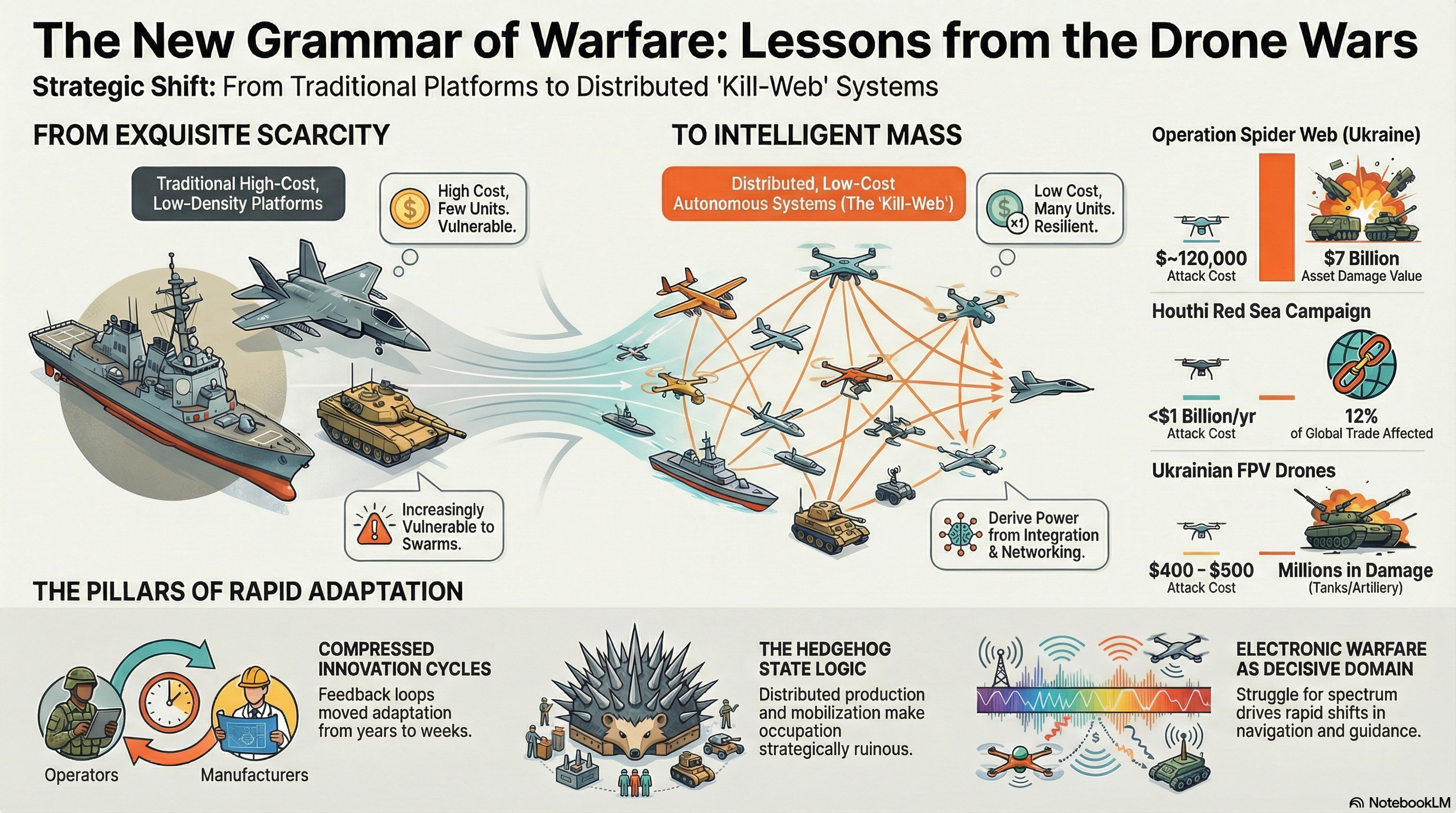
The new grammar of warfare is being written in real time over Ukraine, the Red Sea, and other contested zones, and the language it speaks is that of drones, data, and distributed systems. The graphic you provided captures this shift succinctly: a world moving from “exquisite scarcity” to “intelligent mass,” from a handful of expensive, vulnerable platforms to webs of cheap, networked autonomous systems that can impose disproportionate costs on an adversary.
For decades, advanced militaries organized their power projection around a relatively small set of high‑end platforms: major surface combatants, fifth‑generation fighters, main battle tanks, large manned ISR aircraft. These platforms were technically sophisticated, enormously expensive, and procured in low numbers. In this older grammar of warfare, the dominant questions were: How survivable is the platform? How stealthy, how heavily armored, how fast, how lethal? The assumption was that qualitative superiority could offset numerical inferiority.
The left side of the graphic crystallizes this world. A destroyer slices through the water, a stealth fighter looms in the sky, and a tank rumbles forward—icons of conventional military power. Yet the callouts underscore their emerging vulnerability. They are described as “high cost, few units, vulnerable” and “increasingly vulnerable to swarms.” That phrase, vulnerable to swarms, captures the new asymmetry. When an adversary can put dozens or hundreds of inexpensive drones against a single exquisite platform, traditional notions of survivability begin to break down.
In the emerging grammar, the center of gravity shifts from platform performance to system behavior. The right side of the graphic depicts a seascape and battlespace filled with drones: aerial, maritime, and land systems linked together in a dense web of lines. Instead of a handful of capital ships or aircraft, we see mass—many nodes, each individually expendable, collectively decisive. This is labeled “distributed, low‑cost autonomous systems (the ‘kill‑web’)”: a network in which sensing, communication, and effects are shared among many platforms rather than concentrated in a few.
The economic logic here is as important as the tactical logic. Low unit cost and high numbers allow a force to absorb losses while continuing to fight. If an adversary must expend million‑dollar interceptors or expose premium platforms to counter a $500 drone, the cost‑exchange ratio begins to erode their campaign over time. In such an environment, resilience is not about protecting every node; it is about ensuring that the network continues to function even as nodes are lost.
The top‑right of the graphic anchors this theory in practice through Operation Spider Web in Ukraine. In mid‑2025, Ukraine launched a coordinated long‑range drone strike against multiple Russian air bases, using over a hundred relatively inexpensive UAVs to reach deep into Russian territory. Open‑source assessments suggest the operation destroyed or damaged around forty long‑range bombers and support aircraft—roughly a third of Russia’s strategic bomber force—along with fuel and infrastructure.
The infographic compresses these numbers into a stark comparison: approximately 120,000 dollars in attack cost versus an estimated 7 billion dollars in asset damage value. The exact figures may be debated, but the order of magnitude tells the real story. By using large numbers of inexpensive drones, Ukraine was able to generate a strategic effect, crippling a portion of Russia’s long‑range strike capability—at a tiny fraction of the cost of the assets destroyed.
This is intelligent mass in action. The operation did not depend on a single exquisite platform penetrating Russian air defenses. Instead, it relied on many relatively simple systems, some of which would inevitably be shot down, but enough of which would penetrate to achieve their mission. The graphic’s web of lines around the drones suggests that their power comes not only from numbers, but from coordination and shared targeting. Massed autonomy, well‑networked, becomes a strategic lever.
A second example in the graphic is the Houthi campaign against shipping in the Red Sea. Using a mix of drones, cruise missiles, and ballistic missiles, the Houthis have been able to threaten merchant ships transiting one of the world’s key maritime chokepoints, forcing many major carriers to reroute around the Cape of Good Hope. The effect has been to lengthen transit times, raise freight costs, and inject uncertainty into global supply chains.
The infographic captures this by highlighting that the Red Sea and Suez route accounts for roughly 12 percent of global seaborne trade. Even intermittent attacks, or the credible threat of attack, are enough to trigger risk calculations among shipping firms and insurers. The text notes annual attack costs under a billion dollars, yet the economic repercussions, measured in higher shipping costs, delayed deliveries, and increased insurance premiums, are vastly larger.
Again, the grammar is asymmetric. A relatively small investment in offensive systems by a non‑state actor has forced a coalition of advanced navies and air forces to maintain high‑tempo defensive operations, tying up ships, aircraft, and munitions that could be used elsewhere. The operational burden and the economic impact far exceed the Houthis’ material outlay. Intelligent mass need not be technologically exquisite to be strategically disruptive; it only needs to exploit critical nodes in the global system.
The third vignette in the graphic focuses on Ukrainian first‑person‑view (FPV) drones. These are small, relatively simple quadcopters or fixed‑wing drones flown by operators using live video feeds, often adapted from commercial systems and fitted with improvised warheads. Their typical cost runs in the 400–500 dollar range, yet they have destroyed or disabled large numbers of Russian tanks, artillery pieces, air defense systems, and logistics vehicles, often worth hundreds of thousands or millions of dollars each.
The infographic summarizes this reality: a few hundred dollars in attack cost generating “millions in damage” against high‑value armor and artillery. Videos from the front show FPV teams operating in cells, with spotters, pilots, and support personnel working together to locate targets, maneuver around obstacles, and strike vehicles in their weak points. In many sectors, these teams have become the primary anti‑armor and counter‑battery capability, reshaping how both sides employ and protect heavy equipment.
Here the new grammar is visible at the company and battalion level. Tactical units that once depended on a small number of manned platforms for precision fires now field swarms of cheap drones, experimenting with attack profiles, fuses, and guidance tweaks on a weekly basis. The boundary between soldier and weapons engineer blurs, because frontline operators and backyard tinkerers iterate together. The effect is a constant pressure on the opponent: any movement, any parked vehicle, any artillery position risks immediate, precise attack.
The lower half of the graphic shifts from describing effects to explaining why this transformation is happening so quickly. It identifies three “pillars” that enable rapid adaptation: compressed innovation cycles, the hedgehog state logic, and the centrality of electronic warfare.
First, compressed innovation cycles. The graphic shows operators and manufacturers linked by a feedback arrow, with the caption that adaptation has moved from years to weeks. This reflects what we see in Ukraine and other theaters: drone designs, software, and tactics evolve through tight loops between frontline experience and small, agile manufacturing or modification facilities. Lessons learned from yesterday’s mission are incorporated into tomorrow’s airframe, payload, or control algorithm.
This stands in stark contrast to traditional defense acquisition, where major platforms are designed over decades, fielded over years, and updated in slow, deliberate spirals. In the drone wars, a commercial quadcopter model might be adopted, modified, used in combat, and then replaced by a superior variant in a matter of months. Software updates can be pushed even faster. The result is a kind of Darwinian battlefield, in which systems that cannot adapt quickly simply disappear.
Second, the hedgehog state logic. The hedgehog image in the graphic—bristling with spikes—symbolizes a state that distributes production and mobilization widely across society. Instead of a few large factories producing a small number of exquisite systems, many small workshops, startups, volunteer groups, and dual‑use firms produce thousands of expendable platforms. Ukraine’s drone ecosystem, with its blend of state programs, private companies, and volunteer initiatives, is a living example of this model.
For an occupier or coercive adversary, such a state is extremely hard to neutralize. Destroying a single factory does not meaningfully reduce the flow of drones to the front. Targeting a few large air bases does not eliminate the ability to launch attacks, because drones can fly from small, dispersed sites. Occupation becomes “strategically ruinous” because the defender can continue to regenerate intelligent mass at relatively low cost, imposing ongoing attrition and political pain.
Third, electronic warfare as a decisive domain. The rightmost pillar in the graphic shows a colorful spectrum, with drones and vehicles on either side, representing the contested electromagnetic environment. Drones depend on radio links, GPS or other navigation aids, and often on data networks for coordination. This makes them vulnerable to jamming, spoofing, and interception—and it forces both sides into an intense, ongoing struggle for control of the spectrum.
In Ukraine, each improvement in FPV employment has been met by new Russian jamming or interference, which in turn drives Ukrainian adaptations such as frequency‑hopping, increased autonomy, or alternative navigation schemes. EW units, once seen as specialized support, are now frontline combat multipliers. The new grammar of warfare is not just about platforms and numbers; it is about who can sense, communicate, and act in an environment where the very act of emitting a signal exposes you to countermeasures.
Taken together, the elements of the graphic point to a profound set of strategic implications. First, militaries that rely primarily on a small inventory of exquisite platforms risk catastrophic cost‑exchange ratios when confronted by intelligent mass. If a carrier strike group, air base, or armored brigade can be held at risk by swarms of cheap, networked drones, then survivability must be reconceived not as the invulnerability of individual platforms, but as the resilience and redundancy of the overall system.
Second, integrating legacy platforms into kill‑webs will be crucial. High‑end aircraft, ships, and ground systems are unlikely to disappear, but their roles will evolve. A stealth fighter, for instance, might function as a quarterback for swarms of collaborative combat drones, providing command, control, and high‑end sensing while staying out of the densest threat envelopes. Surface combatants may act as hubs and magazines for unmanned surface and subsurface vehicles, projecting power while reducing their own exposure. The key is that value shifts from what the platform can do alone to what it enables the web to do collectively.
Third, industrial and mobilization policy becomes a core element of warfighting capability. States that can rapidly scale production of low‑cost autonomous systems, exploit commercial supply chains, and align innovators with operators will enjoy a sustained advantage. This favors societies with flexible industrial bases, strong digital sectors, and political systems capable of harnessing civilian innovation for defense when needed. The hedgehog state is as much about governance and social resilience as it is about technology.
Fourth, doctrine and training must adapt to a battlespace in which every unit is both a sensor and a potential target. Camouflage, deception, dispersion, and rapid movement regain importance in an era when a cheap quadcopter overhead can spot and strike within minutes. Commanders must assume that anything that emits, concentrates, or lingers will eventually be found and attacked. This pushes forces toward more distributed, mission‑command‑style approaches, where small units have the authority and tools to act within broader intent.
Finally, the political threshold for using force may shift. When strategic effects can be achieved with inexpensive, deniable, or semi‑autonomous systems, states and non‑state actors may be more inclined to test boundaries, probe defenses, or wage prolonged campaigns in the gray zone. The Red Sea campaign shows how relatively low‑cost attacks can impose high economic costs without crossing into full‑scale war between major powers. Managing escalation in such an environment will require new frameworks for signaling, deterrence, and defense cooperation.
The graphic, taken as a whole, is both analytical and cautionary. It shows a world in which power no longer rests comfortably in the hands of those who can build the largest ships, the fastest jets, or the heaviest tanks. Instead, advantage accrues to those who can combine numbers, networking, rapid adaptation, and electronic warfare into a coherent kill‑web. The examples of Operation Spider Web, the Red Sea campaign, and Ukrainian FPV units are early chapters in this story, not its conclusion.
For militaries, defense industries, and policymakers, the message is stark. Clinging to the old grammar, exquisite scarcity, slow acquisition, centralized production, risks strategic surprise and unfavorable cost‑exchange in the next conflict. Embracing the new grammar means investing in intelligent mass, resilient networks, hedgehog‑style industrial bases, and spectrum dominance. It means treating every platform as a node in a larger web, and every engagement as a contest of adaptive systems rather than isolated duels of hardware.
The drone wars have made the outlines of this future impossible to ignore. The challenge now is to translate the lessons captured in this graphic into concrete choices about force design, doctrine, and industry.