
The FCAS Saga: How Europe’s Most Ambitious Fighter Program Fell Apart
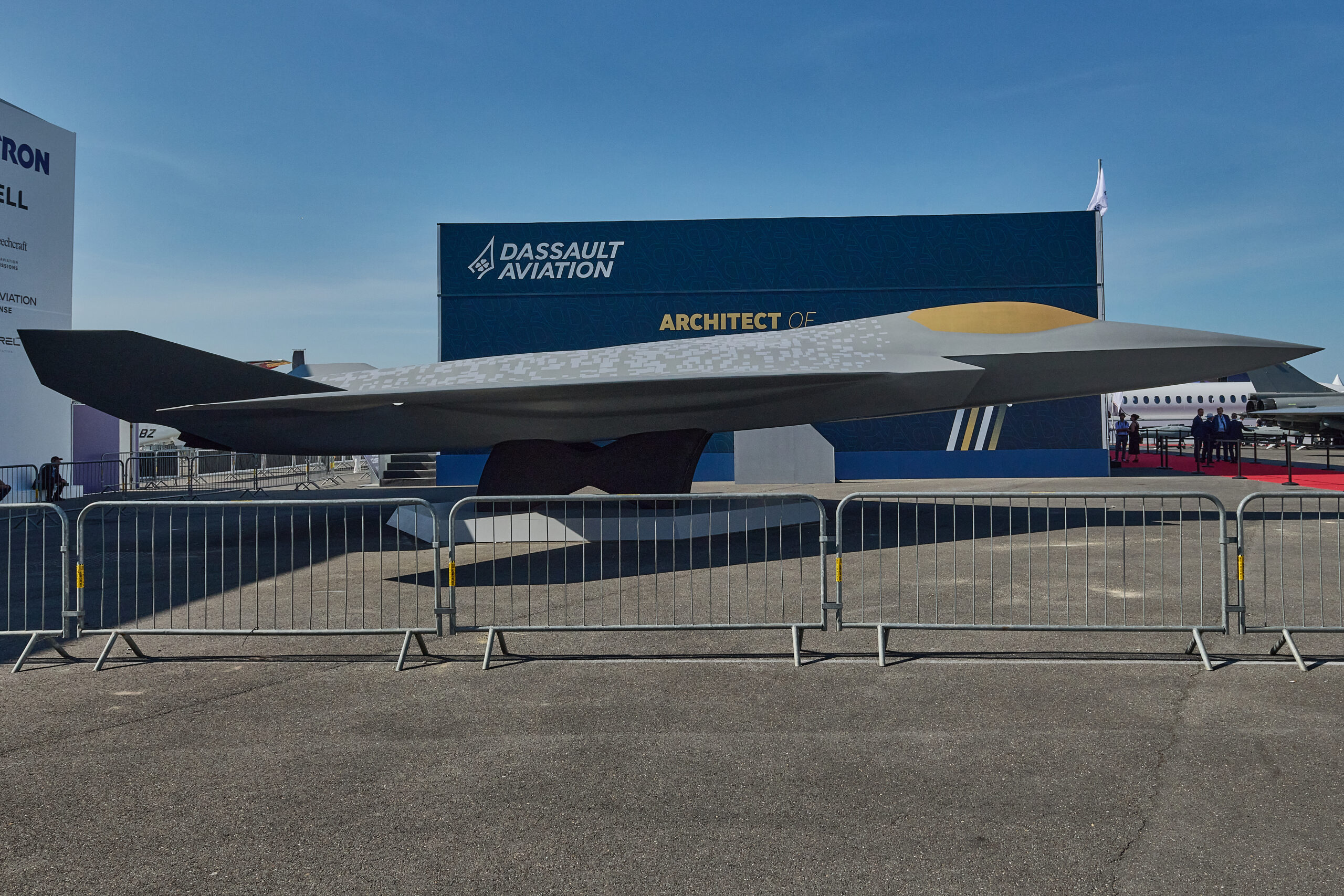
On June 8, 2026, German Chancellor Friedrich Merz stood before the ILA Berlin Air Show and confirmed what many inside European defence circles had long suspected: the New Generation Fighter (NGF) at the heart of the Future Combat Air System, known in France as the Système de Combat Aérien du Futur (SCAF)—was dead. The announcement, formally communicated to French President Emmanuel Macron four days earlier on the sidelines of the EU-Western Balkans Summit in Montenegro, ended a seven-year industrial saga that had consumed hundreds of millions in study contracts, thousands of engineering hours, and immeasurable diplomatic capital. Europe’s flagship answer to the F-35, the F-47, and China’s twin sixth-generation prototypes had walked off the stage before a single demonstrator had ever flown.
For those who had followed FCAS sine its inception, the ending was not a surprise.
It was the culmination of a structural contradiction that had been visible from the first day the programme was announced: France and Germany wanted fundamentally different things from the same aeroplane, and neither was willing to pay the price of genuine compromise.
What follows is the story of how that contradiction played out—from the euphoria of Le Bourget 2017 to the ILA reckoning of 2026.
Origins: A Political Vision in Search of an Industrial Logic
The FCAS concept was born in the bilateral relationship between Emmanuel Macron and Angela Merkel at the Paris Air Show in June 2017. The two leaders announced that France and Germany would jointly develop a next-generation combat air system to succeed the Rafale and the Eurofighter Typhoon around 2040. Spain joined the program the following year. The political symbolism was powerful: here was the Franco-German engine of European integration extending its reach into the most technically demanding and strategically sensitive domain of national sovereignty—combat aviation.
The architecture was ambitious from the outset. FCAS was conceived not merely as a new fighter jet but as a ‘system of systems’: a New Generation Fighter at the centre, a family of unmanned Remote Carriers flying in coordinated swarms alongside it, and a Combat Cloud, a networked digital architecture linking every aircraft, drone, sensor, and missile in the battlespace into a single integrated picture. The program was estimated at upwards of €100 billion over its lifetime. It was, by any measure, the most complex joint defence programme Europe had ever attempted.
The Joint Concept Study was formally launched in February 2019 when French Armed Forces Minister Florence Parly and German counterpart Ursula von der Leyen signed contracts with Dassault Aviation and Airbus Defence and Space in Paris. Eric Trappier, Dassault’s Chairman and CEO, described the moment as ‘the cornerstone to ensure tomorrow’s European strategic autonomy.’ Dirk Hoke of Airbus Defence and Space called FCAS ‘one of the most ambitious European defence programmes of the century.’ The language of partnership was effusive. The reality beneath it was already more complicated.
We covered that contract signing at Defense.info at the time, noting that the program rested on a High Level Common Operational Requirements Document signed at the Berlin Air Show in April 2018.
The intent was sound: agree on what the system needed to do before arguing about who would build which part of it.
In practice, the military requirements remained a bridge over very different national strategic traditions, traditions that would prove impossible to reconcile in the industrial phase.
The Nuclear Fault Line: French Sovereignty vs. German Industrial Balance
The deepest structural problem in FCAS was not industrial: it was strategic. France and Germany came to the programme with fundamentally incompatible requirements derived from their respective defence postures, and those incompatibilities were present from the beginning.
France’s requirements for the NGF were shaped entirely by its doctrine of independent nuclear deterrence. The Rafale is, among other things, a nuclear delivery platform. It carries the ASMP-A air-launched cruise missile as the airborne leg of the French dyad. Any aircraft that succeeds the Rafale must therefore be capable of carrying nuclear weapons. It must also be capable of operating from the Charles de Gaulle aircraft carrier and its planned successor, since French naval aviation is an integral part of the deterrent posture. These are non-negotiable requirements driven not by preference but by the architecture of French strategic independence.
Germany has no nuclear role. The Bundeswehr operates Eurofighters and Tornados, the latter in a NATO nuclear sharing role carrying B61 gravity bombs—but Germany has no independent deterrent and no aircraft carrier. The German air force’s requirements for a next-generation fighter centered on interoperability, cost-effectiveness, and the preservation of a competitive industrial base. Germany needed a capable multirole aircraft. France needed a sovereign nuclear platform with carrier capability. These are different aeroplanes.
The French air chief, General Philippe Lavigne, articulated France’s position clearly in a December 2018 interview we published on Second Line of Defense. Connectivity was at ‘the heart of collaborative combat,’ he said, and the Rafale F4 upgrade was conceived as a technology demonstrator for FCAS network capability.
But he was also unequivocal that the NGF would be manned rather than unmanned—’there will not be a robot flying an airborne nuclear weapon, for reasons of ethics.’ France was building a successor to its deterrent aircraft. Germany was building a NATO multirole jet. The overlap was real but insufficient to sustain a single jointly-designed platform.
Germany, recognizing this divergence, eventually proposed developing two variants of the NGF to satisfy the different national requirements. France rejected the proposal flatly. A two-variant approach would have complicated production economics, diluted the French design authority, and raised questions about technology transfer for nuclear-sensitive systems. Paris chose instead to insist on a single aircraft designed around French requirements and with France in the driving seat. Berlin found that position unacceptable.
The Industrial War: Dassault Against Airbus
Beneath the strategic divergence ran a parallel industrial conflict that proved equally intractable.
At its core was a single question: who leads the fighter?
Dassault Aviation’s position was principled from its own perspective and entirely predictable. The company had designed, developed, and continuously evolved the Mirage and Rafale families across decades. It had accumulated unmatched expertise in combat aircraft system architecture, airframe design, weapons integration, and critically nuclear weapons compatibility. Trappier and his team argued that design authority for the NGF should reside with Dassault, the proven ‘best athlete’ in combat aircraft development. Dassault reportedly sought as much as 55 to 80 percent of the core fighter workshare, depending on which phase and which estimate one credits.
Airbus Defence and Space, representing the German and Spanish industrial interest, saw that position as an invitation to industrial subordination. To accept Dassault’s terms would be to relegate Germany’s aerospace sector to a subcontractor role on the defining European defence programme of the coming decades—an arrangement politically unacceptable in Berlin and industrially unacceptable to Airbus’s board. Germany had contributed substantially to the Eurofighter through DASA and its successors and expected equivalent standing in any successor program. Airbus pushed for genuine co-leadership with balanced workshare. The two positions were irreconcilable.
The dispute played out across a series of critical industrial milestones. In April 2021, after weeks of intensely difficult negotiations, Airbus and Dassault reached what was described as a breakthrough agreement on Phase 1B workshare, the demonstrator phase. The deal was hailed as saving the program. In retrospect, it papered over the underlying incompatibility rather than resolving it. The questions of design authority, IP ownership, and leadership of the full Phase 2 development were deferred, not settled.
By late 2023, the IP dispute had become the central obstacle. The two companies could not agree on how to share the intellectual property generated in the joint study phases, particularly as it related to software architecture and the combat cloud. France’s insistence on maintaining sovereign control over nuclear-related technology and Dassault’s insistence on retaining design authority over systems it had architected clashed with Germany’s requirement for genuine bilateral ownership of the program’s technical outputs.
An April 2024 article we published on Second Line of Defense by Pierre Tran, drawing on the Franco-German ministerial context of that period, captured the contrast with the parallel MGCS tank program instructively. French Armed Forces Minister Lecornu observed that the MGCS had deliberately prioritized agreement between the French and German armies on common military requirements before allowing industry to compete over workshare, in contrast to FCAS, where ‘time consumed by French and German industry in competing claims to win project leadership’ had dominated from the outset.
The lesson was noted. It was too late to apply it to FCAS.
The Political Environment: Scholz, Merz, and the Erosion of Bilateralism
The industrial deadlock was exacerbated throughout this period by the deterioration of the Franco-German political relationship at the highest level. The personal chemistry between Macron and Olaf Scholz was visibly poor in a way that had operational consequences for both FCAS and MGCS. Our 2023 coverage at Second Line of Defense noted bluntly that ‘there appears to be little warmth between Macron and Scholz, making it harder to advance cooperation between the two nations.’ Senior officials and industry insiders confirmed privately that the two leaders’ mutual wariness was reflected in bureaucratic foot-dragging on both sides.
Germany’s Zeitenwende, the €100 billion special fund announced by Scholz following Russia’s invasion of Ukraine, created additional complexity. Berlin’s sudden financial ambition for defense rearmament raised the question of which systems Germany would actually buy. The German government’s decision to procure the F-35 for the nuclear sharing role, rather than waiting for an FCAS-derived solution, was a telling signal. Berlin was hedging against FCAS’s failure long before it announced it.
The European Sky Shield Initiative, launched under German leadership and drawing on U.S. and Israeli missile systems, deepened the Franco-German rift. Paris was furious that Berlin had organized a European missile defense architecture that largely excluded Franco-Italian systems such as the SAMP/T Mamba in favour of Arrow-3 and Patriot. From the French perspective, this was not merely a procurement disagreement. It was a direct challenge to the concept of European strategic autonomy that FCAS was supposed to embody. Macron said so publicly. The acrimony poisoned the wider bilateral atmosphere in which FCAS had to be negotiated.
Friedrich Merz, who replaced Scholz as Chancellor following the February 2025 elections, brought a different personal style but inherited the same structural problems. His government’s new national aviation strategy formally adopted by cabinet on June 10, 2026, the same week as the FCAS cancellation announcement was explicit: any future German combat aircraft program must include Airbus as a co-lead.
This was not a negotiating position. It was a condition.
It was also, from Paris’s perspective, incompatible with Dassault’s requirements for design authority over a nuclear-capable platform. Merz and Macron discussed the impasse in Montenegro on June 6. They concluded there was no way through.
The Final Year: Mediation, Collapse, and Denouement
The last serious attempt to save the NGF came in the first quarter of 2026. Following a dinner between Macron and Merz in Brussels on March 18, the two governments launched a formal mediation process, appointing senior officials to seek a compromise on the industrial leadership question and the technical requirements divergence. The mediators had until mid-April to report.
They reported on April 18. Their conclusion was stark: a jointly built crewed fighter was no longer feasible under any framework either government was prepared to accept. The Macron-Merz meeting in Cyprus on April 23 acknowledged the findings but handed the decision back to defense ministries, a classic face-saving deferral that convinced no one. By May, senior officials in both Paris and Berlin were privately describing continuation as ‘very unlikely.’ The only remaining question was how and when to make the announcement.
The answer came at ILA. The Berlin Air Show provided a suitable industrial backdrop and perhaps a moment of bitter symbolism for Merz to confirm publicly what he had told Macron in Montenegro. The sixth-generation fighter that was supposed to define European air power for the second half of the twenty-first century was abandoned before it had ever flown.
Germany advised France ‘not to pursue the construction of a joint fighter jet any further.’ France, for its part, had by this point begun mapping its own path forward.
What Survives: The Combat Cloud and the Way Ahead for European Air Power
The cancellation of the NGF does not end all FCAS-related cooperation. Both governments have confirmed that work on the Combat Cloud, the networked digital architecture that was always the more tractable part of the program, will continue. The specific division of responsibilities is to be negotiated at the next Franco-German ministerial council, currently expected on July 17, 2026. Germany has also signalled interest in salvaging a broader ‘system of systems’ concept focused on drone connectivity, command and control, and cross-platform data sharing, work that does not require agreement on fighter design authority or nuclear requirements.
This is not nothing. The Combat Cloud concept, if developed with genuine ambition and proper funding, could provide a meaningful contribution to European operational capability. The vision of networked manned-unmanned teaming that underpinned FCAS’s system architecture remains relevant arguably more so given the lessons of Ukraine and the proliferation of autonomous systems in the contemporary battlespace. If France and Germany can cooperate credibly on the digital layer, that cooperation has real value.
But the strategic picture for European air power is sobering. Britain, Italy, and Japan are advancing the Global Combat Air Programme (GCAP) toward a 2035 service entry target, with a prototype demonstrator already in development. The United States is flying the F-47. China has flown at least two new prototypes. The Rafale and the Eurofighter Typhoon, the two front-line types FCAS was meant to succeed, now face a future without an agreed European replacement. France will almost certainly develop its own NGF successor to the Rafale, drawing on the substantial investment it has made in FCAS-related technologies through the Rafale F4 program and the national study work. That aircraft will be French, sovereign in the fullest sense of the word.
Germany faces a more complex decision. Its aviation strategy insists on Airbus co-leadership for any future program. The available options include deepening its stake in GCAP, unlikely given the trilateral structure already established, developing a national Eurofighter successor through FCAS-derived technology, or pursuing a bilateral program with another partner. None of these is straightforward.
Lessons of the Saga: What FCAS Tells Us About European Defence Integration
The FCAS saga offers a set of lessons that extend well beyond combat aviation.
The first and most fundamental is that genuine joint development of a sovereign defence capability requires genuine alignment of strategic requirements. France and Germany are close allies with deep institutional ties and a shared commitment to European integration. But they are not the same country. France has nuclear weapons; Germany does not. France has an aircraft carrier; Germany does not. France has a tradition of strategic autonomy rooted in De Gaulle; Germany has a tradition of multilateral embeddedness rooted in the post-war settlement. These differences are not incidental. They shape what each country needs from its air force at the deepest level.
No amount of political will at the bilateral summit level can override a requirement for nuclear compatibility if the other partner has no nuclear role. The politicians can sign joint declarations; they cannot change the physics of weapons design or the logic of nuclear deterrence. FCAS tried to bridge a gap that was, in the end, unbridgeable in a single airframe.
The second lesson concerns industrial governance. The decision to launch FCAS before settling the question of industrial leadership, before establishing who would design the fighter, who would hold the IP, and on what basis workshare would be allocated, ensured that the most contentious negotiations would occur under the maximum pressure of sunk costs and political embarrassment. The contrast with MGCS, where military requirements alignment preceded industrial competition, is instructive and painful. Program governance matters. Agreeing on who leads before you sign the first contract is not a detail. It is the program.
The third lesson is about the relationship between European strategic autonomy and allied interdependence. FCAS was conceived in part as a demonstration that Europe could develop world-class defense capability without dependence on Washington. That instinct is understandable and, in the long run, correct.
But strategic autonomy cannot be proclaimed into existence. It has to be built, component by component, through sustained investment, industrial cooperation that actually works, and willingness to accept the constraints that genuine partnership imposes.
FCAS’s failure does not invalidate the aspiration for European strategic autonomy. It illustrates how difficult it is to achieve.
The fourth lesson, finally, is about time. The threat environment of 2026 is not the threat environment of 2017. Russia has been at war with Ukraine for four years. China’s military aviation program has accelerated dramatically. The United States, under two successive administrations, has demonstrated that transatlantic commitments cannot be taken for granted. Europe needed its next-generation fighter. It needed it badly.
The seven years consumed by the FCAS saga have not stood still. GCAP will fly in the mid-2030s. The F-47 is already in development. Europe’s flagship programme is gone. The window for a joint European sixth-generation fighter has, for now, closed.
Conclusion: The Unfinished Pillar
When Macron and Merkel launched FCAS at Le Bourget in 2017, they spoke of European sovereignty, technological leadership, and the indispensability of Franco-German cooperation. Those aspirations were not wrong. The ambition was genuine and the need was real. What was missing was a clear-eyed reckoning with the structural incompatibilities that the program would have to overcome and the institutional courage to address them honestly before the industrial interests had calcified.
The combat cloud survives. Some of the technology developed under FCAS contracts will find its way into future systems. France will build its own next-generation fighter. Germany will eventually find a path to a credible combat aviation future.
But the jointly designed, jointly built Franco-German-Spanish sixth-generation aircraft that was supposed to be the centerpiece of European air power in 2040 will not exist. That is a significant failure, not of European ambition, but of European program management and strategic alignment.
We have written about FCAS from its earliest days, tracking the concept studies, the industrial negotiations, the political crises, and the repeated attempts to find a compromise that would allow the program to proceed. Throughout that coverage, the underlying tension was visible. The question was never whether there would be a reckoning, but when and in what form.
The form, in the end, was a quiet conversation on the margins of a summit in Montenegro, followed by an announcement at an air show in Berlin. Europe’s most ambitious defense program ended not with a bang but with a bureaucratic communiqué and a promise to negotiate the future of the combat cloud at a ministerial council in July.
That, too, is a lesson worth remembering.
Note: I would like to thank the photographer Paul Grayson for his photo. His work can be seen at the following:
Note: Coming next year is our new series on the Western Alliance in Transition.