
The Defense.info team offers a range of insightful podcasts, designed to provide a scaffolded perspective on critical global strategic issues. Each episode unpacks layered insights on defense and security, building a clearer, well-supported understanding of complex topics. Exclusively available on our website, these podcasts give listeners an essential framework to interpret the latest developments with context and depth. Many of these podcasts highlight our longer reports or publications and provide a discussion of their findings and perspectives.
Podcasts

03/23/2026
We are not living through a passing disturbance. We are living through the Age of Chaos, a systemic transition from one global order to another whose destination remains fiercely contested. The familiar language of a “rules-based international order” trending toward liberal norms no longer describes the world that democratic leaders actually have to navigate. It describes an assumption that has been operationally falsified by events.
For more than three decades after the Cold War, Western strategic thinking rested on a powerful and largely unspoken premise: that the international system had entered a phase of durable stability. The wars in Iraq and Afghanistan, the 2008 financial crisis, the resurgence of Russian revisionism, and China’s methodical rise were not isolated shocks to that system. They were staging points in the emergence of a fundamentally different system altogether. The full-scale invasion of Ukraine in 2022 did not initiate that transformation. It exposed it in concentrated form.
This book maps three forces that now define the strategic landscape. The first is a multi-polar authoritarian architecture, not a formal alliance, but a marketplace of coercion in which Russia, China, Iran, and North Korea trade resources, technology, and political cover in ways that sustain each other’s capacity to challenge democratic order. Alongside it, and with deeper long-term consequence, is what this book terms Global China: a twenty-first-century informal empire built through finance, infrastructure, ports, and digital systems rather than territorial conquest. Students of British imperial history will recognize the logic — deep influence without formal rule, dependency without occupation.
The second force is the transformation of warfare itself. Ukraine has become the first large-scale laboratory of kill web warfare — where distributed sensors, commercial satellite constellations, artificial intelligence, and networked command structures have combined to overturn platform-centric force design. The lessons emerging from that conflict are not limited to Europe. They define what high-end combat now demands of democratic militaries, industries, and alliances across every theater.
The third force is the pivotal role of middle powers — Australia, Japan, Poland, Brazil, and others — whose economic alignments and security partnerships will determine whether the global order hardens into rival blocs or finds some form of competitive coexistence. Their choices are not peripheral to the contest. In the Age of Chaos, they are central to it.
Running through all three is a practical challenge to democratic leadership. The shift from crisis management to chaos management is not rhetorical. Crises no longer arrive in isolation: they overlap, interact, and amplify one another. Economic shocks reshape security policy; technological competition rewires alliances; regional conflicts reverberate through global supply chains. The decisive question is whether democratic societies can align their institutions, industries, and partnerships fast enough to compete — not to restore a stable equilibrium that no longer exists, but to shape what comes next.
The argument that follows is grounded in four decades of field research and direct engagement with commanders, planners, and officials across allied democracies — from Cold War Europe to the contemporary Indo-Pacific. The vantage point is not the seminar room but the lived reality of those adapting institutions and forces in real time. That methodological choice is deliberate. Independent analysis, rooted in practitioner experience rather than comfortable consensus, is essential precisely when consensus has failed. The post-Cold War settlement failed to anticipate the Age of Chaos. The task now is to understand the world as it is.
The Age of Chaos does not signal the inevitability of democratic decline. It signals the end of an era in which stability could be assumed, and the beginning of one in which it must be actively constructed. The generation that navigated the early Cold War built the institutions that defined the strategic landscape for decades. Our moment presents a comparable test.
This book is a framework for understanding the contest.
03/01/2026
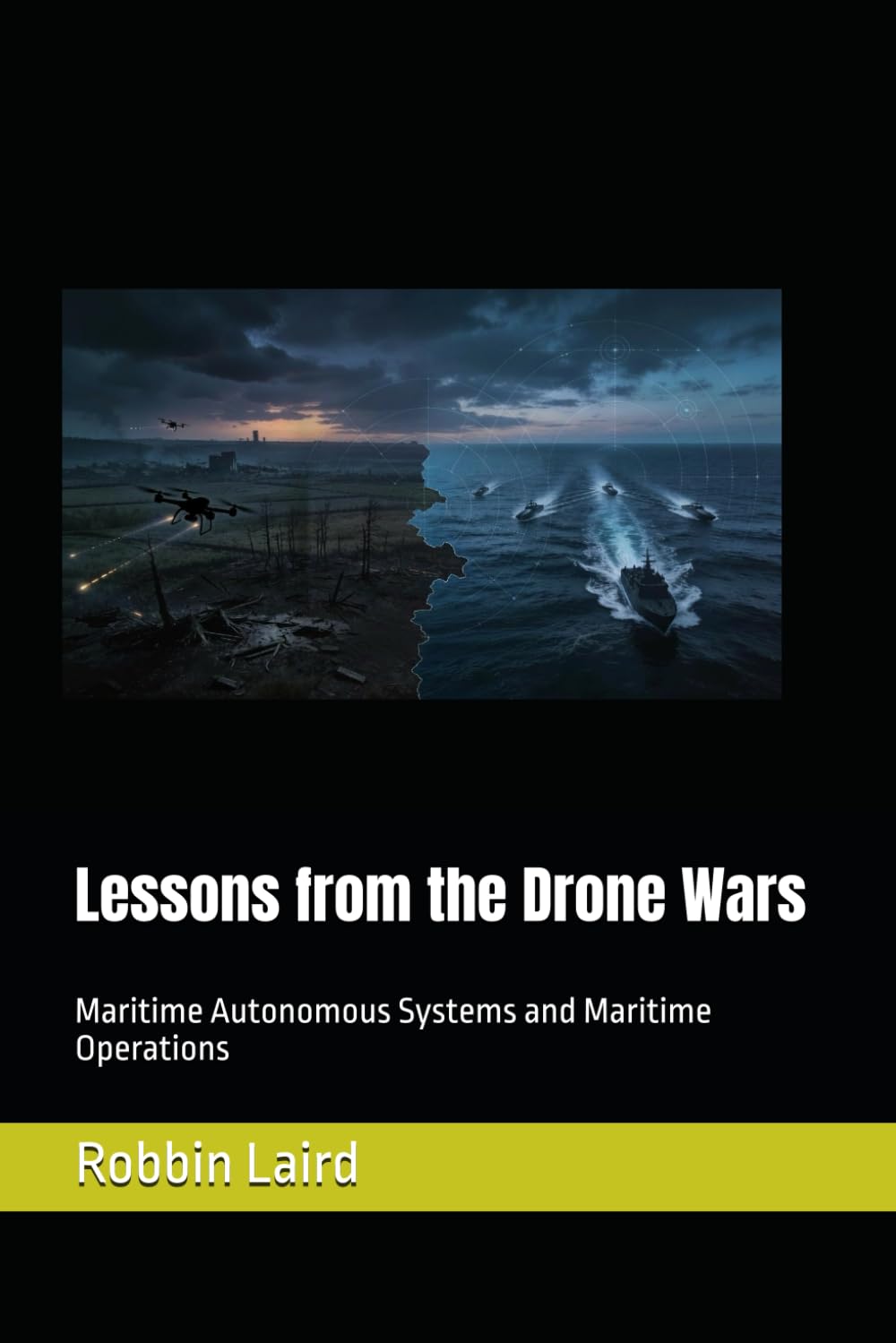
Picture a Russian soldier in a fortified trench, overwhelmed by an enemy he cannot see. In desperation, he holds up a piece of cardboard reading “We want to surrender” and points it not at a human officer but at the camera of a ground robot rolling toward his position. This is not speculative fiction; it is the new routine of the Ukrainian battlefield as described in Robbin F. Laird’s 2026 book, Lessons from the Drone Wars: Maritime Autonomous Systems and Maritime Operations. The book and a recent podcast discussion about it portray a world in which a 400‑dollar commercial drone can destroy a multimillion‑dollar strategic bomber, museum aircraft train AI systems to strike active warships, and a spool of fiber‑optic microfilament can neutralize high‑end electronic warfare domes. The math of modern conflict has been broken and rebuilt on entirely different foundations.
The Autonomy Illusion
Laird begins by dismantling one of the most persistent myths surrounding drone warfare: that autonomous weapons are already roaming battlefields as fully independent, Terminator‑style killers. In military doctrine, autonomy is defined along a strict five‑level scale, with level five representing a fully independent system making strategic decisions without human intervention, a capability that remains firmly theoretical. Even the most advanced systems in service today, such as the MQ‑9 Reaper, the MQ‑4C Triton, and Australia’s Ghost Bat, operate in the far more constrained world of levels two and three.
At level two, a machine can handle basic functions such as steering and acceleration, but a human operator still guides the mission and remains responsible for its conduct. At level three, the system may make immediate tactical decisions, adjusting course, avoiding obstacles, refining a firing solution, but a human must be ready to intervene at any moment. The Reaper’s cockpit still has a physical stick and throttle; they simply sit in a ground control station thousands of miles away from the aircraft itself. Laird warns that calling such systems “autonomous” obscures the real issues. Sensational debates about rogue AI crowd out the more urgent operational questions of what current systems can truly do, where they are vulnerable, and how commanders should employ them in combat.
Intelligent Mass vs. Exquisite Scarcity
At the core of Laird’s analysis lies a stark tension between two competing philosophies of power: intelligent mass and exquisite scarcity. Exquisite scarcity is the traditional Western and Russian model, invest heavily in a small number of technologically supreme platforms, from stealth fighters and strategic bombers to billion‑dollar destroyers. These systems are extraordinary but also irreplaceable; the loss of a single platform can constitute a strategic disaster rather than a mere tactical setback.
Intelligent mass offers a radically different logic: saturate the battlespace with large numbers of cheap, networked, “good‑enough” systems that are individually expendable but collectively decisive. In Ukraine, first‑person‑view drones costing between 400 and 500 dollars have, in some engagements, generated casualty rates of 70 to 80 percent among Russian units, destroying armored vehicles and logistics hubs worth millions. The cost‑exchange ratio is devastating to traditional doctrine.
Nowhere is this imbalance more obvious than in the Red Sea. Houthi forces have used drones priced from roughly 2,000 to 50,000 dollars to harass and threaten international shipping lanes. Coalition forces have often responded with advanced interceptor missiles costing between 2 million and 27 million dollars per shot. No economist is required to see that this equation is unsustainable: a determined adversary with industrial capacity and access to inexpensive drones can bleed a superpower’s defense budget simply by forcing it into a defensive posture.
Israel’s Iron Beam program points toward a way out of this trap. By using directed‑energy weapons, Israel has reduced the cost of intercepting an incoming drone to roughly 3 dollars per engagement, with an effectively bottomless “magazine” limited mainly by power supply. Laird frames such systems as one of the few credible long‑term answers to the economics of intelligent mass.
Operation Spider Web: Museum‑Trained Strike
One of the most striking case studies Laird explores is Operation Spider Web, an audacious Ukrainian strike conducted on June 1, 2025 against five Russian air bases spanning five time zones. Rather than sending stealth bombers, Ukraine relied on 117 OSA quadcopters, each hidden inside an ordinary wooden cabin mounted on the flatbed of a commercial truck. Unaware Russian civilian drivers transported these vehicles along standard shipping routes, using commercial 4G networks and parking near the perimeter of supposedly secure installations.
The targeting problem was formidable. Once airborne, the drones would have to operate in heavily jammed environments where radio‑based remote control was impossible. The engineering solution was disarmingly simple and cheap: Ukrainian teams trained their AI targeting algorithms using old Soviet aircraft displayed at the Poltava Museum of Long Range Aviation. Unable to collect data from active bombers, they instead mapped the geometry of museum exhibits, feeding thousands of images and sensor readings into the system until it could recognize 90‑centimeter aim points such as fuel tanks and wing roots. These signatures translated directly to active aircraft in Russia’s bomber force.
The AI was then coupled with open‑source autopilot software, enabling the drones to navigate without radio links, relying entirely on internal cameras and museum‑derived pattern recognition. The operation’s outcome was staggering: those low‑cost systems destroyed 41 aircraft worth roughly 7 billion dollars—around a third of Russia’s strategic bomber fleet—in a single strike. Geographic depth and rear‑area basing, long seen as a sanctuary for scarce, exquisite assets, no longer offered reliable protection.
The “Subsea Baby” and Multi‑Domain Operations
On December 15, 2025, an unmanned underwater vehicle nicknamed the “Subsea Baby” disabled a Kilo‑class Russian submarine at its pier in Novorossiysk, a vessel equipped to launch Kalibr cruise missiles and designed to epitomize stealth. The symbolism was blunt: submarines, the classic silent predators of the sea, could now be hunted in their home ports. Laird shows that this was not a one‑off improvisation but the culmination of careful multi‑domain planning.
Days before the Subsea Baby entered the harbor, Ukrainian forces launched a separate aerial drone strike aimed at destroying Russia’s sole IL‑38 maritime patrol aircraft in the region—the airborne sensor system that functioned as the fleet’s eyes. Eliminating that single aircraft created a precise gap in Russian maritime surveillance. Within that blind spot, the underwater vehicle slipped through undetected, executing its mission against the submarine at the pier. The operational logic was methodical: blind the watchtower, then send in the underwater assassin.
Russia’s reaction to this new vulnerability reinforces one of Laird’s broader themes: mutual vulnerability at sea. Unable to operate surface warships safely in the western Black Sea, where Ukrainian maritime drones made billion‑dollar vessels effectively indefensible, Russia shifted to sustained aerial bombardment of Odessa’s ports and energy infrastructure in late 2025 and early 2026. Ukraine could contest the sea and sink ships but could not fully shield its coastal cities from missile and drone strikes. Neither side could achieve uncontested dominance; both could inflict significant economic damage. Laird describes this as a grinding contest of mutual vulnerability, a technologically enabled stalemate that challenges traditional concepts of sea control.
Fiber Optics and Fast Followers
On land, Laird argues that Ukraine now hosts perhaps the most complex electromagnetic environment in history, as both sides blanket the battlespace with overlapping jamming fields that sever radio links between operators and drones. Sophisticated systems can turn into inert metal the instant they cross into the wrong frequency band. The technical response is paradoxically simple: fiber‑optic control cables.
Instead of relying on jammable radio waves, engineers equip drones with ultra‑thin microfilament cables that unspool behind the aircraft, kept under zero tension as the drone advances. The operator retains an unjammable high‑definition video feed and control link, effectively immune to expensive electronic warfare systems thanks to a spool of wire. It is a quintessential example of the low‑cost inversion Laird sees throughout the conflict: a modest technological adjustment that outmaneuvers multimillion‑dollar systems.
But Laird is careful not to turn this into a triumphalist story about Ukrainian ingenuity alone. The fast‑follower dynamic cuts both ways. Russia captures Ukrainian and Western systems, reverse‑engineers them, and fields its own variants, compressing adaptation cycles from years to months or even days. Moscow is now targeting annual production of roughly 1.4 million drones, a figure that underlines Laird’s contention that rapid iteration has become the ultimate weapon of modern war. Having the best idea first matters less if your adversary can replicate and mass‑produce it within weeks.
Hedgehog States and a Distributed Defense
Laird ultimately expands his operational analysis into a structural critique of traditional defense models, which he frames as the “hedgehog state logic”. Twentieth‑century deterrence relied on large standing armies and centralized installations: major bases, massive depots, visible concentrations of combat power. In his view, this architecture has become fundamentally vulnerable in an age of intelligent mass and precision strike. The alternative is a highly distributed, resilient system that draws on the entire fabric of society.
Ukraine’s wartime industrial strategy offers a proof of concept. Rather than concentrating drone production in a small number of major factories, the country deliberately dispersed manufacturing across more than 500 private producers, garage workshops, startup hubs, small‑batch fabrication shops embedded within the civilian economy. The result is a defense ecosystem that behaves more like the Internet than a traditional industrial base: a mesh of nodes rather than a single mainframe. Such a network is far harder to cripple with precision strikes because there is no singular “center” to destroy.
This logic poses uncomfortable questions for established military bureaucracies that can take two decades to field a new fighter aircraft. How can organizations built around slow, linear procurement cycles survive in an environment where frontline units iterate tactics and technologies in weeks ?
Laird suggests that the problem is not limited to defense ministries. Any institution anchored in slow legacy systems and rigid hierarchies now faces similar competitive pressure from cheaper, faster, more adaptive rivals. The multimillion‑dollar bomber on the tarmac is also a metaphor for legacy corporations, regulatory systems, and infrastructure.
A Final Provocation: Democratizing Lethality
The podcast closes on a question that Laird’s book raises but does not fully resolve: what happens when this level of low‑cost, AI‑enabled lethality migrates beyond the battlefield ? If militaries can use 400‑dollar FPV drones, museum‑trained AI, and fiber‑optic‑guided underwater systems with such precision and effect, what will non‑state actors, organized crime, or commercial rivals be able to do when similar capabilities become widely accessible ? How do cities, ports, and civilian infrastructure defend themselves when autonomous or semi‑autonomous strike systems can be acquired for the price of a laptop and a few components ordered online ?
Laird is explicit that his book is a work of strategic analysis rather than prophecy. Yet the trajectory he documents. from garage‑built FPV drones to museum‑trained strike packages to multi‑domain operations against submarines at pier, suggests that these questions are arriving faster than most institutions can adapt. The rules of conflict have been rewritten; the more urgent test is whether our thinking, our organizations, and our societies can keep pace.
02/17/2026
The common perception of the war in Ukraine is that of a brutal, but fundamentally European, conflict. It’s a narrative of national survival and territorial integrity, a story largely confined to the fields and cities between Kyiv and the Donbas.
However, a provocative new strategic assessment, The Global War in Ukraine 2021–2025, argues that the conflict has revealed deeper, counter-intuitive truths that extend far beyond the battlefield. Authored by veteran analyst Robbin Laird and published in 2026, the book presents the war as a global catalyst that has stress-tested the foundations of military strategy, international alliances, and 21st-century power in ways daily headlines often miss.
This analysis moves beyond the immediate tactical situation to distill five of the book’s most impactful and surprising takeaways. These are the truths that, according to Laird’s assessment, reveal not just the nature of this war, but the shape of the world it is forging.
-
Russia’s Aggression Created the Supercharged NATO It Feared Most
Laird’s analysis begins with a strategic own-goal of historic proportions. Vladimir Putin’s invasion, intended to halt NATO’s influence and push the alliance back from Russia’s borders, has instead resulted in the most unified, militarized, and expanded version of the alliance since the Cold War.
The book provides concrete and transformative evidence of this backfire. Before the invasion, NATO often appeared distracted. Today, Laird argues, it is energized with a renewed sense of purpose:
Finland and Sweden, nations with decades-long traditions of formal neutrality, abandoned their non-aligned status to join the alliance, adding over 800 miles of direct NATO border with Russia.
Germany, long Europe’s economic powerhouse but a military lightweight, launched a massive rearmament program, signaling a historic shift in its post-war strategic posture.
The United Kingdom and France revived a deep bilateral defense compact, intensifying their dialogue on nuclear deterrence and coordination.
In the book’s foreword, former Italian Air Force Chief of Staff Pasquale Preziosa captures how Putin’s grievance-fueled approach produced a classic security dilemma, where actions taken to enhance one’s own security are perceived as threats by others, who then take countermeasures that ultimately reduce the original actor’s security.
Putin’s approach to NATO, threat inflation anchored in grievance, produced a self-fulfilling security dilemma: treat a distracted alliance as existential, and you will eventually face the unified, militarized NATO you feared.
Ultimately, Laird concludes that Putin’s attempt to restore Russian influence through force resulted in a catastrophic strategic miscalculation. It not only failed to weaken NATO but galvanized his primary adversary into a more formidable and coherent military bloc than he had faced before the war began.
-
The Conflict Went Global: Asian Powers Are Now Key Players in Europe’s War
What began as a European regional conflict, Laird’s assessment contends, has transformed into a global proxy war where Asian powers are playing direct and startling roles on European battlefields. The book argues that the clean separation between Euro-Atlantic and Indo-Pacific security theaters has effectively collapsed.
The Global War in Ukraine 2021–2025 details several shocking examples of this new reality:
North Korea’s Direct Intervention: In a move unprecedented since the Korean War, Pyongyang transitioned from an arms supplier to an active combatant. The book details how North Korea deployed thousands of its troops to fight alongside Russian forces in the Kursk region, acquiring unwelcome expertise in modern warfare, including drone operations and electronic countermeasures, that will have direct consequences on the Korean peninsula.
Japan’s Intelligence Pivot: In a historic reversal of its post-war posture, Japan became a key intelligence partner for Ukraine. Motivated by the understanding that “Ukraine today may be East Asia tomorrow,” Tokyo provides crucial satellite reconnaissance from commercial providers like iQPS, whose advanced Synthetic Aperture Radar (SAR) capabilities have proven invaluable to Ukrainian defenders.
South Korea’s Industrial Might: Seoul emerged as a pivotal defense producer for the democratic coalition, supplying NATO allies with the advanced weapons and ammunition needed to sustain their support for Ukraine. In a potent insight, the book notes that the two Koreas have effectively “exported their competition to Europe,” with Seoul providing legitimate industrial support while Pyongyang offers illicit supplies and expeditionary forces.
This is a stunning geopolitical realignment. A war for territory in Eastern Europe is now being shaped by North Korean soldiers, Japanese satellites, and South Korean factories. The conflict has demonstrated that major security crises are no longer geographically contained; they are global events that draw in actors from across the international system.
-
Ukraine Revolutionized Modern Warfare with a Homegrown Drone Army
One of the most astonishing stories detailed in The Global War in Ukraine is the country’s military-technological transformation. Starting in 2014 with virtually no drone capability, Ukraine became a world leader in drone technology, production, and doctrine, achieving this transformation at what the book calls “wartime speed.”
Laird’s analysis documents this revolution unfolding in distinct phases:
- Adaptation: The initial phase saw the ingenious adaptation of commercial quadcopters and racing drones for military reconnaissance and attack missions.
- Scaling: This was followed by an explosive scaling of domestic production, with Ukraine reaching a capacity of 200,000 drones per month by 2025.
- Self-Sufficiency: Finally, Ukraine achieved near-total technological independence, moving from a reliance on imported components to producing nearly all components domestically.
The strategic impact of this drone army has been profound. Laird highlights Operation Spider Web, a sophisticated deep-strike operation in 2025 that used swarms of low-cost, AI-assisted drones to destroy a significant fraction of Russia’s strategic bomber fleet thousands of kilometers inside Russian territory. The operation demonstrated what happens when low-cost airframes converge with “smart guidance, distributed sensing, and audacious targeteering,” creating an unsustainable cost-exchange ratio for Moscow.
As Pasquale Preziosa summarizes in the foreword, this shift represents a doctrinal, industrial, and cultural transformation in modern warfare.
The shift is doctrinal, industrial, and cultural: from exquisite scarcity to intelligent mass, from platform-centric to network-centric, from hardware primacy to software advantage.
-
Russia’s “No Limits” Partnership with China is Actually an Economic Surrender
While Vladimir Putin’s pivot to China is often portrayed in Moscow as a strategic masterstroke, Laird’s analysis deconstructs this narrative, revealing a starkly different reality. The book argues that the war has, in practice, transformed Russia from a partner into a subordinate, creating a deep and asymmetrical economic dependency on Beijing.
This “strategic subordination” is evident in two critical areas detailed in the book:
- The “Yuanization” of Russia’s Economy: To escape the Western financial system, Russia has embraced the Chinese yuan. Once a marginal currency, the yuan now dominates Russian trade settlements. This expedient trade, however, places Moscow’s financial reserves and payments at the discretion of Beijing’s policy choices and the Chinese Communist Party’s political apparatus.
- The Price of Dependence: China has become the indispensable buyer for Russian energy, but this comes at a steep price. The book shows how Beijing consistently secures Russian oil and coal at significant discounts, turning Russia from a global price-setter into a price-taker.
- The “no limits” partnership is revealed not as an alliance of equals, but as a relationship of necessity for Russia and opportunity for China. Pasquale Preziosa captures this dynamic perfectly in his foreword.
What appears as a pivot is, in practice, a symbiosis with asymmetry: essential for Russia; optional, and therefore leverage-rich, for China.
In his attempt to escape Western economic pressure, Putin has subjected Russia to a different, and perhaps deeper, form of dependency. He has traded reliance on a system of international rules for reliance on the strategic calculations of a single, powerful neighbor.
-
Nuclear Weapons Are Already Being Used—As a “Head Game”
The most counter-intuitive truth about the war, according to the book’s analysis of strategist Paul Bracken’s work, may be this: nuclear weapons are not just a hypothetical threat waiting in a silo. They are actively shaping the conventional war right now. Their influence is subtle but absolute, creating the unstated rules of engagement that both sides are forced to follow.
This is most evident in the concept of nuclear sanctuaries. These are territories that are effectively immune from large-scale conventional attack, not because they are physically unreachable, but because of the nuclear deterrent that protects them.
NATO countries serve as a sanctuary for Ukraine. The book notes that Ukrainian forces can train openly in the United Kingdom and receive massive shipments of weapons through Poland without fear of a major Russian conventional attack on those territories.
Russian territory serves as its own sanctuary. Russia can stage its forces, launch missile and drone attacks, and operate its command-and-control networks from deep within its own borders without facing a full-scale conventional response aimed at its strategic heartland.
This dynamic, Laird argues, is only possible because of the nuclear deterrent held by both Russia and key NATO powers. This creates a “head game” where both sides operate within unstated but understood limits to avoid catastrophic escalation. This reality is often missed in public discourse, which tends to treat nuclear weapons as an all-or-nothing proposition. Bracken’s perspective, featured in the book, is perspective-shifting.
“My response was ‘they already have.’ It’s a nuclear head game, and very dangerous”.
This is a critical takeaway because it reveals that the West is not operating with complete freedom of action. Every decision about what weapons to provide and what targets are permissible is being made within the shadow of nuclear constraints. Understanding this “head game” is essential to navigating the conflict without stumbling into a catastrophic miscalculation.
Conclusion: A World Remade
The Global War in Ukraine 2021–2025 compellingly argues that the conflict is far more than a struggle for territory. It has acted as a powerful accelerator, forcing latent shifts in global power to crystallize into hard realities. From the rebirth of a militarized NATO to the rise of a global proxy war involving Asian powers, and from the revolution in drone warfare to the quiet but constant influence of nuclear strategy, the conflict has revealed the new, and often uncomfortable, rules of international power.
As these new realities solidify, the central question Laird’s analysis poses is no longer just how the war in Ukraine will end, but what kind of world will emerge from the furnace in which the old order was reforged?