
The Coming of the MV-75
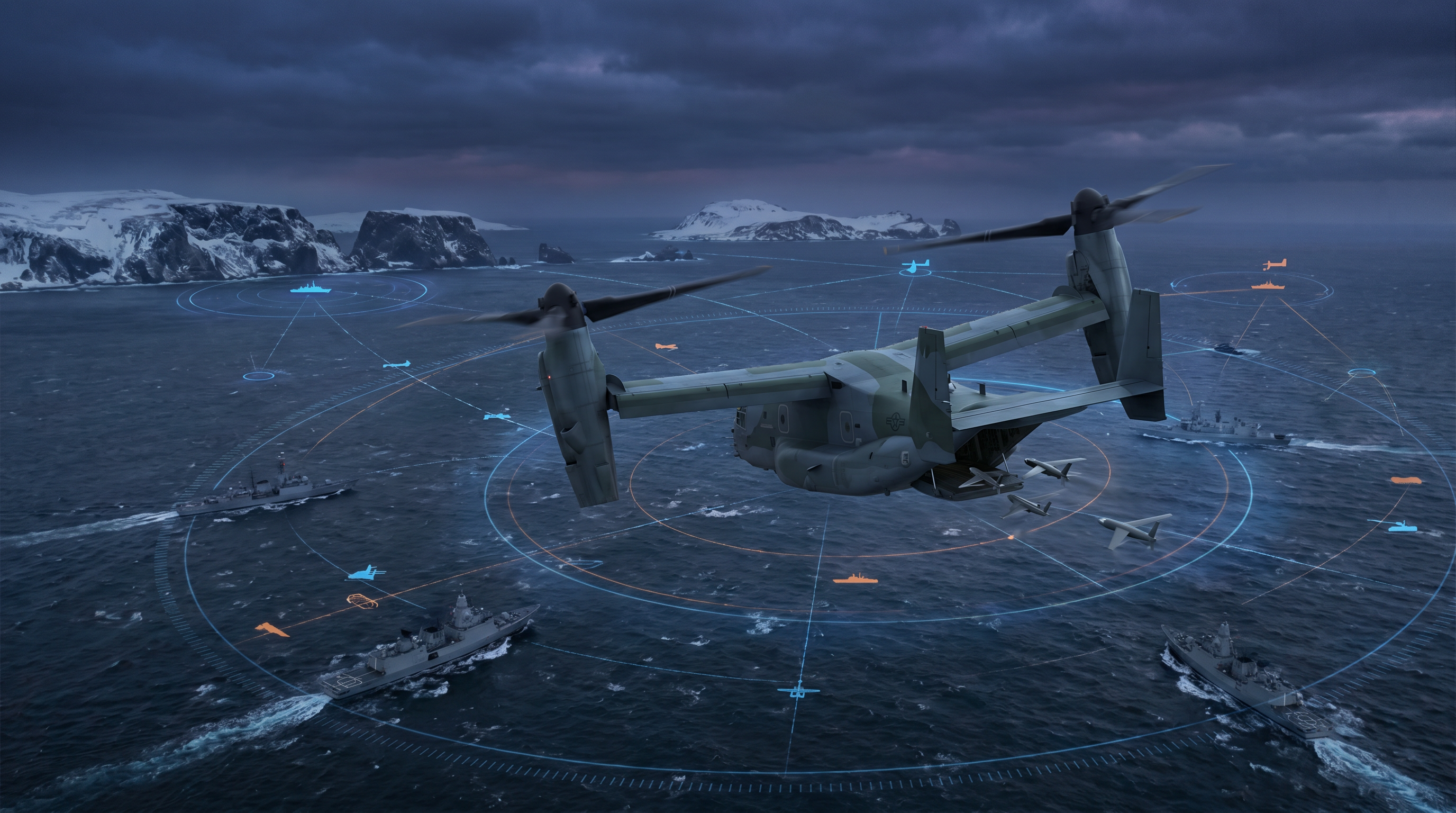
In the High North, geography is the primary adversary. This is a theater defined by “chaos management,” where the operational mobility problem is dictated by the punishing climate and vast, frozen reaches of the North Atlantic. Strategic nodes like Greenland, Iceland, and the Faroe Islands are separated by hundreds of nautical miles of open water, creating a mobility gap that has long constrained NATO’s northern flank. For decades, the Alliance’s ability to defend these corridors was tethered to the limitations of traditional vertical lift, aircraft that simply lacked the legs and the speed to master the environment.
The MV-75 Cheyenne is not an incremental replacement for legacy helicopters. It is a strategic instrument designed to fundamentally close this gap. By merging rotorcraft agility with the speed and range of a fixed-wing platform, the Cheyenne can transform the High North from a collection of isolated national sectors into a unified, responsive operational grid.
This is more than a new airframe; it is the cornerstone of a shift in how the Alliance defends its most consequential corridors.
The technical performance of the MV-75 represents a structural requirement for Arctic survival rather than a mere upgrade. While legacy platforms like the Black Hawk have been the workhorses of tactical lift, the Cheyenne redefines “tactically relevant time” by effectively doubling the standard metrics. The platform features a cruise speed approaching 300 mph (sustained 280-knot cruise) and a combat range of approximately 800 nautical miles, significantly enhanced by aerial refueling capabilities.
For commanders at Joint Force Command Norfolk, this doubling of capability is decisive. An MV-75 detachment based in Iceland can reach the Faroe Islands, southern Greenland, or northern Scotland and return within a single operational cycle.
This allows for theater-wide maneuver in volatile weather that conventional medium helicopters cannot navigate, providing a persistent presence across the entire GIUK Gap.
“In the GIUK context, that doubling is not an incremental improvement. It is the difference between a corridor that can be responded to and one that cannot.”
The MV-75 is a “born digital” platform, designed from its first line of code to serve as the primary node in a multi-domain “Kill Web.” Unlike legacy systems retrofitted for drone control, the Cheyenne’s architecture is centered on Manned-Unmanned Teaming (MUM-T). It functions as a mobile mothership for Air Launched Effects (ALE)—small, attritable drones and electronic-warfare (EW) payloads that extend the aircraft’s reach deep into contested airspace.
The Greenland-Iceland-United Kingdom (GIUK) Gap has evolved from a Cold War maritime chokepoint into a complex multi-domain corridor. Today, the “Fourth Battle of the Atlantic” is fought not just against Russian Northern Fleet surface sorties from the Kola Peninsula, but against hybrid pressure targeting critical undersea infrastructure like fiber-optic cables and pipelines.
Traditional maritime patrol aircraft are excellent for broad surveillance, but they cannot rapidly deliver specialized teams, such as ASW specialists, Special Operations Forces (SOF), or sensor maintainers, directly to exposed nodes. The MV-75 provides the high-speed vertical maneuver necessary to move these enabling capabilities at the “tempo the situation demands” rather than the tempo logistics traditionally permit. By connecting ships, shore installations, and surveillance detachments, it stitches together the seams of a theater that can no longer be managed as compartmentalized national sectors.
“The GIUK Gap is not a legacy Cold War concept kept alive by strategic nostalgia. It is one of NATO’s most consequential operational corridors.”
The MV-75 is built on a Modular Open Systems Approach (MOSA), a digital backbone that standardizes interfaces and data models. This allows the Alliance to move beyond “interoperability”—merely talking to one another, toward “interchangeability.” Under this model, mission software and sensors act like apps on a smartphone; a Danish crew can launch a U.S.-developed sensor or a British EW suite with minimal rework, eliminating proprietary redesign cycles.
The expansion of NATO to include Finland and Sweden has created a continuous Nordic arc. However, this strategic depth is only useful if the Alliance can bypass damaged ground infrastructure and rail chokepoints. During exercises like Arctic Forge, Arctic Shock, and Cold Response 26, the need for intra-theater mobility has become glaringly apparent.
The Cheyenne can convert the political reality of Nordic enlargement into operational depth. It allows commanders to rapidly reposition long-range fires cells and SOF across the Norwegian-Finnish-Swedish border, bypassing traditional transit routes that are vulnerable to long-range strike or environmental disruption.
Canadian Sovereignty In North America, the Canadian nTACS (Next Generation Tactical Armed and Reconnaissance Capability) program, a C$18 billion effort, identifies the need for a “balanced fleet.” Within this framework, Special Operations support is the first priority. The MV-75’s ability to cover enormous distances without prepared airfields is a structural requirement for Canadian Arctic sovereignty, allowing NORAD to modernize its northern surveillance and move specialized teams across the pole into European theaters as a single, interoperable force.
The introduction of the MV-75 Cheyenne will signal the transition from national sectors to a “shared theater grid” managed through the Arctic Sentry framework. By acting as a high-speed connector and a digital mothership, the Cheyenne functions as a force multiplier that compresses the timeline between a commander’s decision and the desired effect.
As the North Atlantic evolves into a drone-dense, multi-domain “Kill Web,” we must ask: Can an adversary ever achieve operational surprise in a theater where the network can reposition its center of gravity faster than they can react?
By filling the mobility gap, the MV-75 ensures that the cost of aggression in the High North remains prohibitively high through a persistent strategy of Deterrence by Detection.
Download Report
Enter your name and email below to download the report directly.