
From Cobra Pilot to Digital Warrior: The Evolution of Marine Corps Digital Interoperability
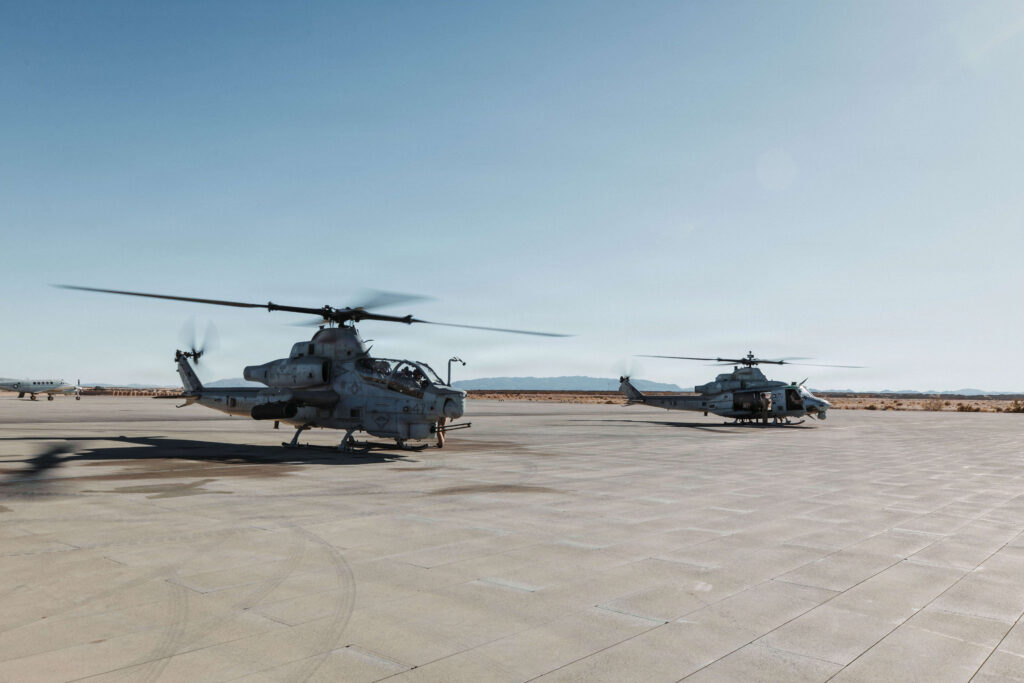
Five years ago, the cockpit of a Marine Corps AH-1Z Cobra attack helicopter was a very different place. Digital interoperability was a distant concept, something discussed in Pentagon briefings but not yet realized in the ready rooms and flight lines where Marine aviators prepared for combat. Today, Major Jonathan Moss sits at the vanguard of a revolution that is fundamentally changing how Marine aviation fights, thinks, and integrates with the joint force.
During a recent interview at Marine Aircraft Group 39, Camp Pendleton, Moss shared insights into his remarkable journey from traditional attack helicopter pilot to one of the Marine Corps’ leading experts in digital interoperability. His story illuminates not just the technical transformation of the H-1 helicopter community, but the profound mental shift required of warriors adapting to information-age warfare.
The Foundation: Diverse Operational Experience
Moss began flying H-1 helicopters in 2015, accumulating experience across three different fleet squadrons. He flew with the Gunfighters at Camp Pendleton, with Scarface out in Hawaii, and completed a West Pacific Marine Expeditionary Unit deployment to CENTCOM and two Unit Deployments to Japan. This broad operational background proved essential, as it exposed him to the full spectrum of Marine aviation missions, from close air support to deep strike operations.
What made his experience particularly valuable was the diversity of operating environments and tactical situations he encountered. Each squadron, each deployment, each mission set contributed pieces to what would become a comprehensive understanding of how attack helicopters integrate into the larger battle space. He learned not just how to employ weapons, but how to think spatially about coordination, deconfliction, and the synchronization of multiple aviation assets in complex objective areas.
Yet throughout these years, a critical gap existed. The information needed to prosecute targets effectively often arrived slowly, through verbal communications over VHF or UHF radio, creating delays that compressed decision-making time and limited operational effectiveness. Moss and his fellow Cobra pilots were exceptional at weapons employment and battle space management, but they operated within significant information constraints.
The Transformation: VMX-1 and Operational Testing
The pivotal moment in Moss’s transformation came when he joined Marine Operational Test and Evaluation Squadron One, known as VMX-1. This assignment placed him at the cutting edge of Marine aviation innovation, specifically working on operational testing for the H-1 digital interoperability program.
At VMX-1, Moss’s role went far beyond simply learning to use new equipment. He was tasked with conducting comprehensive operational tests that examined the entire spectrum of Marine aviation functions and mission essential tasks. The challenge was to evaluate how this new capability could support existing missions and, more importantly, to explore what became possible that wasn’t before.
This systematic evaluation process forced Moss to think differently about his platform and its role in the battle space. Rather than viewing digital interoperability as simply adding new hardware to the aircraft, he began to understand it as a fundamental expansion of capability that changed the domain of the possible. The question shifted from asking what tasks could be accomplished to exploring what new operational concepts could be enabled.
Cross-Community Integration
Perhaps most significantly, VMX-1 provided Moss with a unique opportunity for cross-community integration. He found himself working intimately with essentially an entire Marine Air-Ground Task Force worth of aviation assets. This meant sitting down across the table from F-35 pilots, MQ-9 operators, and aviators from other communities to develop integrated operational concepts. While with VMX-1, Moss held the following billets: Operational Test Director Assault Support Division, and Department Head overseeing H-1 and MV-22 operational testing.
These collaborative planning sessions proved transformative. Instead of operating within the traditional stovepipes that had long characterized military aviation, Moss learned to think in terms of integrated kill webs where different platforms contributed their unique capabilities to shared objectives. He discovered that solving complex battle space problems required bringing together experts from multiple domains, from information warfare specialists to dynamic targeting professionals, from communications SMEs to fellow aviators with different platform perspectives.
The Mental Revolution: Changing the Warrior’s Mindset
Technology alone cannot transform warfare. The most advanced digital systems are useless if the warriors who employ them remain locked in outdated mental frameworks. Moss’s experience illustrates this critical truth. His journey wasn’t just about learning to operate new equipment but about fundamentally changing how he thought about his role, his platform, and the nature of air combat itself.
As Moss describes it, the transformation began with recognizing that information has become as much a weapon as any missile on his wing stores. The fundamental questions driving his operations shifted from purely kinetic concerns to a more sophisticated information-centric framework: What do I know? What do I not know? How can I satisfy those information gaps? How quickly can I access the information I need to continue pursuing my objectives?
This cognitive shift was accelerated by the evolution of the threat environment itself. As Moss points out, the modern fight cannot be reduced to kinetic exchanges alone. Success in contemporary warfare requires mastering the electromagnetic spectrum. The spectrum fight, as he terms it, has become prerequisite to kinetic effects. Understanding electronic warfare, communications security, and information dominance became as essential to his professional development as mastering weapons employment.
Professional Curiosity and Innovation Culture
Moss credits much of his successful adaptation to what he calls professional curiosity, a trait he sees pervading the attack helicopter ready room. Marine Cobra and Huey pilots, he notes, maintain an almost precocious interest in finding new ways to solve old problems. This culture of innovation, fostered through ready room discussions and collaborative problem-solving, creates an environment where aviators continuously think creatively about more efficient approaches to warfare.
Importantly, this innovation culture balances the joy of discovery with the deadly seriousness of combat. Moss describes how maintaining enthusiasm for creative problem-solving helps free the mind from the paralyzing burden of fear, even while acknowledging that self-preservation remains a fundamental concern. The goal is to work faster inside an observable battle space than adversaries can, and achieving this requires both processing information rapidly and making decisions confidently.
The Practical Impact: Transforming the Targeting Cycle
The practical implications of Moss’s transformation become clear when examining how digital interoperability has changed the targeting cycle for attack helicopter operations. Traditionally, Cobra pilots contributed primarily at the attack phase of the find-fix-track-target-engage-assess cycle, depending on their own sensors and pre-mission briefings to locate and prosecute targets.
With digital interoperability, everything prior to the attack phase can now be assisted by other players in the battle space. Instead of depending on information delivered during pre-mission planning or transmitted via radio during flight, Moss can now access near-real-time intelligence before his aircraft even takes off. When he does launch, he knows with higher fidelity where threats are located, where other threats might harm his approach, and how the overall objective area is evolving.
The speed of this information flow represents a quantum leap. Previously, Moss might have ten to fifteen minutes of uncertainty about whether supporting F-35s had even taken off or where assault support aircraft were positioned. Now, a glance at his digital display provides immediate awareness of the common operating picture. Those extra minutes of advance knowledge allow him to think farther ahead, to plan for contingencies, to position himself more effectively for the next phase of the operation.
This capability becomes even more powerful when integrated with the exquisite sensors available on platforms like the F-35 Lightning II or the MQ-9 Reaper. These systems can detect and track targets that a Cobra’s organic sensors might miss, particularly in challenging environments like triple-canopy jungle. By tapping into this network of information, Moss gains access to targeting data that dramatically enhances his effectiveness while reducing his time in vulnerable positions.
Leading the Pack: HMLA-267 and the Digital Future
Today, Moss serves as a department head with Marine Light Attack Helicopter Squadron 267, part of MAG-39 at Camp Pendleton. His squadron holds a unique distinction: they are the first Marine H-1 squadron to receive a complete unit of employment with digitally interoperable, Link 16 capable aircraft. This means they have all the hardware and training to operate as a fully integrated digital force, making them the pioneer squadron for this transformation across the Marine Corps.
This pioneering role brings significant responsibility. With the training syllabus still being developed, Moss and his fellow aviators are not just learning to use new systems but establishing the baseline of knowledge and best practices that subsequent squadrons will follow. They are determining what proficiency looks like, how to integrate planning processes, and how to build capability from the ground up in a community that has historically focused exclusively on kinetic excellence.
Moss’s goal is to ensure that every pilot checking into the squadron develops familiarity with tactical data links and digital interoperability from day one, in much the same way that fixed-wing aviators undergo deep syllabi on these topics. He wants the next generation of attack helicopter pilots to discuss digital interoperability as fluently as they discuss close air support procedures, making it a fundamental rather than an advanced skill.
Conclusion: The Human Element in Military Transformation
Major Jonathan Moss’s journey from traditional Cobra pilot to digital interoperability expert illuminates a profound truth about military transformation: technology alone changes nothing. The most sophisticated systems remain inert without warriors willing and able to reimagine how they fight. Moss’s success came not from the equipment upgrade to his aircraft, but from his willingness to undertake an intellectual upgrade to his own mental frameworks.
His path offers lessons for the broader defense community grappling with rapid technological change. Diverse operational experience provides the foundation for understanding context and complexity. Formal testing and evaluation roles create opportunities for systematic exploration of new capabilities. Cross-community collaboration breaks down stovepipes and enables integrated thinking. Professional curiosity drives continuous innovation. And ultimately, changing the domain of the possible requires changing how warriors think about the possible.
As HMLA-267 leads the Marine Corps into the digital future, they carry forward not just new technology but a new way of thinking about attack helicopter operations. In an era where information dominance increasingly determines tactical success, Moss and his fellow pilots represent the vanguard of a transformation that extends far beyond their platform, pointing toward a future where every Marine aviator must master both the kinetic and the digital dimensions of warfare.