
Built in the Foundry: Robotic Maintenance and the Future of a Warfighting Navy
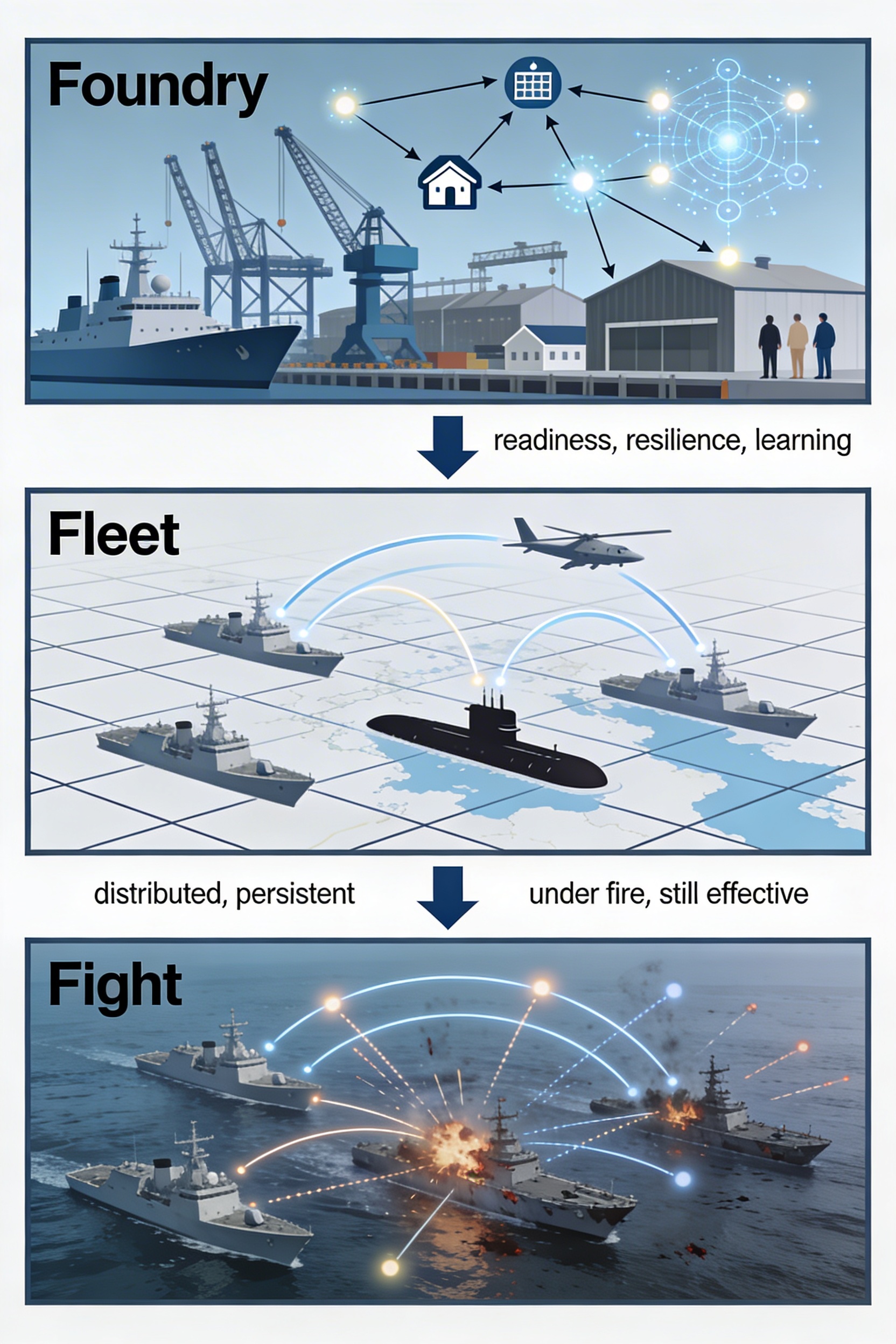
Adm. Daryl Caudle’s Foundry–Fleet–Fight construct is more than a slogan for a new Chief of Naval Operations.
It is an invitation to judge the Navy by how it forges, fields, and fights its combat power.
Built into his Day One message and now reinforced in the U.S. Navy Fighting Instructions, the Foundry represents “the enduring sum of our total force, shore infrastructure, maintenance depots, schoolhouses [and] industrial base” that underwrites the Fleet and the way we Fight.
If that Foundry is brittle, analog, and slow, the Fleet and Fight will be brittle, analog, and slow, no matter how many new platforms we buy.
That perspective should change how we discuss what often get dismissed as narrow technology questions: robotic welding, yard and shipboard robots, augmented‑reality (AR) maintenance tools, and the data they generate.
These are not side projects for engineers and vendors.
They are concrete tests of whether the Navy is serious about modernizing the Foundry for a contested era.
In Caudle’s formulation, we are to view “everything we do through an operational lens focused on the Foundry, the Fleet and the way we Fight.” The Foundry is not simply the industrial backdrop to operations. It is a warfighting system in its own right. Its output is not just overhauled hulls and repaired components, but the readiness, resilience, and learning that enable a distributed Fleet to persist under fire.
From that starting point, the familiar practical question, what are the limiting factors today for wider deployment of robotic welding and other automated systems across fleet repair sites?, takes on strategic weight. If robotic welding remains confined to a handful of demonstration cells, the signal is that our Foundry is still configured for artisanal, manpower‑intensive work rather than high‑throughput, data‑rich production at scale.
Ship access constraints and integration challenges are not just engineering annoyances. They reveal design assumptions. Many hulls and compartment layouts were never envisioned with robots in mind. Safety rules and work practices were written around human welders. Certification regimes often treat automated processes as exotic exceptions requiring bespoke approvals. Standards frequently lag behind what industry already accepts in commercial yards.
Workforce acceptance is equally telling. If skilled artisans see robotics as a threat rather than a tool, it suggests we have not yet made clear that the objective is to keep craftsmen focused on the most complex, value‑added work while shifting the dull, dirty, and dangerous tasks to machines. A Foundry aligned with Caudle’s guidance would tackle all of this head‑on: designing new construction and major refits with robotic access in mind, writing standard interfaces and procedures for automation, and building training and incentive structures that produce sailors and civilians who are competent—and confident—robot operators.
Without those changes, the limiting factor is not the technology.
It is an industrial culture that has not yet accepted the Foundry’s centrality to future warfighting.
How data from robotic systems is integrated into Navy maintenance decision‑making tools cuts even closer to the heart of Foundry reform. In a traditional mindset, robotics primarily accelerate existing processes: a weld laid more quickly, a tank inspected without sending a sailor into a confined space. Valuable, but incremental.
Caudle’s Fighting Instructions describe a Navy that must “hedge lethal effects aggressively, innovate continuously, [and] fight distributivity” in a world where the “speed of decision ruthlessly punishes delay.” That logic applies to industrial decision‑making as much as to combat. A modern Foundry should treat every maintenance action as a sensor event, and the data trails from robotic systems as the raw material for learning.
Robotic welders generate time‑stamped arc parameters, heat input, bead geometry, and defect rates. Automated inspection tools and corrosion‑mapping systems produce imagery, thickness measurements, and damage patterns. When these data are captured in standard formats and ingested into enterprise maintenance and logistics systems, they can feed models that predict failure, optimize work packages, and inform design changes.
That transforms the Foundry from a static repair shop into a learning enterprise. Each weld, inspection, and corrosion survey improves our understanding of how ships age under real operating conditions and how specific practices influence reliability. In a world where we cannot assume numerical overmatch, the ability to generate more available combat power from the same force by reducing unplanned failures and shortening repair intervals is a genuine asymmetric advantage.
But the Navy will only realize that advantage if it builds the digital plumbing to support it. That means:
- Requiring robotic and automated systems to expose data through open, secure interfaces rather than proprietary silos.
- Upgrading maintenance IT systems so they can ingest and analyze high‑volume sensor data, not just hand‑entered work orders.
- Establishing governance for data quality, cybersecurity, and configuration control so commanders are willing to trust predictive recommendations.
Without those measures, we risk buying sophisticated robotic tools and then treating their outputs as disposable by‑product.
The Foundry will look modern, but it will not learn.
Whether the Navy envisions a future where Fleet Maintenance Directorate (FMD) systems are embarked with the ship, not just resident in the depot pushes the Foundry concept out to the tactical edge.
Caudle’s Fighting Instructions acknowledge that we will operate against capable adversaries across multiple regions, under persistent threat to our logistics and fixed infrastructure.
In such a fight, a Foundry confined to CONUS shipyards and a few large overseas facilities becomes a single point of failure.
A more resilient model is a layered “Forward Foundry.” Heavy industrial work still occurs in major yards. But portions of the Foundry, robotic repair tools, deployable additive manufacturing, advanced diagnostics, and AR‑enabled maintenance, are deliberately pushed forward to regional hubs, tenders, expeditionary repair units, and, ultimately, the ships themselves.
For shipboard maintenance, that means asking not only whether robots and AR devices can survive at sea, but how they will change the way crews manage damage and sustain readiness. Ruggedization requirements must account for shock, vibration, electromagnetic interference, and the realities of saltwater and limited space. Systems must integrate with shipboard power and networks, and they must be designed to operate under degraded communications conditions, including EMCON.
Doctrine has to evolve alongside hardware. Battle‑damage repair and casualty‑control procedures should assume the availability of shipboard robots, remote expert support through AR, and portable diagnostics, not treat them as optional extras. That will require experiments and wargames that explore how far we can push self‑repair in combat and what risks are acceptable.
Training is the hinge. Sailors will need new curricula, qualifications, and practice opportunities to make shipboard robots and AR maintenance as normal as a multimeter or a torque wrench. Senior maintainers, those who understand both the art and the science of keeping ships running, should be brought into the design process so that systems reflect real‑world needs and earn operator trust.
If the Navy decides that such systems must remain depot‑only, it is implicitly accepting slower repair cycles, greater dependence on vulnerable infrastructure, and less resilience in a protracted maritime conflict. That is a legitimate choice but not one that aligns with the logic of Foundry–Fleet–Fight.
The three questions raised here offer a practical framework for assessing whether Foundry reform is progressing beyond rhetoric.
- Are robotic welding and other automated systems moving from pilot projects into standard practice across public and private yards, supported by common interfaces, ship access provisions, and updated standards?
- Is data from robotic and automated systems flowing into enterprise maintenance and logistics tools in ways that meaningfully influence predictive maintenance, work‑package design, and ship design decisions?
- Are we designing, funding, and experimenting with a layered Forward Foundry that pushes appropriate maintenance robotics and AR capabilities into forward hubs and onto ships, supported by doctrine and training?
If the answer to these questions is “not yet,” then the limiting factor is not technology.
It is our willingness to treat the Foundry as a warfighting system that must evolve as rapidly as our platforms and weapons.
Caudle has been explicit that Sailors are the Navy’s “primary weapon system” and that the great end is action, not rhetoric. Giving those Sailors the industrial and digital tools they need, ashore and at sea, to keep the Fleet fighting is one of the most concrete ways to honor that charge.
The real test of the Foundry will not be in new slogans or strategy documents, but in whether a future petty officer standing knee‑deep in a flooded space, or a civilian welder in a windswept yard, has access to the robots, data, and support that turn a potential mission kill into a rapid return to the fight.
That is the level at which Foundry, Fleet, and Fight finally converge.
Source: Adm. Daryl L. Caudle, “Foundry – Fleet – Fight,” CNO Day One Message, 34th Chief of Naval Operations, 2 September 2025, Department of the Navy