The Iranian War Can Come Home: The F-35 as America’s Monitor

Preamble
The operation in Iran is not simply an external action. It raises directly concerns about domestic security. The air force of the United States has been a key element forging success in the Iran operations, but there has to be concern about an Iranian “Operation Spider Web” against our bases at home.
We cannot wait for a long-term fix to this problem. We need a ready-now solution and then prepare for a longer-term solution that fits into the U.S. domestic security systems and capabilities.
Fortunately, there is a short-term fix which can be readied now.
President Lincoln in the Civil War was prescient in supporting a solution to a pop-up threat posed by the South in terms of a newly configured Southern ironclad ship. That threat was the CSS Virginia. His response was the Monitor, rapidly developed to counter such a threat and neutralize it. Lincoln personally drove that pace, providing the political will that turned a designer’s drawings into a fleet-saving weapon in two months..
On March 8, 1862, the ironclad CSS Virginia, formerly the USS Merrimack, attacked the Union fleet in Hampton Roads in an era aptly described as “Iron men in wooden ships.” She immediately destroyed the USS Cumberland and USS Congress. That day, the Union fleet was defenseless.
On day two, March 9, 1862, the Union ironclad USS Monitor arrived just in time to meet her. The two vessels fought to a tactical draw, but the strategic result was decisive: the existing Union fleet was saved. That offensive/defensive engagement changed the technological design of surface combatants to this day.
Today there is an emerging combat case study with comparable historical weight: AI-empowered drones versus the kill web F-35. Drones can now take a simple, cheap asymmetric weapon and dramatically multiply its combat effectiveness. That threat is real and it is growing.
Technological capabilities to find, fix, and destroy drones are rapidly evolving. And with the F-35, an inherently integrated sensor/shooter kill-web fighter already flying, there is an aircraft ready, like the Monitor, to prove its worth. This is not an abstract think piece. It is a call to act.
The Article
The Iranian operation has demonstrated the centrality of U.S. airpower in shaping strategic outcomes. But that same success now demands a hard question: what happens when an adversary decides to replicate Ukraine’s Operation Spider Web, not against Russia, but against us?
A recent analysis by retired Air Force General David Deptula examines how Ukraine’s innovative drone strikes are reshaping military doctrine and exposing dangerous American vulnerabilities, as illustrated by the audacious Ukrainian combat operation known as Operation Spider Web.
When Ukrainian forces launched coordinated drone attacks against four Russian airbases on June 1, 2025, they weren’t just destroying enemy aircraft, they were demonstrating a revolutionary approach to modern warfare with profound implications for U.S. military strategy.
That is the assessment of retired Air Force General David Deptula in a comprehensive analysis published in Forbes on June 12, 2025. Deptula argues that Ukraine’s “Operation Spider Web” represents far more than a tactical victory. It signals a fundamental shift in how smaller nations can compete against militarily superior adversaries and a warning that the United States ignores at its peril.
Perhaps most troubling for American readers is Deptula’s assessment of U.S. vulnerabilities. The retired general who previously served as Director of Operations for Pacific Air Forces and currently serves as Dean of the Mitchell Institute argues that the United States has grown dangerously complacent about force protection since the end of the Cold War.
Operation Spider Web stands as the most sophisticated drone warfare operation in modern military history. On June 1, 2025, Ukraine’s Security Service executed a coordinated strike using 117 drones across five Russian airbases spanning 4,300 kilometers, destroying 41 aircraft worth $7 billion. The operation demonstrated how asymmetric warfare can achieve strategic effects at unprecedented cost ratios, $120,000 in equipment destroying $7 billion in assets.
The audacity of Spider Web lay not just in its geographic scope spanning five time zones from Murmansk to Siberia but in its sophisticated integration of deception, technology, and strategic patience. Ukrainian operatives concealed 117 Osa quadcopters inside wooden cabins mounted on commercial trucks. Unwitting Russian drivers transported these systems to positions near five strategic airbases, never knowing they carried Ukraine’s most sophisticated weapons. The drones operated through Russian commercial mobile networks, controlled by individual operators working from Ukraine thousands of kilometers away.
AI-assisted targeting systems enabled drones to identify vulnerable points on aircraft with 90-centimeter precision. The system combined open-source autopilot software with autonomous navigation capabilities, allowing drones to complete missions even when communication links were severed.
The Threat Comes Home
The Iranian war has demonstrated U.S. airpower at its finest. But adversaries are watching, learning, and adapting. Iran, having observed what Ukraine did to Russia’s bomber fleet, now possesses both the motive and the template to attempt something similar against U.S. installations, domestic as well as overseas.
The threat is not theoretical. Commercial drones are ubiquitous. Their ability to quickly and stealthily reach difficult-to-access areas has made them an effective tool to circumvent security detection. A thermite grenade delivered by an off-the-shelf quadcopter—now widely available and notoriously difficult to detect, against parked aircraft on an American airbase represents exactly the kind of “wicked problem” that radar and air-defense planners have long dreaded: low-flying objects masked by ground clutter, terrain, and AI-assisted targeting operators.
During the Cold War, U.S. Air Forces in Europe and Korea routinely maintained aircraft in hardened shelters, recognizing the acute risks of leaving high-value assets exposed. That mindset has largely evaporated, even as the threat environment has grown more complex and lethal. One successful mass-casualty drone strike on American soil would instantly become an “all hands on deck” moment. The question is whether we wait for that attack or prepare before it arrives.
The Monitor Solution: The F-35 Is Ready Now
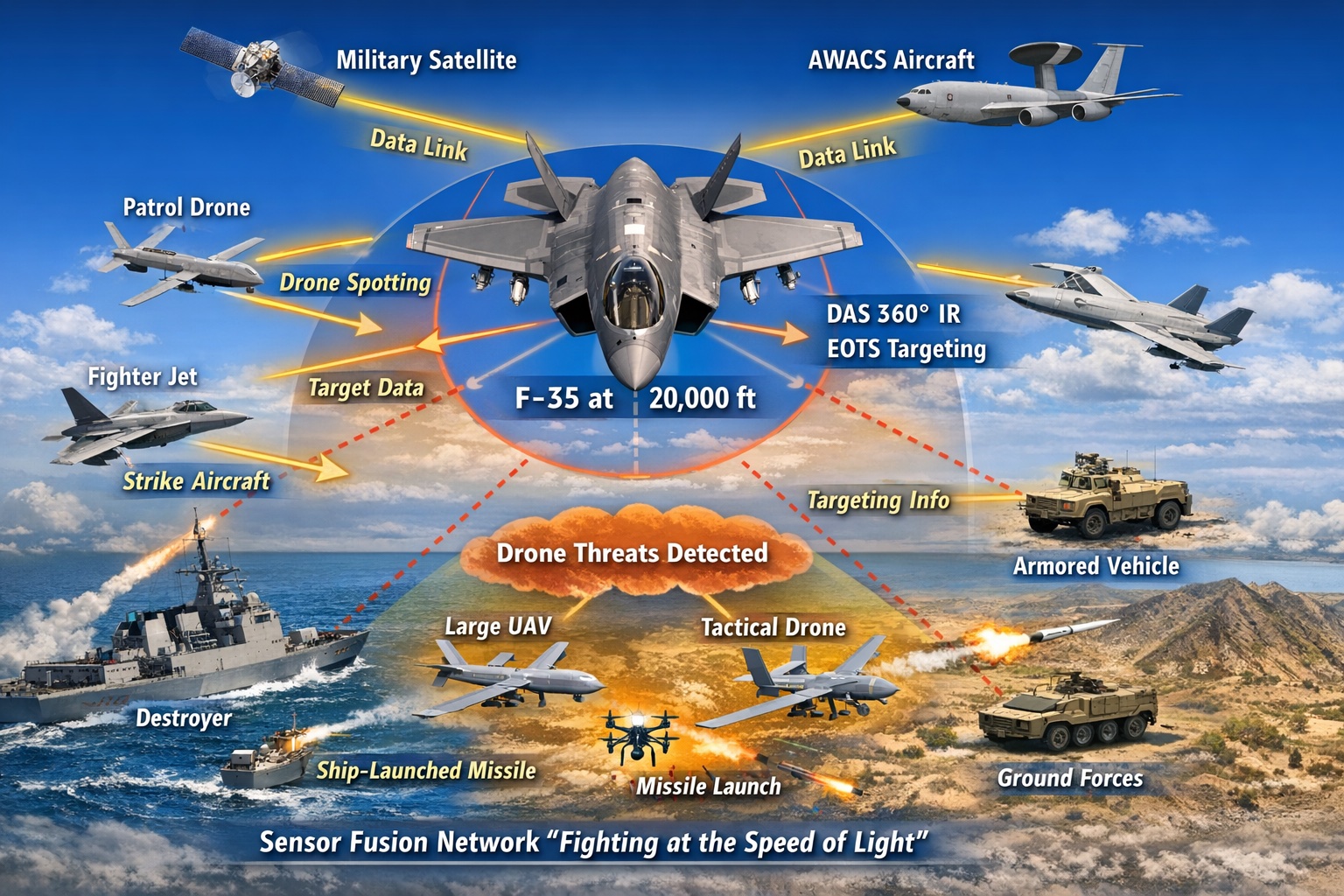
Fortunately, there is a proof-of-concept solution already in the inventory. As a preliminary foundation for building a kill web over America, the F-35 possesses remarkable capabilities to detect small drones, even those attempting to hide in ground clutter.
The AN/APG-81 AESA radar is so sensitive that its software can filter out objects resembling birds. The aircraft’s infrared system can identify very small heat signatures. The electro-optical AN/AAQ-40 targeting system provides high-resolution infrared coverage. The F-35 can also detect radio emissions, and its electronic warfare suite may be able to pick up command transmissions to a drone, providing yet another avenue for targeting and engagement.
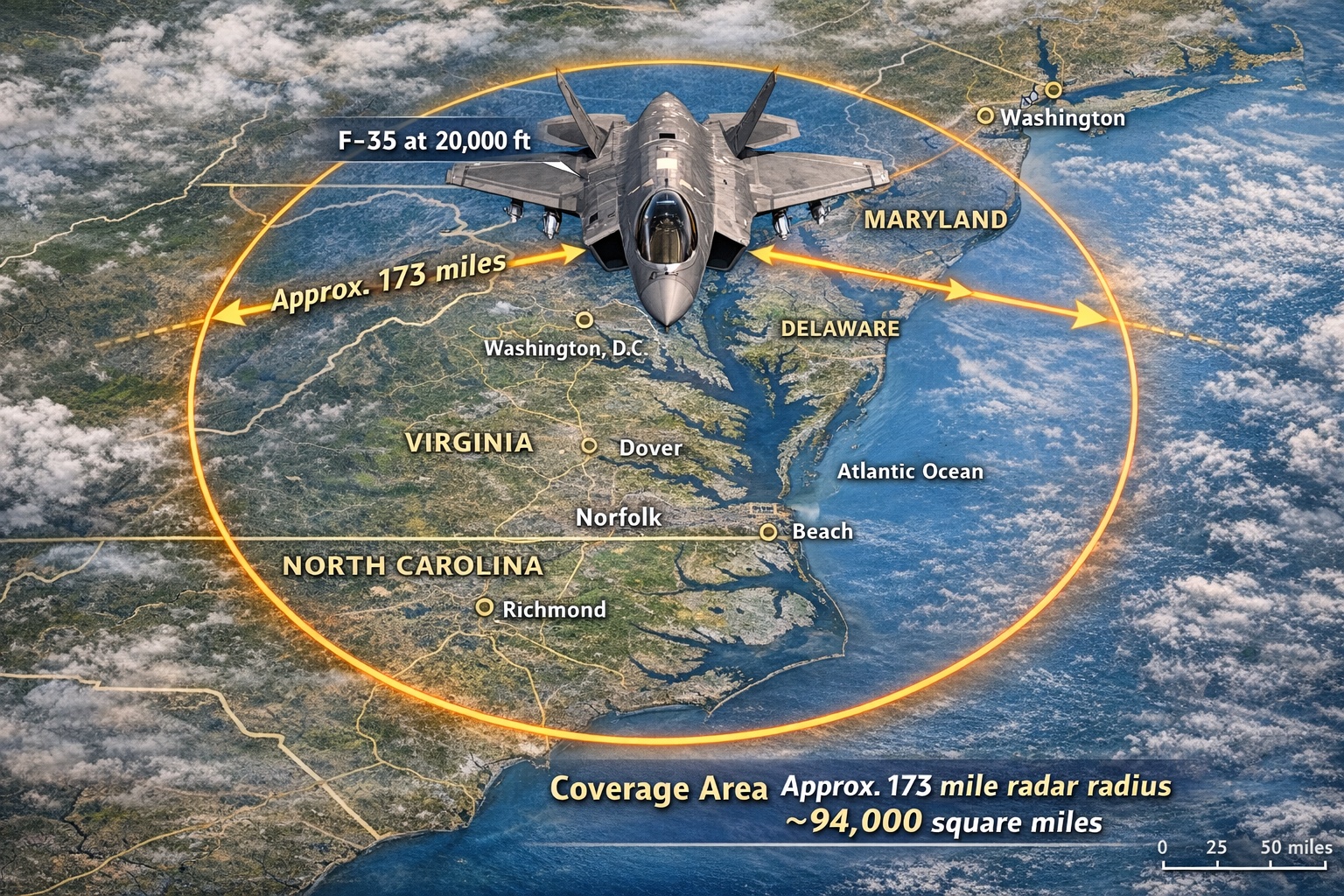
An F-35, fitted with drop tanks and operating without stealth constraints, can patrol above potential targets anywhere in America. Getting the avionics and software fully optimized for this mission will require innovative engineering, but the foundational capability exists today. It represents a credible interim solution while longer-term, purpose-built counter-drone architectures are developed.
Enabling the F-35’s mission data computer with embedded AI software—to fight at the speed of light, distributing information into the cockpit and out to all platforms across air, land, sea, and space would be a revolutionary approach to countering AI-empowered drones. The real-world combat payoff of AI-configured sensors on the F-35 could pioneer the next generation of domestic defense.
Paying full credit to John Boyd’s OODA loop, Observe/Orient is essentially target acquisition, and Decide/Act is target engagement. Better target acquisition combined with better target engagement equals more effective employment of all payloads available to the battle commander. The F-35 is already structured around that logic.
Lincoln’s Lesson for Trump
Swedish-born designer John Ericsson submitted his Monitor plans in early 1862, pre-positioning materials so that construction could begin immediately upon contract award. The contract was signed on March 4, 1862; the ship was launched two days later. Total time from contract to launching: two months. President Lincoln personally drove that pace, then gave the ship priority to depart the Brooklyn Navy Yard and arrive just in time to save the fleet.
Lincoln provided the political will that turned a designer’s drawings into a fleet-saving weapon in two months. The F-35 does not need to be designed or built—it already exists, already flies, and has already demonstrated its worth in combat over Iran. What it needs is the same political will Lincoln provided: the decision to act, now, before the threat materializes at home.
Ukraine’s Operation Spider Web proved that $120,000 in commercial drone technology can destroy $7 billion in strategic aircraft. Iran has watched that lesson carefully. The question for President Trump is the same one Lincoln faced in March 1862: will we deploy what we already have rapidly, decisively before the attack arrives, or will we wait for a Hampton Roads moment on American soil?
The F-35 can make USAF airpower history right now — if supported. The Monitor was ready in two months.
The F-35 is ready today.