
The Malacca Chessboard: And Shaping a Way Ahead for Deterrence
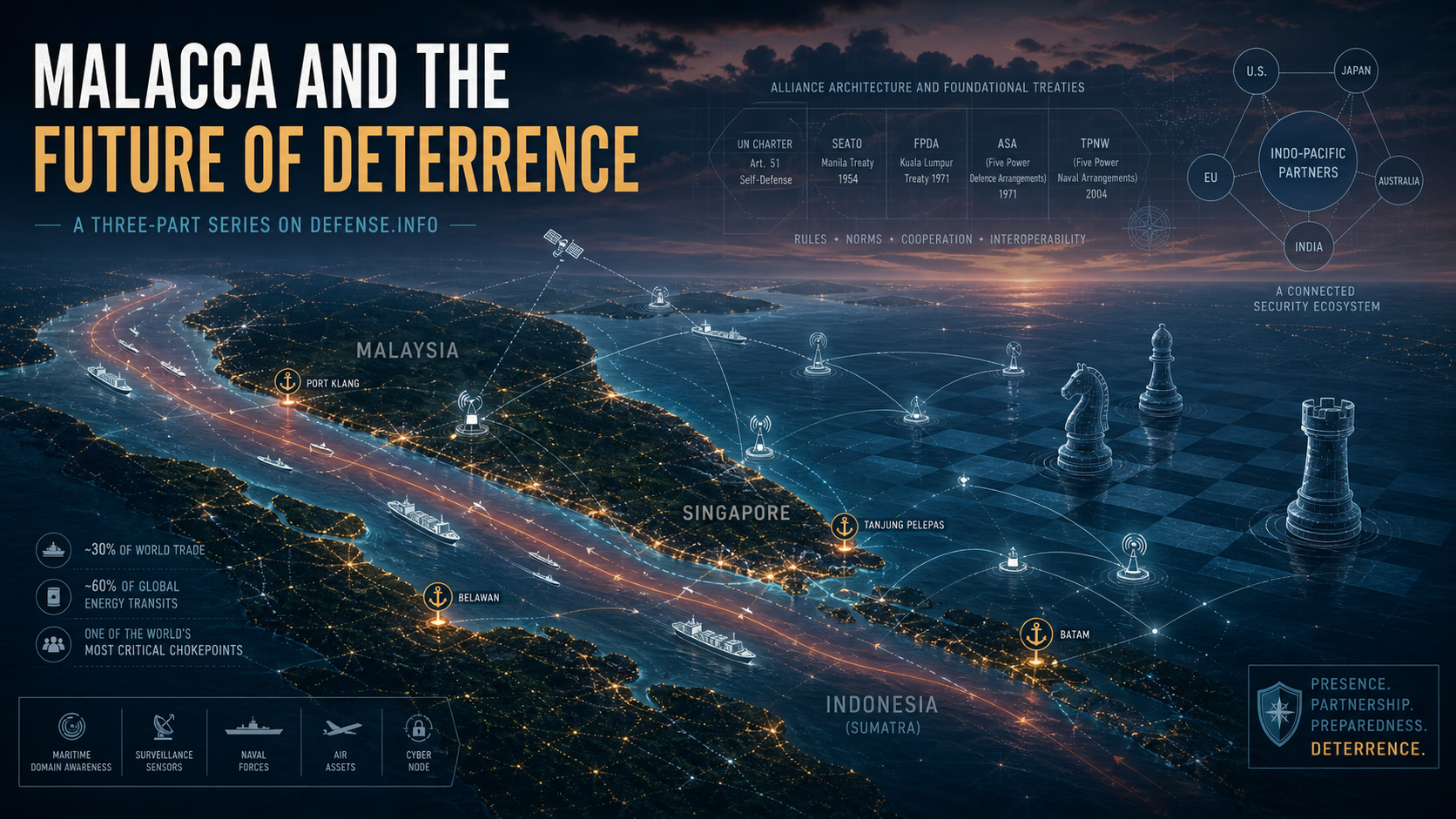
When Washington and Jakarta unveiled a new “Major Defense Cooperation Partnership” in mid‑April 2026, the language sounded routine: capacity building, training, maritime security, advanced systems. Beneath the boilerplate, however, sits the outline of a new operational reality at the Strait of Malacca, the narrow sea lane that carries roughly a quarter of global trade and close to 30 percent of seaborne oil.
Although the Trump administration has not announced a formal coalition task force or blockade plan, it is clearly building the access, ISR architecture, and partner capacity that would matter if Malacca ever became a theater of coercive leverage against China or a venue for crisis management linked to the war with Iran. What is emerging is less a single operation than a toolbox: airspace access, maritime domain awareness, agile naval platforms, and an Indonesian‑anchored framework that keeps options open.
The Strait of Malacca has long been recognized as the world’s most important energy chokepoint, but its relevance is becoming more acute as conflict in the Gulf drives home just how exposed Asian economies are to disruptions along the sea routes between the Middle East and East Asia. The U.S. Energy Information Administration estimates that around 23.2 million barrels of oil per day moved through the Strait in the first half of 2025, about 29 percent of total seaborne oil trade.
For China, this geographic fact is a strategic vulnerability. Former President Hu Jintao famously warned of the “Malacca dilemma”: an industrial power dependent on imported energy that must traverse a narrow passage it does not control. Beijing has spent two decades trying to mitigate that dilemma with overland pipelines, port investments, and diversification of supply, but the structural dependence remains. Even ships that avoid Malacca itself by detouring through the Sunda or Lombok Straits still pass through Indonesian waters and archipelagic sea lanes, keeping Indonesia central to any discussion of leverage or security.
This is the context in which the Trump administration is deepening its defense relationship with Jakarta and carefully signaling that its focus on chokepoints such as the Strait of Hormuz may soon extend more concretely to Malacca.
On 13 April 2026, U.S. Secretary of War Pete Hegseth and Indonesian Defense Minister Prabowo Subianto announced the establishment of a Major Defense Cooperation Partnership (MDCP). Official statements describe the MDCP as a framework to expand joint exercises, military education, modernization support, and cooperation in “maritime, subsurface and autonomous systems,” as well as maintenance, repair, and overhaul.
Those phrases, especially the stress on subsurface and autonomous systems, have drawn particular attention from regional analysts. They point to a long‑term U.S. investment in the enablers needed to monitor, and potentially regulate, traffic not just in the Strait of Malacca itself but across the wider belt of sea lanes linking the Indian Ocean to the South China Sea.
Beyond the published text, reporting from Asian outlets notes that Washington is seeking blanket overflight rights for U.S. military aircraft in Indonesian airspace, shifting from case‑by‑case approvals to a notification regime. Indonesian officials say that proposal technically sits outside the MDCP and remains under review, but its linkage is obvious: without reliable airspace access, any American attempt to sustain an ISR “lid” over Malacca would be fragile.
Jakarta, for its part, insists that the pact does not compromise its “free and active” foreign policy or non‑aligned stance, and that Indonesia is not “choosing sides.” In diplomatic terms that may be true; on the operational map, a deepening defense relationship with the United States, focused explicitly on maritime and subsurface capabilities, inevitably has implications for China’s Malacca calculus.
At the heart of the emerging posture is an attempt to build a robust maritime domain awareness network over and around the Strait. The MDCP and surrounding initiatives envision several layers:
- Airborne ISR and Overflight Access: Under the new framework, U.S. and Indonesian sources describe expanded joint training and potential basing or rotational presence for surveillance aircraft that can cover the approaches to Malacca and alternative routes like Sunda and Lombok. With blanket overflight rights, U.S. P‑8 maritime patrol aircraft, other ISR platforms, and supporting tankers could maintain persistent orbits tracking tankers, bulk carriers, and suspicious vessels moving between the Indian Ocean and South China Sea.
- Surface Presence and Agile Command Platforms: In April 2026, the expeditionary sea base USS Miguel Keith transited the Strait of Malacca, in what Indonesia described as a lawful exercise of transit passage rights under international law. The Miguel Keith is not a conventional combatant but a flexible command‑and‑control platform capable of launching helicopters and small craft, hosting special operations forces, and functioning as a floating base. Its passage underlined the kind of capabilities Washington is likely to employ in any Malacca‑related contingency: modular, reconfigurable nodes that can support ISR, special operations, and limited interdiction without the political weight of a carrier strike group.
- Subsurface and Autonomous Systems: The explicit emphasis on “maritime, subsurface and autonomous systems” in the MDCP has been widely read as code for undersea sensors, unmanned underwater vehicles (UUVs), and potentially unmanned surface vessels (USVs) designed to augment manned assets. These systems could be used to monitor chokepoints, detect unusual patterns in shipping, and, in a crisis, cue interdiction forces more efficiently than a traditional surface‑only picture would allow.
Taken together, these layers amount to an emerging ISR blanket, one that remains partly aspirational but is clearly the direction of travel. In peacetime, such a network can be framed as supporting counter‑smuggling, anti‑piracy, and general security. In wartime or high crisis, it would be the backbone of any attempt to discriminate between traffic that must be protected, traffic that can be pressured, and traffic that might be interdicted.
Indonesia is not simply a convenient partner; it is structurally indispensable. The Strait of Malacca runs between the Malay Peninsula and the island of Sumatra, and the main alternative routes, Sunda and Lombok, are also framed by Indonesian geography. This gives Jakarta leverage in both directions: it can amplify U.S. options, or constrain them.
The Indonesian government has been careful to emphasize that all recent U.S. military movements in the Strait have respected international law and Indonesia’s rights as a coastal state. Navy spokesmen, commenting on the Miguel Keith transit, stressed that while any vessel may exercise transit passage, it must not violate collision regulations or broader legal norms.
Politically, Jakarta faces a dilemma of its own. On the one hand, the MDCP offers modernization, training, and access to advanced technologies that can strengthen Indonesia’s ability to police its own waters and raise its profile as a regional power. On the other, Indonesian officials have publicly warned that accepting U.S. overflight proposals and deeper operational integration could drag the country into South China Sea disputes and erode its non‑aligned identity.
In practice, these concerns translate into several operational red lines that are unlikely to be crossed easily: no permanent U.S. bases, no formal alliance obligations, and no explicit commitment to participate in a blockade or sanctions‑enforcement regime targeting Chinese shipping. This means that, for the moment, Washington must frame its presence as support to Indonesian sovereignty and regional security, even as it quietly builds the architecture that could be repurposed in a crisis.
Within these political constraints, one can see at least three tiers of operational activity taking shape.
- Routine Presence and Capacity Building: At the lowest tier, the MDCP legitimizes a pattern of frequent U.S. ship transits, joint naval drills, combined special forces training, and regular ISR flights coordinated with Indonesian authorities. In this mode, the U.S. emphasizes support to Indonesia’s own maritime enforcement missions—counter‑piracy, illegal fishing, smuggling and broader “freedom of navigation” principles in a heavily trafficked waterway.
- Heightened Alert and Discriminatory Monitoring: In a regional crisis, for example, escalation around Iran or a confrontation in the South China Sea, the same architecture could quickly be shifted to a heightened alert posture. Airborne ISR orbits would be thickened, allied and partner ships (Japanese, Australian, possibly Indian) might increase their presence in adjacent waters, and the undersea/autonomous layer would focus on mapping and tracking tankers and high‑value cargo. The objective at this stage would be to generate a complete, fused maritime picture: who is moving what, where, and under which flag.
- Coercive Leverage and Selective Interdiction: The most sensitive tier, politically and militarily, would involve using Malacca as an explicit lever. Trump has already argued that countries reliant on chokepoints like Hormuz should bear responsibility for keeping them open and has floated ideas that amount to weaponizing maritime bottlenecks as tools of pressure. Extending this logic to Malacca could mean quietly encouraging “inspection regimes,” tightening insurance and port access for certain flows, or in extremis coordinating with Indonesia and others on selective interdictions. While no such plan has been formally announced, regional commentary in India and Southeast Asia increasingly frames the MDCP as providing the enablers for such a gambit, should Washington choose to pursue it.
Importantly, each upward step along this ladder of options would face growing pushback—not only from China but from Southeast Asian states wary of seeing their waters turned into a battlespace.
The operational moves around Malacca come at a time when Southeast Asian states are already grappling with elevated risk from the Iran war and its implications for shipping and insurance. Governments in Singapore, Malaysia, and Indonesia are debating measures once seen as unthinkable, including more active regional coordination on sea lane security and, in some discussions, the possibility of tolls or other instruments aimed at offsetting the costs of heightened risk.
Public responses to the MDCP have been cautious. Singaporean and Malaysian officials have not embraced any explicitly U.S.-led security framework for Malacca, stressing instead that littoral states remain responsible for the Strait’s safety and that existing cooperative mechanisms are sufficient. At the same time, commentary in regional media and online forums shows unease at the prospect that Malacca could be drawn directly into U.S.–China confrontation, even as some welcome the idea that a stronger American presence might deter aggression or piracy.
China’s initial reaction has been to downplay the MDCP while warning against attempts to “militarize” the Strait and encircle Chinese sea lanes. Chinese analysts, particularly in commercial and energy circles, have revived discussion of the Malacca dilemma, highlighting both the risks and the potential importance of further diversifying routes through Pakistan, Myanmar, and Russia.
Seen in isolation, the U.S.–Indonesia pact might be interpreted as another incremental step in Washington’s long-running effort to build security partnerships in Southeast Asia. Placed alongside Trump’s high‑pressure approach in the Gulf, Venezuela, and the broader energy market, it looks more like one piece of a multi‑theater chokepoint doctrine.
In the Strait of Hormuz, Trump has openly demanded that allies contribute naval forces to secure shipping, and he has issued aggressive directives regarding Iranian small boats interfering with traffic. In Latin America, his administration has used sanctions and maritime interdiction pressure against Venezuela and allied actors. The logic is consistent: identify where adversaries’ economic lifelines are most vulnerable, then build legal, operational, and political mechanisms to hold those arteries at risk.
Malacca is the natural extension of this approach into the Indo‑Pacific. Even if the current posture stops short of explicit coercion, Washington is signaling that it intends to have the option. By investing now in access, ISR, and partner capacity, Such actions might ensure that future crises need not start from a standing start at the world’s most important strait.
The real question is whether the emerging operational architecture will be matched by a coherent strategy that balances leverage with stability. A robust ISR and presence posture can deter piracy, improve safety, and reassure markets; the same tools, if used clumsily, can spook insurers, alarm partners, and accelerate Chinese efforts to bypass or counter U.S. pressure.
Indonesia’s hedging, Southeast Asia’s quiet anxiety, and China’s wary monitoring all suggest that the margin for error is narrow. For now, the Trump administration appears content to keep its Malacca options implicit rather than explicit: build the network, deepen the partnership, and let adversaries draw their own conclusions.
What is clear is that operationally, the chessboard is changing. A decade ago, the Strait of Malacca was primarily a commercial concern with a piracy problem. Today, it is rapidly becoming a central arena in a wider contest over chokepoints, energy security, and the future of maritime power projection in the Indo‑Pacific. The moves now being made, with ISR platforms overhead, expeditionary bases quietly passing through, and undersea systems gradually knitting together a subtler picture, will shape the options available to Washington, Beijing, and the littoral states for years to come.
Bibliography
Al Jazeera. “Indonesia, US Sign ‘Major’ Defence Cooperation Agreement.” April 14, 2026. https://www.aljazeera.com/news/2026/4/14/us-indonesia-sign-major-defence-cooperation-agreement
Caixin Global. “U.S.-Indonesia Defense Pact Sparks Debate Over Malacca Strait Security.” April 20, 2026. https://www.caixinglobal.com/2026-04-21/analysis-us-indonesia-defense-pact-sparks-debate-over-malacca-strait-security-102436528.html
Military.com. “US and Indonesia Form Major Defense Cooperation Partnership.” April 13, 2026. https://www.military.com/feature/2026/04/13/us-and-indonesia-form-major-defense-cooperation-partnership.html
NDTV. “The Malacca Gambit: How China Oil-Choke Strategy Could Backfire.” April 14, 2026. https://www.ndtv.com/world-news/caracas-to-hormuz-to-malacca-how-trump-is-trying-to-strangle-chinas-oil-11360453
Open Magazine. “From Strait of Hormuz to Malacca: Is the US Expanding Its Strategic Grip.” April 14, 2026. https://openthemagazine.com/world/from-strait-of-hormuz-to-malacca-is-the-us-expanding-its-strategic-grip
Reuters. “US Warship Passes Through Malacca Strait, Indonesian Navy Says.” April 20, 2026. (Republished at Ground News.) https://ground.news/article/us-warship-passes-through-straits-of-malacca
South China Morning Post. “How New US‑Indonesia Defence Pact Sharpens China’s ‘Malacca Dilemma’.” April 20, 2026. https://www.scmp.com/opinion/asia-opinion/article/3350215/how-new-us-indonesia-defence-pact-sharpens-chinas-malacca-dilemma
SAYS. “A US Warship Just Passed Through the Strait of Malacca. Here’s What We Know.” April 21, 2026. https://says.com/my/news/a-us-warship-just-passed-through-the-strait-of-malacca-heres-what-we-know
SAYS. “The US Has Its Eyes on the Strait of Melaka. Here’s What It Means for Malaysia.” April 16, 2026. https://says.com/my/news/the-us-has-its-eyes-on-the-strait-of-melaka-heres-what-it-means-for-malaysia
U.S. Energy Information Administration. World Oil Transit Chokepoints. Washington, DC: U.S. Department of Energy, 2025. https://www.eia.gov/international/content/analysis/special_topics/World_Oil_Transit_Chokepoints