
Malacca as a Case Study: Alliance Documents, Strategic Games, and the Architecture of Deterrence
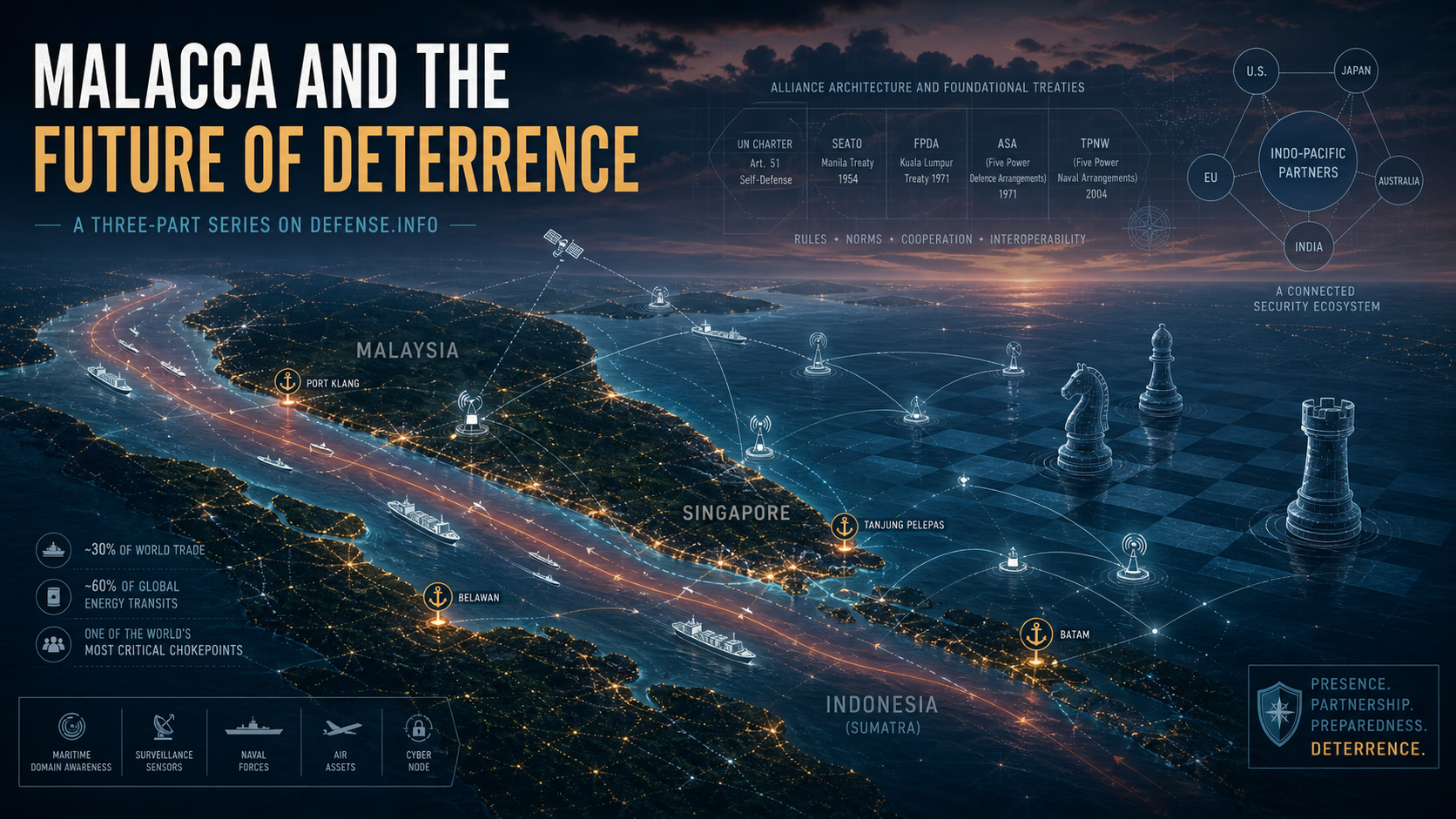
The Malacca Strait is a narrow waterway with outsized strategic significance, where alliance commitments, strategic gaming, and operational realities converge.
In a new three‑part series on Defense.info, I use Malacca as a case study to link alliance architecture to emerging deterrence challenges: the first article examines alliance documents and wargames that frame Malacca as a hinge between the Indian and Pacific Oceans, the second traces three overlapping webs of presence, logistics, and sensing around the Strait, and the final “Malacca chessboard” piece looks at how new force packages, autonomous systems, and dispersed logistics can shape a way ahead for credible deterrence at this critical maritime chokepoint.
This is the first article in the series.
The distinction between alliances as negotiated documents and alliances as issue-specific strategic games is not merely a theoretical proposition. It has direct operational consequences, and nowhere are those consequences more visible at the present moment than at the Strait of Malacca. The emerging U.S.-Indonesia Major Defense Cooperation Partnership, unveiled in mid-April 2026, offers a compelling case study in how the two frameworks interact and in why the gap between them is precisely what sophisticated strategic actors are working to close.
Malacca is, in the political science sense, an alliance-free zone. There is no treaty committing the United States to the defense of the strait, no Article 5 that covers Indonesian waters, no formal coalition structure governing how the littoral states would respond to coercive interference with shipping. What exists instead is a deepening web of operational relationships, access arrangements, ISR architecture, and partner capacity, precisely the kind of issue-specific game-shaping that the game theory framework identifies as the operative layer of strategic commitment. Washington is not signing a document; it is restructuring payoffs.
The Malacca Dilemma as a Strategic Game
For China, Malacca has long represented a structural vulnerability what Hu Jintao famously named the “Malacca dilemma.” An industrial power dependent on imported energy that must transit a narrow passage it does not control faces a game-theoretic exposure of the first order. Beijing has spent two decades attempting to mitigate that exposure through overland pipelines, port investments, and supply diversification, but the structural dependence remains. Around 23.2 million barrels of oil per day moved through the strait in the first half of 2025, roughly 29 percent of total seaborne oil trade. That figure is not a statistic; it is a payoff structure.
From Beijing’s perspective, the game at Malacca is not about whether a treaty exists — no relevant treaty does — but about whether, in a crisis, the United States would have the operational capacity and political will to exercise coercive leverage over Chinese energy flows. For decades, the answer was effectively no: the access, ISR architecture, and partner relationships required for such a move were absent or insufficient. The MDCP, together with the surrounding initiatives it has catalyzed, is changing that calculation. Washington is not making a general commitment to Indonesia; it is reshaping the specific game at the world’s most important chokepoint.
This is exactly the move that game theory predicts sophisticated powers will make when they seek to strengthen deterrence without the political costs of formal alliance commitments. By building access, ISR capacity, and operational relationships by investing in overflight rights, expeditionary sea base transits, subsurface sensor networks, and unmanned surface and underwater vehicles the United States is constructing a payoff structure in which Chinese coercion at or near Malacca becomes dramatically more costly and uncertain. The document is absent. The game is being shaped.
Indonesia and the Limits of the Document Framework
Jakarta’s approach to the MDCP illustrates the political science framework’s inherent limitations with particular clarity. Indonesia maintains, with evident sincerity, that the partnership does not compromise its “free and active” foreign policy, that it is not choosing sides between Washington and Beijing, and that it has no intention of accepting permanent U.S. bases, formal alliance obligations, or explicit participation in any blockade or interdiction regime. In the political science sense, the sense of the negotiated document, these statements are accurate. The text of the MDCP contains none of those commitments.
But in the game theory sense, Indonesia’s position is considerably more consequential than its declaratory stance suggests. The strait runs between the Malay Peninsula and Sumatra. The main alternative routes — Sunda and Lombok — are framed by Indonesian geography. Jakarta is not merely a convenient partner; it is structurally indispensable. Any ISR architecture over Malacca, any credible monitoring of Chinese shipping, any capacity for selective interdiction in a crisis, all of these require Indonesian cooperation, or at minimum Indonesian non-obstruction. By deepening operational relationships with Washington in precisely the domains. maritime domain awareness, subsurface sensors, autonomous systems, overflight access, that matter for crisis operations, Jakarta is shaping the game even as it maintains the diplomatic fiction of non-alignment.
This is not cynicism. It is the normal condition of strategic partners operating in a multipolar environment. The document says one thing; the operational reality says another. Beijing reads both, and what it reads in the operational reality is that its Malacca dilemma is deepening regardless of what the MDCP’s text contains. That is precisely the mechanism by which issue-specific game-shaping functions: the absence of a formal commitment does not neutralize the strategic effect of a restructured payoff environment.
The Three-Web Architecture as a Commitment Mechanism
The conceptual framework of three overlapping webs — security, deterrence, and kill webs — developed in the analysis of the Malacca posture provides an unusually clear window into how operational architecture functions as a commitment mechanism in the absence of a formal treaty. Each web corresponds to a different tier of the game-theoretic logic.
The security web — the persistent ISR architecture of unmanned surface and underwater vehicles, P-8 maritime patrol aircraft, and networked sensor grids — establishes the baseline condition that game theory identifies as essential to credible deterrence: transparency. An adversary cannot conduct gray-zone operations, gray-zone being the preferred instrument of powers seeking to disaggregate alliance responses, without generating a continuous, documented record of its behavior. The omnipresent witness function of distributed sensors removes the ambiguity that salami tactics require. Each individual slice is now recorded, geolocated, time-stamped, and fed into a common operational picture accessible to multiple partners. The incremental aggressor’s greatest tool — the ability to make each individual provocation seem insufficient to justify a response — is systematically degraded.
The deterrence web translates the same infrastructure into friction for coercive behavior. When the sensor architecture is distributed across Indonesian vessels, U.S. maritime patrol aircraft, allied submarines, and commercial shipping monitors, when it cannot be defeated by neutralizing any single node, the political costs of coercion rise substantially. Alliance consultation triggers are built into the architecture itself: the documentary record that the security web generates automatically creates the evidentiary basis for coordinated responses. This is the operational equivalent of what political scientists call tying hands, making follow-through more automatic and therefore more credible, without requiring the political cost of a formal treaty commitment.
The kill web represents the most consequential tier from a game theory perspective. The operational enablers being built at Malacca, blanket overflight rights, expeditionary sea bases, subsurface sensors, autonomous tracking systems, provide future options for selective monitoring, inspection regimes, and coordinated interdiction that fundamentally restructure the payoff calculation for any actor considering coercive interference with strait traffic. The distributed nature of these capabilities creates targeting dilemmas that a single concentrated force posture would not: when sensors, potential effectors, and command nodes are spread across Indonesian waters, the Malaccan approaches, and the wider regional network, an adversary cannot defeat the architecture by neutralizing one capability or one node. This is the kill web logic applied to maritime deterrence and it functions as a commitment mechanism precisely because it is built into the infrastructure rather than declared in a document.
The Trump Chokepoint Doctrine: Documents, Games, and Signaling
The broader strategic context what might be called the Trump chokepoint doctrine illuminates a further dimension of the alliance-document versus alliance-game distinction: the role of deliberate ambiguity in managing the relationship between the two.
Washington has not announced a formal blockade plan for Malacca, has not established a coalition task force, and has not issued any explicit commitment to use the strait as coercive leverage against China. In the political science sense — the document sense — the American position remains unspecified. This is not an oversight. It is a choice. By keeping its Malacca options implicit rather than explicit, the Trump administration preserves strategic flexibility while still signaling, through operational moves, that the capacity for coercive leverage is being built. Adversaries are invited to draw their own conclusions from the architecture — and the conclusions they draw are precisely the ones that deterrence requires.
This is a sophisticated version of the commitment mechanism that game theory identifies as most durable: one that is costly to reverse and visible to adversaries, but that preserves the initiating party’s ability to calibrate its response to the specific scenario that emerges. By investing in access, ISR, and partner capacity now, before any crisis has materialized, Washington ensures that future contingencies need not start from a standing start. The architecture itself communicates resolve. The document need not.
The consistency of the chokepoint doctrine across theaters — Hormuz, Venezuela, and now Malacca — amplifies this signal. A pattern of behavior across multiple scenarios creates what game theorists call a reputation for resolve that no single treaty commitment can generate. The United States is demonstrating, through operational moves in multiple theaters, that it intends to hold adversaries’ economic vulnerabilities at risk. Each additional theater in which this pattern is established strengthens the credibility of the implicit threat in all the others.
Chaos Management and the Limits of Both Frameworks
The Malacca case also illuminates a dimension of contemporary strategic competition that neither the political science nor the game theory framework fully captures on its own: the condition of persistent turbulence that makes both formal commitments and clear equilibria unstable.
Traditional crisis management, the framework implicit in both the political science and game theory approaches, assumes a baseline of relative stability from which crises depart and to which they eventually return. The three-web architecture at Malacca is designed for a different environment: one of persistent complexity in which Chinese economic coercion, hybrid gray-zone tactics, the proliferation of autonomous systems, and the blurring of commercial and military shipping are not exceptional conditions but the normal operating environment. Mesh fleets of unmanned systems are suited to this environment precisely because they can be rapidly reprogrammed, their mission sets can evolve through software updates, and they can adapt to local conditions without fundamental platform reconfiguration. The architecture is designed not to manage discrete crises but to operate effectively within ongoing turbulence.
This is the operational expression of the chaos management concept and it represents an evolution beyond what either framework, taken alone, can prescribe. The political science framework provides the diplomatic architecture: the MDCP text, the reassurance to Indonesian non-alignment, the framing of presence as support to regional security rather than power projection. The game theory framework provides the operational logic: the issue-specific payoff restructuring, the commitment mechanism built into distributed architecture, the targeting dilemmas imposed on adversaries. Neither is sufficient without the other. The document provides political legitimacy and partner confidence; the game-shaping provides the deterrent effect that the document alone cannot deliver.
The Architecture Is the Strategy
What emerges from the Malacca case study is a strategic proposition of considerable importance: in the contemporary operating environment, the architecture is the strategy. The commitment mechanism that matters is not the treaty text but the operational reality that adversaries must plan against, the ISR blanket, the distributed sensor network, the expeditionary platforms quietly transiting, the autonomous systems knitting together a persistent picture of the maritime domain.
This does not mean that documents are irrelevant. The MDCP provides the political framework within which the operational architecture can be built and sustained. Indonesian domestic politics require that the partnership be framed in terms consistent with non-alignment; the document provides that framing. Regional partners in Singapore, Malaysia, and beyond require assurance that the emerging posture is consistent with international law and regional stability norms; the document provides that assurance. The text is the political container that makes the operational content possible.
But it is the operational content, the specific game being shaped at the world’s most important chokepoint, that does the strategic work. Beijing’s Malacca dilemma is deepening not because of anything the MDCP says but because of what the emerging architecture makes possible. The real question for the years ahead is whether Washington can sustain the strategic discipline to build and maintain the three-web architecture that makes the implicit commitment credible and whether it can do so while managing the regional anxieties that the same architecture inevitably generates among partners who want the deterrent effect without the political exposure.
That tension between the document that reassures and the game that deters is the central management challenge at Malacca.
It is also, in miniature, the central challenge of American alliance strategy in the Indo-Pacific.