
Fight Tonight: The Hard Work of Industrial Readiness

The Williams Foundation seminars have long served as a crucible for serious thinking about Australian defence. Year after year, the discussions move from strategic abstraction toward operational reality, from what Australia needs in principle to what Australia must be able to do in practice, and soon.
The April 2026 seminar, “Fight Tonight: Exploiting Australia’s Strategic Advantage,” was no exception. And among the presentations that defined the day, the remarks by Kris Christensen, Director of Integrated Defence and Autonomy Systems at BAE Systems Australia, stood out for their disciplined practicality.
Christensen runs a major line of business inside BAE Systems Australia covering guided weapons, defence sustainment, and autonomy research and development programs. She brings more than two decades of experience across defence, aerospace, and advanced manufacturing, platforms ranging from the F-35 to the Typhoon to the Boeing 787. She knows what it takes to deliver complex capability across multiple domains from development through to sustainment. More to the point, she knows what it takes to keep that capability in the fight.
Her core message was direct: fight tonight is not a slogan. It is a stress test. And when that stress arrives, as the world keeps reminding us it will, without asking permission—the system will reveal whether anyone actually built readiness or merely discussed it.
Christensen drew a sharp distinction between the long game and the near term. She acknowledged the importance of decade-plus national programs that will reshape Australia’s force structure and industrial base. Those matter enormously. But they are not the answer to a problem that may arrive in ten months. “Recent events worldwide” demand near-term capability at scale, built now, not sequenced over a generation.
What BAE Systems Australia decided to do was stop talking about readiness in general terms and start treating it as a practical planning problem. That required a framework and when Christensen looked for one, she didn’t find it. So she borrowed one: the American DEF CON model. The logic was not borrowed uncritically; it was adapted to provide a shared language for how both industry and defence needed to change their behaviour as threat levels rise. At the low end, normal business conditions, there is time to plan, sequence, and optimize. At the high end, everything compresses. Speed, resilience, and keeping capability in the fight become the only metrics that matter.
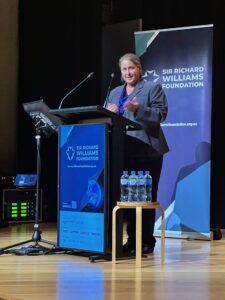
The methodology Christensen employed to stress-test her organization deserves attention. She ran what she called war footing workshops, scenario planning exercises with a specific set of guardrails. Assume you cannot support anything when it matters. Assume demand spikes in ways that normal plans don’t cover. Assume there is no clear runway. Assume VUCA, volatility, uncertainty, complexity, ambiguity, will only increase. And assume that if you wait to be asked, it is already too late.
The analytical technique she used with her program leaders was back-casting rather than forecasting. Imagine it is late 2027, ten months from now, and you are looking back at yourself in 2026.
• What do you wish you had done? What would you have stockpiled?
• What skills would you have built into your workforce?
• What single points of failure would you have addressed before they became catastrophic?
• What decisions should have been pushed further to the front line before the pressure made deliberation impossible?
What emerged from that work was a finding that Christensen presented with some force: readiness is not one thing. It is three things. And none of them live exclusively inside industry, and none live exclusively inside defence. The three dimensions are workforce readiness, business readiness, and capability readiness.
Workforce readiness asks the hard questions about people.
• Do you have the right people with the right clearances and the right skill depth to surge?
• Can you go to multiple shifts?
• Can you crash-deploy personnel to where the work needs to be done?
• Do you have backfills if service members are recalled?
These are not abstract questions. The workforce decisions made in calm conditions determine what is possible in a crisis. That is as much a system-level problem as it is an organizational one.
Business readiness is about whether the organization can make decisions and contract quickly under pressure without getting in its own way. Christensen described pre-agreed “break glass” arrangements with customers that would allow rapid response to urgent operational requirements. She described a delegation matrix that adapts as DEF CON levels increase, pushing decision-making authority further down into the organization, closer to where the most current and relevant information actually lives. But that only works if those arrangements are understood and pre-agreed before the clock is running. Negotiating them under pressure is a formula for delay.
Capability readiness is about the unglamorous work that nobody sees but that determines whether the system actually functions.
• Can you produce more of what already exists, faster? Can you support it in-country?
• Do you have critical spares and parts buffers?
• Do you have trusted and tested local suppliers who can step up on short notice?
• Do you have the test equipment, tooling, and quality discipline to scale without creating risk?
Christensen put it bluntly: if you cannot sustain it, you do not really have it. Combat mass is not only about what you buy. It is about what you can replace.
The call to arms she offered the room was precise. Three options, not all required simultaneously, but each addressable now.
First: build your “fight tonight switch.” Write down what changes for your organization when the situation shifts from normal to urgent. What will you stop doing? What will you accelerate? What decisions will you push down the chain? What approvals will you simplify? What arrangements need to be pre-agreed now so you are not negotiating them under fire?
Second: look at your top three single points of failure and fix one of them, now. The person, supplier, or piece of equipment that would stop you cold. Create redundancy. Cross-train. Dual-source. Build a buffer. Do one thing, then move to the next.
Third: run the scenario planning exercise—the war footing workshop, with your partners. It does not need to be formal or expensive. It needs to be specific. Import stock doubles. Demand spikes. Timeline shrinks. What breaks first? Play it through. The answer becomes apparent within the first ten minutes.
What struck me about Christensen’s presentation was its intellectual honesty about the boundary conditions of the problem. She was speaking to a room that included both industry and defence leaders, and she made clear that neither side gets a pass. The readiness system spans organizational boundaries.
The “fight tonight” standard is demanding precisely because it compresses the timeline to zero. There is no runway. There is no phasing. There is only whether the system works or does not. The answer to that question is not determined when the crisis arrives. It is determined in the months and years before, in the unglamorous work of pre-positioning, cross-training, dual-sourcing, simplifying processes, and building the decision authority that allows response at the speed the situation demands.
Christensen closed with the simplest version of her message: if we can’t sustain it, we don’t really have it. We may only have ten months. Let’s not wait ten months.
It was, in the best tradition of these seminars, a presentation that left the audience with no comfortable ambiguity about what is required and no excuse for not beginning the work immediately.