
The MARTAC T38’s 192-Hour Mission: Proof of Concept for the Mesh Fleet
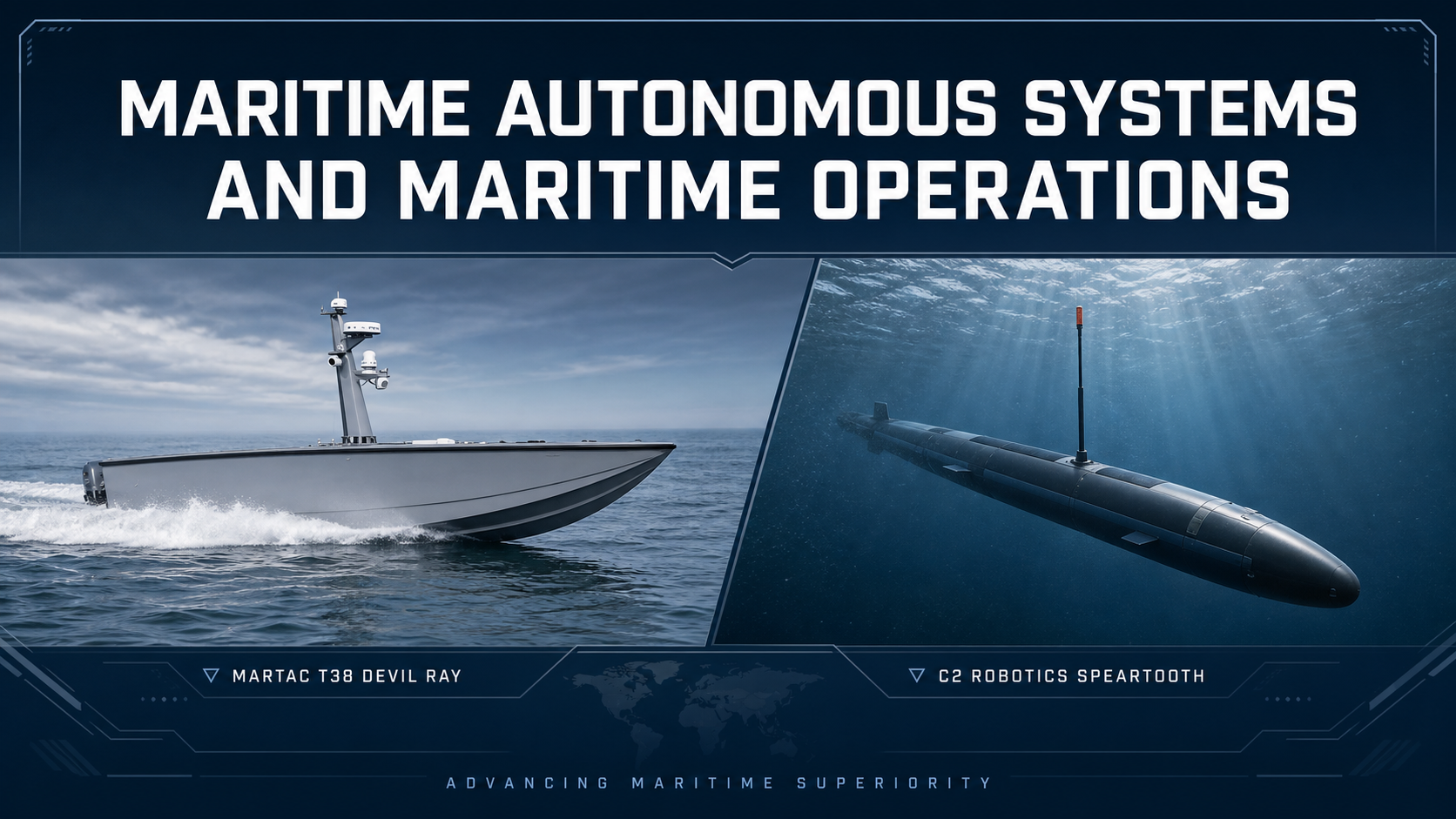
When Maritime Tactical Systems (MARTAC) announced that its T38 Devil Ray unmanned surface vessel had completed an eight-day, fully autonomous mission 400 nautical miles off the California coast, the defense press treated it as a milestone in USV endurance. That framing is not wrong, but it misses the more important point.
What the T38 demonstrated on May 5, 2026 was not simply that an unmanned boat can stay at sea for a long time. It was a validation of the operational logic at the heart of what I have been calling the mesh fleet and it arrived at precisely the moment when the strategic argument for that concept is becoming most urgent.
The headline numbers are striking enough. One hundred and ninety-two hours. Four hundred nautical miles offshore. No chase boats. No escorts. Sea states reaching Force 5. A deliberate two-day period of single-engine operation, not as a failure but as an intentional maneuver to extend loiter time and stress the autonomy stack under reduced propulsion. Confirmed compliance with COLREG, navigating around multiple static and mobile contacts autonomously. And at full fuel, an operational range exceeding 2,400 nautical miles.
But the numbers tell only part of the story. What matters operationally is the combination: persistence at distance, modular payload capacity, open-architecture autonomy that can integrate into broader networked operations, and the ability to modulate propulsion intelligently to extend mission duration. That combination is what transforms a capable unmanned vessel into a node in a distributed maritime kill web.
In Lessons from the Drone Wars, I developed the argument that maritime autonomous systems are forcing a fundamental reconceptualization of naval power, not by replacing manned platforms, but by generating intelligent mass: the ability to hold a wide set of targets, maintain persistent presence across vast maritime areas, and create exchange ratios that exquisite, scarce platforms cannot sustain on their own.
The T38 and the MARTAC family have been central to that argument. I cited their performance in Task Force 59 and in U.S.-Philippines cooperation specifically because they demonstrated what the book described as “persistent presence at sea, real-time data collection, and coordinated swarming activities through onboard AI-driven decision-making and mesh networking capabilities.” The 192-hour California mission moves the capability into genuine open-ocean operations.
The significance cannot be overstated. I wrote in the book that “an unmanned surface vessel can maintain station in contested waters for weeks or months, providing continuous sensor coverage and strike capability without crew rotation, provisioning, or the human factors that limit endurance.” The T38 mission at 400 nautical miles offshore — without support, without escorts, in real sea states — begins to validate that claim not as a theoretical projection but as demonstrated performance.
The temptation in covering USV milestones is to emphasize burst speed. The T38 can exceed 50 knots. That is impressive, and it matters for certain mission profiles. But the California mission was explicitly designed around the opposite emphasis: persistence over speed. The vessel averaged just over 4 knots across eight days. That is the relevant data point.
The mesh fleet concept depends on persistence. A distributed maritime presence that can hold adversary attention, contribute continuous ISR, and integrate into a kill web requires platforms that can stay forward without the logistical tail of manned vessels. The question I posed in the book was not “how cheap can our USVs be?” but “what combination of manned and unmanned maritime systems, operating in distributed networks with resilient command and control, will dominate the seas we actually expect to contest?” The T38 is the right answer to the right question, a medium-endurance, long-range, payload-flexible node that does not force a choice between sprint capability and persistent presence.
The single-engine operational period is worth dwelling on. MARTAC made the deliberate choice to demonstrate reduced-propulsion performance not as a contingency response but as a designed operational mode, a way to extend loiter time at distance. That is sophisticated operational logic. It reflects a platform designed not just to reach a location and execute a scripted task, but to manage its own operational parameters intelligently over extended periods. That is exactly the kind of autonomy stack that enables the one-to-many or many-to-many control relationships that I argued would be essential for cost-effective deterrence across the Indo-Pacific.
What distinguishes the mesh fleet from a simple collection of autonomous boats is its networked character. A mesh fleet operating around and ahead of capital ships generates what I described as “signature dilution”, the electromagnetic and acoustic emissions from dozens of autonomous platforms masking the capital ship’s specific signature within a cloud of contacts. An adversary’s sensors detect multiple radar returns across a wide area but cannot determine which contacts represent high-value targets versus expendable autonomous nodes.
The T38’s open-architecture autonomy framework and modular payload integration are precisely what makes this possible. The platform supports resilient communications enabling mission execution in denied or degraded conditions. That is not incidental to the design. It is the design. MARTAC built a kill web node that happens also to be a capable individual platform.
The California mission validated the individual platform dimension comprehensively. The kill web integration dimension has been validated through Task Force 59 and the Philippine context. What is now needed is the operational architecture that brings the two together at scale, the concept of operations that deploys T38-class vessels not as single-mission platforms but as persistent distributed nodes in a maritime mesh.
I devoted considerable attention in the book to the Philippines as the most mature real-world expression of the porcupine defense concept: the use of geography, allied support, and autonomous systems to create overlapping layers of capability that complicate any adversary’s operational planning across more than 7,000 islands. The T38’s formal role in the Philippine Navy’s Unmanned Surface Vessel Unit established in 2024 with ISR and maritime domain awareness as its primary mission is the operational context in which this California endurance data becomes strategically significant.
A USV that can maintain station for 192 hours at 400 nautical miles without support is a USV that can sustain persistent presence across the Luzon Strait, the South China Sea approaches, or the waters around Palawan without the logistics infrastructure that currently limits Philippine Navy presence. The porcupine defense works only if the quills are actually deployed, persistent, forward, and networked. The T38 California mission provides the confidence data that makes forward deployment a credible option rather than an aspirational one.
The California mission should be read alongside the broader trajectory of autonomous maritime development. NAWCWD’s Point Mugu Sea Range and its Future Capabilities Office operated the T38 for this mission specifically to advance the Navy’s ability to conduct test and evaluation in challenging maritime environments where traditional fixed instrumentation is unavailable. That institutional framing matters. The Navy is not just acquiring a platform. It is building the operational and evaluation infrastructure for a distributed maritime architecture.
The decisive competition is not between precision and mass but between exquisite scarcity and intelligent mass. The T38 California mission is the maritime expression of that argument made concrete. Eight days. Four hundred miles offshore. No support. Confirmed COLREG compliance. Modulated propulsion. Over 2,400 nautical miles of confirmed range.
The mesh fleet is demonstrating its operational parameters one mission at a time.
Note: During my recent trip to Australia, I focused in part on maritime autonomous systems addressing the Royal Australian Navy’s hull gap. This is the first in these most recent pieces which am publishing on MAS and the hybrid fleet.