
From Chokepoint to Corridor: MV-75 Cheyenne in the Defense of the GIUK Gap
The Greenland-Iceland-United Kingdom gap is not a legacy Cold War concept kept alive by strategic nostalgia. It is one of NATO’s most consequential operational corridors, and it is becoming more demanding, not less, as the Arctic and North Atlantic merge into a single theater of great-power competition.
Russian naval and undersea activity tied to the Kola Peninsula gives the corridor renewed military urgency: the Northern Fleet’s submarine operations, surface sorties, and hybrid pressure campaigns all transit or threaten the GIUK gap as a matter of operational geography. Meanwhile, the fragility of undersea infrastructure, cables, pipelines, sensor arrays, has introduced a new category of vulnerability that NATO is only beginning to defend systematically.
The Alliance’s problem in this theater is not simply one of detection or deterrence by declaration. It is an operational mobility problem. The geography is vast. Bases are few. Weather is punishing. The key anchors of the corridor, Greenland, Iceland, the Faroe Islands, and northern Scotland, are separated by hundreds of nautical miles of open North Atlantic. Moving the right people, sensors, and enabling capabilities among these nodes at operationally meaningful speed is something NATO’s current vertical-lift inventory cannot reliably do. The MV-75 Cheyenne changes that calculus.
The GIUK Gap as a Joint and Multi-Domain Theater
During the Cold War, the GIUK gap was understood primarily as a maritime chokepoint: a barrier through which Soviet submarines had to pass to reach the open Atlantic, and from which NATO’s ASW forces could contest that passage. That framing was never entirely adequate, and it is insufficient today. The corridor is simultaneously a maritime barrier, a reinforcement route, an undersea infrastructure zone, a surveillance domain, and, increasingly, a space where hybrid pressure, unattributed maritime activity, cable interference, drone reconnaissance, operates in the grey area below the threshold of armed conflict.
Greenland and Iceland are the corridor’s strategic anchors, each contributing differently to its defense. Greenland which is part of the Kingdom of Denmark provides radar, warning, and logistics value at the northwestern edge of the gap, and its strategic importance has accelerated in recent years as the Arctic has moved to the center of Alliance planning. Iceland, despite lacking a standing military, offers basing infrastructure for maritime patrol aviation, ASW operations, and air defense, a set of capabilities whose relevance grows with every Russian Northern Fleet sortie. The Faroe Islands and northern Scotland complete the southern edge, tying the corridor to the UK and Denmark defense posture and to NATO’s broader eastern flank.
This joint and multi-domain character means the GIUK gap cannot be adequately defended by any single service or capability type. Maritime patrol aircraft provide the sustained surveillance backbone, surface combatants patrol and enforce, and submarines operate below the gap’s surface layer. But none of these can rapidly move specialized teams, sensors, command elements, or enabling packages between the corridor’s dispersed nodes in response to a developing situation. That is precisely the gap in capability that a high-speed tiltrotor fills.
What the MV-75 Brings to the Corridor
The MV-75’s performance profile was not designed with the GIUK gap specifically in mind, but it aligns with the corridor’s operational demands with unusual precision. Cruise speed approaching 300 miles per hour and with its capability to operate at extended range with its aerial refueling capability mean that an MV-75 detachment based in Iceland can reach the Faroe Islands, southern Greenland, or northern Scotland and back within a single operational cycle, in weather and at a tempo that no conventional medium helicopter can sustain.
Bell and the U.S. Army consistently describe this as twice the speed and twice the range of the Black Hawk-class platforms the aircraft replaces, the same “twice as far, twice as fast” standard that defines the Future Long Range Assault Aircraft program from which the MV-75 descends. In the GIUK context, that doubling is not an incremental improvement. It is the difference between a corridor that can be responded to and one that cannot.
Four operational functions stand out for GIUK defense.
The first is rapid reinforcement of exposed nodes: Iceland, Greenland, and the Faroes cannot be permanently garrisoned at the scale that contingencies may require, but they can be reinforced quickly if the right platform is available. The MV-75 provides that option without depending on runway access at every point, a critical distinction in a theater where prepared airfields are scarce and intermittently weather-closed.
The second is movement of specialized teams: ASW specialists, sensor maintainers, special operations forces, forward air controllers, and long-range fires cells are the enabling capabilities whose timely presence or absence can determine whether a developing situation is managed or escalated. The MV-75 moves them at the tempo the situation demands rather than the tempo logistics permits.
The third function is linkage across the maritime battlespace: connecting ships, shore installations, and surveillance detachments across the North Atlantic in a fluid operational picture rather than a set of nationally managed sectors.
The fourth, and strategically most consequential, is response speed when Russian submarine sorties or hybrid pressure events require allied action before a conventional buildup can be organized. The MV-75 compresses the timeline between decision and effect in exactly those scenarios, the ones where speed matters most and where NATO’s current inventory is most constrained.
Speed and range, however, are only half of what the MV-75 offers the corridor. The other half is what the aircraft carries in its digital architecture, and that is where its contribution to the GIUK gap becomes genuinely distinctive.
Deterrence by Detection: The Drone Dimension
The GIUK gap is as much an information contest as a maneuver corridor. Deterrence in this theater depends increasingly on what has been called deterrence by detection, the demonstrated ability to find, track, and attribute Russian submarine and surface activity before it can achieve operational surprise, and to do so persistently enough that the cost-benefit calculation for Russian operations in the corridor shifts unfavorably. That requires not just sensors, but mobile sensor platforms that can reposition as the operational picture develops.
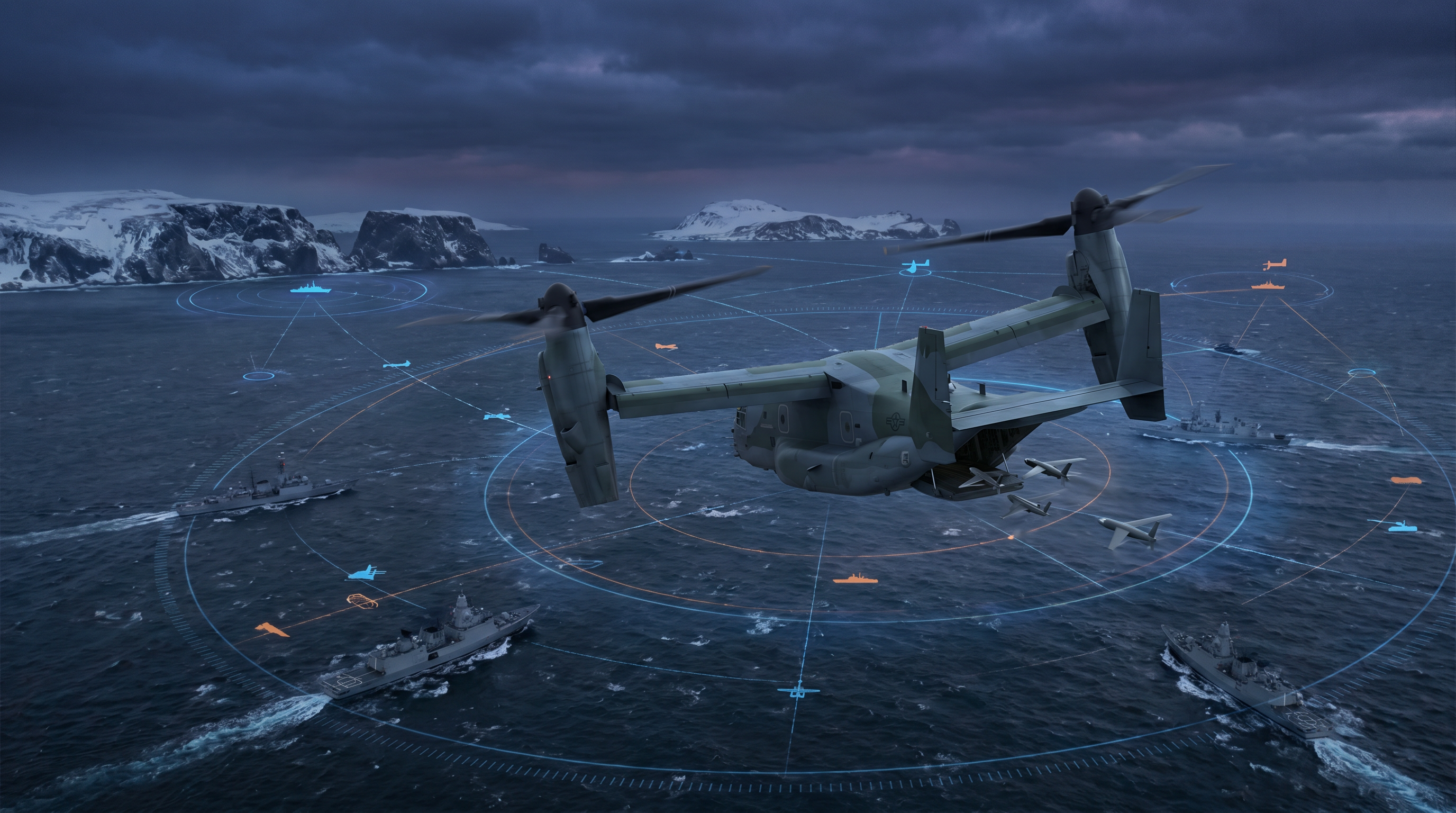
The MV-75 is emerging from a Future Vertical Lift ecosystem built around manned-unmanned teaming and launched effects: small, attritable drones and electronic-warfare payloads that the crewed platform carries, deploys, and controls to extend its sensing and striking reach. What makes this more than a marketing claim is the aircraft’s underlying architecture.
The MV-75 is built around a Modular Open Systems Approach digital backbone that functions, in effect, as the aircraft’s nervous system, standardizing interfaces and data models so that new sensors, effectors, and mission software can be integrated as plug-and-play modules rather than through expensive, proprietary redesign cycles.
U.S. Army doctrine treats Air Launched Effects as a central element of the Future Vertical Lift concept, extending an aircraft’s reach, survivability, and lethality through small air- or ground-launched unmanned systems performing reconnaissance, decoy, electronic warfare, and kinetic roles inside contested airspace. The MV-75 is explicitly designed as the primary mothership for these payloads, and because launched effects are software- and data-intensive by nature, it is the open digital backbone that allows new effectors and unmanned systems to be added as threats and operational concepts evolve, rather than waiting on the next major airframe upgrade.
This is also why manned-unmanned teaming functions as a design center for the MV-75 rather than a retrofit. Unlike legacy helicopters adapted after the fact to control unmanned systems, the MV-75 is a born-digital tiltrotor built from the outset to orchestrate multiple unmanned assets, tactical UAS, launched-effects swarms, and potentially unmanned ground systems, from a common cockpit and mission system. Applied to the GIUK gap, this architecture makes the aircraft something considerably more than a fast transport.
It becomes a mobile node in a distributed surveillance and effects network, a platform that can carry polar-capable ISR drones into the corridor, deploy them to monitor submarine chokepoints or undersea infrastructure, relay their feeds to surface combatants and shore-based command centers, and reposition the entire sensor complex in response to new intelligence, all while the manned crew remains at a survivable standoff distance and lets the unmanned systems absorb the risk in the most exposed parts of the corridor.
This is the kill web logic applied to the North Atlantic: not a sequential chain of sensor, decision-maker, and shooter, but a fluid, networked system in which any node can contribute to the operational picture and any platform can reposition the network’s center of gravity faster than adversaries can adapt.
NATO’s Arctic Sentry framework is attempting to aggregate national surveillance activities and exercises into exactly this kind of coherent operational picture. A common MV-75 capability across U.S., UK, and Danish forces would give Arctic Sentry commanders a mobile connector that current inventory does not provide, one that can stitch together maritime patrol aircraft coverage, surface combatant sensors, and autonomous systems into an integrated North Atlantic surveillance architecture.
The Alliance Architecture: Who, and Why
The nations with the most immediate operational case for MV-75 capability in the GIUK corridor are the United States, the United Kingdom, and Denmark, the three with the most direct basing and operational commitments in the gap itself. The United States operates from Iceland and has broad Arctic Sentry responsibilities that span both sides of the Atlantic. The UK anchors the southern edge of the corridor and has a long tradition of North Atlantic ASW and maritime patrol operations that a high-speed tiltrotor would substantially enhance. Denmark, through Greenland and the Faroe Islands, holds the northwestern and mid-corridor anchors, territories that are strategically critical and chronically difficult to reinforce at speed.
Canada’s relevance is growing. Arctic defense and North Atlantic reinforcement are converging in Alliance planning, and Canadian Arctic sovereignty obligations increasingly intersect with NATO’s GIUK commitments. A Canadian MV-75 capability would extend the North American contribution to the corridor and deepen the joint operational architecture that Arctic Sentry requires. Norway, while focused primarily on the Baltic-to-Barents land corridor, has maritime approaches that connect directly to GIUK operations and a defense establishment that understands the operational geography with uncommon precision.
The critical point is that a strategically distributed set of MV-75 detachments across these nations — positioned at Keflavik, Thule, the Faroes, and northern Scotland — would provide Arctic Sentry commanders with genuine theater-wide vertical maneuver capability for the first time. The effect on the corridor’s defensibility would be disproportionate to the acquisition scale.
What makes a multinational MV-75 fleet more than a shared airframe is the same open digital backbone that gives the aircraft its drone-teaming capability. Because the MOSA architecture maximizes commonality across national variants, mission equipment and software developed by one ally can be ported onto another’s MV-75 with minimal rework.
That moves the Alliance beyond mere interoperability, in which allied systems can exchange data, toward genuine interchangeability, in which a British or Danish MV-75 crew could launch a U.S. or European-developed sensor or electronic-warfare payload, or vice versa, under a common mission-app suite.
For a corridor defended by a coalition rather than a single nation, that is not a secondary benefit; it is the difference between national detachments operating in adjacent lanes and a true shared combat cloud spanning the GIUK gap. A GIUK-focused MV-75 acquisition structured around European mission-system integration, autonomous payload development, and open architecture would feed operational lessons from the world’s most demanding maritime environment directly into those programs.
Conclusion
The GIUK gap is where the defense of the North Atlantic begins, and where the reinforcement of Europe from North America either holds or fails under pressure. It is a theater that demands speed, range, and the ability to connect dispersed nodes under contested conditions, precisely the combination of attributes the MV-75 was designed to provide. Filling the operational mobility gap in the corridor does not require large fleets or the displacement of existing maritime aviation. It requires a modest, strategically positioned tiltrotor capability shared among the allies with the most direct stake in the corridor’s defense.
The MV-75 is not the single answer to every GIUK challenge. Maritime patrol aviation, surface combatants, submarines, and fixed sensor networks all remain indispensable. But the gap between what those systems can do and what the corridor’s operational demands require is real, persistent, and consequential.
High-speed vertical maneuver across the North Atlantic, a born-digital backbone enabling manned-unmanned teaming in a surveillance-dense environment, and the ability to reinforce exposed nodes faster than adversaries can exploit them. These are the capabilities the MV-75 adds. In one of NATO’s most consequential theaters, that addition matters.