
Combat Depth, Not Just Mass: Collaborative Combat Aircraft and the Australian Industrial Base
The most useful argument at the Sir Richard Williams Foundation’s seminar on air combat mass and depth in Canberra on 1 October was not about aircraft. It was about what kind of enterprise Australia needs behind its aircraft if collaborative combat platforms are to matter at all.
The panel, “Collaborative Combat Aircraft in Context: CCAs and Defence Industry,” brought together practitioners from the air force’s ideas community, from industry, and from the Foundation itself. John Conway, Sir Richard Williams Foundation Research Fellow, served as moderator. The two participants were WGCDR Chris McInnes, PhD, ir and Space Centre and Jeremy Feldhahn, CCA Strategy Leader, MQ-28 Boeing Defence Australia.
The moderator set three guardrails: keep the discussion relevant to Australia’s theatre, avoid being captivated by tactical detail from other wars, and think about mass and depth in terms of national strategy and the choices open to government. The conversation honoured them. It never settled into a platform comparison.
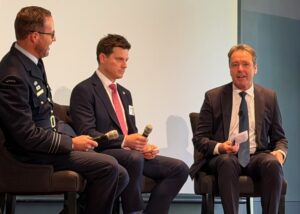
What emerged was a coherent position, reached from several directions. Collaborative combat aircraft, or autonomous collaborative platforms (ACPs), the broader term many panelists preferred, are valuable to Australia less as expendable mass than as a way to build combat depth, persistence and options for commanders. They add to the force rather than replace anything in it. Their value depends on institutions that can integrate them and on an industrial base that can design, build and adapt them at speed. And the economics should be argued in terms of value and effect, not unit price.
The panel did not agree on everything. Questions from the floor on price expectations and vendor lock-in produced the sharpest exchange of the session, and the closing minutes opened a topic, command and control, that the format had no time to explore. This chapter follows the panel’s reasoning, themes first, then the points left contested.
The problem has not changed since 1937
Australia’s defence problem is a persistent mismatch between its responsibilities and its resources, and the panel began there rather than with technology. In early 1937, at the end of the Depression, the then opposition leader John Curtin argued that the strength of Australia’s defence must lie in aviation. The air force had roughly 96 aircraft in eight squadrons, and he called for more than three times that number. His reasoning was geographic and demographic: a small population, a vast territory, and isolation. Nearly ninety years later, one panelist observed, the country is having the same conversation with different technology.
The figures cited reinforce the point. Australia holds more than 8,000 islands across some 10 million square kilometres of sovereign territory, before the wider Indo-Pacific, an area of roughly 260 million square kilometres, is considered at all. Airmen add height to that, up to perhaps 50,000 feet, so the real quantity to be defended is a volume of airspace rather than a map.
One framing deserves to travel beyond the seminar: Australia functions as an archipelago, not as a continent or an island. Its cities are separated by what one speaker called oceans of dirt and sea, and they connect to each other by air. The Sydney-Melbourne route, cited as the sixth busiest in the world in 2025, was described as the most aviation-intensive on the planet when measured by scheduled seats against the population served, at nearly 90 seats per 100 people, against under 70 for the next highest, Riyadh to Jeddah. The sea lines of communication that Australia depends on, in turn, depend on aviation for surveillance and security.
The discipline this imposes was stated plainly. There are no “defence needs” separate from national needs; there are national needs, and defence is one of the ways to meet them. Autonomous platforms were therefore introduced as another evolution in using technology to close a mismatch that geography will not close. The question for the rest of the session was which technology, applied how, and built by whom.
From range to reach to coverage
The panel argued that range is the wrong metric for air power, and that much of the recent planning vocabulary has been built around it. Range is a fair description of a land- or sea-launched weapon, measured from the launcher. It misleads for air-launched weapons, because the launching platform does roughly two thirds of the engagement and is reusable. Charts that plot weapon range from the launch point therefore understate what air power contributes.
In its place the panel proposed two terms. Reach combines range, the speed at which a force arrives, and what it delivers on arrival. The last element matters more than it is given credit for: some of the warheads now being acquired, one speaker suggested, would have no meaningful effect on the targets they are meant to engage. Coverage is reach sustained over time, or reach combined with tempo.
The distinction has operational consequences. A long-range strike off the east coast on Monday is something several parts of the Australian Defence Force could manage. Repeating it in the Indian Ocean on Tuesday or Wednesday is something only air power can do. Air power is the closest the force comes to being in two places at once, which is exactly the attribute a country with Australia’s resource-to-responsibility mismatch needs.
This reframing is what makes the later discussion of CCAs coherent. If the goal is coverage, then what matters is the capacity a system adds: how many places, how often, for how long. Whether it is a fighter, an uncrewed wingman or a communications node is secondary. Several later arguments, on persistence, on leverage and on value for money, follow from this starting point.
What has changed, and what has not
Four drivers of change were identified, and each bears on how quickly uncrewed systems can move from concept to fielded capability.
• Autonomy and AI. Autonomy is advancing quickly and is now ready to field and experiment with, with humans on the loop rather than in the cockpit.
• Design speed. Model-based systems engineering and digital pipelines allow a design to move from concept to build far faster, and to be matched with a supply chain earlier.
• Government reference architectures (GRAs). Industry initially resisted them. Their purpose is to break vendor lock, so that a mission autonomy package, a payload, an autonomy skill or a weapon built to open missile standards can be swapped in without rebuilding the platform. The approach has been driven by the United States and accepted by several other countries.
• The character of conflict. Over the past four years the proliferation of autonomous systems has accelerated change. The panel was careful to separate these platforms from what the press calls drones, which are often munitions or low-cost cruise missiles.
A historical precedent kept the discussion honest. Between 1964 and 1973 the United States Air Force flew some 3,500 combat sorties with the Lightning Bug uncrewed aircraft, adapted into about 27 variants. It began with bomb damage assessment, moved to chaff laying and leaflet dropping, and then made a consequential contribution to signals collection against the SA-2 surface-to-air missile, whose data was used to reprogram payloads and improve the survivability of the crewed B-52s and Phantoms. But it was launched from a C-130, controlled from the back of one, and recovered by a helicopter with a grappling hook. When combat ended, the business case collapsed.
The lesson drawn was that the earlier problem was the lifecycle: logistics, maintenance and operational support. Modern jet-powered systems, down to something as basic as landing gear, have addressed much of that, which makes them useful beyond high-end combat.
One panelist offered a second reason for optimism. Reference architectures and design tools are bringing in different kinds of people, software engineers, supply chain specialists and production designers, who were not historically part of air power. The concept moved from hypothesis to practice in about five years, and fielding is planned for 2028.
What CCA’s are for: Depth, not disposable mass
The panel rejected the picture that dominates the popular debate, in which a force buys large numbers of platforms because it expects to lose many of them. That is not the movie Australia is in. Australia’s strategy is denial, which calls for combat depth, and for a force that looks somewhat more formidable than it is. The point is to outsize the force that exists, not to plan for attrition.
The case was built on three pillars.
• Risk management. A commander at the strategic, operational or tactical level gains the option to use an asset with no human aboard, or one employed in a different way. That adds a layer of risk management to the whole force.
• Capacity optimisation. This was described as the most important potential. It offers capacity where there was none, within both the services and industry, from the low end to the high end of the force.
• Persistence. Persistence supports coverage. The panel suggested that with the right capacity ratio, strikes that now have to be sequenced across the continent could be done at the same time.
A companion idea was leverage. The ADF has a small number of high-value assets that cannot be replaced quickly: crews above all, but also aircraft such as the E-7 and KC-30, which cannot be built overnight any more than a battleship could be. CCA’s do not exist to give crewed aircraft something to do, and the issue is not jobs. The aim is to maximise the force already in hand. This moves the conversation away from crewed against uncrewed and toward how existing capability can be extended.
Two further points shaped the panel’s view.
First, “collaborative combat aircraft” is too narrow. The term covers a family of platforms that can act as communications nodes, weapons carriers or distributed sensors, not just wingmen. They are becoming part of the fabric of the force, not an adjunct to it. Second, they are additive.
Normally a new platform replaces an old one and inherits its people and infrastructure. CCA’s replace nothing, and when international partners ask what is being replaced, the answer is that nothing is. This is the source of the real difficulty. The constraint is the capacity of the organisation to absorb something new, not whether the technology works.
The operational record offered some support. The panel pointed to recent operations over Iran, where the United States Air Force’s chief of staff reportedly named an uncrewed Reaper as the most valuable platform.
Two explanations were offered. One was the extreme cost of the rescue of a downed crew member, in resources diverted, aircraft at risk and tasking disrupted. An uncrewed loss would not trigger that cascade, though nobody argued that crews should not be rescued. The other was the same value uncrewed aircraft showed in Afghanistan: they soak an area, endure, and close the kill chain organically once airspace is no longer lethal on entry.
Learn from the people and ideas, not the things
Asked what to take from Ukraine, the Middle East and elsewhere, one panelist borrowed Boyd’s trinity of people, ideas and things and argued for learning from the first two. The hardware matters less, because the geography is different, and Ukraine is a continental land war. How systems are designed, produced and organised is directly relevant. How they are used around a land front is of limited relevance.
The contrast offered was between two uses of air power. In Ukraine, Russian aerospace forces held numerical and technical superiority but failed to turn it into air superiority. Their air arm is subordinate to the land forces, and an early campaign against enemy air defences was switched off when ground commanders demanded close air support. The comparison was with Israel’s dismantling of Iran’s air defence system. It was described as an overnight success thirty years in the making, built by an air-minded force that combined airborne ballistic missiles, drones and cyber effects under air-minded leadership. That did not resolve the conflict, but it set conditions on land and at sea.
Air-mindedness is a way of thinking
The discussion kept returning to air-mindedness, and the panel treated it as a mindset, not a licence held by pilots. It was characterised as a higher, faster, further perspective that values expertise and looks for other ways to achieve an effect. Flying informs it, but it is not about hands on a throttle and stick. This matters because of a worry raised at the seminar: how will air-minded leaders be developed when aircrew numbers fall? The panel’s answer was that air-mindedness can be taught and held by people who do not fly.
Institutions can absorb this, if they let themselves
Western air forces separate force generation from force application, and organise by time and task using whatever resources are available. That is exactly the model that can absorb CCAs.. The panel pointed to the Pitch Black exercise, where roughly 100 aircraft from 21 nations are formed into packages and flown every day, as evidence that the institutional capacity exists. One speaker said the obstacle may simply be getting out of our own way.
The underlying principle was the right tool for the job. Autonomous systems do not need to be fitted into the way the force already does business. They need to be embedded in it, so that persistence and risk management are designed in from the start.
Sovereign industry as a kernel, not a standing army
The industrial argument was the most developed of the session, and it rested on a distinction between what Australia must build in peacetime and what it must be able to build when it counts. Nobody argued that taxpayers should fund a large aerospace industry for defence alone. The argument was that the country needs the kernel: the skills, competencies and people who know how to design, build, adapt and manage these systems at scale and at speed.
The precedent was the Second World War. Australia had no machine-tool industry before the war and no ships to import one, yet it went on to build about 2,500 combat aircraft and 2,000 high-performance aero engines, producing the great majority of its own machine tools with a workforce that was largely untrained. Britain’s shadow factories were commercial car-engine makers repurposed for aircraft, not idle plants waiting for war. The speaker’s conclusion was that claims the country cannot do such things should be resisted.
Adjacent industry and dual use
If the kernel is the goal, adjacent industry is the route. Panelists asked what the nuclear enterprise being built for the submarines could be repurposed to produce, and what other Australian industrial activity could pivot. Ukraine was the modern example. Its accelerating development cycle, reported to have fallen from seven months to weeks, drew on a strong domestic base in car manufacturing and wiring looms. Dual-use development was described as largely unexplored for aviation: logistics, surveying, even mail delivery to the outback could add to industrial depth without being combat aircraft.
What the MQ-28 programme shows
The MQ-28 programme has run since roughly 2017 to 2018, has at least 125 active suppliers, and has had as many as 200. Around 70 per cent of the investment goes back into Australian industry. Several suppliers had never worked in aerospace, and some have since moved on to other things. It is described as the first military aircraft built in Australia in some fifty years. The point was not that this one aircraft is the answer but that the intellectual depth now exists to pivot if a different system is needed.
Choose your dependencies
On sovereignty the panel was realistic. Doing everything at home is not feasible, and the more useful aim is to choose your dependencies rather than have them chosen for you, keeping control over the elements that matter most. A related distinction was drawn with the Heron remotely piloted aircraft, which Australia could effectively rent and operate using existing fast-jet, intelligence and engineering people. CCAs do not work that way, because the challenge is having sovereign industry able to build them together.
The funding mismatch
A structural problem was raised without being fully resolved. Australian practice funds acquisition and sustainment, but has no equivalent research and development line, so much development is carried inside sustainment through spiral upgrades. The result is a habit of buying and sustaining, and little interaction with industry on long-term goals. Without that line, the depth the panel wants is hard to build or to renew.
Value for money, not cheap mass
The panel’s most pointed argument was that cost is the wrong place to start. The moderator framed the issue as a question of what Australia values, then of what it costs to protect it. Australia values its people and does not accept the casualty rates that some adversaries will. That ordering changes what counts as affordable.
Several speakers disliked “cheap” and “affordable” for the same reason. A cheap car is not what you buy your children, and the cheapest aircraft is not necessarily the most cost-effective one. The better question is cost per effect, a line of analysis the panel credited to the Mitchell Institute. Nothing is ever unaffordable, one speaker remarked, it is only not prioritised.
Two concepts supported this view:
• Operational opportunity cost. A cheap launcher for a weapon may cost little to buy but impose heavy burdens on the rest of the force to deploy and use, making it expensive in practice.
• Massive effect, not massive equipment. The question is what effect has been created, not how many platforms exist.
The illustration was drawn from Ukraine. A one-way attack drone costing tens of thousands of dollars and carrying a warhead of tens of kilograms is, by the figures cited from CSIS, shot down in a large majority of cases, and those that arrive achieve little. Their real effect is to impose defensive costs on the target. Under a strategy of denial, the panel observed, an adversary will not be deterred by annoyance, and sinking ships requires heavier weapons. By contrast, a reusable platform carrying a 2,000-pound warhead may achieve far more. A multi-million-dollar ACP that protects a crewed aircraft worth a hundred million and achieves the required effect beats a drone costing a few thousand dollars that achieves nothing.
Systems that fight into dense defences and fight out again, with large warheads, cannot be built on the cheap, and some uncrewed systems will cost more than was once expected. As supply, demand and industry investment mature, cheaper systems will arrive for particular missions and threats.
What ties them together is architecture: a reference architecture so that systems costing ten thousand dollars or twenty million can all work together.