
Iran After Seven Months of War: A Balance Sheet
Asking whether Iran has been “defeated” leads nowhere. If defeat means removing the regime, the answer is plainly no. The Islamic Republic is still standing. Its supreme leader, however, was not merely removed. Ali Khamenei was killed in an Israeli strike on the first day of the US-Israeli campaign, February 28, 2026, along with dozens of senior military and political leaders. His son Mojtaba Khamenei was named successor on March 8. He was reportedly badly injured, has not appeared in public, and governs through handwritten orders delivered by courier, according to the Congressional Research Service. The UK House of Commons Library notes the view of analysts that Iran has moved toward a shared-leadership model with a larger role for the Revolutionary Guards.
The leadership was decapitated and the regime survived. That distinction matters, because it tells us the right question is not whether the regime endures but what its power position is now, regionally and in a multipolar system, compared with where it stood before the strikes.
That calls for a bilan, as the French say: a balance sheet of what has been gained, what has been lost, and what remains undecided. It should not be applause for the Trump Administration, and it should not be Bronx cheers either. In an age of chaos, the discipline is to measure results against costs, and to resist the temptation to read a tactical success as a strategic one.
The Ledger in Brief
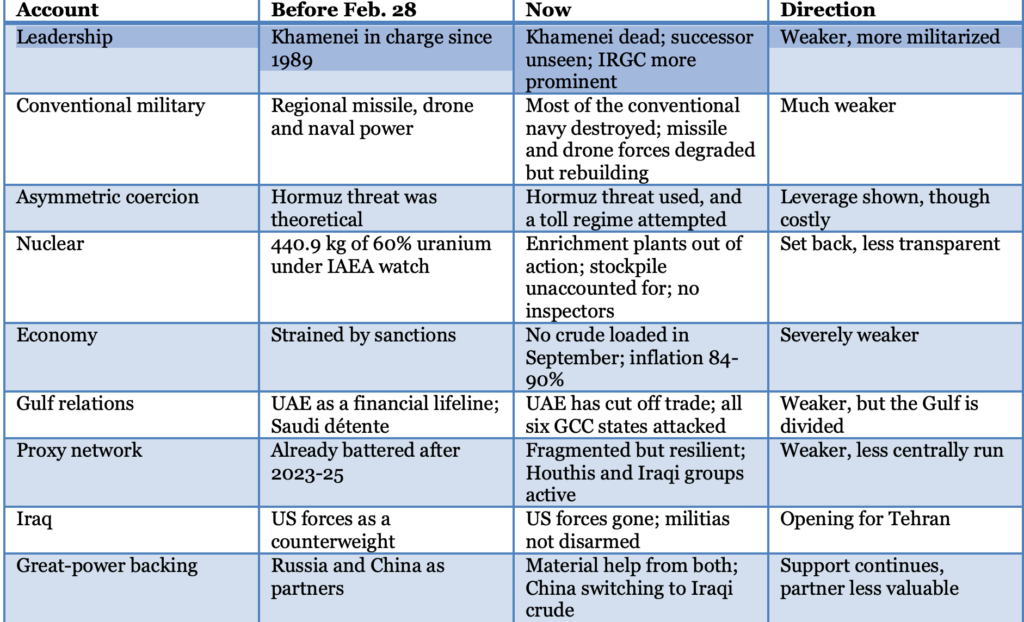
Seen whole, the ledger shows a power that is weaker on almost every line and not yet beaten on the lines that matter most to its neighbors: the strait, the uranium, and the proxies. The sections below take the accounts in turn.
Iran’s Losses
Conventional Power Projection
My original judgment that Iranian power projection has been “dramatically reduced” holds for the conventional instruments. The CRS reports that the United States apparently destroyed most of Iran’s conventional navy, leaving the IRGC Navy’s small craft and minelayers. The USS Abraham Lincoln strike group alone reported 64 Iranian warships sunk and 450 Tomahawks fired over its deployment, according to CBS News. In May, CENTCOM commander Adm. Brad Cooper said Iran’s power projection had been cut to a “nuisance capability,” and testified that 90% of Iran’s defense industrial base had been destroyed and could not be rebuilt “for years.”
The ledger has to show the dissent as well. US intelligence assessments reported in May found that about two-thirds of Iran’s missile launchers had survived and that Iran retained roughly half of its drone capability. One official told CNN that Iran had “exceeded all timelines the IC had for reconstitution.” The CRS cites reports that Iran kept up to 75% of its mobile launchers and 70% of its prewar missile stockpile, and that it restarted missile production underground in September. The fair reading is that Iran’s conventional reach is sharply reduced, while its ability to regenerate is real and disputed.
The Nuclear Program
Enrichment is physically out of action. The known plants at Natanz and Fordow were destroyed or badly damaged, and even Israel does not now allege that Iran is enriching. The problem is accounting. Iran held 440.9 kg of uranium enriched to 60% before the June 2025 strikes. IAEA Director General Rafael Grossi said in March that “a bit more than 200 kg” was believed to be in the Isfahan tunnel complex, where a new enrichment plant of unknown status sits largely unscathed. He repeated the judgment to the Associated Press in late April. The IAEA has carried out almost no safeguards activity since February 28.
The program has been set back, but it has also become opaque. A smaller program that no one can see is not plainly a better outcome than a larger one under inspection. Anyone who spent years in arms control understands that verification is the core of the matter, and that an unverified stockpile is a standing invitation to worst-case planning by every capital in the region.
The Economy
This is where the losses are clearest. Iran loaded no crude oil onto tankers in September, the first such month since Kpler began tracking in 2013. Production has fallen to about 2 million barrels per day, half the prewar level. Annual inflation has reached 90%, and the economy shrank at an annualized 10% rate between March and June, according to CNN. The rial has fallen below 2.5 million to the dollar, which puts the monthly minimum wage at about $66, Iran International reports. The IMF projects a 5.4% contraction for 2026.
The Treasury Department’s pressure campaign, “Operation Economic Outcast,” launched in late August, continues. On October 8 Treasury sanctioned 17 more tankers, which it says neutralizes most of what remains of Iran’s shadow fleet. Parliament speaker Qalibaf has conceded that whatever its military strength, Iran will not endure “if people are hungry.” A regime can survive hunger for a long time. It cannot easily fund a military reconstitution from it.
The Gulf Financial Lifeline
The GCC has realized it cannot coddle the regime or launder its money. For the UAE, that is right and well documented. After more than 3,000 Iranian missiles and drones in the first five weeks, Emirati authorities detained dozens of Tehran-linked money changers and shut exchange houses that had channeled billions to the IRGC, according to the Foundation for Defense of Democracies. On August 19 the UAE suspended all trade and financial transactions with Iran, the Associated Press reported. That is a structural loss. Iran supplied 30% of UAE imports, and the UAE was Iran’s third-largest export market.
The Proxy Network
The “axis of resistance” was already badly damaged before February: Hezbollah and Hamas weakened, Assad gone, and the land bridge to Lebanon cut. The Economist’s judgment is that the network is more likely to “fragment than collapse.” The Houthis are increasingly autonomous, and the Iraqi state, not Tehran, is now the main paymaster of more than 200,000 militiamen, as Iran International summarizes the Economist’s reporting.
Where Iran Still Holds Cards
Hormuz as Leverage
The war turned the Hormuz threat from a theory into practice. Traffic fell more than 75% in the second quarter, to about 4.9 million barrels per day, and by late August averaged 17 vessels a day against 135 before the war, according to the Institute for National Security Studies. Iran set up a toll regime and confirmed charges of $1.5 to $2 million per crossing, Kurdistan24 reports. Analysts suspect that some Gulf exporters are quietly paying for safe passage even under US escort, though Al Jazeera notes this has not been verified. Brett McGurk’s assessment is that, in the short term, Iran has the advantage in this contest, because defeating drones and cruise missiles launched from more than 1,000 km away is hard.
The card is losing value, though. Secretary Rubio says Iran has “lost complete control” of the strait. Kpler reports that regional oil exports passed prewar levels last week, while Shell’s CEO puts Middle East flows at about 80% of prewar. Iran can still raise the cost of passage. It cannot set the terms.
Regime Durability and Repression
The CRS finds no organized opposition able to threaten the regime and judges that collapse is not imminent. The regime crushed the December-January protests, in which Iran Human Rights has identified 4,219 killed, and has made more than 6,000 arrests since the war began. That is a strength in a narrow sense only. Alberto Fernandez describes the likely path as “North Koreanization” or “Houthization”: a poorer, more predatory state that survives with hollowed-out institutions.
The Proxies Still Fight
The proxies have been more resilient than expected. The Houthis began blockading Saudi shipping in July and threaten the Bab al-Mandab, the Los Angeles Times reports. This week Houthi attacks on Saudi airports in Abha and Riyadh killed three people. Attacks attributed to Iran-backed groups in Iraq shut Saudi Arabia’s East-West pipeline in September. The network is less a chain of command and more a franchise, but the franchise still does damage. That is the logic of a kill web as much as a kill chain: a distributed system is harder to defeat by removing a node, even a node as important as a supreme leader.
Major-Power Backing
Iran has not been abandoned by its partners. Russia reportedly sent explosives, drone components and ammunition across the Caspian and supplied target intelligence. Chinese firms reportedly provided satellite imagery used in strikes on US forces. Putin and Pezeshkian are scheduled to meet in Turkmenistan on Friday. Still, the strategic value of the partnership is shrinking. China’s independent refiners are turning to Iraqi crude to replace Iranian barrels. For Beijing, an Iran that cannot sell oil matters less. Moscow and Beijing are supporting a client, and they are not underwriting an ally.
Some Key Elements
The GCC Has Turned
This is true of the UAE and overstated for the GCC as a whole. Iran struck all six GCC states, firing more than 6,700 drones and missiles at them by mid-May, nearly half of them at the UAE. The responses differed sharply. The UAE moved from rapprochement to outright hostility and let Israeli soldiers operate an Iron Dome battery on its territory. Oman still argues that engagement manages Iran better than confrontation. Qatar hosted Iranian mediators. Saudi Arabia called for de-escalation and denied the United States use of its territory and airspace for Project Freedom.
Analysts now see two camps: an Israel-UAE line committed to confrontation, and a Saudi-Pakistan-Turkey-Egypt grouping willing to accommodate and balance Iran. The lesson the Gulf has drawn is that Iran is dangerous. It has not concluded that it should line up behind Washington.
Energy Transport Is Shifting
On a 2027-2030 timescale, and the shift relocates risk more than it removes it. Goldman Sachs estimates that bypass routes could carry about 60% of normal Hormuz oil by the end of 2028. Saudi Arabia plans 9 million barrels per day of bypass capacity by 2029, and the UAE plans to double Fujairah capacity to 3.6 million barrels per day by 2027. But routing Saudi oil to Yanbu exposed it to the Houthis at Bab al-Mandab, and Saudi exports fell to 3 million barrels per day in August, a ten-year low. Qatari LNG has no alternative route at all. Ras Laffan lost about 17% of its capacity, and repairs may take three to five years, according to INSS. Over the long run this weakens Iran’s leverage. For now, the main instrument is US naval escort, which costs money and ships.
The Security Logic Underlaying the Abraham Accords has Been Strengthened
This needs the most qualification. What has accelerated is the security logic behind the Accords, not the Accords themselves. Integrated air defense intercepted more than 6,000 drones and 1,500 ballistic missiles, and the Israeli Iron Dome deployment in the UAE was a first. Formal expansion has not followed. The member states held their first official meeting since October 7, 2023, only on September 24, according to CBS News. The most recent new member, Kazakhstan, joined in November 2025, before the war. Saudi Arabia’s conditions for normalization remain unmet.
President Trump’s May demand that Saudi Arabia, Qatar, Pakistan, Turkey, Egypt and Jordan sign on “at a minimum” was answered in part by the Mecca Joint Defence Agreement among Saudi Arabia, Turkey and Pakistan, signed in August. That is a hedge, and it is not an Accords framework.
The Iraq Withdrawal Could Change Things
In the near term the change is more likely to favor Tehran than hurt it. The last US forces left on September 30. Iran and its allies are calling it a victory, and Iraqi analysts warn of losing “a military presence that for years acted as a counterweight to Tehran’s influence,” as Reuters reports. Baghdad has pushed its militia-disarmament deadline to June 30, 2027. Kata’ib Hezbollah, Nujaba and Kata’ib Sayyid al-Shuhada show no sign of giving up their weapons, according to Deutsche Welle. Defectors from Asaib Ahl al-Haq have formed a new militia with “significant” Iranian support that reportedly joined attacks on Saudi energy infrastructure, the Institute for the Study of War reports.
There are counter-currents. Baghdad has closed some border crossings and replaced its central bank governor to tighten anti-money-laundering controls, and Iraqi crude is replacing Iranian crude in China. Iraq is a contested space, and the US exit has weakened Washington’s hand in that contest.
The American Side of the Ledger
A bilan that leaves out American costs is not a bilan. As of mid-September, 18 US service members had been killed and 824 wounded. The Congressional Budget Office estimated operational costs at $38 billion through August 1. About a quarter of the MQ-9 Reaper fleet has reportedly been lost, and Iran reportedly destroyed much of Naval Support Activity Bahrain, pushing supply routes out to Diego Garcia. An April analysis estimated that the United States had fired about a third of its prewar Tomahawks and more than half of its Patriot and THAAD interceptors. A Lead Inspector General report relays a Defense Department finding of “strategic inventory shortfalls,” as the CRS notes.
For anyone who watches the industrial base, that last point may be the most important line in the American column. It mortgages readiness for other theaters, and it arrives at a moment when the Indo-Pacific allies are asking whether Washington can supply the munitions that deterrence in their region requires.
The economic costs are wider still. Brent rose from $72 before the strikes to $118 at the peak and stood at $103 to $105 this week. Gulf oil and gas infrastructure worth more than $25 billion was destroyed by early April.
The diplomatic record is weak. The June memorandum collapsed within weeks, its 60-day deadline for a final deal passed on August 17, and the blockade was lifted and then reimposed. Washington’s position on enrichment has moved from Trump’s “no enrichment” to Vice President Vance’s “meaningful reduction.” The core dispute is still sequencing: Iran wants economic relief before it reopens Hormuz or makes nuclear concessions, according to ISW.
Net Assessment
Weighed account by account, the ledger supports three judgments.
First, Iran is a materially weaker power than it was on February 27. It has lost its founding-era supreme leader, most of its conventional navy, its working enrichment capacity, its Emirati financial lifeline, and, for now, its oil export revenue. Its proxies operate more as independent franchises than as a coordinated axis. Its great-power partners still help, but they value it less. In absolute terms, Iran’s power position has clearly declined, as my original note argued.
Second, the war has not yet produced a strategic result that matches the military one. The regime survived decapitation and has shown it can impose costs on global energy markets, the Gulf states and US forces. It holds an unaccounted stockpile of near-weapons-grade uranium beyond the reach of inspectors and is rebuilding faster than US planners expected. It also gains from a US withdrawal from Iraq that it can present as a victory. Iran is weaker, but it is not yet contained, and it has not been brought to terms.
Third, the gains for the United States and its partners are real but not yet secured, and they have been bought at a cost that has not been fully counted. Interceptor and munitions shortfalls, damaged Gulf basing, a divided GCC, the Saudi-Turkish-Pakistani hedge and a Gulf that now doubts the US-led security order are not footnotes. Whether these costs prove to be an investment or a write-off depends on what comes next.
In short: Iran has lost the war of attrition so far, and the United States has not yet won the peace. Both applause and Bronx cheers are premature. The honest judgment is a large Iranian loss and an unrealized American gain.
What Would Change the Verdict
- Hormuz settlement. Watch whether any deal restores free passage without Iranian administrative rights. Iran’s reading of Article 5 of the June memorandum showed what it wants.
- Accounting for the uranium. A verified disposition of the roughly 200 kg or more of 60% material would turn a setback into a resolution. Without one, the nuclear account stays open.
- Reconstitution rate. If Iran regains drone mass within months, as US intelligence suggests is possible, the “nuisance capability” judgment will not last.
- Iraq’s militias. Watch whether Baghdad makes real progress before the June 2027 deadline, or whether IRGC-backed splinter groups take over the space US forces left.
- Saudi Arabia’s choice. Riyadh’s direction will matter most for the regional order: deeper security ties with the United States and Israel under Houthi pressure, or more hedging through the Mecca pact.
- US escalation after the midterms. The President has said there will be no strikes before November 3, while the Pentagon has been told to prepare options, CBS News reports. A renewed campaign without a political end state would add costs to the American column without settling the Iranian one.
The bilan, then, is not a verdict on the Trump Administration’s intentions. It measures results against costs. On that measure, the war has changed the regional balance against Iran. Whether it has changed it lastingly is still undecided.
Sources
- Congressional Research Service, Iran conflict and Gulf-state reporting (leadership, navy, missile reconstitution, US costs, Iraq)
- House of Commons Library, Iran war briefings (leadership model, IMF projection, UAE trade)
- CBS News, Iran war coverage (Abraham Lincoln strike group, Houthi attacks, Abraham Accords meeting, Vance and Trump positions)
- CNN, US intelligence assessments on Iranian reconstitution; McGurk; Iranian economy; bypass-route estimates
- Reuters, Grossi on the Isfahan uranium; Iraqi withdrawal reaction; Mecca pact
- Al-Monitor, Much of Iran’s near-bomb-grade uranium likely to be in Isfahan, IAEA’s Grossi says (March 2026)
- Associated Press via WTOP, Iran’s highly enriched uranium likely is still at the Isfahan site (April 29, 2026)
- Shafaq News, Iran crude loadings fall to zero in September (Kpler)
- gCaptain, Trump administration launches sweeping new Iran sanctions campaign (Operation Economic Outcast)
- Foundation for Defense of Democracies, Operation Economic Outcast commences and where it could head (Aug. 27, 2026)
- Gulf News, Saudi Arabia, Turkey and Pakistan sign Mecca Joint Defence Agreement
- Iran International, rial, arrests and Economist summary of the proxy network
- Institute for National Security Studies (INSS), Hormuz traffic and Ras Laffan damage
- Institute for the Study of War (ISW), Iraq militias and US-Iran negotiating positions
- Associated Press, UAE suspends trade with Iran (Aug. 19); Deutsche Welle, Iraqi militia disarmament; Los Angeles Times, Houthi blockade; Al Jazeera, Hormuz toll payments; Kurdistan24, toll charges