
Five Airmen on the Way Ahead for Airpower

The Sir Richard Williams Foundation’s seminar on The Requirement for Air Combat Mass and Depth in the Indo-Pacific, held in Canberra on October 1, 2026, drew many speakers. Three of the practitioner sessions, taken together, say more than any one of them says alone. Each speaker stood somewhere different, and each described a different layer of the same problem.
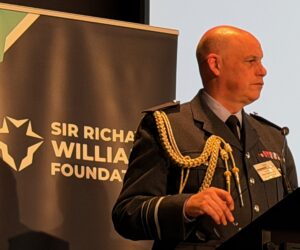
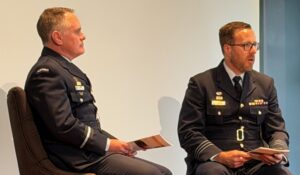
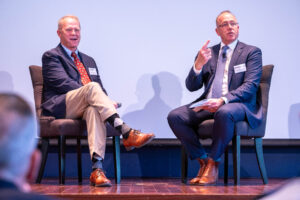
Air Marshal Paul Lloyd, the Royal Air Force’s Deputy Chief of the Air Staff, spoke from the European theatre, where the air force of a major NATO power is resetting its combat air strategy around a war on its own continent. Air Commodore Jarrod Pendlebury, Director of Strategy and Planning for the Royal Australian Air Force, spoke with Wing Commander Chris McInnes. He argued for the nation-level purpose of airpower and for the institutional qualities that turn aircraft into strategic effect. Air Vice-Marshal (Ret’d) Steve “Zed” Roberton and General Mark “Mike” Kelly, a former RAAF fighter pilot and the former commander of US Air Combat Command, offered a candid reading of what recent conflicts actually teach.
Read in sequence, the three sessions give a coherent account of where airpower is going. In the first, control of the air returns as the non-negotiable foundation of everything else. In the second, control is shown to be a broader strategic effect than winning the air battle. In the third, delivering either one depends on an enterprise of sustainment, production, training and connectivity that no one buys with a platform. The way ahead that emerges is less about the next aircraft than about building an air force that can absorb loss, sustain tempo, and regenerate combat power over a long fight across very long distances.
The first requirement returns
Lloyd opened with the Battle of Britain, which the RAF was marking that month, 86 years on. He used it as a corrective as much as a commemoration. Because of the way Britain remembers 1940, he said, many people think of control of the air as a purely defensive mission: protecting the homeland. That is only part of it. Even in 1940, Air Chief Marshal Wilfrid Freeman understood that the battle had to be won in a way that allowed the offensive to follow. A wholly defensive posture could avoid losing but could never win.
The offensive half of the idea found its great exponent in the Australian-born commander Sir Arthur “Mary” Coningham. Across the North African and European campaigns, Lloyd said, Coningham’s first lesson was that air superiority is the first requirement for any major land operation. Lloyd called the pairing “shield and punch”: defend against air attack, and strike the enemy’s air power at its source. Once control of the air was achieved and held, air power could be released to support the joint campaign. Lloyd summarised what control provides to a coalition commander as three freedoms: to operate, to manoeuvre, and to take the initiative. He reinforced the point with Montgomery’s line that whoever controls the air generally controls the surface, and with David Petraeus’s modern echo that with air superiority anything is possible and without it everything is dangerous.
His diagnosis of how the West forgot this was blunt. For three decades, the peace dividend produced forces optimised for wars of choice fought far from home against adversaries who could not contest the sky. Close air support, reconnaissance and air mobility dominated the contribution of air forces. Control of the air was a given, a free benefit, rarely needed by the service or its partners, and as its relevance faded, so did its funding. Few people in uniform today remember an era of no-notice exercises, fighting from the home base, and routine operations at scale with allies.
Then Ukraine arrived. Lloyd called the war, now past four and a half years, a case study in mutual air denial. Neither side has achieved enduring control of the air. The result is a grinding attritional conflict he compared with the First World War: armour destroyed by low-cost drones, people moving underground, progress measured in metres. From an air force perspective, he said, the deduction is stark. If you cannot achieve air superiority, you will be forced into the meat grinder.
That is the strategic logic behind the RAF’s present reorientation. The 2025 Strategic Defence Review pushed the service toward warfighting readiness, a NATO-first focus, and lessons drawn from Ukraine. The Chief of the Air Staff’s “four by four” approach holds that the RAF must optimise its current forces for the fight tonight while modernising for the fight tomorrow. Its four pillars are people, delivery of the Review, a NATO-first orientation, and modernised capability programmes aimed at gaining and keeping control of the air.
What matters for the rest of this article is how Lloyd described the force that results. It is not a single-platform story. He described a bridge built from several layers:
- Typhoon as the mass. The fleet is being upgraded with an advanced radar and enhanced weapons integration, becoming what he called a beyond-fourth-generation workhorse.
- F-35 as the penetrator. The RAF is buying more of them, including the F-35A with its nuclear dual-capable aircraft role and increased deep precision strike. Stealth and Typhoon’s mass together provide, in his words, an immediately lethal entry into contested environments.
- Collaborative combat aircraft as affordable mass. Crewed platforms alone, he said, cannot handle a complex and saturated battle space. The refreshed strategy accelerates the introduction of uncrewed combat aircraft, flying with AI “brains” as an integrated package with crewed jets. They are meant to provide affordable mass, sensors, dispersion and weapons carriage, with greater range and similar stealth properties. The aim is a concept demonstrator flying alongside Typhoon next year and an operational capability by 2030, with the deliberate purpose of absorbing risk and, as he put it, shifting the economic calculus back in favour of the defender.
- Lower-end autonomous systems. Electronic warfare capability and a new one-way attack drone of 1,000 nautical miles’ range, to be operated by the RAF Regiment, sit beneath the CCAs, all tied to a UK digital targeting web.
- GCAP as the destination. The Global Combat Air Programme, with Japan and Italy and now with Canada’s involvement, is the sixth-generation fighter, still more than a decade from the front line. Today’s mix, Lloyd said, is a deliberate stepping stone that matures the digital engineering, human-machine teaming and software-driven approach the future system will need.
He added that control of the air is no longer just a fighter and sensor story. It is multi-domain and multinational, and now has to reach into space and cyber, just as the Dowding system integrated land, sea and air in 1940. The RAF, he noted, worked with 45 nations in the last 12 months. In his words, allies are the superpower that adversaries both want and fear.
What control is for
The Australian session began by deliberately stepping back from the question Lloyd had answered. McInnes opened with a joke at the expense of the way air power appears in official investment documents: the air force is going to be helpful by doing stuff. The two airmen were there to argue that the real answer is much bigger, and they framed it around two documents. One is the “More Options, More Places, More Often” paper, which sets out why airpower matters to the country as a whole, not only to the Defence Force. The other is Pendlebury’s paper on what a Tier One air force is, due to appear in the relaunched Australian Journal of Defence and Strategic Studies.
The central proposition they asked the room to test was that the distinctive strategic contribution of airpower is neither air domain capability nor warfighting in the air. It is creating connection and control across vast distances in hours rather than days, over and over again, shaping who and what can move where, when, and on what terms.
Pendlebury unpacked control in three directions. There is control in the air: the AWACS and ISR that control information, data and situational awareness. There is control from the air: strike and close air support exercising control over surface and subsurface domains. And there is control through the air: air mobility moving people and cargo once access is secured. The framing, he suggested, has a further virtue. It pulls conversations out of the rut of platforms and toward the strategic effect that a platform exists to serve.
Both men were careful about what they were not saying. Airpower is not decisive on its own, and it does not replace domain forces, which remain necessary for direct control of land and sea. The claim is that airpower shapes access to those domains and what is possible within them. The Second World War is the model: Allied dominance of the air allowed armies and navies to move freely, and it shaped the Atlantic and Pacific shipping wars. The point, McInnes stressed, is integrated force advantage and not a ranking of services. If Australia controls the air and the approaches, then land forces can do more things and naval forces can do more things.
Pendlebury added a corollary that deserves more attention than it gets. Control also limits the choices of an adversary. The same set of capabilities that expands the options for Australia constricts those of a potential opponent, which is why control, in this reading, is a strategic and not merely operational idea.
The payoff has a name, “more options, more places, more often”, and three sources: flexibility, reach and tempo.
- Flexibility is the ability to re-task multi-role assets, giving the government of the day choice and discretion. McInnes gave a deliberately wide range of examples: air mobility missions to Antarctica to maintain sovereign presence, reach throughout the South West Pacific, a 2,000-pound bomb on a target at the bottom of an ocean. The same assets doing different jobs in different places, again and again, is what makes airpower cost-effective even though it is not cheap. It also explains how a workforce of a little under 25,000 people, which McInnes compared to the population of a mid-sized regional town, can generate effects across millions of square kilometres.
- Reach is more than range. It is how fast you get there, what you deliver, and what you can penetrate to do it. McInnes insisted that penetration is not just a matter of defences. It includes getting through bushfire smoke and heavy weather to land on Norfolk Island in a storm. It is the closest a force can come to being in two places at once, and it lets the whole force mass in one place from across the continent, as exercises such as Pitch Black and Talisman Sabre demonstrate.
- Tempo is the combination of speed and the amount of sustained operation. It creates presence and pressure and generates options more often.
Pendlebury connected these to a concept the Chief of Air Force calls “building fighting depth,” which he described in terms of posture, space and time. Depth through posture means agile operational capabilities that can move quickly. Depth through space means being able to be in more than one place, and he pointed to a striking chart in the Integrated Investment Program that makes the Air Force look as though it has the shortest reach of any service. That chart measures the range of the missile, not the thousands of miles the aircraft carries it before launch. Depth through time means doing things more often: quick turns, reprogrammable, fungible assets that can be used for many tasks. Fighting depth, McInnes added, is not an end in itself. It exists to preserve the ability to create control, choice and connection over vast distances under pressure.
The pressure, he noted, is new. The last air raid on Australia was in September 1943. The last Australian soldier killed by an air attack died the following month, and the last attack from the air on an Australian warship was in January 1945. More than 80 years of serene skies have made the country comfortable. McInnes borrowed a line attributed to the UK Chief of the Defence Staff that people who have enjoyed air security tend to remember its lessons less vividly than those who have been denied it. His own gloss was that the Air Force had been in the bath too long.
What the recent wars teach
AVM Steve Roberton and General Mark Kelly, former commander of Air Combat Command’s fireside conversation supplied the bridge from concept to hard operational reality. Kelly started with a caution: lessons from the Middle East cannot be pasted into the Pacific, because geography, politics and threats differ. But it would be foolish to ignore the glaring ones.
He offered five.
- Sustainment is the quiet constraint. Press coverage fixates on munitions expenditure because it makes a readable story. Less visible is the strain on the supply, maintenance and sustainment enterprise behind the aircraft. Air forces build a day-to-day flying hour programme and then fund it below the requirement, in some years in the mid-80s per cent. That is manageable in a sprint. It is a different matter when crisis becomes combat and combat runs for months. “Our supply chain is not prepared for a tenfold increase,” Kelly said, and the pain falls on allies drawing on the same parts. Funding sustainment is a harder case to make to a legislature than buying more weapons, which is exactly why the problem persists.
- Exquisite and affordable mass are converging. Western forces have long used exquisite platforms and sensors to kick in the door and suppress air defences, then followed with affordable mass such as JDAMs. Adversaries have their own version, with ballistic and hypersonic missiles at one end and Shahed-type drones at the other. The important trend is that each side keeps making its cheap mass a little more exquisite. JDAM and Hellfire have become far more capable, and so have the drones, with quieter engines, anti-jam navigation and basic autonomy.
- Nobody has enough air and base defence. The cost-exchange problem is brutal. A defender without an affordable interceptor fires a $3 million or $6 million missile at an $80,000 threat, because the threat is still pointed at someone’s sons and daughters. Kelly expects lasers and high-powered microwaves to fill part of the gap, citing Israel’s Iron Beam as an early example.
- Range is a hard test of any design. Tankers help, but eventually the aircraft has to unhook and do the job. Kelly said he is relaxed about whether a design is called fourth, fifth or sixth generation. “If it’s a 500 nautical mile tool for my 1,000-mile problem, I don’t need it.” The Pacific demands solutions sized for problems of 1,000 to 1,500 miles.
- Long-range kill chains decide who sees first. Kelly described the brief India-Pakistan clash of May 2025 as a canary in the coal mine. Both sides flew capable fourth-plus generation aircraft with good weapons and well-trained crews. The difference was that one side brought a more advanced communications, sensor and command-and-control architecture, and the information advantage tipped the balance.
When asked what should keep the region awake, Kelly moved to the strategic. His first concern was production capacity. The alliance won the Second World War in large part because nobody could out-produce it, and he cited the Willow Run plant rolling out a bomber every 63 minutes. Today the region faces an adversary with serious industrial capacity, and the open question is whether it can match the West in quality as well as quantity. He noted that his own airmen are still firing the AIM-120 family he first fired as a young captain in F-15s, which shows how long designs persist when the industrial base is not renewed. His second concern was technology development and insertion. Governments drove nuclear physics and space, but today much of the advance in space is led by industry, and in artificial intelligence, he said, government “is barely in the passenger seat.” His third was resources: a force that has run at high operating tempo for years cannot be restored to peer-fight readiness by a few budget cycles alone.
Where the three accounts converge
On their face, the three sessions answer different questions. Lloyd talks about air superiority and the kit to win it. Pendlebury talks about national purpose and institutional character. Kelly talks about the enterprise behind the aircraft. But they interlock at several points, and these points are the way ahead.
Lloyd’s case that control of the air is the first duty and the vital ground, and Pendlebury’s insistence that control is the strategic effect that shapes what other forces can do, are not competing claims. They are two ends of the same chain. Lloyd tells us why airpower cannot be dispensed with: without control of the air, the joint and coalition campaign becomes problematic, and the alternative is the attritional stalemate of Ukraine. Pendlebury tells us what to do with control once it exists, and why its value to the nation exceeds the air battle itself. Together, they say that the air force must be able to win the contest for the air, and also must understand that winning is the beginning of its contribution and not the end of it.
One implication is worth drawing out. Lloyd’s emphasis on the offensive half of control, the “punch” that strikes the enemy’s air power at its source, sits uneasily alongside the geography Kelly describes, where the problem is 1,000 to 1,500 miles in size and the forward bases from which you would punch are themselves under threat. Control of the air in the Indo-Pacific cannot be assumed to begin with an uncontested home base. This is where Pendlebury’s fighting depth earns its place: depth in posture, space and time is what makes it possible to contest the air from a base structure that is itself being contested.
All three speakers circled the same economic problem. Lloyd framed the RAF’s CCA programme explicitly as a way to shift the cost calculus back in favour of the defender by absorbing risk and letting crewed platforms survive. Kelly framed the same problem from the defensive side, with the $6 million interceptor and the $80,000 drone. Pendlebury arrived at it from the other direction, warning of the corner of irrelevance that comes from maximising ever more expensive capabilities. He invoked Augustine’s Law: if the cost of military capability keeps climbing, a future air force might afford only one remarkable multi-role aircraft, and its loss would be the loss of the entire air capability.
The three positions form a single argument. The costs of exquisite capability push toward fewer and fewer platforms, which makes the force brittle. The cost-exchange arithmetic of the modern battlespace punishes anyone who responds to cheap threats with expensive defences. Affordable mass, whether in the form of a CCA, a lower-end autonomous system or a directed-energy interceptor, is the only way out. But Kelly’s observation about convergence is the necessary warning. Cheap mass is getting better on both sides, so affordable does not mean disposable and unsophisticated. The design discipline is to keep making mass cheap while making it good enough, and to keep the exquisite layer that opens doors for it.
Pendlebury’s final point on this theme deserves emphasis because it is so easily overlooked: air-minded people must understand the totality of the air domain, including small, cheap airborne assets that can affect the operation of an airbase. An air force that cares only about what flies high, fast and far will miss the threat that arrives low, slow and cheap, and will have no answer to it at the one place it cannot be spared: the airfield.
Kelly’s 500-mile tool for a 1,000-mile problem and Pendlebury’s fighting depth through space are two statements of one requirement. The Indo-Pacific is large, and its geography imposes a tyranny of distance on every design choice. Lloyd’s CCAs with “increased combat range,” his 1,000-nautical-mile one-way attack drone, and the Typhoon and F-35 mix all address the same constraint from a European angle. Pendlebury’s observation about the Integrated Investment Program chart makes the Australian version vivid: the weapon’s range understates the reach of the force, but only if the force can actually carry the weapon that far and recover, regenerate and do it again.
That last clause is the link to depth through time. Reach that can be used once is a raid. Reach that can be repeated is a campaign. And repeating it is a question of sustainment, which brings us back to Kelly’s flying-hour programme funded in the mid-80s.
When Pendlebury says the distinctive strategic contribution of airpower is “connection and control,” and when Kelly points to the India-Pakistan clash as a demonstration that architecture beats airframes, they are describing the same thing from different ends. Lloyd’s reference to the UK’s new digital targeting web, and his insistence that control of the air is as much about sensors and command and control as fighters, completes the triangle.
The common thread is that the platform is a node. It matters because of what it connects to, what it can see, and how quickly the information turns into a decision. That is why the most useful single question to ask of any air combat investment is not how capable the platform is on its own, but how it improves the force’s ability to see first, decide first and act first across the whole system, including when the system is being jammed. Kelly’s description of AI-enabled drones in Ukraine illustrates the stakes: an adversary jams the control link, then navigation, then sensors, and by that stage the algorithm on board has enough capability to continue alone, identify the target, and send a brief, low-probability-of-intercept report to the fires unit. In a contested spectrum, autonomy is how a kill chain survives its own severing.
Kelly’s remarks on space add a point of particular relevance to a middle power. A nation does not need to own every layer. Commercial connectivity has shown in Ukraine how much a short-range kill chain gains from assured links, and how much the other side loses when denied them. Access to capability can be rented, in his analogy, like a signal to watch a championship match in the outback. The question for a middle power is which layers it must own, which it can buy, and which it must secure with partners.
People, ideas, things
Both the Australian and American speakers brought the discussion back to the human side, and the emphasis is telling. Pendlebury’s definition of a Tier One air force rejects the way the term is usually used. In his observation, “Tier One” tends to be invoked to justify particular capabilities, almost always exquisite ones. He prefers John Boyd’s order of priorities: people, ideas, things, and in that order. A Tier One force develops people capable of conceiving novel ways to use capabilities in the air domain and of introducing innovation quickly. It earns the label only if tactical successes aggregate into national strategic effect. McInnes added the cultural dimension: air-mindedness, the instinct for higher, faster, further, the respect for technical expertise, and the habit of finding ways over a problem and not through it. Technology, in his summary, creates the possibilities, but people turn it into power.
Kelly’s account of training put flesh on the argument. Before he left uniform, the high-end range airspace north of Nellis had become a national treasure but was too small and confined. As commander, he could not jam a coalition aircraft’s communications, data links or GPS in a way that matched the threat, so crews met such conditions first in a simulator. His view was that it falls on commanders if crews are declared combat ready without ever having experienced them. His answer was Bamboo Eagle, which launches aircraft over long distances, some from Hawaii, with realistic jamming, while young aviators join a tanker without knowing which base they will recover to, and are told only when they are hooked up. “We owe them that fog and friction and confusion for their first few missions,” he said, and the practice had lapsed mainly because of legal limits and real estate.
This is where the three speakers’ ideas become practical. If control of the air will be contested, and if the kill chain will be jammed, and if the adversary will target the airbase with cheap drones, then the force that wins is the one whose people have already lived in those conditions. A Tier One air force in Pendlebury’s sense is one that trains for friction before the first real mission. Lloyd’s first pillar, people, belongs in the same sentence.
The unresolved tensions
An honest reading of the three sessions has to acknowledge what they leave open, because the open questions are as instructive as the answers.
- The interim problem. Lloyd was frank that the next major RAF platform, GCAP, is more than a decade from the front line, and that the force must fight with what it has in the meantime. The bridge he described, upgraded Typhoons, more F-35s, CCAs by 2030 and lower-end autonomous systems, is a plausible one, but it is a bridge built under time pressure. The same applies to Australia. Which capabilities must be in place in the next five years, not the next fifteen, is the question that the long-term platform debate tends to crowd out.
- The economics of sustainment. Kelly’s observation that sustainment is a harder case to make to a legislature than munitions is a political fact with a strategic consequence. Funding a force to the mid-80s per cent of its flying-hour requirement saves money in peacetime and costs capability in war. The tenfold surge that Kelly says the supply chain cannot meet is not a technical problem. It is a decision about what to fund. And Lloyd’s observation that control of the air lost funding when it lost relevance applies equally here: the unglamorous enterprise is the first thing to be cut when the threat seems distant.
- Industrial capacity and the business case. Kelly’s concern about production, and about the long life of designs such as the AIM-120 when industrial lines are not renewed, points to a problem that no air force can solve on its own. Production lines survive on business cases that extend well beyond the defence budget. For a middle power, this raises the question of what it can make, what it can co-produce with allies, and what it must buy.
- Whether the Australian narrative can carry weight. Pendlebury and McInnes were admirably open that their proposition was a draft to be tested, and they asked the audience to push back. There is a real risk to the “more options, more places, more often” framing, which is that a strategic effect so general can describe any force. The test of the idea will be whether it changes decisions: whether it lets the Air Force argue that a fungible, repeatable, sustained capability is worth more than a single, spectacular one, and win that argument in budget terms. The framing is strongest when it is tied to numbers, such as turn rates, sortie generation, and the flying hours behind each effect.
- The dependence on allies. Lloyd’s claim that allies are a superpower and Kelly’s reminder that a surge in US demand falls on allies drawing on the same spares are two sides of one fact. Alliances multiply capability, and they also share its bottlenecks. A coalition that cannot surge its supply chain cannot surge its operations, however many nations take part.
The way ahead
Put together, the three sessions describe an air force that differs from the platform-centred model in five ways.
First, it begins from the proposition that control of the air is contested and must be won, which is Lloyd’s Battle of Britain lesson restated for the age of drones and long-range missiles. It cannot be assumed to be a free benefit. The Ukrainian stalemate shows what happens to the force that cannot achieve it.
Second, it treats control as a means to national effect, which is Pendlebury’s argument. The force is judged by what it makes possible for the joint force and the country: options, places, frequency. That argument is an invitation to think about airpower in terms of the effects it creates on other domains and not in terms of its own tonnage.
Third, it builds mass that is affordable and depth that is real. That means CCAs and lower-end autonomous systems that absorb risk, interceptors that change the cost exchange, fighting depth through posture, space and time, and weapons and aircraft sized to a 1,000-to-1,500-mile problem and not a 500-mile one.
Fourth, it competes on connection. The side with the better architecture sees first, as India and Pakistan demonstrated, and autonomy that keeps a kill chain alive under jamming is part of that architecture. Where a middle power cannot own every layer, it secures access through partnership and commercial arrangements.
Fifth, and most important, it treats the enterprise as the weapon. The aircraft, the interceptor and the CCA are the visible part. Beneath them are the flying-hour programme funded to the requirement, the supply chain that can surge, the production line with a business case that keeps it alive, the training area large enough to rehearse the real threat, and the people who have learned to think in terms of ideas and not just things. A force that has these can absorb a long fight, lose assets, and regenerate. One that lacks them has a short fight, whatever its aircraft are called.
That last point is the unifying insight of the day. Airpower’s next generation will be defined less by a generation number than by whether it is an enterprise that can regenerate. Platforms will be lost, which is why Pendlebury’s warning about Augustine’s Law matters, and why Lloyd’s CCAs are meant to absorb risk. Links will be jammed, which is why Kelly’s autonomous drones continue the mission on their own. Bases will be attacked, which is why Pendlebury wants air-minded people to attend to small, cheap airborne threats. In every case, the force survives if it can replace, reconstitute and keep operating. The air force that can do this faster than the adversary is the one that holds control of the air, and with it the freedom to operate, manoeuvre and take the initiative that Lloyd described.
For Australia, the questions that follow are specific. Can its sustainment arrangements, and those of its partners, surge by an order of magnitude? Does it have affordable answers to cheap and improving threats, in the air and at the airbase? Are its crews trained for jamming, distance and uncertainty before the first real mission, with the fog and friction that Kelly argues they are owed? Can its weapons and production plans close a business case that extends beyond the defence budget? And can the Air Force’s own narrative, more options, more places, more often, be turned into measurable requirements that win the argument for depth and endurance against the pull of the exquisite?
None of the three sessions claimed to answer them. Together, they made clear why they must be asked, and in what order. People first, then ideas, then things, as Boyd would have it, and behind all three, the enterprise that keeps the force in the fight.