
Beyond Arms Sales: Building the Taiwan Mesh Fleet Where the Fight Will Be
Major Joseph Potter’s new essay for the Center for International Maritime Security, “Arming Taiwan: America First in Action,” makes an argument that deserves a wide hearing. Arming Taiwan, he contends, is neither charity nor entanglement. It is a direct expression of American interest. It deters Chinese aggression, shares the burden of defense with a partner willing to fight for itself, and puts foreign money to work rebuilding the American defense industrial base.
Most usefully, Potter identifies the maritime domain as the “clear outlier.” Of roughly $20 billion in U.S. defense packages authorized for Taiwan since 2022, he calculates that only 0.7 percent relates to maritime operations, mostly anti-ship missiles and 30mm gun mounts. Unmanned surface and subsurface systems, he argues, are where Taiwan’s needs and America’s industrial opportunity most clearly meet.
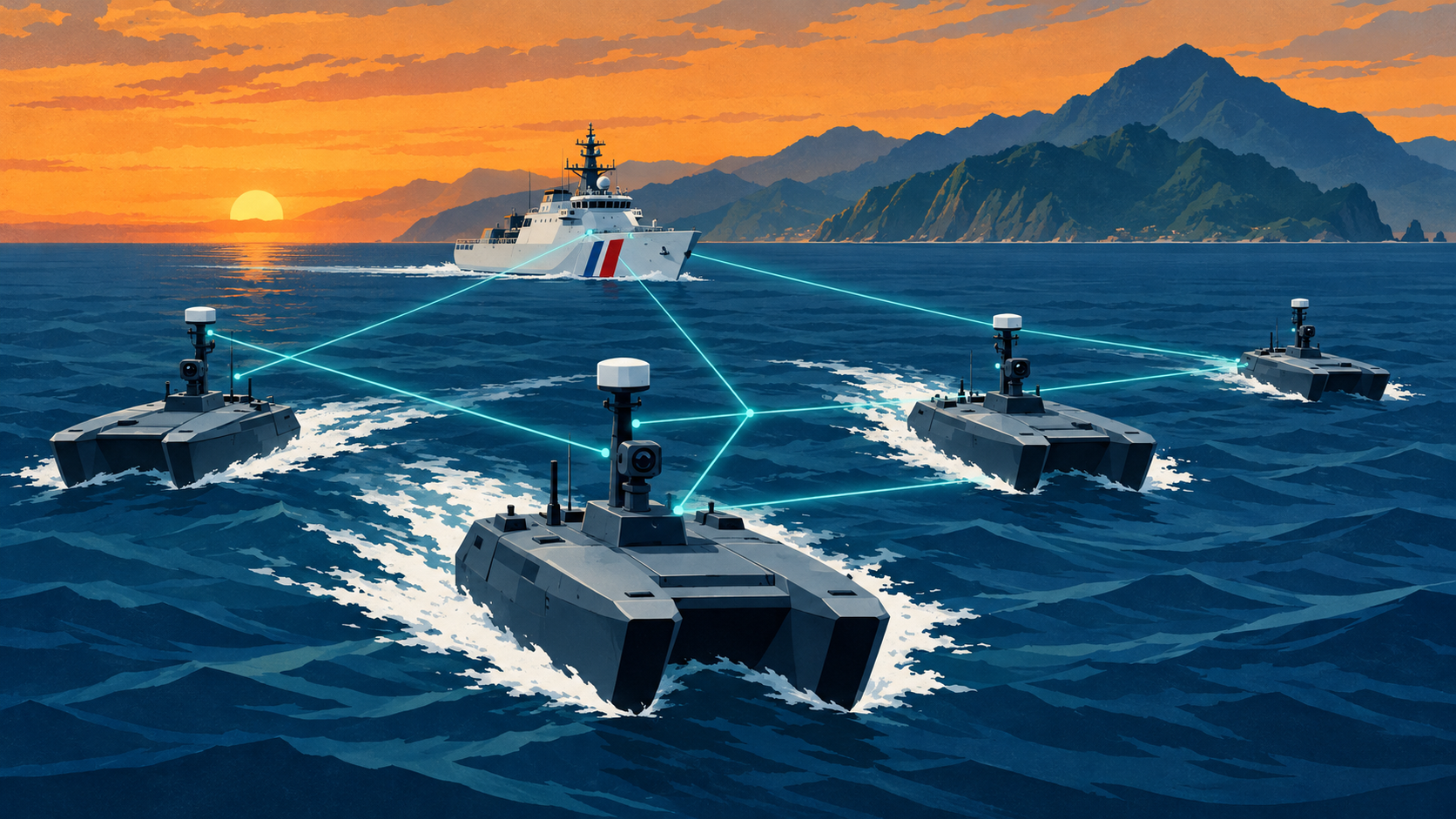
I agree with the direction of the argument. Much of my own work over the past two years, from Lessons from the Drone Wars to Lessons in Military Transformation, has been about exactly this shift: from exquisite scarcity to intelligent mass, and from platform-centric navies to mesh fleets operating inside a kill web.
But the essay frames the opportunity too narrowly. It treats the challenge as selling more American equipment to Taiwan through Foreign Military Sales. The real opportunity is to build a distributed maritime capability with Taiwan, in Taiwan and across the First Island Chain. That means rethinking the target, the architecture, the production model and the alliance itself.
The Case for Taiwan, Restated
Start with what Potter gets right. Taiwan’s procurement has leaned toward what he calls “legacy, high-visibility, high-end equipment,” such as the M1A2T tank and the F-16. Against a modernized People’s Liberation Army, symmetry is a losing game. What Taiwan needs, in his words, is “less tanks and more stopping power in the Strait.” He also draws on the CSIS finding that U.S. forces could expend some 5,000 long-range missiles in the first three weeks of a war, including hundreds of anti-ship missiles with long replacement lead times. It is a useful reminder that magazine depth is now a strategic variable, not a logistics footnote.
He is equally right that air, cyber and ground sectors already have a strong demand signal from the wars in Ukraine and the Middle East, while unmanned maritime systems do not. The maritime autonomy industrial base remains small, fragmented and under-capitalized relative to its strategic importance.
Where I part company with him is on three issues: what the mesh should target, how capability should reach Taiwan, and what burden-sharing means when the partner must fight largely alone in the opening phase.
Target the Crossing, Not Just the Beachhead
Potter’s sea-denial goal is to “sink as many vessels as possible” and destroy invading forces “before they can secure a beachhead.” That is right, but incomplete. As I argued in “The Narrow Sea” at Defense.info in August, the beach is the last hundred meters of an operation whose real weakness lies further out to sea. It lies in the continuing flow of troops, fuel, ammunition and vehicles that must keep crossing the Strait for as long as the campaign lasts.
The PLA’s purpose-built amphibious fleet can lift only a first wave. Beijing has addressed that limit not by building many more landing ships, but by folding civilian roll-on/roll-off ferries, barges, tugs and Shuiqiao-class causeway barges into the invasion system. This heterogeneous population of hulls is the real target set, for three reasons. Each hull is replaceable, but the fleet as a whole cannot be replaced at any sustained rate of loss. It must transit a fixed corridor whose approaches can be watched continuously. And it is crewed largely by people who are not trained to fight through a drone-boat wolfpack.
Ukraine’s campaign against Russian supply shipping to Crimea showed what happens when the logistics flow, rather than the objective, becomes the target. Taiwan is not Crimea, and the PLA is not the Black Sea Fleet. A Taiwanese mesh would face denser air defense, far more capable counter-drone systems and a much harsher electronic warfare environment. But the core lesson transfers: persistence beats precision against a large fleet of support shipping that has to keep transiting. A mesh built only to greet the first wave at the waterline concedes the more favorable cost-exchange fight in mid-Strait, on day five, day ten and day twenty.
That changes what Taiwan should buy. The priorities become endurance, persistence, maritime domain awareness and the ability to regenerate losses, not just terminal lethality at the beach.
There Is No Ukraine Model for Taiwan
Potter points to Ukraine as a precedent for arms transfers that protect American interests without direct conflict. The comparison is understandable, but it cuts the other way. The same CSIS wargame series he cites concluded that “there is no ‘Ukraine model’ for Taiwan,” because China can isolate the island for weeks or months. Ukraine has land borders with NATO states through which equipment can flow during the war. Taiwan has none. Whatever Taiwan fights the first phase with must already be on the island, or be producible there under fire.
The measure that matters, then, is the timeline of delivery, not the dollar value of notifications. The Taiwan Security Monitor puts the backlog of notified but undelivered U.S. arms sales at $29.72 billion as of its September 2026 update, with asymmetric systems making up nearly half of it. The Harpoon Coastal Defense System, the most significant maritime denial item in the pipeline, is still only partially delivered. Meanwhile, the Associated Press reports that a record $14 billion arms package has been stalled since the Trump–Xi summit in Beijing in May.
Potter closes by arguing that, following the recent summitry, the United States must keep arming Taiwan. I agree. But the pause exposes the weakness of relying on a sales pipeline alone. A capability that can be switched off in Washington, or slowed by production queues in the United States, is a weaker deterrent than one built in Taiwan.
From Foreign Military Sales to Co-Production
This is where the maritime autonomy sector offers something more valuable than another FMS market. Small unmanned surface vessels are not destroyers. They need neither large drydocks nor decade-long build cycles. They can be produced in molds, in dispersed facilities, by firms ranging from established shipbuilders to start-ups. That production model is ideal for a partner that must replace losses during a blockade.
Taiwan has already started to move this way. Naval News reported in September 2025 that Taiwan’s National Chung-Shan Institute of Science and Technology signed a memorandum of understanding with the American firm MARTAC and its Taiwanese partner covering joint research, co-manufacturing and supply-chain integration for unmanned surface vessels. That agreement is now turning into orders. Nikkei Asia (link) reported in July that Taiwan will procure 25 unmanned surface vessels and two unmanned underwater vehicles for its Coast Guard Administration from NCSIST, working with MARTAC, with a first prototype due for testing in the first half of 2027. The aim is to counter Chinese gray-zone pressure around Taiwan’s waters and undersea cables without further straining a stretched crewed fleet. A MARTAC-built M18 has already appeared with the Coast Guard (link) in rehearsals for this year’s National Day parade.
Janes reported last month that Havoc and Taiwan’s state-linked shipbuilder CSBC will co-produce autonomous surface vessels, pairing CSBC’s manufacturing and lifecycle support with Havoc’s autonomy software. CSBC’s chairman said Taiwan’s defense policy calls for autonomous platforms that can be mass-produced, maintained and upgraded domestically. Taiwanese firms are moving as well: STR8 Industries plans capacity for 200 of its Ghostwake USVs a year from a single site near Kaohsiung.
American policy should accelerate this model. The benefit to the U.S. defense industrial base is real, but it does not come mainly from revenue that offsets unit costs, as with the F-35 lots Potter cites. It comes from learning. American autonomy, sensor and software firms that co-develop and co-produce with Taiwanese yards gain operational feedback, production experience and a scaled supply chain they can bring home to the U.S. Navy. That is how Ukraine’s drone industry became the world’s fastest-learning defense sector: through rapid cycles of building, using, failing and adapting. The United States should want its firms inside that kind of loop in the Western Pacific.
The Gap Between Ambition and Production
None of this is assured. Taiwan’s political system has struggled to fund its own declared priorities. The Legislative Yuan’s NT$780 billion special defense procurement law, passed in May, excluded drones and unmanned boats altogether. On August 27, the legislature passed a separate six-year, NT$240 billion unmanned-vehicle law by a vote of 60 to 50. It requires coastal surveillance drones, coastal attack drones and small one-way attack unmanned boats, but makes the Ministry of Economic Affairs, not the defense ministry, the lead agency.
As The Diplomat noted during the debate, Taiwan’s military holds fewer than 5,000 drones. Under the Cabinet’s original plan, that force would have been joined by 1,320 small one-way attack USVs. Taiwan News assessed in September that this maritime “drone wall” will not reach full production until 2028, or swarm control and serial output until 2031.
Set that against the other side of the Strait. The same Taiwan News analysis reports that Guangdong yards are producing dozens of combat-ready USVs a month, and that Beijing has rehearsed mass formations of civilian fishing vessels numbering in the thousands. The PLA is building its own mesh. The question is not whether autonomy will shape a cross-Strait war. It is whose mesh will be larger, more resilient and better integrated when it matters.
That is why the industrial question sits at the heart of deterrence, not beside it. What counts is not the initial inventory but the credible ability to replace losses and surge production faster than the adversary. An FMS case is not built around that standard.
The Autonomy Illusion
There is a second caution. Buying unmanned systems is not the same as building a mesh fleet. In Lessons from the Drone Wars, I called this the autonomy illusion: the belief that the vehicle is the capability. It is not. The capability is the combination of vehicles, sensors, communications, command relationships, operator training and doctrine that turns a collection of boats into a kill web able to find, decide and strike faster than the adversary can adapt.
For Taiwan, that means building the program around a few hard questions. How will the mesh be cued by persistent maritime domain awareness when space and terrestrial networks are under attack? Who controls which assets, at what echelon, with what delegated authority, when communications are cut? How are boats launched, recovered, refueled and rearmed from dispersed sites on an island under bombardment? And how do manned platforms, such as the frigates, the Hai Kun submarine program and coastal missile batteries, work with the unmanned mesh rather than in parallel to it?
The U.S. Navy’s experience with Task Force 59 in the Middle East, and the Philippine experience operating American-built USVs with U.S. Marine advisors, point to the same conclusion. The boats are the easy part. The concept of operations, the network and the people are where the investment, and the learning, must go.
From Burden-Sharing to Co-Design
Finally, the language of burden-sharing, politically useful as it is, undersells what is happening in the region. Taiwan is not an isolated porcupine. It sits in the middle of a First Island Chain where allies are building their own distributed maritime defenses. Japan’s SHIELD framework for littoral defense, funded in its FY2026 budget, covers attack and surveillance drones, small USVs and UUVs, and shared control systems for the southwest islands. The Philippines is building a distributed archipelagic defense around fast-boat bases and unmanned surface vessels, with U.S. support. Australia is using its hull gap as an opportunity to develop expertise in autonomous maritime systems that can reach north into the archipelago.
The strategic payoff is not a series of national porcupines. It is a regional defense geometry with multiple axes of operation, each complicating China’s attack planning and each able to share sensing, targeting data and, in time, production. In my work on Australian defense, I have described this as moving beyond hosting toward co-design: allies building forces together, rather than the United States designing the force and partners buying into it. The same principle applies at sea. American strength is multiplied when allies co-develop the mesh with us, not when they simply buy from us.
Seen this way, “America First” and alliance co-design are not in tension. As Secretary Hegseth put it at Shangri-La, in a line Potter quotes, America First “does not mean America alone.” For the maritime fight in the Western Pacific, it should mean America as the integrator: providing autonomy software, sensors, command-and-control architecture and industrial partnership to a network of allies who build, operate and regenerate the mesh where the fight will happen.
Conclusion
Major Potter is right that the maritime domain is where Taiwan’s security and American industrial renewal most clearly meet, and right that unmanned systems are central to that convergence. But the measure of success is not how many FMS cases are notified. It is whether, on the fifth day of a blockade or the twentieth day of a crossing, Taiwan can still put a dense, networked, regenerating mesh of unmanned systems into the Strait and keep the invasion’s logistics under fire.
That outcome requires four things: targeting the crossing as well as the beach; prioritizing co-production in Taiwan over a delivery pipeline that can be paused or delayed; investing in the network and the people as much as the boats; and treating Taiwan as one node in a regional mesh of allied maritime defenses. Do that, and arming Taiwan becomes more than America First in action. It becomes the model for how the United States and its allies build intelligent mass together for the wars of the autonomy era.